
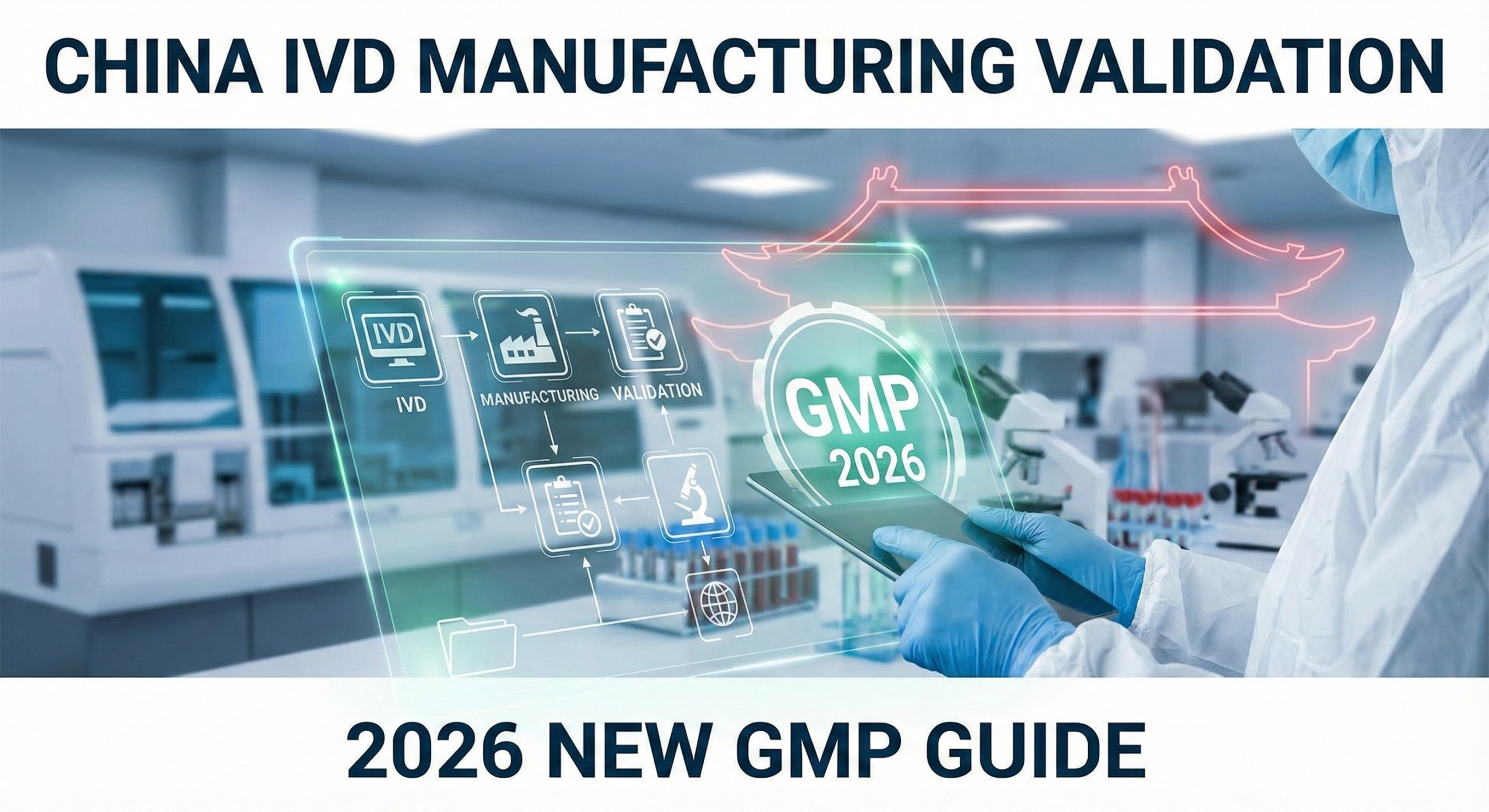
China IVD Manufacturing Validation Requirements: Comprehensive Guide for 2026 New GMP Implementation
Executive Summary
For Japanese companies manufacturing in vitro diagnostic (IVD) products in China, compliance with the new Good Manufacturing Practice (GMP) regulations taking effect in November 2026 represents a critical strategic imperative. The National Medical Products Administration (NMPA) has promulgated a substantially revised GMP framework comprising 132 articles, including newly dedicated chapters on quality assurance, validation, and contract manufacturing, significantly strengthening alignment with international standards. This comprehensive report examines five core validation domains—equipment, process, software, sterilization, and cleaning—providing detailed guidance on NMPA regulatory requirements, practical implementation approaches, and inspection readiness strategies.
For Japanese companies manufacturing in vitro diagnostic (IVD) products in China, compliance with the new Good Manufacturing Practice (GMP) regulation…
Chapter 1: Overview of China IVD Regulatory Framework and New GMP System
Regulatory Modernization and ISO 13485:2016 Harmonization
Since 2021, China’s IVD regulatory system has undergone rapid modernization with substantially enhanced alignment to ISO 13485:2016. The new GMP (announced in 2025 via NMPA Announcement No. 107) will be implemented on November 1, 2026, expanding from the previous 84 articles to 132 articles. Notable additions include three newly established chapters on “Quality Assurance,” “Validation,” and “Contract Manufacturing.”
Key Regulatory Documents Framework
| Regulatory Document | Overview | Implementation Status |
|---|---|---|
| Medical Device Production Quality Management Standards (New GMP) | 15 chapters, 132 articles integrating risk-based approach | Effective November 2026 |
| IVD Reagent Annex (2015 Announcement No. 103) | IVD-specific requirements (cleanroom specifications, etc.) | Currently effective |
| GB/T 42061-2022 | Chinese equivalent of ISO 13485:2016 | Implemented November 2023 |
| IVD Reagent Registration and Filing Management Measures | Registration and filing procedures | Effective October 2021 |
IVD Product Classification and Registration Requirements
IVD products are regulated based on risk classification (Class I/II/III). Class I products require filing (备案), while Class II/III products require registration (注册). For Class III products, type testing using samples from three consecutive production batches is mandatory, underscoring the critical importance of robust validation practices.
Understanding the Registration Process: The Chinese system differentiates between “filing” (备案, beian) for lower-risk devices and “registration” (注册, zhuce) for higher-risk devices. Class I devices undergo a simpler filing process with provincial authorities, while Class II and III devices require full technical review and registration approval from NMPA or provincial authorities, depending on the classification.
NMPA Overseas Inspections and Common Deficiencies
NMPA overseas inspections resumed in full scale in 2024, with Japanese companies increasingly subject to audit. The most frequently cited deficiency category involves design and development control inadequacies, including absence of design change control documentation, insufficient design transfer records, and inconsistencies between design outputs and inputs.
Inspection Trends: Recent inspection data indicates that approximately 35% of observations relate to design controls, 25% to process validation, 20% to software validation, and 20% to other quality system elements. Understanding these focus areas enables proactive remediation and inspection readiness preparation.
Chapter 2: Equipment Validation (Equipment/Facility Validation)
Critical Elements of Validation Planning
Equipment validation follows the three-stage IQ/OQ/PQ approach, explicitly required by NMPA’s new GMP and GB/T 42061-2022. The Validation Master Plan (VMP) must comprehensively address:
- Identification of processes requiring validation
- Validation approach and methodology
- Resource allocation and timeline
- Organizational structure and responsibilities
- Revalidation criteria and triggers
- Risk assessment methodology
Risk-Based Approach: The new GMP emphasizes risk-based validation, requiring manufacturers to justify the extent of validation based on product criticality, process complexity, and historical performance data. This approach aligns with ICH Q9 quality risk management principles.
Installation Qualification (IQ) verifies equipment identification, installation conditions, environmental parameters, calibration status, safety functions, and spare parts inventory. Particular attention must be paid to material certificates for product-contact components and verification of electrical grounding integrity.
Operational Qualification (OQ) follows IQ completion and encompasses testing at parameter range extremes, challenge testing under worst-case conditions, and verification of emergency stop functions and interlocks.
Performance Qualification (PQ) requires a minimum of three consecutive production runs using actual production materials and conditions. Statistical process capability evaluation is also mandated. The concept of “consecutive” is nuanced—batches must be sequentially numbered, completed within a defined timeframe to minimize personnel and seasonal variations, and intervening production of other products may be permissible (e.g., D-D-F-D pattern where D is the validated product and F is another product).
Cleanroom Requirements for IVD Manufacturing
According to the IVD Annex (2015 Announcement No. 103), the following operations must be conducted in Class 100,000 or better cleanrooms:
- ELISA reagent preparation and dispensing
- Immunofluorescence and chemiluminescence reagents
- PCR reagent preparation
- Gold colloid (immunochromatographic) reagents
- Dry chemistry reagents
- Enzyme, antigen, and antibody active component preparation
- Coating, dispensing, membrane spotting, drying, cutting, lamination, and primary packaging
Special Requirements for Infectious Materials: When handling positive serum, plasmids, or blood products, operations must be conducted in Class 10,000 or better cleanrooms maintained under negative pressure relative to adjacent areas. PCR reagent manufacturing and testing must occur in independent buildings or completely segregated spaces with no direct air connection to prevent contamination.
Environmental Monitoring Requirements
| Parameter | Standard | Frequency |
|---|---|---|
| Temperature | 18-28°C | Once per shift |
| Relative Humidity | 45-65% | Once per shift |
| Pressure Differential | ≥5Pa between grades, ≥10Pa to external | Monthly |
| Airborne Particles | Per grade specification | Quarterly |
| Airborne Microorganisms | Per grade specification | Quarterly |
| Settling Microorganisms | Per grade specification | Weekly |
Cleanroom Classification Reference: Chinese cleanroom classifications correspond to ISO 14644-1 standards. Class 100,000 (ISO Class 8) allows maximum 3,520,000 particles ≥0.5μm per cubic meter, while Class 10,000 (ISO Class 7) allows 352,000 particles ≥0.5μm per cubic meter.
Common Inspection Findings and Remediation Strategies
Frequently identified equipment-related deficiencies during NMPA inspections include:
- Absence or incompleteness of equipment qualification documentation: Each IQ/OQ/PQ stage requires approval signatures, accompanying raw data, and statistical analysis. Maintain comprehensive qualification reports in both English and Chinese.
- Gaps in calibration records: Maintain calibration certificates for all measuring instruments with effective date management. Establish a calibration schedule aligned with equipment criticality and manufacturer recommendations.
- Cleanroom personnel limit exceedances: Validate maximum personnel occupancy during qualification and strictly enforce these limits during routine operation. Consider implementing electronic access control systems.
- Deficient environmental monitoring programs: Establish proper testing methods based on GB/T 16292/16293/16294 standards. Implement automated monitoring systems where feasible to ensure continuous compliance documentation.
Chapter 3: Process Validation (Process Validation)
NMPA Definition of Process Validation
Process validation is defined as “providing objective evidence that a process consistently produces results or products meeting predetermined requirements.” Under Chinese regulations, the following processes specifically require validation:
Special Processes (特殊过程, teshu guocheng): Processes whose results cannot be fully verified by subsequent inspection or testing. These inherently require prospective validation due to the impossibility of detecting all defects through final product testing.
Critical Processes (关键工序, guanjian gongxu): Processes with determinative impact on product quality and performance. Identification of critical processes should be based on formal risk assessment using methodologies such as FMEA (Failure Mode and Effects Analysis) or FTA (Fault Tree Analysis).
Typical Validation Targets in IVD Manufacturing
IVD manufacturing processes commonly requiring validation include:
- Reagent formulation and mixing (称量和配制)
- Coating and immobilization processes (包被工艺)
- Freeze-drying (冻干)
- Aseptic filling and dispensing (分装)
- Sterilization processes
- Labeling and packaging
Process Understanding: Modern validation approaches emphasize process understanding over mere documentation of successful batches. Manufacturers should develop process capability studies, establish process analytical technology (PAT) where appropriate, and demonstrate comprehensive understanding of critical process parameters (CPPs) and critical quality attributes (CQAs).
Validation Batch Number Requirements
PQ under normal conditions requires a minimum of three consecutive batches. Critical interpretation of “consecutive batches” includes:
- Batch numbers must be sequential
- Completion within a defined timeframe to minimize personnel and seasonal variability
- Intervening production of other products (pattern D-D-F-D where D is validated product) may be acceptable under certain circumstances
- Selecting 3 from 4 manufactured batches (cherry-picking) is unacceptable
- For initial validation, each batch must pass acceptance criteria before proceeding to the next
Statistical Considerations: While three batches represent the regulatory minimum, statistical rigor may require additional batches depending on process variability and acceptance criteria width. Consider applying statistical tools such as process capability indices (Cp, Cpk) to demonstrate process control.
For Class III product registration, testing using samples from three consecutive production batches is mandatory.
IVD-Specific Process Validation Considerations
ELISA Kit Manufacturing Critical Parameters:
- Plate coating (temperature, duration, concentration, pH)
- Blocking efficiency
- Enzyme conjugate preparation (enzyme-antibody ratio, activity retention, stability)
- Washing procedures and washing buffer composition
Gold Colloid (Immunochromatographic) Manufacturing:
- Colloidal gold preparation (particle size control is critical—typically 20-40 nm)
- Conjugation and labeling
- Test/control line dispensing precision
- Humidity management during drying (typically 20-40% RH)
PCR Reagent Manufacturing:
- Master mix preparation and homogeneity verification
- Primer/probe synthesis validation
- Positive control (plasmid) handling procedures
- Facility segregation requirements for amplification areas
Nucleic Acid Extraction Reagent Manufacturing:
- Lysis buffer pH and composition verification
- Binding buffer performance validation
- Wash buffer removal efficiency
- Elution buffer recovery studies
Revalidation Triggers
Revalidation is required under the following circumstances:
- Production site relocation or significant facility modification
- Process parameter changes beyond validated ranges
- Equipment changes affecting critical parameters
- Batch size increases or decreases beyond validated ranges
- Critical raw material supplier changes
- Repeated batch failures or out-of-specification (OOS) results
- Extended production suspension (typically >6-12 months)
Change Control Integration: Effective change control systems should include provisions for determining whether changes necessitate revalidation. The decision should be risk-based, documented, and reviewed by quality assurance.
Comparison with FDA and EU Requirements
| Element | China NMPA | US FDA | EU IVDR |
|---|---|---|---|
| Batch Number Requirement | Generally 3 consecutive batches | No specified minimum (data-driven) | Based on ISO 13485 |
| Framework | IQ/OQ/PQ model | 3-stage lifecycle approach | ISO 13485 process approach |
| Statistical Justification | Increasing emphasis | Strongly emphasized | Risk-based |
| Continued Verification | Implied through continuous monitoring | Explicitly defined as Stage 3 | Integrated with post-market surveillance |
Lifecycle Approach: While China traditionally followed the IQ/OQ/PQ model, the new GMP increasingly incorporates lifecycle concepts, including continued process verification (CPV) to ensure sustained process control after initial validation.
Chapter 4: Software Validation (Software Validation)
China CSV Regulatory Framework
China’s Computer System Validation (CSV) requirements are established through the following key documents:
- Medical Device Software Registration Review Guidance (2022 Revised Edition): Core guidance for all medical device software including IVD
- YY/T 0664-2020: Chinese equivalent of IEC 62304:2015 (Software Lifecycle)
- GB/Z 42217-2022: Equivalent to ISO/IEC 80002-2 (QMS Software Validation)
- GB/T 25000.51-2016: Software quality evaluation (SQuaRE)
New GMP Software Requirements: Article 75 of the new GMP (2025) explicitly requires validation of computer software used in production and testing that affects product quality. Initial validation before first use and revalidation following changes are mandatory.
Software Classification and Requirements
IVD Product Software Categories:
| Type | Description | Examples |
|---|---|---|
| Standalone Software (SaMD) | Software that itself constitutes a medical device | IVD data analysis software, diagnostic algorithms |
| Software in Medical Device (SiMD) | Software as an embedded component of a medical device | Analyzer control software, firmware |
Software Safety Classification (YY/T 0664-2020):
- Class A: No possibility of injury to health
- Class B: Possible non-serious injury
- Class C: Possible death or serious injury
Risk-Based Documentation: Higher software safety classes require increasingly rigorous documentation, testing, and configuration management. Class C software demands comprehensive hazard analysis, extensive testing including security testing, and formal verification and validation protocols.
Traceability Requirements
The following trace relationships must be documented:
- Software Requirements ↔ Product Requirements
- Software Requirements ↔ Risk Analysis
- Software Design ↔ Software Requirements
- Software Design ↔ Risk Management Measures
- Source Code ↔ Software Design (unit level)
- Source Code ↔ Test Cases
- System Testing ↔ Software Requirements
- User Testing ↔ Product Requirements
- All Testing ↔ Risk Management
Traceability Matrix: Manufacturers should maintain comprehensive traceability matrices, ideally in electronic form using Application Lifecycle Management (ALM) tools, to demonstrate bidirectional traceability between all lifecycle artifacts.
Data Integrity Requirements
The “Drug Records and Data Management Requirements” (effective 2020) applies ALCOA+ principles in China:
- Attributable (归属性): Data must be linked to operator identity through unique user IDs
- Legible (判读性): Records must be clear and readable throughout retention period
- Contemporaneous (同时性): Data recorded at the time of activity
- Original (原本性): First recording or authenticated true copy
- Accurate (正确性): Error-free and complete data
Electronic Record System Requirements (Article 21):
- Unique user identification for attribution
- Role-based access control (RBAC)
- Audit trails recording operator ID, operation time, process, and change rationale
- Time-stamped records (synchronized to national time standard)
- Regular password changes with complexity requirements
- Automatic logout after inactivity periods (typically 15-30 minutes)
Note on 21 CFR Part 11 Equivalence: While China lacks a direct equivalent to FDA‘s 21 CFR Part 11, these requirements are distributed across multiple regulations and collectively achieve similar data integrity objectives. Understanding both frameworks facilitates harmonized global compliance strategies.
Software Change Management
Major Software Updates (重大软件更新):
Changes to functionality, architecture, user interface, core algorithms, or diagnostic workflows require change registration application similar to design changes for hardware devices.
Minor Software Updates (轻微软件更新):
Changes not affecting safety and effectiveness may be managed under QMS without registration. Documentation must be submitted at next registration change. Manufacturers should establish clear criteria for distinguishing major from minor changes, typically based on risk assessment.
Common Inspection Findings (59% of Overall Observations)
Software Requirements-Related:
- Incomplete requirements not covering all implemented functions
- Missing interface, performance, and risk analysis requirements
- Inadequate requirements traceability
Software Testing-Related:
- Overly simplistic test cases with insufficient risk coverage
- Test execution not following test plans
- Missing test reports and review records
Personnel-Related:
- Developers conducting their own black-box testing
- Unclear separation of development and testing roles
Remediation Strategies: Implement independent test teams, establish formal test protocols with risk-based test case design, and maintain comprehensive documentation of all software lifecycle activities. Consider adopting Agile development with appropriate adaptations for regulatory compliance.
Chapter 5: Sterilization Validation (Sterilization Validation)
Scope of Sterilization in IVD Products
Critical Distinction: Most IVD reagents (试剂盒) are not sterilized but produced under aseptic conditions. Sterilization primarily applies to accessories and collection devices:
| Product Category | Sterilization Requirement | Typical Method |
|---|---|---|
| Blood Collection Tubes | Sterile (SAL 10⁻⁶) | Radiation (Gamma) |
| Collection Needles | Sterile (SAL 10⁻⁶) | EO or Radiation |
| Specimen Swabs | Sterile | EO or Radiation |
| Liquid Reagents | Sterile Filtration | 0.22 μm filtration |
| Solid Reagents | Non-sterile (bioburden control) | Not applicable |
Sterility Assurance Level (SAL): For terminally sterilized products, the target SAL is 10⁻⁶, meaning a theoretical probability of not more than one non-sterile unit per million sterilized units. This represents the international standard for medical devices requiring sterility.
China Sterilization Standards Framework
Chinese sterilization standards are harmonized with ISO standards through “identical adoption (IDT)”:
| Chinese Standard | ISO Equivalent | Content |
|---|---|---|
| GB 18278.1-2015 | ISO 17665-1:2006 | Moist heat sterilization |
| GB 18279-2023 | ISO 11135:2014 | Ethylene oxide sterilization |
| GB 18280.1-2015 | ISO 11137-1:2006 | Radiation sterilization |
| GB/T 19974-2018 | ISO 14937:2009 | General requirements for sterilizing agents |
| GB/T 19973.1-2023 | ISO 11737-1:2018 | Microbiological methods – Bioburden |
| YY/T 0567 Series | ISO 13408 Series | Aseptic processing |
Sterilization Method-Specific Validation Approaches
Ethylene Oxide (EO) Sterilization (GB 18279-2023):
Applicable products include blood collection tubes, collection needles, and plastic consumables. Critical parameters requiring verification include:
Preconditioning Phase:
- Temperature (typically 40-60°C)
- Humidity (typically 45-75% RH)
- Duration (typically 2-24 hours to achieve moisture equilibration)
EO Exposure Phase:
- Gas concentration (typically 400-1200 mg/L)
- Temperature (typically 37-63°C)
- Humidity (typically 45-85% RH)
- Pressure (positive pressure or vacuum)
- Exposure time (typically 2-6 hours)
Aeration Phase:
- Temperature (elevated temperature accelerates EO desorption)
- Duration (until residual EO meets specifications)
- Air exchange rate
Biological Indicators: Bacillus atrophaeus (ATCC 9372) spore strips or self-contained biological indicators with population ≥10⁶ CFU.
EO Residuals: Requirements follow GB/T 16886.7 (ISO 10993-7), with typical limits ≤10 μg/g for EO, ≤250 μg/g for ethylene chlorohydrin (ECH), and ≤250 μg/g for ethylene glycol (EG).
Radiation Sterilization (GB 18280 Series):
Dose Setting Methods (GB 18280.2):
| Method | Description | Bioburden Limitation |
|---|---|---|
| VDmax 25 | Verification with 25 kGy | ≤1,000 CFU/device |
| VDmax 15 | Verification with 15 kGy | ≤1.5 CFU/device |
| Method 1 | Product-specific dose based on bioburden | Variable |
| Method 2 | Product-specific dose based on bioburden | Variable (different calculation from Method 1) |
Dose Auditing: Conduct within 3 months of routine processing establishment, then quarterly thereafter. Annual dose audits verify continued appropriateness of sterilization dose.
Filtration Sterilization (YY/T 0567.2-2021):
Applicable to liquid reagents, buffers, and sensitive solutions that cannot withstand terminal sterilization.
Validation Requirements:
- Filter selection: 0.22 μm membrane (standard for sterilizing-grade filtration)
- Bacterial challenge testing: Brevundimonas diminuta (ATCC 19146) at ≥10⁷ CFU/cm² effective filter area
- Integrity testing: Bubble point, diffusive airflow, or pressure hold tests performed pre-use and post-use
- Filter compatibility: Chemical compatibility with product components
Critical Limitation: Filtration sterilization cannot achieve a defined SAL. Products should be labeled as “filtered” rather than “terminally sterilized.” This distinction is important for regulatory classification and risk communication.
Contract Sterilization Considerations
2024 Announcement No. 38 establishes contract sterilization requirements:
Manufacturer Responsibilities:
- Supplier qualification and evaluation
- Quality agreement specifying sterilization parameters, validation responsibilities, documentation requirements, change control, and quality release criteria
- Ongoing supervision through periodic audits, monitoring, and performance reviews
Critical Points:
- Product quality responsibility remains with manufacturer
- Sterilization parameters must be specified by product manufacturer
- Product-specific validation required (generic sterilization validation insufficient)
- Annual audits recommended for contract sterilizers
Contract Manufacturing Oversight: The new GMP Chapter 14 on Contract Manufacturing provides detailed requirements for oversight of contract operations, including sterilization. Manufacturers should implement robust vendor qualification programs and maintain active oversight through the product lifecycle.
Critical Inspection Findings
Critical Deficiencies (关键项):
- Absence of sterilization validation documentation
- SAL not achieved or demonstrated
- Bioburden exceeding validation limits
- Positive biological indicator results without investigation
- EO residuals exceeding limits
Major Deficiencies:
- Incomplete IQ/OQ/PQ documentation
- Validation not updated following changes
- Deficient bioburden monitoring program
- Contract sterilizer not audited
- Expired calibration of monitoring equipment
Remediation Strategy: Develop comprehensive sterilization master files documenting the complete sterilization program including validation protocols, routine monitoring procedures, and change control processes. Maintain these in both Chinese and English.
Chapter 6: Cleaning Validation (Cleaning Validation)
NMPA Cleaning Validation Requirements
The IVD Annex and GMP regulations establish the following cleaning requirements:
Equipment Cleaning Validation Requirements:
- Establishment of cleaning procedures for all production equipment
- Mandatory prevention of cross-contamination (particularly critical for PCR reagent manufacturing)
- Strict cleaning and disinfection protocols following use
Cleanroom Cleaning:
Surfaces (walls, floors, ceilings, work surfaces) must be smooth, seamless, corrosion-resistant, and easily cleanable and disinfectable. Cleaning methods must be documented in SOPs.
Emerging HBEL Approach: The CFDI “Cleaning Validation Technical Guidelines” (January 2025) introduces health-based exposure limit (HBEL) approaches increasingly adopted in China, aligning with international trends away from traditional default limits.
Residual Limit Calculation Methods
Health-Based Exposure Limit (HBEL)/ADE/PDE Approach:
MACO = (ADE × MBS) / (TDD × SF)

Where:
ADE = Acceptable Daily Exposure (mg/day)
MBS = Minimum Batch Size of subsequent product (kg/L)
TDD = Maximum Daily Dose of subsequent product
SF = Safety Factor
Traditional Default Limits (10 ppm criterion):
MACO = (10 ppm × MBS) / 1000

Swab Limit = (MACO × Swab Area) / Total Equipment Surface Area
IVD Reagent Considerations: For IVD reagents (non-administered products), since therapeutic doses are not defined, residual limits should consider:
- Impact of target residue on product performance
- Interference with assay results
- Cross-contamination effects on test accuracy
- Biological safety evaluation based on extractables/leachables
Calculating Acceptance Criteria: Work closely with toxicologists and quality assurance to establish scientifically justified limits. For IVD products used in automated analyzers, consider potential effects on instrument calibration and quality control materials.
Sampling Methods
Swab Sampling (Direct Method):
- Optimal for accessible surfaces
- Typical swab area: 25 cm² (5 cm × 5 cm)
- Recovery validation required (typically >50-90% recovery)
- Application: Reactor interiors, mixers, filling lines
Swab Procedure Best Practices: Use sterile, pre-moistened swabs in consistent patterns. Validate swab materials for non-interference with analytical methods. Document exact sampling locations with photographs or diagrams.
Rinse Sampling (Indirect Method):
- Suitable for complex equipment, internal channels, piping systems
- Sample collected from final rinse water
- Must establish correlation with surface residue levels
- Particularly useful for equipment that cannot be easily disassembled
Analytical Method Validation Requirements
| Parameter | Requirement |
|---|---|
| Specificity | Detect target residue without interference |
| Linearity | R² ≥ 0.99 over working range |
| Accuracy (Recovery) | 70-130% acceptable range (product-specific) |
| Precision | %RSD typically <15% |
| Detection Limit (LOD) | Detect residues at ≤1/10 of acceptance limit |
| Quantitation Limit (LOQ) | Quantitate at acceptance limit level |
Method Development: For IVD-specific residues (enzymes, antibodies, antigens), develop specific methods using techniques such as ELISA, HPLC, or spectrophotometry. Total Organic Carbon (TOC) may be acceptable for some applications but requires justification.
Establishment of Acceptance Criteria
According to the Beijing Medical Device Product Cleaning Process Confirmation Inspection Guide (2024):
| Test Item | Acceptance Criteria |
|---|---|
| Visual Inspection | No grease, flux, slag, oxidation scale, dust, or metal particles |
| Wipe Test | No discoloration after wiping with clean cloth |
| Microbial Count | Reference Chinese Pharmacopoeia 2020 or GB/T 19973.1-2023 |
| Cleaning Agent Residue | Below validation limit, typically <10 ppm or detection limit |
Microbial Limit Guidelines:
- Swab sampling: 1-2 CFU/cm² (typical limit); 25-100 CFU/25 cm² (standard)
- Rinse sampling: Purified water ≤100 CFU/mL; WFI ≤10 CFU/100 mL
Visual Inspection Standards: Develop photo standards representing acceptable and unacceptable cleanliness levels for each equipment type. Train personnel using these standards to ensure consistent visual inspection results.
Worst-Case Selection
Worst-Case Product Selection Criteria:
- Solubility risk – Most difficult to dissolve compounds
- Toxicity – Highest toxicity/pharmacological activity
- Equipment adhesion – Products that adhere to equipment surfaces
- Formulation complexity – Products containing difficult-to-clean oils, dyes
- Production frequency – High-volume products representing typical operations
Worst-Case Equipment Selection:
- Equipment with dead ends, seals, narrow passages
- Areas with abrupt pressure/flow changes
- Areas with reduced internal surface smoothness
- Areas difficult for cleaning solution to contact
Scientific Justification: Document worst-case selections with scientific rationale considering physicochemical properties, toxicological data, and production history. Justify selections in validation protocols for regulatory review.
Common Inspection Findings
Documentation-Related Issues:
- Production equipment/utensil cleaning validation not performed
- Cleaning agent effectiveness and residual validation not performed
- Incomplete validation protocols or reports
- Lack of worst-case product justification
- No justification for sampling locations
Technical Issues:
- Swab sampling recovery rates not determined
- Incomplete analytical method validation
- No scientific basis for acceptance limits
- No revalidation following changes
- Reliance solely on visual inspection as acceptance criterion
IVD-Specific Deficiencies:
- Inadequate cleanroom qualification
- UV lamp effectiveness not validated
- Lack of glassware cleaning validation
- Improper segregation of PCR manufacturing/testing areas
Comparison with FDA/EMA/PIC/S Requirements
| Element | China | FDA | EMA/PIC/S |
|---|---|---|---|
| HBEL/PDE Requirement | Being introduced | No formal requirement | Mandatory |
| 10 ppm/1000 dose | Commonly used | Acceptable | Being phased out |
| Statistical Process Control | Being introduced | Optional | Recommended |
| Toxicologist Requirement | Not specified | Not specified | Required for HBEL calculation |
| Lifecycle Approach | Being introduced | Recommended | Mandatory |
Trend Toward Science-Based Limits: The international trend strongly favors health-based exposure limits over arbitrary default limits. Chinese regulations are evolving in this direction, and proactive adoption of HBEL approaches demonstrates regulatory sophistication and scientific rigor.
Chapter 7: Practical Recommendations for Japanese Companies
Regulatory Compliance Priorities
Preparation for November 2026 New GMP Implementation:
- Gap Analysis: Conduct comprehensive gap analysis comparing current systems against all 132 articles of new GMP, with particular attention to newly added chapters on quality assurance (Chapter 3), validation (Chapter 7), and contract manufacturing (Chapter 14).
- Validation Master Plan Update: Revise VMPs to address new requirements including expanded validation scope, risk-based approaches, and lifecycle concepts.
- Design Control Strengthening: Address the most frequent inspection findings by enhancing design change control documentation, design transfer records, and design output-input consistency verification.
- Computer System Validation Enhancement: Ensure compliance with new GMP Article 75 requirements for software affecting product quality.
- Lifecycle Risk Management Implementation: Adopt risk management throughout product lifecycle as core principle of new GMP, integrating ISO 14971 methodologies.
Change Management Integration: Establish robust change control systems that automatically trigger validation assessments. Use risk-based decision trees to determine change significance and appropriate validation response.
Key Differences Between China, Japan, US, and EU Regulations
| Element | China NMPA | Japan PMDA | US FDA | EU |
|---|---|---|---|---|
| QMS Standard | GB/T 42061 | ISO 13485 (QMS Ordinance) | 21 CFR 820 → QMSR | ISO 13485 |
| Validation Batch Number | 3 batches | Typically 3 batches | Data-driven | Risk-based |
| Registration Certificate Validity | 5 years | Unlimited | Unlimited | 5 years (CE mark validity) |
| Document Language | Chinese mandatory | Japanese | English | National languages |
| Overseas Inspection | Increasing | As needed | Frequent | Through Notified Body |
Harmonization Opportunities: ISO 13485-based QMS provides strong foundation for China compliance. Focus efforts on China-specific requirements (Chinese language documentation, 3-batch validation, 5-year renewal, annual self-inspection reporting) for efficient market entry.
China Market Entry Validation Strategy
Phase 1: Pre-Registration Preparation
- Detailed investigation of Chinese regulatory requirements
- Preparation of Chinese translation of existing validation documentation
- Gap analysis and corrective action planning
- Selection of Chinese testing laboratories and consultants
Phase 2: Registration Preparation (Application Preparation Stage)
- PQ data acquisition through 3 consecutive batch manufacturing
- Sample manufacturing for type testing
- Chinese-language technical dossier preparation
- MAH (Marketing Authorization Holder) structure establishment
Regulatory Agent Considerations: Select experienced China regulatory agents (代理人) with demonstrated IVD expertise. The agent will interface with NMPA throughout registration and post-market surveillance activities.
Phase 3: Post-Production Launch
- Continued process verification implementation
- Periodic revalidation execution
- Rigorous change control operation
- Annual self-inspection report submission (by March 31)
Post-Market Surveillance Integration: Establish robust complaint handling, adverse event reporting, and post-market clinical follow-up (PMCF) systems aligned with Chinese requirements. Integrate post-market data into quality management and validation programs.
Quality System Best Practices
Documentation Management:
- Implement electronic document management systems with audit trail functionality
- Establish rigorous change control procedures
- Maintain complete traceability from design through production
- Conduct personnel training based on Chinese regulatory requirements
Bilingual Documentation: Maintain critical quality documents in both English and Chinese. Consider using professional translation services for regulatory submissions to ensure accurate technical terminology.
Inspection Readiness:
- Organized, accessible documentation architecture
- Staff training on inspection procedures
- Readiness for unannounced inspection (飞行检查, feixing jiancha – flying inspection)
- Capability for root cause analysis within 30 days, technical remediation within 90 days
Mock Inspection Programs: Conduct internal mock inspections simulating NMPA inspection protocols. Include Chinese-speaking quality personnel in inspection teams to address language-related compliance challenges.
Conclusion
Japanese companies manufacturing IVD products in China must urgently initiate preparation for the new GMP taking effect in November 2026. Critical priorities include strengthening design controls, establishing comprehensive software validation programs, and implementing lifecycle risk management approaches.
Chinese regulations are rapidly increasing harmonization with international standards. Japanese companies already operating ISO 13485-based QMS can achieve efficient market entry by focusing on China-specific requirements including Chinese-language documentation, 3-batch validation, 5-year registration renewal, and annual self-inspection reporting.
For validation, a risk-based approach is fundamental, supported by scientifically justified limit setting, complete traceability assurance, and implementation of continued process verification. These practices are essential for both NMPA inspection readiness and product quality assurance.
Looking Forward: As China continues regulatory modernization, expect increasing adoption of advanced concepts including process analytical technology (PAT), quality by design (QbD), and real-time release testing (RTRT). Companies investing in these approaches now will be well-positioned for future regulatory evolution.
The Chinese IVD market represents enormous opportunity, with domestic consumption projected to grow 15-20% annually through 2030. However, regulatory rigor continues to increase, and only companies committed to comprehensive quality systems and validation excellence will achieve sustained success.
Appendix: Key Regulatory Document Reference List
NMPA Regulations
- Medical Device Production Quality Management Standards (2025) (NMPA Announcement No. 107)
- IVD Reagent Annex (2015 Announcement No. 103)
- GB/T 42061-2022 (Chinese version of ISO 13485:2016)
- IVD Reagent Registration and Filing Management Measures (2021 No. 48)
- Medical Device Software Registration Review Guidance (2022 Revised Edition)
- Drug Records and Data Management Requirements (Trial) (2020 No. 42)
Technical Standards
- GB 18278.1-2015 (Moist heat sterilization)
- GB 18279-2023 (Ethylene oxide sterilization)
- GB 18280.1-2015 (Radiation sterilization)
- YY/T 0664-2020 (Medical device software lifecycle)
- GB/Z 42217-2022 (QMS software validation)
- GB/T 16292/16293/16294 (Pharmaceutical cleanroom standards)
Inspection Guidelines
- IVD Production Quality System Inspection Key Points Guide (2017 Revised Edition)
- Beijing Medical Device Product Cleaning Process Confirmation Inspection Guide (2024 Edition)
- CFDI Cleaning Validation Technical Guidelines (January 2025)
International Standards References
- ISO 13485:2016 – Medical devices – Quality management systems
- ISO 14971:2019 – Medical devices – Application of risk management
- IEC 62304:2015 – Medical device software – Software life cycle processes
- ISO 11135:2014 – Sterilization of health-care products – Ethylene oxide
- ISO 11137-1:2006 – Sterilization of health care products – Radiation
- ISO 14937:2009 – Sterilization of health care products – General requirements
Document Information:
- Original Preparation Date: December 12, 2025
- English Version Date: December 31, 2025
- Version: 2.0
- Language: English
- Target Audience: Quality Assurance professionals, Regulatory Affairs specialists, Manufacturing engineers, Senior management of Japanese IVD companies operating in or planning entry to Chinese market
Disclaimer: This document provides general guidance based on publicly available regulatory information current as of December 2025. Companies should consult with qualified regulatory professionals and directly reference official NMPA documents for compliance activities. Regulatory requirements are subject to change, and companies must monitor regulatory developments continuously.
Related FDA QMSR Templates
Streamline your FDA QMSR compliance with our professionally crafted templates:

Related Articles
- Quality Manuals in Pharmaceutical Manufacturing: A Comprehensive Guide
- Data Integrity Implementation Sequence: A Comprehensive Guide for Pharmaceutical Organizations
- Understanding Qualification in Process Validation: A Comprehensive Guide
- Understanding Qualification in Pharmaceutical Manufacturing: A Comprehensive Guide
- Understanding Japan’s Validation Guideline: Evolution, Requirements, and Global Context
- Process Validation: Requirements and Implementation Conditions

Comment