
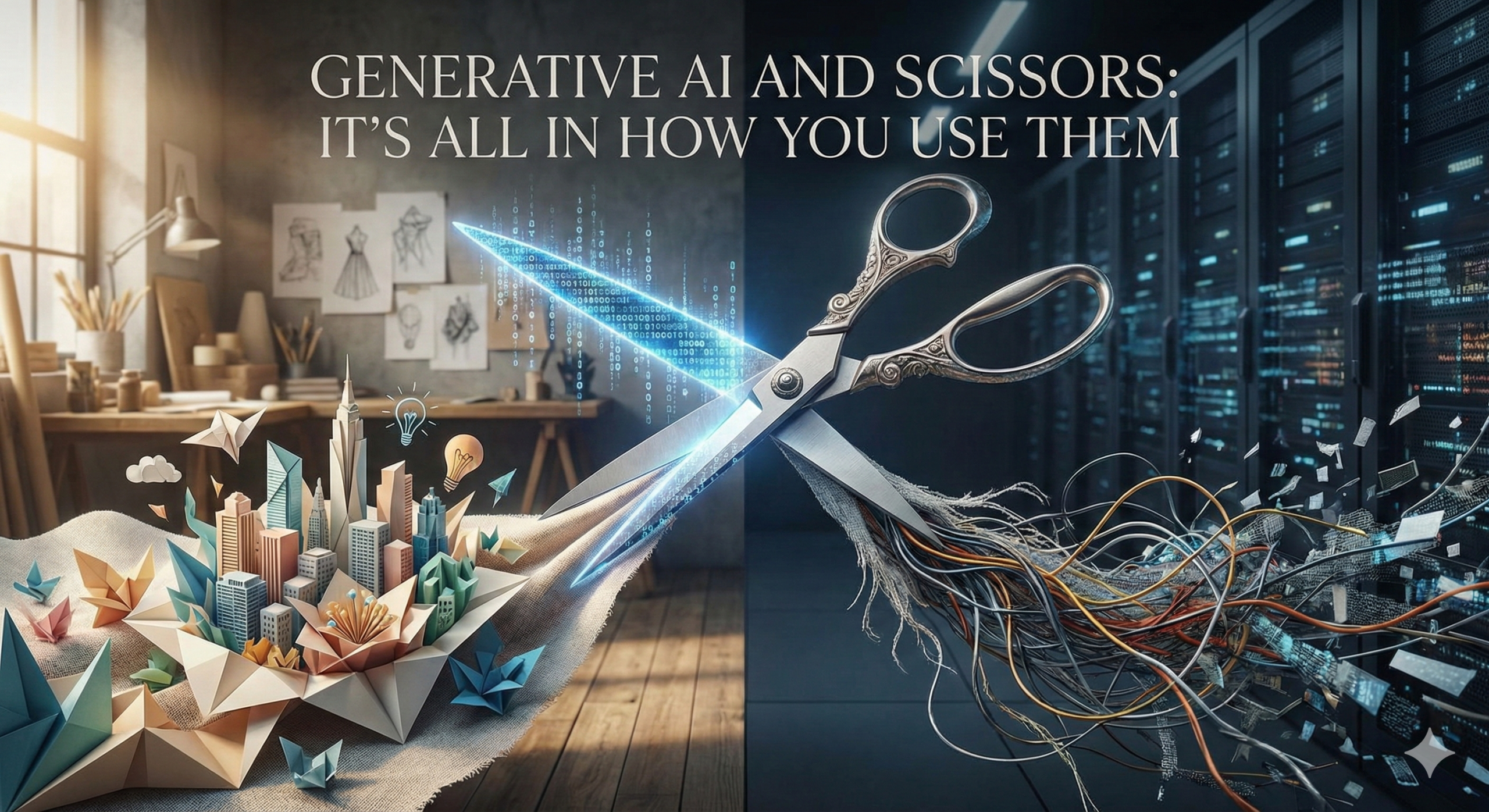
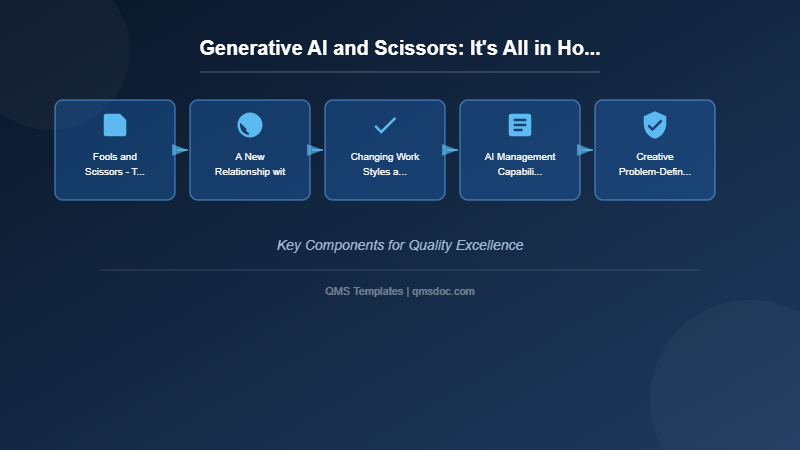
Fools and Scissors – Toward Appropriate AI Utilization
In 2025, artificial intelligence (AI) continues its rapid evolution. AI, which was once merely a “tool to be used,” is gradually transforming into a “reliable partner.” As the Japanese saying goes, “Fools and scissors are useful depending on how you use them”—a tool’s value depends entirely on its usage. When utilized appropriately, AI holds remarkable potential.
In 2025, artificial intelligence (AI) continues its rapid evolution. AI, which was once merely a “tool to be used,” is gradually transforming into a “…
A New Relationship with AI
Traditional AI operated within limited parameters, following detailed human instructions. For instance, teaching an image recognition AI that “this is a photo of a cat” and having it classify images accordingly. It was akin to a highly sophisticated calculator.
From 2024 to 2025, agentic AI has garnered significant attention. Major tech companies have made substantial investments, and 2025 is being called the “Year of AI Agents.” According to a 2025 McKinsey survey, 88% of companies regularly use AI in at least one business function. Additionally, 62% of survey respondents indicated that their organizations have progressed beyond the experimentation stage with AI agents.
Understanding the actual capabilities of current AI agents is crucial. While they have reached a practical stage for relatively routine tasks such as email responses and simple schedule coordination, they have not yet achieved fully autonomous execution of complex business operations. In fact, Gartner predicts that over 40% of agentic AI projects will be canceled by the end of 2027, citing reasons such as escalating costs, unclear business value, and inadequate risk management frameworks. Conversely, a May 2025 PwC survey reports that 66% of companies already deploying AI agents have realized measurable value in the form of increased productivity, demonstrating that gradual practical implementation is steadily progressing.
Changing Work Styles and Evolving Skills
This transformation is gradually changing how humans work. Particularly noteworthy is the evolution of required skills.
AI Management Capabilities
Moving forward, the ability to set appropriate goals for AI and evaluate its results will become essential. One must engage with AI as if managing a highly capable subordinate. Gartner predicts that by 2029, at least 50% of knowledge workers will develop new skills to work with, govern, or create AI agents on demand for complex tasks.
Creative Problem-Definition Capabilities
While AI excels at finding solutions, identifying “what should be solved” remains a distinctly human role. The ability to discover and define essential problems will become increasingly important.
Practical Implementation Tips
Here are several steps for successfully working with AI:
Start with small steps. Rather than attempting company-wide implementation immediately, begin with specific departments or operations. Areas with easily measurable outcomes, such as standardized report creation or data analysis, are recommended. In practice, business process automation accounts for 64% of AI agent deployments, with utilization advancing in areas such as support operations, human resources, sales operations, and administrative tasks.
Continuous improvement. AI learns and improves in performance the more it is used. By regularly evaluating results and providing feedback, organizations can cultivate AI partners optimized for their needs. However, workflow redesign is key to success. McKinsey’s research reveals that half of the companies deriving the most value from AI intend to use AI to transform their business, and most are redesigning workflows accordingly.
Preparing for the Future
Fascinating developments are progressing throughout 2025.
Practical Implementation of Multi-Agent Systems
Technologies enabling multiple AI agents to collaborate on tasks are advancing. This allows for more efficient processing of increasingly complex tasks. Systems are being built where multiple specialized agents employ a “divide and conquer” approach, assigning tasks within and across platforms to manage intricate workflows more effectively.
Establishment of Legal and Ethical Frameworks
Significant regulatory development concerning AI usage is also advancing.
The EU AI Act was published in the Official Journal on July 12, 2024, and entered into force on August 1, 2024. Phased enforcement is underway, with provisions regarding prohibited AI systems and AI literacy requirements taking effect from February 2, 2025. From August 2, 2025, rules concerning GPAI (General Purpose AI) models and governance provisions apply, with main provisions for high-risk AI systems scheduled for full application on August 2, 2026. Violations may result in fines of up to €35 million or 7% of global annual turnover, whichever is higher.
Japan’s AI Promotion Act, formally titled the “Act on the Promotion of Research and Development and the Utilization of AI-Related Technologies,” was passed by the National Diet on May 28, 2025, with most provisions taking effect on June 4, 2025. This represents Japan’s first AI-specific legislation. Unlike the EU AI Act, it adopts a “name-and-shame” approach involving government advice, guidance, and public disclosure of malicious operators, without establishing penalty provisions. This embodies Japan’s unique approach of not hindering technological development and represents a flexible regulatory method called “agile governance.”
South Korea’s AI Framework Act has also been established, forming a comprehensive AI regulatory framework in the Asia-Pacific region. These laws are expanding oversight responsibilities and ethical review mechanisms for high-risk AI.
Notable Predictive Data
Research institutions such as Gartner offer intriguing predictions:
| Category | Prediction | Timeframe |
|---|---|---|
| Enterprise Applications | 40% of applications will integrate task-specific AI agents (less than 5% in 2025) | End of 2026 |
| Enterprise Software | 33% of enterprise software applications will include agentic AI (less than 1% in 2024) | 2028 |
| Daily Work Decisions | 15% of day-to-day work decisions will be made autonomously (0% in 2024) | 2028 |
| AI Agents Market Size | Market reaches approximately $7.6 billion ($5.4 billion in 2024), expanding at 45.8% annual growth rate | 2025 |
| Long-term Market Forecast | Market expected to reach $103.6 billion | 2032 |
| Project Cancellation Rate | Over 40% of agentic AI projects may be discontinued | End of 2027 |
However, it is also reported that 79% of companies have already adopted AI agents in some form, revealing a situation characterized by both caution and proactivity.
Conclusion
The transformation of AI from something we “use” to something we “delegate to” is not merely a technological innovation. This represents a significant transition that is gradually changing how humans work and create value.
What matters is directing the time and energy freed up by “delegating” to AI toward more creative and distinctly human activities. McKinsey’s 2025 survey reports that 64% of companies indicate AI is enabling innovation. Furthermore, companies deriving the most value from AI (high performers) often set growth and innovation as additional objectives beyond efficiency alone. Indeed, these high performers are more than three times as likely as their peers to be scaling their use of AI agents across many business functions.
Leveraging technological evolution to create unprecedented value—this is the key to thriving in the coming era.
AI is not omnipotent. As Gartner points out, many current agentic AI propositions lack significant value or return on investment (ROI), as current models lack the maturity and agency to autonomously achieve complex business goals or follow nuanced instructions over time. However, like scissors, AI holds remarkable potential depending on how it is used. With proper understanding, preparation, and gradual implementation, AI will undoubtedly become a powerful partner that transforms how we work and creates new value.

I’m amazed, I must say. Seldom do I come across a
blog that’s both educative and interesting, and let me tell
you, you have hit the nail on the head. The issue is something too few people
are speaking intelligently about. I’m very happy I found
this in my hunt for something regarding this.