
Key Points of ISO 13485 Revision
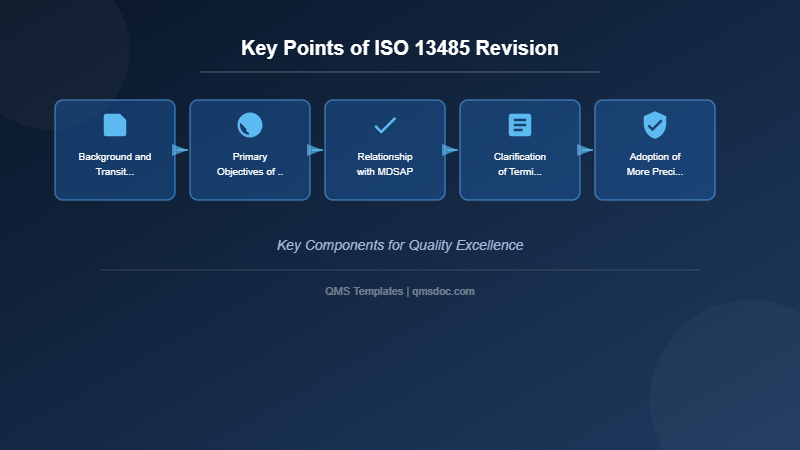
Background and Transition Timeline
ISO 13485:2016 was published on February 25, 2016. The certification transition period from ISO 13485:2003 followed the same schedule as ISO 9001. For three years following the publication, certifications under the old version remained valid. New certifications under the old version were permitted for two years after publication. From the second through third year after publication, only new certifications under the revised version were accepted. As a result, many medical device manufacturers faced the obligation to transition to ISO 13485:2016 by the deadline of February 25, 2018.
ISO 13485:2016 was published on February 25, 2016. The certification transition period from ISO 13485:2003 followed the same schedule as ISO 9001. For…
ISO 9001:2015 was revised on September 15, 2015, preceding the ISO 13485 revision. However, ISO 13485:2016 did not follow ISO 9001:2015; instead, it was aligned with ISO 9001:2008. This decision reflected the recognition that ISO 13485 serves as a specialized, higher-level interpretation of ISO 9001 for the medical device industry. Consequently, the revised standard did not adopt the new structure defined in Annex SL (Management System Standard: MSS), but rather retained the traditional eight-clause structure. As ISO 9001 underwent subsequent revisions to progressively adopt Annex SL requirements, it was anticipated that ISO 13485 would eventually undergo similar structural revisions. However, as of late 2025, no official announcement has been made regarding a planned revision to ISO 13485:2024.
Primary Objectives of ISO 13485:2016 Revision
The principal goals of the ISO 13485 revision were to clarify QMS (Quality Management System) requirements and strengthen alignment with current regulatory requirements across different countries.
QMS is based on the PDCA (Plan-Do-Check-Act) cycle; however, the 2003 version had incomplete coverage of critical tasks within this cycle. The revised version supplemented necessary elements to ensure consistent execution of the PDCA cycle. In other words, it addressed functional gaps in the quality system and established a more practical management framework.
Additionally, harmonization of international regulatory requirements became a major objective. References to various international standards were strengthened, including ISO 14971 (Risk Management), ISO 14644 (Cleanroom Environment Management), ISO 14698 (Related Standards), and IEC 62366 (Usability). In particular, the standard moved substantially closer to FDA QSR requirements and was designed to promote international regulatory harmonization.
Relationship with MDSAP
Regulatory authorities such as the FDA promoted MDSAP (Medical Device Single Audit Program). MDSAP aimed to enable medical device manufacturers seeking approvals in multiple countries to address the requirements of multiple regulatory authorities through a single audit. ISO 13485:2016 was revised with detailed clauses to facilitate MDSAP implementation. Additionally, many notes in the previous version were incorporated into the main text of the clauses, minimizing interpretive differences across different countries.
Clarification of Terminology and Definitions
The 2016 version included many new term definitions compared to the 2003 version, enriching the terminology section. Care was also taken to ensure international alignment of these definitions. For example, the definition of “medical device” was updated to align with changes in GHTF definitions.
An important distinction must be noted regarding the definition of “risk.” In ISO 9001:2015, the definition of risk was aligned with ISO 31000, becoming more abstract as “the effect of uncertainty on objectives.” In contrast, ISO 13485:2016 continued to cite the ISO 14971 definition, maintaining the concrete definition of “the combination of the probability of occurrence of harm and the severity of harm.” This approach reflects the recognition that ISO 9001 must accommodate all industries, including services, whereas ISO 13485 is specialized for the high-risk medical device sector.
The revision to the definition of “complaint” was particularly significant. In the previous version, it was narrowly titled “customer complaint.” In the revised version, “complaint” encompasses not only direct reports from customers but also quality information from manufacturing processes, maintenance service reports, feedback from service personnel, and post-market safety reports—essentially all negative information related to the product. This represents an approach closer to the FDA QSR definition of “complaint,” reflecting a comprehensive perspective.
The distinctions among “manufacturer,” “distributor,” and “importer” were clarified. Notably, “manufacturer” is now defined with reference to GHTF/SG1/N055:2009 definition 5.1, with more stringent precision.
The revised version explicitly emphasized that medical device quality management should cover the entire “lifecycle” of the product. Accordingly, “post-market surveillance,” exemplified by GVP regulations and EU MDR requirements, was formally defined, making clear that the post-market phase of medical devices is subject to quality management.
A new term, “sterile barrier system,” was introduced and defined, reflecting the recognition that the packaging system of sterilized products plays a critical role in medical device safety.
In clause 4.2.4 (Document Control), it was clarified that “documents” encompass both “documents” (master documents) and “records” (implementation records). This clarification reduced the risk of ambiguity when constructing document management systems.
The terms “risk,” “lifecycle,” and “regulatory authority” appear frequently throughout the revised standard, underscoring that these concepts form the foundation of ISO 13485:2016.
Adoption of More Precise Language
International standards, not limited to ISO 13485, require clear, understandable, and detailed language to ensure consistent implementation across organizations. The revised version deliberately presented both “correction” (Correction) and “corrective action” (Corrective Action) side by side to emphasize that these are distinct concepts.
In practical consulting contexts, cases are frequently encountered where “correction” and “corrective action” are confused. Correction is a direct action taken on the nonconforming product itself (for example, disposal or repair of defective items), whereas corrective action is a process improvement intended to eliminate the root cause of nonconformity and prevent future recurrence. This distinction is of paramount importance in quality systems.
Revision of Clause Sequence and Detailed Specification
To enhance readability and comprehensibility, the sequence of certain clauses was revised. Important matters such as “supplier management” were positioned in earlier clauses than in the previous version. Additionally, in clause 7.5 (Production and Service Provision), the sequence was reorganized to align with the flow of processes.
Furthermore, to ensure that audit findings can be clearly mapped to specific requirements, requirements were subdivided. For example, within management review inputs, “results of corrective actions” and “consideration of preventive actions” were separated into distinct clauses. This clarification enables auditors to specify precisely which requirement is being addressed in findings and facilitates more targeted preparation by organizations.
Adoption of Risk-Based Approach
The revised version contains frequent reference to “according to risk” throughout its clauses. This principle means that resources allocated to quality assurance (personnel, equipment, funding, effort, and time) must be evaluated and appropriately distributed according to the risk characteristics of the relevant product.
The risk-based approach has been advocated by the FDA since the early 2000s and is embedded in FDA Compliance Program Guidance. This methodology addresses a fundamental dilemma for regulatory authorities. Protecting patient and user safety requires strengthened regulatory requirements; however, excessively stringent regulations generate compliance costs that escalate product prices, leading to higher healthcare expenses. Consequently, only affluent patients can access state-of-the-art medical care, creating an inequitable situation. The risk-based approach represents a strategic solution to balance patient safety and equitable healthcare access. Under this framework, medical device manufacturers are required to implement appropriate quality responses commensurate with the risk profile of their products.
Unification of Identification Requirements
In clause 7.5.8 (Identification), the previous version distinguished between “identification” and “identification of product status,” whereas the revised version unified these into a single “identification” requirement. Practically, it was difficult to clearly explain the distinction between these two concepts, so the unification in the revised version significantly improved the clarity and simplicity of implementation. Identification, in essence, refers to the system that ensures every product or lot throughout the manufacturing process can be traced to determine its current manufacturing stage and status.
Time-Sequenced Categorization of Nonconforming Product Management
In clause 8.3 (Control of Nonconforming Product), management of nonconformities became differentiated based on the timing of discovery. Specifically, actions for nonconforming products identified prior to delivery and actions for nonconforming products discovered after delivery are now clearly distinguished.
Additionally, in alignment with former Japanese medical device GQP regulations, the issuance of a “notice” (notification) for significant nonconformities was incorporated. This formalized the process whereby important product safety nonconformities discovered post-market must be promptly reported to regulatory authorities and healthcare facilities.
Timeframe Requirements for Corrective and Preventive Actions
Clear timeframes are now required for CAPA (Corrective and Preventive Actions). Specifically, time management is required for the entire sequence from initiation of a CAPA through its closure and verification. The timeframe should be determined according to the severity of the issue and its risk characteristics; serious patient safety concerns demand rapid response.
It is noteworthy that ISO 9001:2015 deleted the clause on preventive action, as the concept of prevention was integrated into “risk management.” Similarly, in future revisions of ISO 13485, preventive action is anticipated to be subsumed within the risk management framework.
Enhanced Alignment with FDA QSR
The FDA Quality System Regulation (QSR), issued in 1997, has not undergone substantive revision. (Minor corrections and clarifications have been provided.) In other words, the FDA anticipated and codified international best practices approximately 20 years before their adoption in international standards.
Based on analysis, the principal elements believed to have been incorporated into ISO 13485:2016 due to FDA requirements include the following:
Strengthened Documentation Requirements
Previously, ISO 13485 used relatively lenient language such as “shall clarify.” The revised version changed many of these to explicit requirements to “document.” Documentation enables third parties (auditors, regulatory authorities) to objectively verify the implementation status of the quality system.
Introduction of Device Master Record
A new clause 4.2.3 (Device Master Record) was added to Section 4. The Device Master Record corresponds to the “DMR” (Device Master Record) in FDA QSR and encompasses a document system containing basic product specifications, manufacturing methods, and test methods. In Japan, this corresponds to a “Product Standard Specification,” a concept already implemented by many organizations, so the impact was relatively limited. However, internationally, the explicit requirement for a formal Device Master Record system facilitates regulatory authority verification of product specifications during inspections.
Formalization of Design History File
The Design History File (DHF) is a concept emphasized in FDA QSR. It comprises a comprehensive documentation system containing all design-related records (initial design, design changes, review results, and approval documentation) organized chronologically for easy reference. The revised version made the preparation of a Design History File a more explicit requirement.
Elevation of Design Transfer to Independent Requirement
“Design Transfer” was addressed in the 2003 version only as part of the content of the design and development plan. In the revised version, design transfer was elevated to an independent clause, 7.3.8 (Design and Development Transfer). Design transfer refers to the process of ensuring that product specifications verified and validated during the development phase are reliably transferred to the production manufacturing phase such that no process variation occurs. It is important to note that design transfer is frequently confused with production scale-up. Design transfer refers to specification finalization and manufacturing process establishment; production scale-up refers to the subsequent phased expansion of production volume. These represent distinct phases, and the distinction is critical for quality management.
Expanded Application of Statistical Methods
The requirement for trend analysis and process performance evaluation in quality matters to be based on statistical methods was significantly strengthened. In practice, management reviews are typically conducted in one to two hours. Within such a short timeframe, presenting multiple data inputs to executives makes it difficult for management to render appropriate judgments and issue accurate directives. Statistical methods allow visualization and objective representation of critical quality performance trends, thereby enhancing the quality of management decision-making.
Additionally, the validity of manufacturing batch sizes and scale-up ranges in process validation (such as sterilization processes and component machining) must be scientifically demonstrated using statistical methods. Furthermore, post-market failure trends compiled from service reports have become subject to statistical analysis, promoting quantitative risk assessment based on post-market surveillance data.
Expansion of Design Control Requirements
Requirements for “design control” (Design Control) have been substantially expanded. Medical device safety and effectiveness are fundamentally assured through appropriate design control. The revised version elevated the design control requirement from the lenient “clarification” standard to explicit “documentation.”
Adherence to the design and development plan is now explicitly required. The design and development plan must be carefully prepared in accordance with company QMS procedures and updated appropriately as the design project progresses. In executing design activities, the deliverables (verification test reports, validation reports, design review records, and similar documentation) must be produced using the resources (personnel, test equipment, and budget) and approach defined in the plan. Any discrepancy between the design and development plan and the actual deliverables produced may result in audit findings.
The concepts of “traceability” and “competence” are now emphasized in design control. Personnel designing medical devices must possess appropriate competence and experience in their respective design disciplines. In terms of implementation, it is recommended that organizations prepare a competency matrix for staff and develop a competency map for each department.
“Usability” has been added as a new input to design requirements. This addresses the risk that poor usability may lead users to make operational errors, potentially resulting in patient harm. In addition to traditional hazard analysis based on design risk analysis, consideration of usability according to the principles of IEC 62366-1 (Usability Engineering) is now required.
“Interface” has been added to design inputs to address medical device network connectivity. Contemporary medical devices are increasingly connected not only as standalone devices but also to hospital LANs, electronic health record systems, and remote medical consultation systems. In such environments, in addition to conventional validation, the design must incorporate safeguards against computer viruses, malware, and cyber attacks. Reference to standards such as IEC 81001-5-1 (Cybersecurity of Medical Devices) and risk assessment and mitigation design against security threats are now mandatory.
Design verification and design validation activities must now incorporate statistical methods where appropriate. In particular, sample size determination, acceptance criteria setting, and results interpretation require statistical rigor.
An important modification concerns validation deliverables. The revised version requires preparation of both validation “records” (detailed test execution and data) and a separate validation “report” (conclusions and decision-making). Previously, some organizations prepared hybrid documents such as “records and reports combined”; going forward, records and reports must be clearly separated.
“Design and Development Transfer” is now formalized as a requirement.
Requirements for “design changes” have also been expanded. Design changes require review of before and after specifications, impact assessment on risk, validation activities, and appropriate preservation of all related documents and implementation records.
Systematic preparation of a “Design and Development File” (corresponding to FDA’s DHF) is now formally required.
Expanded Scope of Software Validation
Traditionally, only software embedded in manufacturing equipment (such as control programs for injection molding machines) was subject to validation requirements. The revised version extended this scope to computer systems that manage the quality system itself.
Systems subject to validation include event management systems (such as MasterControl, Trackwise, or Greenlight Guru), document management systems, electronic signature systems, and data analysis tools. When these systems are directly linked to the quality history management of medical devices, the validity of the computer system must be assured through validation.
However, a risk-based approach is required, and excessive compliance costs should not be incurred. In low-risk domains, simple inspection or verification of COTS (Commercial-Off-The-Shelf Software) authorization status may be sufficient.
Detailed Requirements for Complaint Handling
In the previous version, complaint handling was subsumed within broad categories such as “feedback from product recipients” and “improvement.” In the revised version, clause 8.2.2 (Complaint Handling) was elevated to an independent clause with substantially detailed requirements. FDA QSR similarly contains detailed requirements for complaint files, achieving international alignment.
In complaint handling, “correction” and “corrective action” are now clearly distinguished. Additionally, whereas the previous version addressed only direct customer complaints, the revised version expands the scope to include service reports, field information, and internal failure reports. All are now considered within the complaint handling framework.
A particularly notable change is that the 2003 version required corrective action (CAPA) for all complaints as a general principle; this requirement has been deleted from the revised version. This reflects the practical recognition that minor product defects (such as small packaging scratches) do not necessarily reflect serious quality system root causes. Instead, the revised version requires that all complaints must generally be subject to “investigation.” That is, the cause and process-based root cause of complaint occurrence must always be investigated, though CAPA initiation may not be necessary depending on investigation results. This represents a more flexible, judgement-based approach.
Additional New and Enhanced Requirements
“Health Information Protection” has been added to clause 4.2.5 (Records Management). For example, in the case of wearable or portable monitoring medical devices returned for repair with patient health information (test results or treatment data) recorded in memory, appropriate management and disposal measures must be implemented to prevent unauthorized access or loss of this health information. This requirement is related to personal information protection regulations such as GDPR and HIPAA.
Clause 6.4.2 (Contamination Control) was elevated from a section of “working environment” to an independent clause. This underscores the heightened importance of protecting products from microbial contamination, particulate contamination, and chemical contamination in the manufacturing of sterile medical devices and sterilized products.
Clause 7.4.2 (Purchasing Information) now explicitly requires that supplier contracts include a “notification of changes” clause. With the internationalization of supply chains, the sourcing of raw materials from China and ASEAN countries has increased dramatically. Regrettably, under cost reduction pressures, suppliers occasionally change material specifications or manufacturing methods without prior notice or approval (quietly, as it were). Such unannounced changes can introduce latent defects into medical devices, significantly elevating patient safety risk. Therefore, where applicable, contracts must explicitly include “notification and review of changes” provisions with legal binding force. This requirement is believed to derive from strong FDA advocacy.
“Regulatory Authority Communication” has been added as a new requirement alongside the existing “Customer Communication” requirement. This recognizes the importance of medical device manufacturers promptly reporting to regulatory authorities when post-market safety concerns arise and coordinating necessary responses (recalls, usage advisories, and similar actions).
The concept of GDP (Good Distribution Practice: proper management of medical device distribution) has been incorporated. Even when medical devices are manufactured with utmost rigor, they may become defective during transport due to packaging defects, excessive vibration, temperature and humidity fluctuations, or impacts. Accordingly, all stakeholders in medical device transportation, storage, and distribution are now required to implement appropriate measures including temperature control, vibration mitigation, protective packaging, and traceability assurance.
Conclusion
The ISO 13485:2016 revision represented a comprehensive review aimed at achieving higher safety standards in the medical device industry while promoting international regulatory harmonization. The introduction of the risk-based approach enables manufacturers to deploy limited resources most effectively, while regulatory authorities can assure medical device safety based on consistent standards across multiple countries. Nearly a decade has elapsed since this revision; contemporary challenges such as cybersecurity and artificial intelligence/machine learning in medical devices have become urgent, and the direction of the next revision (planned for ISO 13485:2024 or 2025) is generating significant attention from the industry.
Related FDA QMSR Templates
Streamline your FDA QMSR compliance with our professionally crafted templates:
Related Articles
- Outlook for Part 11 Revision: Historical Context and Current Status
- Analysis of EU GMP Annex 11 Revision: The Significance of the 2025 Draft and Future Outlook
- Revision of Japan’s GMP Ministerial Ordinance
- Significant Revision of Manufacturing Manager Responsibilities Under the Revised GMP Ministerial Ordinance
- Key Points of the Pharmaceutical Quality System in the Revised GMP Ministerial Ordinance
- Key Points of Quality Risk Management

Comment