
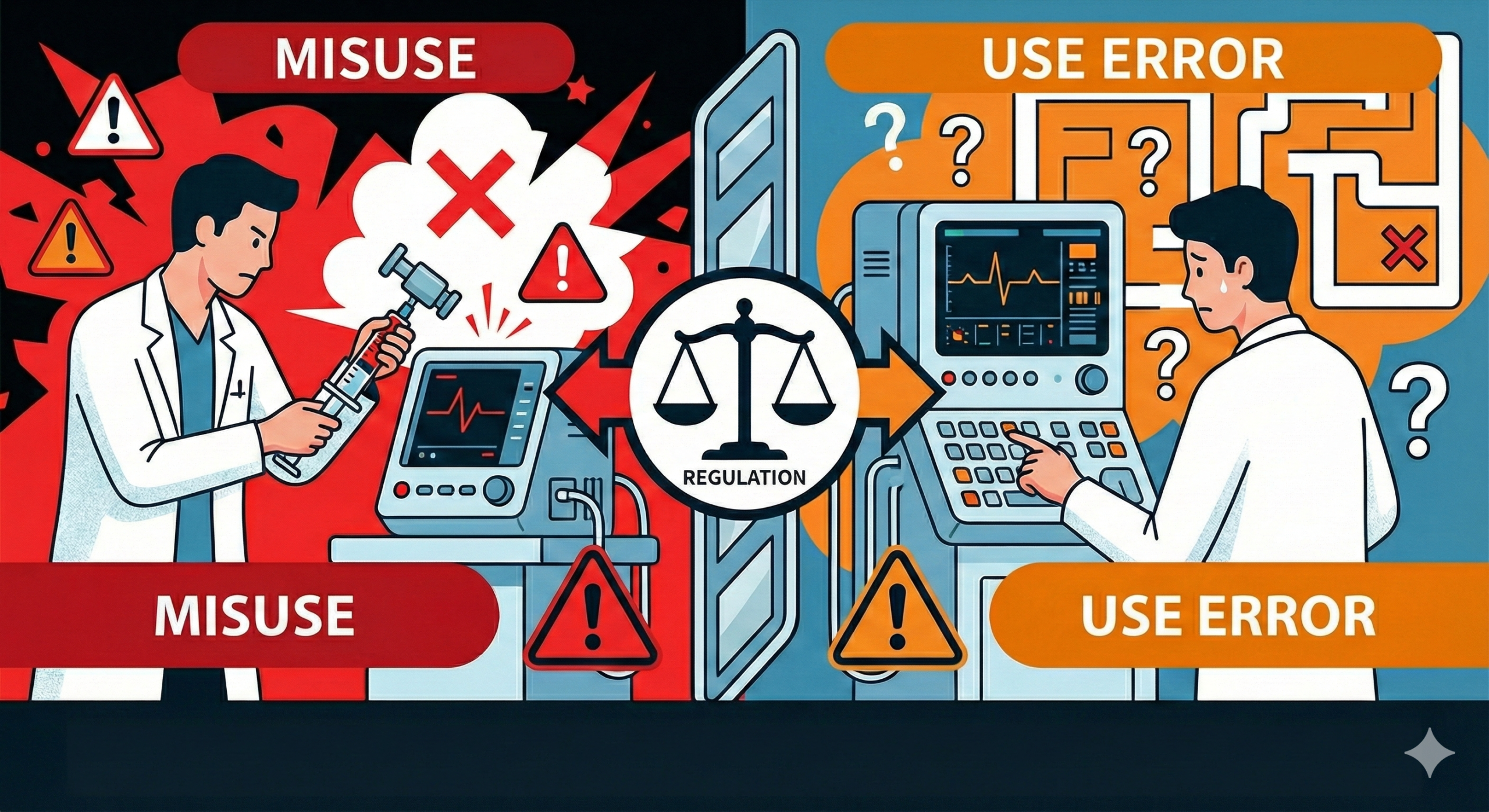
Distinguishing Between “Misuse” and “Use Error” in Medical Device Regulation
Introduction
In the regulatory requirements for medical devices, international standards such as ISO 14971 (Risk Management) and IEC 62366-1 (Usability Engineering) employ the terms “misuse” and “use error.” While these concepts are interrelated, the distinction between them is often unclear, leading to considerable confusion in practical implementation.
In the regulatory requirements for medical devices, international standards such as ISO 14971 (Risk Management) and IEC 62366-1 (Usability Engineering…
Moreover, whereas the English version of ISO 14971 clearly differentiates between “misuse” and “use error,” the Japanese standard (JIS version) translates both terms as “誤使用” (misuse), compounding the ambiguity. This article aims to clarify the precise definitions and scope of applicability of these terms, thereby promoting a more accurate understanding of safety assessment for medical devices.
Differences in Scope Between ISO 14971 and IEC 62366-1
ISO 14971 and IEC 62366-1 are complementary standards that work in concert to ensure the safety of medical devices; however, their scopes of application differ. As illustrated in the diagram, the scope of ISO 14971 (shown in light blue) is broader, while the scope of IEC 62366-1 (shown in orange) is encompassed within that of ISO 14971.
Specifically, ISO 14971 establishes the risk management methodology applicable to medical devices in general, requiring manufacturers to evaluate all “reasonably foreseeable misuse,” including use methods within the manufacturer’s intended use. Conversely, IEC 62366-1 focuses specifically on usability engineering and is specialized in addressing “use error.”
Classification of “Reasonably Foreseeable Misuse”
As shown in the diagram, “reasonably foreseeable misuse” can be divided into two major categories: “use error” and “abnormal use.”
Use error represents one component of this classification and constitutes a subordinate concept within “misuse.” In contrast, abnormal use refers to a use method that, while reasonably foreseeable, deviates from the normal intended range of use.
Definitions and Distinctions Between “Use Error” and “Abnormal Use”
Definition and Characteristics of Use Error
“Use error” is defined as an action or failure to act (omission of action) that results in an outcome different from what the manufacturer intends or what the user expects from the medical device. This includes situations where the user cannot successfully complete a task or, even if completed, the outcome differs from expectations.
An important characteristic is that situations where users cannot perform complex operations due to physical limitations (such as reduced vision or restricted handling ability), cognitive limitations (such as memory impairment or diminished judgment), or environmental constraints are also considered “use error.” Thus, use errors can arise from mismatches between the user, user interface, the task to be performed, and the use environment.
It is critical to note that malfunction or failure of the medical device itself is not classified as “use error” but rather as a product defect, and therefore must be distinguished from use error. Additionally, it should be recognized that users may not themselves perceive that a use error has occurred.
IEC 62366-1, from a usability engineering perspective, requires that design validation and usability validation activities be conducted to address this “use error.” These require thorough verification that considers the diverse capabilities of target users and various use environments.
Characteristics of Abnormal Use
“Abnormal use” refers to a use method that, while reasonably foreseeable, deviates from the normal intended use range established by the manufacturer. Examples include using a medical device under inappropriate environmental conditions or ignoring manufacturer-specified use conditions.
The critical distinction for abnormal use hinges on whether it is “reasonably foreseeable.” If reasonably foreseeable, even if it constitutes abnormal use, it must be included in the scope of risk evaluation under ISO 14971. Conversely, use methods that are entirely unforeseeable (such as using a medical device for purposes other than medical treatment) fall outside the scope of evaluation.
Evaluation of “Reasonably Foreseeable Misuse” Under ISO 14971
According to the requirements of ISO 14971, medical device manufacturers are obligated to thoroughly examine and document “reasonably foreseeable misuse.” This is not limited to the “use error” addressed by IEC 62366-1; rather, if reasonably foreseeable, “abnormal use” should also be included.
Therefore, in the risk evaluation process, it is essential to comprehensively examine the diversity of anticipated users, the diversity of use environments, and the diversity of use methods, and subsequently identify and evaluate the risks that may arise from these variations.
Comparative Overview
| Concept | Definition | Scope | Applicable Standard |
| Misuse | Broader concept encompassing unintended use | All reasonably foreseeable unintended use | ISO 14971 |
| Use Error | Inaccurate use arising from user action | Subset of misuse; user-related failures | ISO 14971, IEC 62366-1 |
| Abnormal Use | Deviation from normal use range | Reasonably foreseeable but outside intended use | ISO 14971 |
Conclusion
In understanding the relationship between ISO 14971 and IEC 62366-1, it is essential to precisely distinguish among three concepts: “misuse,” “use error,” and “abnormal use.”
- Misuse: The broader concept encompassing all unintended use that is reasonably foreseeable
- Use error: A subset of misuse characterized by inaccurate use arising from user action
- Abnormal use: Use that, while reasonably foreseeable, deviates from the manufacturer’s intended range of normal use
Under ISO 14971-based risk analysis, all three categories must be evaluated from the perspective of “reasonable foreseeability.” In contrast, usability engineering based on IEC 62366-1 primarily addresses “use error” and focuses on constructing mechanisms through user-centered design to prevent or mitigate errors. Effective application of both standards requires clear delineation of their respective roles and their interrelationship.
Related Articles
- Distinguishing Between Misuse and Use Error: Critical Concepts in Medical Device Safety Evaluation
- Differences in Change Application Requirements for Medical Device Regulations Between Japan and the United States
- Misuse and Use Error: Usability Engineering in Medical Device Design
- Differences Between Pharmaceutical and Medical Device Regulations Regarding Engineering Design
- Differences Between Pharmaceuticals and Medical Devices
- Pharmaceutical Regulations for Medical Devices in Canada

Comment