
Why Planning Documents Require Continuous Updates
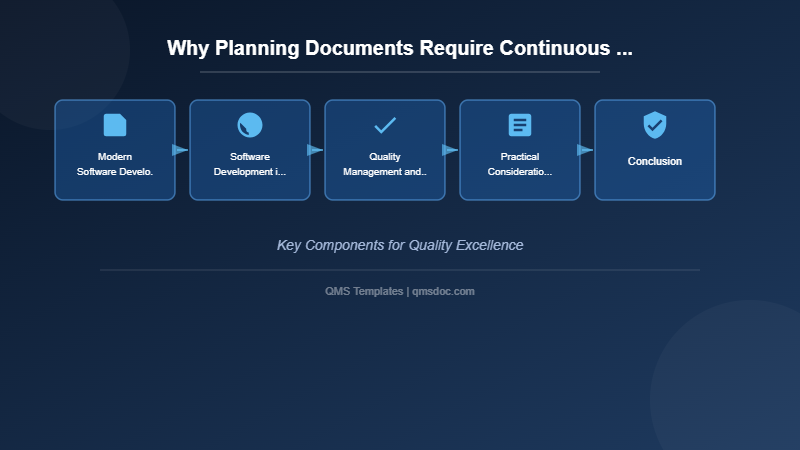
Modern Software Development and Sustained Document Management
Anyone involved in software development work knows that planning documents and their updates are an unavoidable reality. The subject of this article is precisely this question: why do planning documents require continuous updating? While plan document updates may initially seem like a cumbersome burden, they are in fact a critical element supporting our work and maintaining quality. This is particularly true in medical device development, where continuous update of planning documents is not merely recommended but is a regulatory requirement and key to project success.
Anyone involved in software development work knows that planning documents and their updates are an unavoidable reality. The subject of this article i…
Software Development is Inherently Dynamic
First, it is important to recognize that software development rarely proceeds exactly according to plan. Requirements changes, unforeseen shifts in team circumstances, technical difficulties, and numerous other factors frequently arise, causing the landscape to shift dramatically even as work progresses. Concrete examples include sudden requests for new features from customers, unexpected technical challenges in setting up development environments, changes in productivity due to remote work transitions, and the need to respond to regulatory requirement updates. This volatility is particularly pronounced in medical device development, where new risks are frequently identified during the development process, additional clinical data becomes available, and regulatory authorities may issue findings requiring program modifications.
Quality Management and the “Living Document”
Now, let us address why plan document updates are necessary amid such fluid development activities. This is no longer merely a recommendation—it is a regulatory requirement. The International Organization for Standardization (ISO) and the International Electrotechnical Commission (IEC) have jointly established IEC 62304, the medical device software development process standard, which explicitly defines development planning documents as “Living Documents” and requires that they be maintained in a current state at all times.
Beyond IEC 62304 alone, quality management standards including ISO 13485, and medical device market regulations such as FDA 21 CFR Part 11 and EU MDR/IVDR all expect that technical files, risk management plans, test plans, and change management records operate as Living Documents. The correspondence between these documents and actual development status across time is among the most critical points of verification during regulatory authority inspections and surveillance activities.
The reasons for this requirement can be summarized in three key points: “quality management,” “regulatory compliance,” and “project transparency.” First, when planning documents and actual records do not align, this indicates potential quality management issues—insufficient project management, inadequate resource allocation, or overlooked risks. Second, medical device development requires documented evidence that development processes have been executed according to plan to demonstrate regulatory compliance. When planning and actual results diverge, without clear documentation of the justification and corrective actions taken, this may result in significant findings during inspection. Third, accurate understanding of an ongoing project’s status enables identification of new risk factors, discovery of improvement opportunities, and re-prioritization of tasks with uncertain prospects, thereby enabling flexible and efficient development.
Practical Considerations in Living Document Implementation
Having understood the necessity of plan document updates, it is equally important to consider how they should actually be implemented in practice. Many development organizations tend to view plan document updates as isolated activities, but they should in fact be organized and managed as part of a formal change management process. Specifically, when changes to planning documents occur, the change rationale, scope of impact, approvers, and implementation dates must be recorded, and version control must be rigorously maintained. This creates an audit trail allowing anyone to later trace what changed, when it changed, and why—enabling persuasive explanations in response to regulatory authority questions.
Furthermore, between 2024 and 2025, the international medical device regulatory environment is undergoing rapid transformation. The implementation of the FDA’s Quality Management System Regulation (QMSR), the phased application of EU MDR/IVDR, and the emergence of new guidance for medical devices utilizing artificial intelligence have compelled many organizations to undergo strategic changes. To respond promptly to these regulatory developments, continuous updating and refinement of planning documents is essential.
Conclusion
The continuous updating of planning documents may initially appear to be a burden on field operations. However, from a quality management perspective, this is an exceptionally important activity that enables flexible and efficient development by capturing dynamic shifts in development accurately and in a timely manner. Moreover, from a regulatory compliance standpoint, it becomes an indispensable process for demonstrating consistency between plans and actual results. By creating and updating planning documents in accordance with the latest regulatory trends—such as FDA QMSR and EU MDR/IVDR requirement changes—organizations can leverage knowledge that is directly applicable to field operations while simultaneously fulfilling their accountability obligations to regulatory authorities.
Despite the demands of busy development environments, neglecting plan document updates is short-sighted. When their value is understood and they are implemented appropriately, planning document management significantly contributes to project success. In cutting-edge software development environments—particularly in the medical device field—organizations are implementing parallel practices of visualizing project progress through document updates and ensuring regulatory compliance. Rather than viewing this as mere paperwork, we recommend establishing plan document updating as a habit, integrating it as an integral part of development work and placing it at the core of quality assurance activities.
Related Articles
- The Relationship Between URS (User Requirements Specification) and PQ (Performance Qualification)
- Understanding Authenticity: A Core Requirement of Japanese ER/ES Guidelines
- Understanding Legibility: A Fundamental Requirement for Electronic Records
- Understanding Data Retention Requirements in Pharmaceutical Regulations
- Electronic Documents Requiring Electronic Signatures: Understanding FDA Part 11 and Japan’s ER/ES Guidelines
- Challenges in Electronic Record Retention Requirements: Maintaining Authenticity During Long-term Preservation and System Migration

Comment