
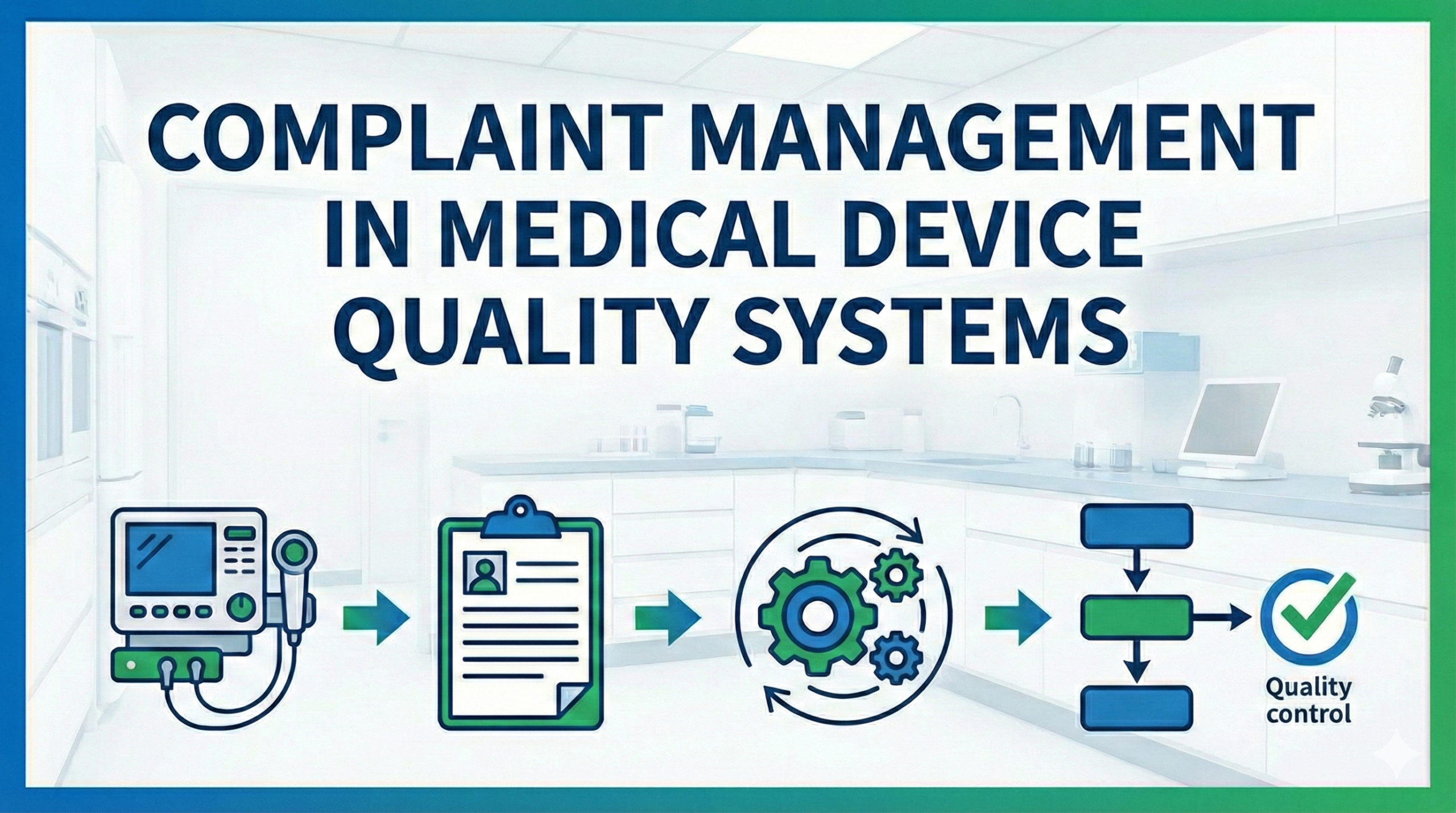
Complaint Management in Medical Device Quality Systems
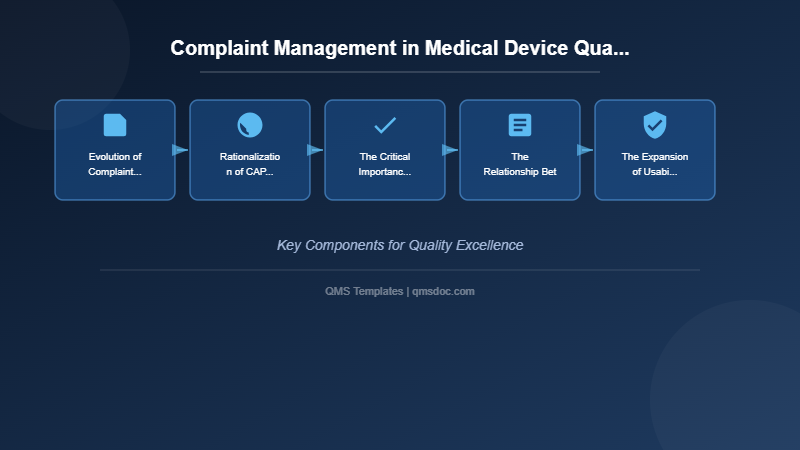
Evolution of Complaint Handling in ISO Standards
The revision of ISO 13485, the international standard for medical device quality management systems, has brought significant changes to how complaints are treated. Under ISO 13485:2003, complaint handling was merely incorporated within “feedback from product recipients” and “improvement,” but ISO 13485:2016 elevated complaint management by establishing it as an independent requirement under “8.2.2 Complaint Handling.” This structural change reflects the international recognition of complaint management’s critical importance to product safety and quality assurance.
The revision of ISO 13485, the international standard for medical device quality management systems, has brought significant changes to how complaints…
The transition to ISO 13485:2016 brought substantially enhanced and detailed requirements for complaint processing. A particularly significant clarification was the explicit distinction between “Correction” and “Corrective Action.” Correction refers to the immediate response to address a device malfunction temporarily, while Corrective Action encompasses the elimination of root causes and implementation of sustained preventive measures to avoid recurrence. This distinction was formally articulated because widespread confusion existed globally between these two concepts in actual quality management practices.
Another notable change was the inclusion of information from service reports (repair records) as sources of complaint data. This expansion recognizes that device failures discovered during repairs constitute valuable and actionable intelligence for complaint management systems.
Rationalization of CAPA Requirements
ISO 13485:2003 mandated that all complaints, in principle, trigger the formal initiation of CAPA (Corrective and Preventive Actions) documentation and investigation. However, ISO 13485:2016 deleted this blanket requirement. This pragmatic revision reflects real-world operational constraints. Requiring CAPA documentation for every complaint would consume disproportionate resources from quality assurance personnel and management. The consequence would be that critical issues affecting patient safety and device performance would be deprioritized while resources are exhausted on minor, non-critical complaint documentation. ISO 13485:2016 promotes risk-based prioritization, allowing organizations to focus resources on matters of genuine significance.
Instead, ISO 13485:2016 imposes a universal requirement that organizations conduct thorough investigations of all complaints, regardless of apparent severity. Every complaint must be investigated to understand its cause, context, and implications. Only following this comprehensive investigation should organizations, applying risk judgment, determine whether formal CAPA implementation is warranted. The investigation itself is the mandatory step; CAPA action follows conditionally based on investigative findings.
The Critical Importance of Complaint Definitions
In many medical device companies’ quality management system (QMS) documentation, the term “Claim” (Kleim or クレーム in Japanese usage) appears instead of the formally defined term “Complaint.” However, ISO 13485:2016 specifies the precise term “Complaint,” and the use of vague, colloquial terminology such as “Claim” creates potential misalignment with regulatory requirements and can lead to systematic under-reporting of safety-related issues.
ISO 13485:2016 fundamentally revised the complaint definition, moving beyond the previous formulation of “customer complaint” to establish a comprehensive, technically precise definition.
ISO 13485:2016 Clause 3.4 – Definition of Complaint
Communication, expressed in any medium (written, electronic, or oral), of an alleged defect related to the identity, quality, durability, reliability, usability, safety, or performance of a medical device released under the organization’s control, or related to service that could affect the safety or performance of such a device.
This definition encompasses far more than simple product failure reports; it addresses the full spectrum of issues arising from medical device use and performance.
The Relationship Between Warranty Period and Complaint Scope
In the author’s consulting practice, one of the most frequently encountered misunderstandings concerns the temporal scope of complaint management. Organizations often restrict complaint handling to the warranty period—for example, treating only failures occurring during a one-year, no-cost repair window as formal complaints. However, whether repairs are performed at cost to the customer or provided at no cost represents an entirely separate economic issue with no bearing on complaint management obligations. The inclusion of “Durability” in the ISO 13485 complaint definition illustrates this point precisely. When an organization specifies a design life or durability period for a medical device, all failures occurring within that specified timeframe must be formally treated as complaints, regardless of whether the customer bears repair costs. Failing to apply this principle uniformly results in systematic loss of critical device safety information and directly threatens patient safety.
The Expansion of Usability-Related Complaints
Historical complaint management practices often excluded issues from formal treatment by classifying them as “specification” or “by design” features. Under ISO 13485:2016, the inclusion of “Usability” (ease of use, operability, user interaction) in the complaint definition marks a profound shift. Statements such as “the device is difficult to use,” “the control interface is not intuitive,” or “the instructions for use are unclear” now constitute formal complaints requiring investigation and documentation. This expansion reflects international consensus that medical device safety and effectiveness fundamentally depend on users’ ability to operate devices correctly and intuitively. Medical devices that function technically correctly but frustrate users through poor design invite operator error and, ultimately, patient harm.
Essential Cautions for Implementing ISO 13485:2016 Complaint Definitions
When reviewing medical device companies’ QMS documentation, it is common to observe the ISO 13485:2016 complaint definition reproduced verbatim from the standard. However, a critical principle must be observed: organizations should not create independent interpretations, refinements, or supplemental definitions of “complaint.” If your organization’s current QMS defines complaints differently from ISO 13485:2016, this discrepancy should be addressed urgently and corrected to achieve full alignment with the international standard.
Furthermore, the “complaint” as defined in ISO 13485:2016 differs from the concept of “customer complaint” as defined in ISO 9000:2015 (the general framework for quality management systems). Recognizing and respecting this distinction between specialized medical device terminology and general industrial terminology is essential for regulatory alignment and operational clarity.
FDA Quality System Regulation (21 CFR Part 820) Requirements for Complaint Management
The United States Food and Drug Administration (FDA) enforces the Quality System Regulation (QSR), codified as 21 CFR Part 820, which establishes requirements for complaint handling that are substantially more detailed and prescriptive than those of ISO 13485. Under FDA QSR, complaint investigations must achieve a level of documentation and comprehensiveness that exceeds many organizations’ baseline practices.
Mandatory Components of FDA QSR Complaint Investigations
To comply with FDA QSR, complaint investigations must document and retain the following information in a manner that creates an auditable, traceable record:
Required Documentation Elements in Complaint Records
- The name of the medical device involved
- The date on which the complaint was received
- Unique Device Identifier (UDI) or Universal Product Code (UPC) for the device in question, together with all other available identification and control numbers
- The complainant’s full name, complete address, and telephone contact information
- A thorough description of the nature and substance of the complaint
- The date(s) on which the investigation was conducted and a complete summary of findings
- All corrective actions undertaken based on the investigation findings
- A detailed record of the response provided to the complainant
Serial Number Tracking as an Audit Trail Requirement
From an FDA QSR perspective, a complaint investigation in which the device’s serial number cannot be determined is fundamentally unacceptable. Inability to identify the serial number represents a critical deficiency in investigational rigor and traceability. Without serial number information, investigators cannot access the manufacturing specifications, design specifications, materials of construction, lot records, and sterilization batch data applicable at the time the specific device unit was manufactured. This information gap makes it impossible to determine the root cause of the alleged failure and equally impossible to design appropriate remedial measures to prevent recurrence. During FDA inspections, deficiencies in device traceability—particularly the absence of serial number documentation in complaint files—represent high-risk areas. Such deficiencies typically result in significant FDA observations under Form FDA 483 or, in severe cases, Warning Letters.
The Requirement to Identify End Users
The FDA QSR requirement to document “the complainant’s full name, complete address, and telephone contact information” requires careful interpretation. The “complainant” is not the medical device distributor, the hospital’s procurement department, or the organization’s primary contact person. Rather, the complainant is the actual “end user”—the individual healthcare provider, clinician, or technician who directly uses the medical device in clinical or laboratory practice.
In practice, many organizations receive complaints through institutional channels and record only the organization-level contact information, failing to obtain and document details identifying the specific clinician or technician who experienced the problem. However, FDA QSR demands extend beyond the institutional level to encompass the specific individual end user—the physician, nurse, laboratory technician, or other practitioner who directly encountered the alleged defect during actual device use.
This requirement remains a focal point during FDA inspections, where investigators examine whether the organization has the capacity to trace complaint origins not merely to institutions but to specific departments, specific individuals, and specific clinical contexts. The ability to reconstruct the complete chain of custody from end user through institution to the manufacturer is a fundamental expectation.
Documentation of Responses to Complainants
Whether a response to a complainant is provided orally or in writing, FDA QSR requires that written documentation of the response be created and retained in the complaint file. The regulatory rationale underlying this requirement is as follows:
Even when a complainant receives an oral response from a company representative, that response must be grounded in and guided by a written document that captures the company’s investigative findings, conclusions, and remedial actions undertaken. The responding individual must adhere to the content of this written record to ensure consistency, accuracy, and alignment with the organization’s position. Permitting representatives to improvise responses based on individual judgment creates unacceptable risk: inconsistent messaging, factual errors, and misrepresentations of the company’s investigation or remedial measures may result. Moreover, individual discretion in complaint response undermines regulatory compliance and creates potential liability.
In FDA inspections, the documentation supporting complainant responses functions as a critical audit trail for evaluating the organization’s overall responsiveness to complaint issues. When an oral response is provided without corresponding written documentation of the investigative and response rationale, FDA investigators typically issue observations during inspection conclusions. Establishing a clear, documented basis for every response—oral or written—is therefore essential for demonstrating FDA compliance.
Conclusion
Complaint management transcends the role of customer service function; it represents a core quality system activity through which medical device manufacturers systematically monitor, evaluate, and enhance device safety, effectiveness, and performance. By fully understanding the ISO 13485:2016 complaint definition and consistently implementing the detailed investigation and documentation requirements of FDA QSR, organizations achieve dual objectives: demonstrating regulatory compliance and protecting patient safety. Every medical device manufacturer must ensure that international complaint management standards are precisely reflected in organizational QMS documentation and reliably executed across all operational levels.
Related Articles
- Proper Japanese Translation of “Review” in Medical Device Regulatory Requirements: Clarifying Terminology in Quality Management Systems
- Quality Management Systems in Medical Device Regulation
- Data Analysis in Medical Device and Pharmaceutical Quality Management Systems
- Understanding Quality Systems in Pharmaceutical and Medical Device Industries
- FDA Design Control Guide: Foundation of Medical Device Quality Management
- Complaint Management in Medical Device Regulation

Comment