
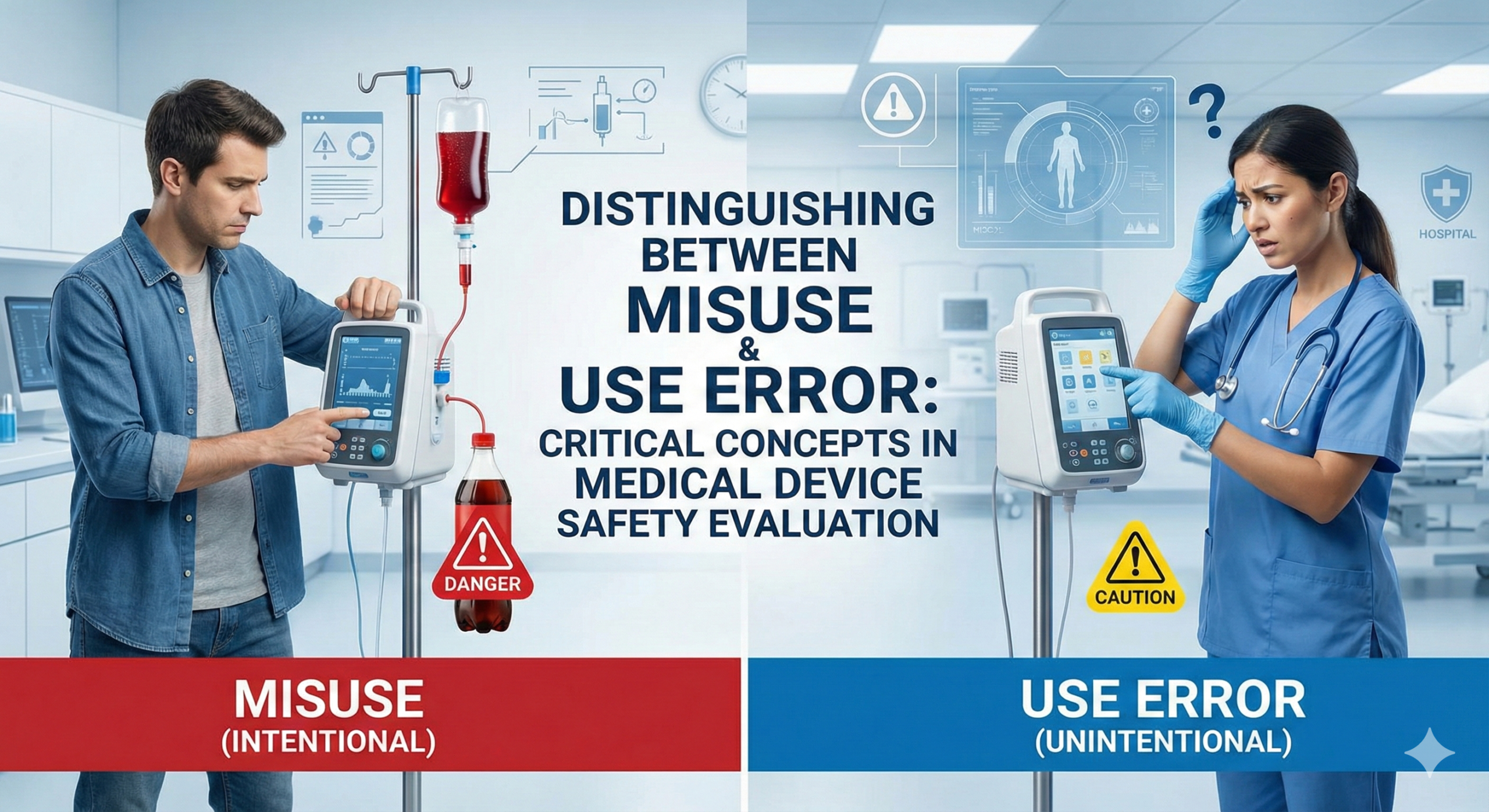
Distinguishing Between Misuse and Use Error: Critical Concepts in Medical Device Safety Evaluation
Introduction: The Essential Definition of Safety
The ISO/IEC Guide 51:2014 “Safety aspects — Guidelines for their inclusion in standards” is a fundamental guideline that serves as the basis for developing safety standards. This guide presents a deceptively simple yet profound definition of safety: “Safety is the absence of unacceptable risk.”
The ISO/IEC Guide 51:2014 “Safety aspects — Guidelines for their inclusion in standards” is a fundamental guideline that serves as the basis for devel…
Scope of Risk Assessment: The Critical Importance of “Reasonably Foreseeable Misuse”
ISO/IEC Guide 51 describes a risk evaluation process that encompasses not only the intended use as defined by the designer, but also “reasonably foreseeable misuse.” The standard illustrates an iterative risk reduction process that continues until an acceptable level of risk is achieved.
The most significant aspect of this guidance is the explicit inclusion of “reasonably foreseeable misuse” within the scope of risk assessment. Notably, this assessment requires the specific identification of user attributes such as age, physical capability, and educational level.
Subsequently, the latest version of the medical device standard ISO 14971:2019 formally incorporated this concept of “reasonably foreseeable misuse” into its terminology definitions. This development signifies that addressing foreseeable misuse has become a mandatory requirement in international medical device safety evaluation.
Acceptable Risk: A Dynamically Changing Concept
A critical perspective to understand is that “acceptable risk is dynamic and subject to change over time.” This evolution is driven by several key factors:
Changes in Social Standards and Values (Evolution of the Social Environment)
As medical devices remain on the market, societal values and expectations undergo transformation over time.
Accumulation of Product History and Real-World Use Experience
Through market experience, new hazards and unexpected use patterns emerge and become evident.
Diversification of User Attributes
Users with attributes beyond the original design assumptions begin to adopt the device, expanding the user population significantly.
These factors combine to ensure that situations previously not considered “reasonably foreseeable misuse” may eventually require manufacturer response and mitigation.
Real-World Example: Microwave Ovens and the Boundaries of Foreseeability
Understanding this concept is enriched by considering a notable case reported in the United States involving microwave ovens. A young girl attempted to warm a cold cat by placing it in a microwave oven during winter. The microwave manufacturer had not initially recognized placing living organisms in the device as “reasonably foreseeable misuse.” However, once such an incident occurred, the manufacturer became obligated to implement preventive measures. In this manner, through interaction with society, the scope of misuse requiring mitigation gradually expands.
The Inevitability of Human Error and Safe Medical Device Design
The urgent need to prevent “misuse and carelessness” accidents stems from the fact that human error is a fundamental component of such incidents. An essential recognition is that human error cannot be completely eliminated; it occurs with a certain probability and is essentially inevitable.
Many industries beyond medical devices have documented severe consequences of human error.
Lessons from Aviation
The Japan Airlines Flight 123 accident (1985) resulted directly from improper repair of the aircraft’s bulkhead. The Tenerife ground collision (1977) occurred when pilot assumptions combined with multiple unfortunate coincidences to create the world’s deadliest aviation accident. More recent examples include Airbus landing failures where excessive reliance on automation complicated decision-making, and Aloha Airlines accidents resulting from inadequate maintenance procedures.
Critical Errors in Healthcare Settings
Medical errors include wrong-blood transfusions, patient misidentification, medication mix-ups, and incorrect-site surgery. These incidents reflect not merely individual carelessness but systemic problems in many cases.
Incidents in Other Industries
The Bhopal pesticide plant disaster in India (1984) involved the simultaneous failure of multiple redundant safety systems—a scenario difficult to anticipate during design. At the individual level, Japan’s stock market experienced a massive trading error where 610,000 shares intended to be sold at 1 yen each were instead sold at 610,000 yen per share. This error triggered automated loss-avoidance systems at other firms, accelerating market decline.
These examples demonstrate that despite sophisticated expertise and multilayered safeguards, human error still occurs. Medical device design must therefore operate from the premise that error is inevitable, implementing measures to contain its consequences within acceptable limits.
“Use Error” and “Misuse”: The Importance of Precise Conceptual Distinction
This represents the most critical point. “Use error” and “misuse” are distinct concepts, and understanding this distinction clearly is fundamental to appropriate medical device safety design.
Medical device usage can be broadly categorized as “normal use” and “abnormal use.” Notably, “use error” is a specific category that falls within “normal use.”
A crucial misunderstanding to avoid is the assumption that “use error is always equivalent to human error.” This is incorrect.
Definition of “Use Error” and Its Diverse Causative Factors
“Use error” is defined as an act or omission by the user that results in device operation different from that intended by the manufacturer or expected by the user. This definition includes situations where the user cannot complete a task.
For example, elderly persons, children, or pregnant women may attempt to use a device normally but lack the physical strength or capability to do so correctly. Similarly, individuals with color vision deficiency or visual impairment may be unable to read labels or instructions, preventing successful completion of proper procedures.
In essence, various user attributes—including physical ability, cognitive capacity, and sensory capability—can prevent proper execution of intended procedures. This represents not user carelessness or inappropriate behavior, but rather a fundamental mismatch between the user and the device.
Root Causes of Use Error: The Essential Role of Usability Engineering Validation
Use error can arise from mismatches between the characteristics of the user, the user interface, the task, or the use environment. Identifying and resolving such mismatches requires rigorous validation through usability engineering.
A particularly important consideration is that users often remain unaware when they have committed a use error. When an error occurs but its consequences are not clearly distinguishable from expected device function, users may continue operating normally while remaining unconscious of the problem, delaying detection.
Additionally, device malfunction (mechanical or software failure) constitutes a device failure, not a use error. This distinction is important to maintain.
Composition of “Reasonably Foreseeable Misuse”: Use Error and Abnormal Use
When illustrated diagrammatically, “reasonably foreseeable misuse” encompasses both “use error” and “abnormal use.”
Stated differently, “use error” represents a subset of “reasonably foreseeable misuse” excluding “abnormal use.” In this context, “abnormal use” refers to use patterns that substantially exceed the legitimate scope of intended use and are not reasonably foreseeable.
Differing Scopes of Application: ISO 14971 versus IEC 62366
An important distinction exists in the risk evaluation scope of ISO 14971 and IEC 62366.
ISO 14971 (Risk Management for Medical Devices) encompasses the entire scope of “reasonably foreseeable misuse,” including both “use error” and “abnormal use.” In contrast, IEC 62366 (Usability of Medical Devices) focuses exclusively on “use error” within “reasonably foreseeable misuse,” excluding “abnormal use” from its scope.
Understanding this difference in scope is essential for accurately grasping how these standards complement each other in medical device development. Risk management (ISO 14971) examines a broader range of potential hazards, while usability engineering (IEC 62366) focuses on errors that actual users may realistically encounter within legitimate use. These represent complementary rather than overlapping functions.
Conclusion: Integrated Understanding for Medical Device Safety Design
Medical device safety design requires precisely distinguishing among the concepts of “misuse,” “use error,” and “human error,” and implementing appropriate countermeasures for each. Following the principles of ISO/IEC Guide 51, designers must consider a diverse range of reasonably foreseeable scenarios during the design phase, and subsequently conduct detailed evaluation of use errors through rigorous usability validation studies with actual users. This integrated and phased approach is fundamental to developing truly safe medical devices.
Related Articles
- Distinguishing Between “Misuse” and “Use Error” in Medical Device Regulation
- Misuse and Use Error: Usability Engineering in Medical Device Design
- Differences Between Pharmaceuticals and Medical Devices
- Differences in Change Application Requirements for Medical Device Regulations Between Japan and the United States
- Application Strategy and Insurance Coverage Strategy: Two Critical Hurdles in the Medical Device Business
- Understanding Use Errors in Medical Devices

Comment