
Full Implementation of the EU Medical Device Regulation (MDR)
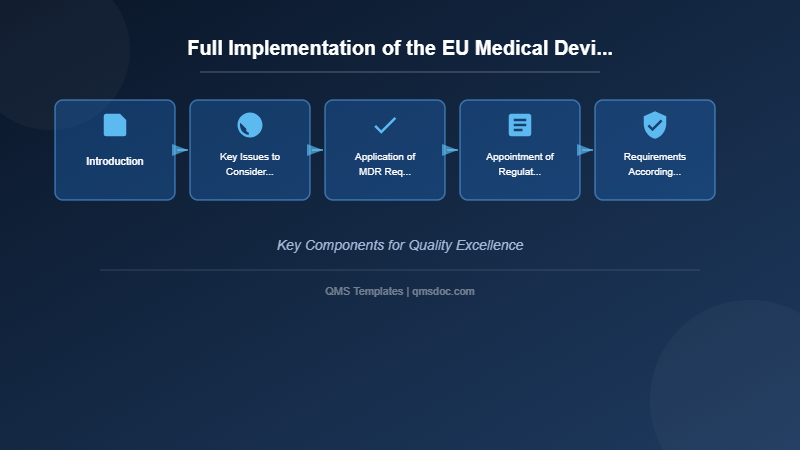
Introduction
The full implementation of the MDR (European Medical Device Regulation) represents the most significant regulatory transformation in European medical device regulation. Although initially scheduled for May 26, 2020, the effective date was postponed by one year due to the COVID-19 pandemic and officially took effect on May 26, 2021. On this date, the MDD (Medical Device Directive) became invalid and the MDR established the new legal framework as the governing regulation. For all medical device manufacturers marketing products in Europe, full compliance with the MDR has been mandatory since May 26, 2021. This article explains the key issues manufacturers must address during the MDR full implementation, the transition schedules, and practical implementation challenges.
The full implementation of the MDR (European Medical Device Regulation) represents the most significant regulatory transformation in European medical …
Key Issues to Consider at Full Implementation
Application of MDR Requirements Beyond Certificate Validity
Even when holding valid certificates, post-market surveillance (PMS), market surveillance, post-market surveillance (Vigilance), and requirements regarding the registration of economic operators and devices must comply with the MDR provisions from May 26, 2021 onward (MDR Article 120(3)). This means that regardless of certification status, the processes related to medical device safety monitoring transition to the new regulatory framework.
Appointment of Regulatory Compliance Responsibility Contact (PRRC)
The MDR mandates that all manufacturers appoint and register a Regulatory Compliance Responsibility Contact (PRRC). Under the traditional MDD, only manufacturers established within the EU were required to register; however, the MDR extends this requirement to manufacturers established outside Europe as well, requiring them to designate and register a PRRC in their own country. The PRRC must meet specific educational qualifications and practical experience requirements.
Requirements According to Medical Device Classification
The MDR implementation requirements for medical devices vary depending on their classification.
Medical devices requiring certification by a Notified Body must meet the MDR conformity conditions at the effective date. This includes sterile medical devices and Class I devices with measuring functions.
Class I medical devices that do not require Notified Body involvement must fully comply with the MDR from May 26, 2021.
Implantable devices and Class III medical devices must comply with the Unique Device Identification (UDI) rules from May 26, 2021 onward.
Quality Management System (QMS)
From the MDR effective date, maintaining a valid QMS is a critical requirement for all manufacturers. The MDR requires manufacturers to demonstrate the existence of a valid QMS. Particular attention should be paid to the possibility that a valid QMS becomes ineffective if the certification certificate expires.
Expanded Scope of Application
The MDR covers a broader range of medical devices compared to the traditional MDD. The following products now fall under the MDR:
Devices intended for cleaning, sterilization, or disinfection of medical devices (MDR Article 2(1)); reprocessed single-use medical devices (MDR Article 17); non-medical products with equivalent functionality to medical devices—such as colored contact lenses and EMS devices (MDR Annex XVI)—and internet-based sales of medical devices used for remote diagnosis or treatment (MDR Article 6).
These products may have fallen outside the scope of traditional MDD regulation, requiring particular attention.
Transition Schedule from MDD to MDR
Basic Transition Framework
The transition schedule for each device class is established in MDR Article 120 “Transitional Provisions.” For medical devices marked with CE according to the MDD, different schedules apply depending on the device type. Importantly, medical devices already circulating on the market are provided with transition periods, meaning they do not need to be immediately withdrawn from the market. However, it should be noted that from May 26, 2021 onward, even without an EU MDR certificate, audits based on the MDR requirements commence.
Validity Period of MDD Certificates and Market Availability
Medical devices bearing CE marking based on an MDD certificate that have already been legally placed on the market may continue to be made available on the market or put into service until May 27, 2025 at the latest. After this date, medical devices bearing CE marking based on MDD certificates are no longer permitted to be placed on the market or put into service.
All certificates issued by Notified Bodies under the MDD expire on May 27, 2024. However, if the validity period stated on the certificate (five years from issuance) expires earlier, the certificate expires at that earlier date.
Conditions for Continued Market Distribution Based on MDD Certificates
If medical devices continue to be placed on the market based on an MDD certificate after May 26, 2021, the devices must continue to comply with the MDD and must undergo surveillance audits by the Notified Body that issued the certificate. Furthermore, significant changes to the medical device’s design or intended purpose are prohibited.
For medical devices bearing CE marking based on an MDD certificate to continue being placed on the market, a critical condition is that there must be no significant changes to the device’s intended use and design during the certificate’s validity period (until May 26, 2024 at the latest).
Transition Schedule for Class I Medical Devices
Class I medical devices require particular attention. According to MDR Article 120, transitional provisions apply to Class Im (measuring devices), Is (sterilizing devices), and Ir (reusable surgical instruments).
Class I medical devices (excluding measuring function and sterilizing devices) placed on the market for the first time on or after May 26, 2021 must comply with the MDR.
Class I medical devices that do not require Notified Body certification (devices without certificates) and were placed on the market before May 26, 2021 may continue to be made available on the market or put into service until May 26, 2025. However, from May 26, 2021 onward, new placement on the market is prohibited.
Significant Change Point: Under the MDD, Notified Body involvement was not required for Class Ir (reusable surgical instruments); however, under the MDR, Notified Body certification becomes mandatory. For such Class Ir devices, if a Declaration of Conformity based on MDD Annex XII was prepared before May 26, 2021, placement on the market or putting into service is permitted until May 26, 2024, provided no significant changes are made to the device.
Class I medical devices meeting all of the following five conditions may be placed on the EU market until May 26, 2024:
- The device is in conformity with the MDD (93/42/EEC)
- Notified Body certification is required under the MDR
- The device is a Class I device without measuring functions or sterilization functions and a Declaration of Conformity based on MDD Annex XII was prepared before May 26, 2021
- No significant changes to the device’s design or intended use are implemented after May 26, 2021
- Requirements concerning post-market surveillance, market surveillance, Vigilance, economic operators, and device registration are subject to MDR requirements from May 26, 2021 onward
For Class I (measuring function, sterilization, reusable surgical instruments), Class IIa, Class IIb, and Class III medical devices requiring MDR certification by a Notified Body, the Notified Body conducts a conformity assessment and issues an MDR certificate.
Validity Period of MDD and AIMD Certificates
For reference, the validity period of EC certificates issued under the MDD (Medical Device Directive) and AIMD (Active Implantable Medical Device Directive) is as follows:
Certificates issued before May 25, 2017 remain valid for the period stated on the certificate but expire no later than May 27, 2022.
Certificates issued on or after May 25, 2017 remain valid for the period stated on the certificate but no longer than five years, expiring no later than May 27, 2024.
If the medical device undergoes no significant changes, placement on the market or putting into service based on such certificates is permitted from May 26, 2021 onward.
Transition Period Until Full EUDAMED Implementation and Alternative Processes
The implementation of the MDR involved certain preparatory shortcomings on the European side. For example, EUDAMED (European Database on Medical Devices)—the central repository for registering information about economic operators, UDI information, and safety data—was not fully operational at the time of MDR implementation and was rolled out in phases.
To address the phased implementation of EUDAMED, the MDCG (Medical Device Coordination Group) issued “Guidance on harmonised administrative practices and alternative technical solutions until EUDAMED is fully functional” (MDCG 2021-1). This guidance provides detailed explanations of interim alternative processes to be followed until EUDAMED achieves full operational status, outlining the alternative procedures that economic operators and Member State authorities must observe during this transition period.
The delayed full implementation of EUDAMED created practical challenges for many manufacturers, requiring coordination with regulatory authorities in each country. It is important to continuously monitor official announcements from the European Commission and the MDCG for the latest developments.
Definitions of Important Terms
To correctly understand the MDR, the distinction between the following terms is critically important (MDR Article 2):
“Placing on the market” means supplying medical devices to the EU market for distribution, consumption, or use, whether for payment or free of charge. This term refers to the act of medical devices first entering the distribution channel within the EU.
“Making available on the market” means making a medical device available on the EU market for the first time. While similar to “placing on the market,” this is a broader concept.
“Putting into service” means the stage at which a medical device is first ready to be used for its intended purpose and has reached the end user in the EU market. This term represents the point at which actual clinical use begins.
The distinction between these terms is critically important in determining when various regulatory requirements apply to medical devices.
Implementation of the Unique Device Identification (UDI) System
The Unique Device Identification (UDI) system significantly strengthens traceability and the effectiveness of post-market activities related to medical device safety (MDR Article 27). UDI implementation has been phased in according to the following schedule for medical device packaging (including all packaging levels containing the device) and the medical device itself:
The mandate to mark UDI on the device itself becomes effective two years after the packaging marking requirement. Accordingly, Class III and implantable medical devices must bear UDI on the device itself from May 26, 2023; Class IIa and Class IIb devices from May 26, 2025; and Class I devices from May 26, 2027.
| Device Class | Packaging Marking Required | Device Marking Required |
| Class III | May 26, 2021 | May 26, 2023 |
| Implantable Devices | May 26, 2021 | May 26, 2023 |
| Class IIa | May 26, 2023 | May 26, 2025 |
| Class IIb | May 26, 2023 | May 26, 2025 |
| Class I | May 26, 2025 | May 26, 2027 |
The implementation of the UDI system has created an environment in which medical device recalls, post-market surveillance, and regulatory authority market surveillance can be executed more effectively.
Conclusion
The full implementation of the MDR has brought about qualitative changes to European medical device regulation. Manufacturers must understand the transition timelines and plan appropriate responses for each medical device classification. In particular, attention to five key areas is essential: certificate validity periods, Notified Body certification acquisition, appointment of regulatory compliance responsibility contacts, QMS maintenance, and UDI system implementation.
Continuous monitoring of guidance from the European Commission, the MDCG, and Notified Bodies in each country, with preparation tailored to a company’s medical device portfolio, leads to appropriate regulatory compliance.
Related Articles
- The Latest Timeline and Implementation Status of the Medical Device Regulation (MDR) and In Vitro Diagnostic Regulation (IVDR)
- Implementation Dates of the Revised Pharmaceutical and Medical Device Act (PMD Act)
- Differences in Change Application Requirements for Medical Device Regulations Between Japan and the United States
- Pharmaceutical Regulations for Medical Devices in Canada
- Complaint Management in Medical Device Regulation
- From the PIP Scandal to MDR: A New Era in Medical Device Regulation

Comment