
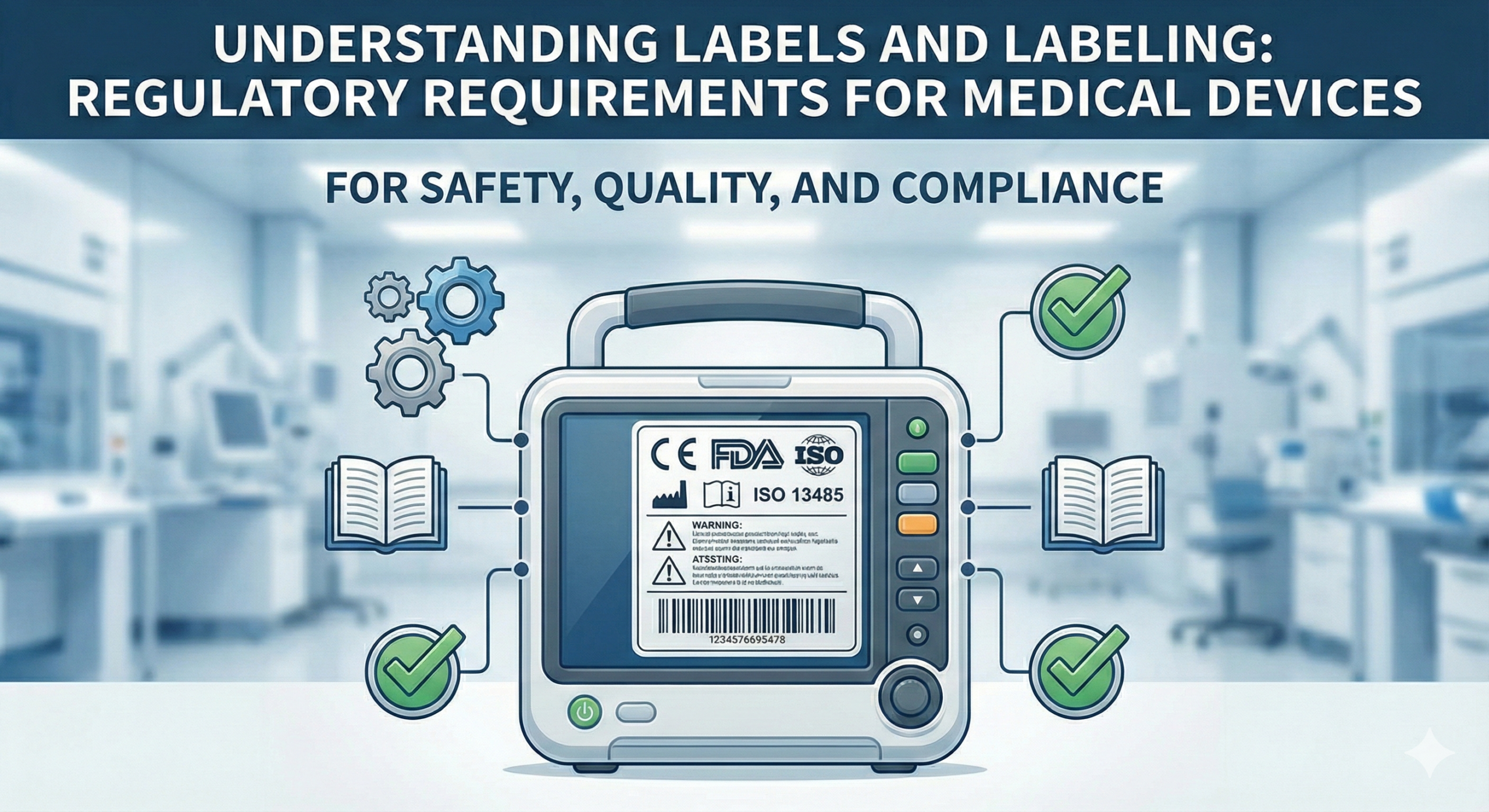
Understanding Labels and Labeling: Regulatory Requirements for Medical Devices
Introduction: Distinguishing Labels from Labeling
Labels and labeling are distinct concepts in medical device regulation, though the relationship between them often causes confusion. While a label is technically a subset of labeling, understanding the precise differences is essential for regulatory compliance. This distinction has significant implications for document management, design review processes, and quality systems across the medical device industry.
Labels and labeling are distinct concepts in medical device regulation, though the relationship between them often causes confusion. While a label is …
Regulatory Definitions
United States Federal Regulations
The U.S. Federal Food, Drug and Cosmetic Act (FFDCA) provides the authoritative definitions for labels and labeling. These legal definitions form the foundation for compliance strategies in the U.S. market and are widely referenced by regulatory professionals worldwide.
Label (FFDCA Section 201(k))
A label is defined as any written, printed, or graphic matter upon the immediate container of any article. This includes text, images, and other visual information that appears directly on or affixed to the physical package containing the medical device. Examples include nameplate information, unique device identification (UDI) codes, and markings printed or engraved on primary packaging (the innermost package contacting the device) and secondary packaging (outer shipping boxes).
Labeling (FFDCA Section 201(m))
Labeling encompasses all labels and other written, printed, or graphic matter, whether (1) upon or affixed to any article, its container, or wrapper, or (2) accompanying any article. This definition is intentionally broad and captures every document, material, or communication that reaches or is associated with the end user or patient. Labeling represents the complete universe of user-facing communications.
Practical Classification and Examples
What Constitutes a Label
A label, in its narrowest sense, refers to the physical markings directly on the device itself or its packaging. These include:
- Nameplate information with manufacturer identification
- Unique Device Identification (UDI), including both machine-readable and human-readable formats
- Markings on primary packaging (the innermost container)
- Markings on secondary packaging (outer boxes and shipping containers)
- Printed labels, decals, or engraved inscriptions
What Constitutes Labeling
Labeling encompasses a far broader array of materials and communications. Every printed material, digital content, or instructional item that a patient or user may see or use in connection with a medical device falls within this definition. Labeling includes, but is not limited to:
- Instructions for use (IFU) and user manuals
- Package inserts and prescribing information
- Printed information on packaging and boxes
- Simplified or abbreviated manuals and quick-start guides
- User training materials and training documentation
- Product catalogs and brochures
- Product information on websites and digital platforms
- Exhibition videos and promotional materials
- Safety labeling and warning information
The critical principle is that any communication providing information about the device’s function, performance, use, benefits, method of operation, or diagnostic capabilities constitutes labeling and is subject to regulatory oversight.
The Gray Zone: Distinguishing Advertising from Labeling
One of the most challenging aspects of labeling compliance involves determining where the boundary lies between permissible advertising and regulated labeling, particularly in digital contexts such as websites and catalogs.
When Content is Advertising (Not Labeling)
Content that identifies the product by name or model number and states its price may be considered general advertising rather than labeling. Such purely commercial information, without claims about function or benefit, typically falls outside the regulatory definition of labeling.
When Content Becomes Labeling
The classification changes when the content makes any claim or statement about:
- The intended use or indication for use of the device
- Device benefits, advantages, or therapeutic effects
- Device features, functions, or technical capabilities
- Device specifications or performance characteristics
- Operational procedures or diagnostic methods
For example, a website page containing only the device model number and price would generally be advertising. However, the same page becomes labeling if it describes how the device works, what conditions it can diagnose or treat, how to operate it, or what clinical outcomes users can expect.
This distinction has significant consequences, as labeling must meet substantially more stringent regulatory requirements than advertising, including design review, validation, and compliance documentation.
Special Consideration: Simplified and Quick-Start Manuals
Simplified manuals, abbreviated user guides, and quick-start materials deserve particular attention because they are frequently misclassified as marketing documents rather than regulatory labeling.
A simplified manual, even one that condenses or abbreviates the full instructions for use, remains labeling because it communicates essential operational, safety, and functional information to the end user. These abbreviated documents must undergo the same rigorous design review and regulatory documentation processes as comprehensive instruction manuals.
Common Compliance Challenges
In practice, simplified manuals are sometimes created by marketing or sales departments without formal design control involvement. This practice creates significant regulatory and safety risks. The abbreviated format may cause authors to omit critical safety information, assume user knowledge that may not exist, or communicate operational steps ambiguously. Such deficiencies can directly cause adverse events and user injuries.
Best practice requires that all marketing and sales departments coordinate with the design engineering team to ensure that any abbreviated or simplified manual undergoes formal design review. The design team must verify that the condensed format does not sacrifice essential safety information, that all critical operational steps are clearly communicated, and that the language is suitable for the intended user population, whether they are healthcare professionals, technicians, or lay patients.
Design Control and Regulatory Requirements
Design Output Requirements
Labeling must be generated as a formal design output. The 21 CFR Part 11 design control regulations and international design management practices (particularly ISO 13485 and IEC 62304) establish clear requirements for labeling development.
Labeling documents must:
- Be generated through formal design processes as documented design outputs
- Undergo formal design review by appropriate cross-functional teams
- Be retained in the Design History File (DHF) with documented design review records
- Include traceability to regulatory requirements and design input specifications
- Be subject to version control and change management procedures
This requirement applies universally to all labeling materials, whether they are comprehensive instruction manuals, simplified quick-start guides, package inserts, training materials, catalogs, or website content containing functional or performance claims.
Usability Validation Considerations
In certain circumstances, labeling materials must undergo formal usability validation studies. While not all labeling requires full usability engineering assessment, instructions for use and other critical labeling may require:
- Formative usability testing during design phases
- Cumulative usability assessment across the user population
- Validation studies demonstrating that actual users can safely and effectively operate the device using the labeling as provided
The decision regarding whether usability validation is required depends on the device’s risk classification, the complexity of the instructions, and the criticality of correct device use to patient safety. Devices with significant use-related risks typically require documented usability validation, often performed according to IEC 62366-1 principles and FDA guidance on human factors validation.
Documents That Are NOT Labeling
Certain patient-facing materials do not fall within the regulatory definition of labeling, despite being visible to end users.
Example: Shipping and Delivery Documents
Packing slips, shipping manifests, delivery notes, and similar documents that accompany the device but serve purely administrative functions are not considered labeling. These documents contain logistics, shipping, and commercial information rather than functional or safety information about the device itself.
The key distinction is whether the document communicates information about the device’s intended use, function, performance, or safety. If it does, it is labeling. If it serves only administrative, commercial, or logistics purposes unrelated to device use, it may not be labeling and therefore may not be subject to design control requirements.
References
- U.S. Federal Food, Drug and Cosmetic Act (FFDCA), Sections 201(k) and 201(m)
- FDA Code of Federal Regulations, Title 21, Part 801: Labeling
- FDA Guidance: “Labeling Guidance”
- ISO 13485: Medical devices—Quality management systems
- IEC 62304: Medical device software lifecycle processes
- IEC 62366-1: Medical devices—Part 1: Guidance on usability
- 21 CFR Part 11: Electronic Records; Electronic Signatures (design control principles)
Related FDA QMSR Templates
Streamline your FDA QMSR compliance with our professionally crafted templates:
Related Articles
- ECG Devices Used in Ambulances: Understanding Medical Device Classification and Regulatory Requirements
- Why Objective Evidence Matters: Performance Evaluation and Regulatory Requirements in Medical Devices
- Regulatory Requirements for Medical Device Software Development
- Understanding Amendment Methods in Regulatory Requirements: The Case of Partial Amendments
- Understanding Risk in Pharmaceuticals and Medical Devices
- Understanding Labeling Definitions in the United States: Navigating FDC Act, QSR, and QMSR Requirements

Comment