
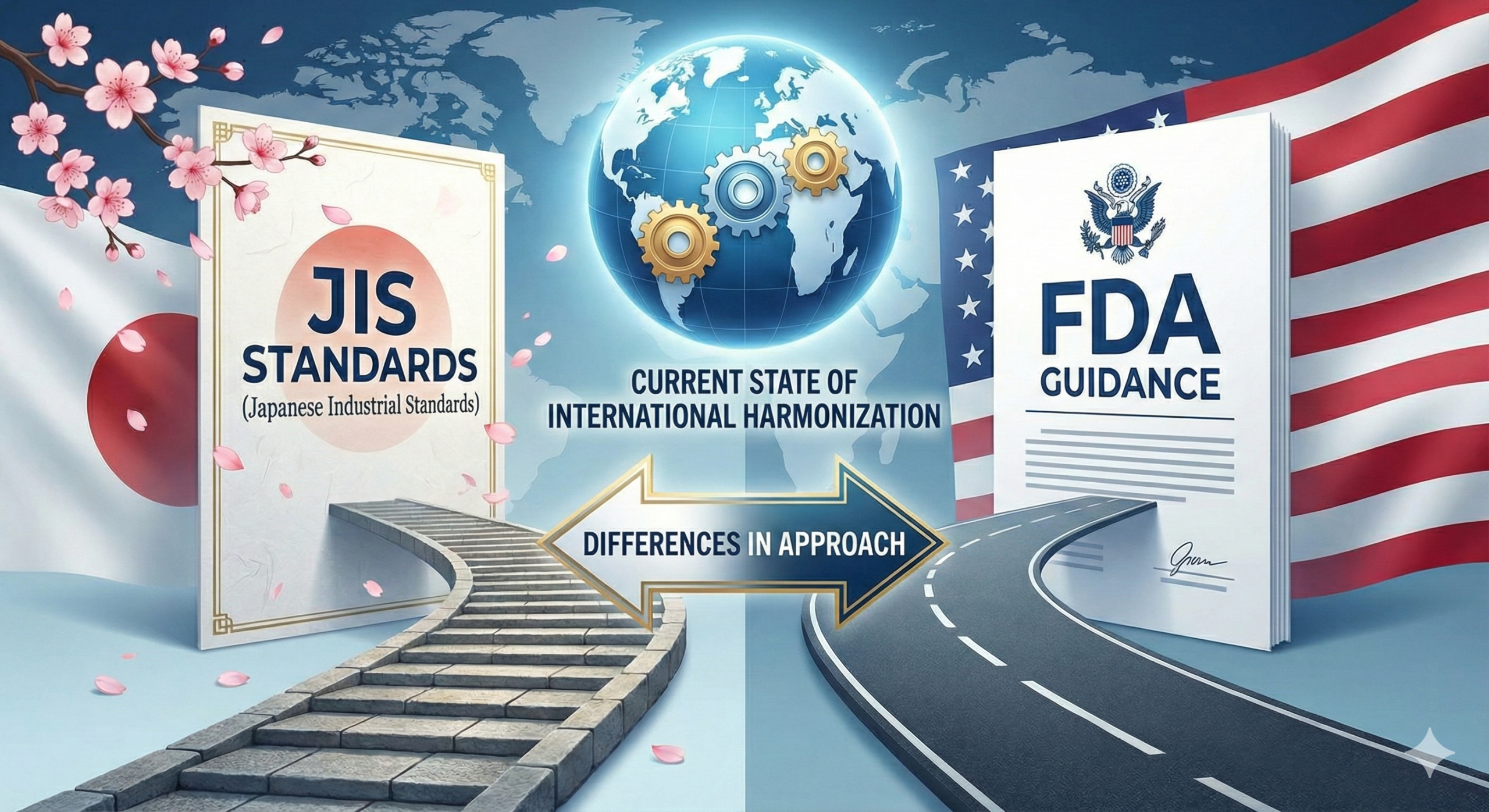
Differences in Approach Between JIS Standards and FDA Guidance: Current State of International Harmonization
The Role and Characteristics of Japanese Industrial Standards (JIS)
Japanese Industrial Standards (JIS) are national standards established under the Industrial Standardization Law and specify the types, quality, performance, and testing or evaluation methods for products, data, services, and more. These standards are established or revised by the relevant ministers through deliberation at the Japanese Industrial Standards Committee (JISC), which is located within the Ministry of Economy, Trade and Industry.
Japanese Industrial Standards (JIS) are national standards established under the Industrial Standardization Law and specify the types, quality, perfor…
In the medical device field, many JIS standards are developed based on ISO/IEC standards, thereby achieving international harmonization. For example, JIS Q 13485:2024, which specifies the quality management system for medical devices, is consistent with ISO 13485:2016. Similarly, JIS T 14971:2020, which addresses risk management for medical devices, corresponds to ISO 14971:2019. Following the publication of the new ISO 13485:2024 in 2024, subsequent revisions to the Japanese JIS standard are anticipated.
JIS standards comprehensively establish product performance criteria and specifications, testing and evaluation methods, quality management system requirements, and risk management processes. This framework enables manufacturers to produce and provide high-quality products and services, while consumers and other users can obtain and utilize these quality products and services.
The Role and Characteristics of FDA Guidance
FDA (Food and Drug Administration) guidance documents provide information on the interpretation of regulations and methods for achieving compliance with regulatory requirements. While guidance documents themselves have no binding legal force, they are treated as de facto industry standards as they represent the FDA’s current thinking. Companies can adopt alternative approaches; however, they bear the responsibility to demonstrate scientific validity for such alternatives.
The FDA’s approach emphasizes quality assurance throughout the entire product lifecycle. For example, the Process Validation Guidance (2011) recommends managing the entire sequence from product development through commercial manufacturing to continuous quality assurance through three stages. In the first stage, process design, the commercial manufacturing process is designed based on knowledge acquired during the development phase. In the second stage, process performance qualification, the capability of the process to achieve reproducible commercial manufacturing is verified. In the third stage, continued process verification, ongoing assurance that the process remains in a controlled state during routine manufacturing is maintained.
This approach is aligned with international guidelines such as ICH Q8 (Pharmaceutical Development), Q9 (Quality Risk Management), Q10 (Pharmaceutical Quality System), and Q14 (Analytical Procedure Development). The FDA actively promotes international harmonization and contributes to the development of global pharmaceutical and medical device industries.
Actual Differences in Approaches Between the Two
Both JIS standards and FDA guidance are based on international standards (ISO/IEC/ICH), and therefore share basic conceptual approaches. However, practical emphasis differs between the two.
Regulatory Nature and Implementation
JIS standards have a clearly defined legal status as national standards and may be directly cited as certification criteria for medical devices. The revision cycle typically occurs on a five-year basis. In contrast, while FDA guidance is recommended and has no binding legal force, companies that do not follow guidance must demonstrate scientific validity of alternative approaches, creating substantial de facto influence. Furthermore, FDA guidance tends to be flexibly revised in response to industry or scientific advancement.
| Aspect | JIS Standards | FDA Guidance |
| Legal Status | National standards with binding force | Recommendations without binding force |
| Revision Cycle | Typically every 5 years | Flexible revision based on scientific progress |
| Alternative Approaches | Methods specified in certification criteria are mandatory | Alternatives possible if scientific evidence is provided |
| Certification Requirements | Proof of JIS compliance is required | FDA guidance compliance is de facto standard |
Concrete Differences in Software Development Approaches
The differences between JIS and FDA approaches become clearer when examining medical device software development. In Japan, JIS T 2304:2023 (Medical Device Software) is established with content equivalent to IEC 62304:2015, and documents proving compliance with this standard are required during conformity certification. Test result reports corresponding to the device classification must be submitted.
In the United States, validation has historically been conducted based on the “Software Validation Guidance” (finalized in 2002). The “Computer Software Assurance (CSA)” guidance, announced in 2024 following draft publication in 2022, represents a significant shift from traditional Computer System Validation (CSV) to a risk-centric approach based on Critical Thinking. This guidance, with implementation envisioned for 2025, represents an evolution toward more flexible and practical quality assurance methods. In particular, for software incorporating machine learning or AI, adoption of approaches that supplement traditional deterministic testing is recommended.
Detailed reviews are conducted for premarket applications (510(k), PMA, etc.). In Europe, under the Medical Device Regulation (MDR) 2017/745, software risk management based on IEC 62304 is strengthened, including cybersecurity considerations (for example, enhanced requirements in IEC 62304:2023 Edition 2).
On the Conventional Distinction of “Process-Oriented” versus “Results-Oriented”
It has been traditionally said that “JIS standards are results-oriented while FDA guidance is process-oriented”; however, this characterization is not accurate. In reality, both emphasize both process and results. JIS standards, including the quality management system standard (JIS Q 13485), clearly adopt a process approach, while the FDA places paramount importance on the “results” of product safety and efficacy. The difference lies in the degree of detail with which specific processes are documented and verified, not a fundamental difference in approach.
However, practically speaking, there are significant differences in the granularity of documentation requirements. The FDA generally requires more detailed documentation of decision-making rationale and process development, which includes the logic behind decisions, reasons for evaluating alternatives, and background on the deliberation process. This practical difference in documentary detail contributes to the impression of FDA being “process-oriented.”
Current Status and Importance of International Harmonization
International harmonization in medical device and pharmaceutical fields progresses through two major frameworks: adoption of ISO/IEC standards and adoption of ICH guidelines.
International Standards and Regional Regulatory Alignment in Medical Devices
ISO 13485, the international standard for medical device quality management systems, is adopted in Japan as JIS Q 13485:2024. In the United States, it is utilized in a complementary manner to the FDA’s Quality System Regulation (QSR), while in Europe it is positioned as a harmonized standard under the Medical Device Regulation (MDR). The newly published ISO 13485:2024 adds enhanced leadership requirements, deeper risk-based approaches, and strengthened quality management throughout the product lifecycle, including cybersecurity considerations.
Similarly, IEC 62366-1:2023 (Medical Device Usability Engineering) is an international standard for usability aspects of medical devices and is adopted in Japan as JIS T 62366-1:2023. In the United States, it is largely aligned with FDA’s Human Factors Engineering Guidance (published in 2016 with several updates); however, in practice, FDA requirements are more stringent in certain areas. Particular attention must be paid to FDA-specific additional requirements regarding methods for identifying critical tasks, determination of participant numbers in summative evaluation, and accessibility evaluation aligned with an aging society.
In Europe, conformity with MDR requires compliance with IEC 62304, IEC 62366-1, and software/system safety standards such as IEC 61508/IEC 62061, with notable differences in the level of requirement by region.
International Harmonization in Pharmaceuticals
In the pharmaceutical field, the International Council for Harmonisation (ICH), comprising regulators from Japan, the United States, and Europe, has established a series of common guidelines including Pharmaceutical Development (ICH Q8), Quality Risk Management (ICH Q9), Pharmaceutical Quality System (ICH Q10), Development and Manufacture of Drug Substances (ICH Q11), Lifecycle Management (ICH Q12), and Analytical Procedure Development (ICH Q14). These are commonly adopted across Japan, the United States, and Europe, substantially streamlining global development. By complying with these ICH guidelines, pharmaceutical companies can more easily conduct simultaneous applications and obtain approvals across multiple regions.
In 2024, the new version of ICH Q3C (guideline on impurities) was published, adding more stringent regulatory requirements. Additionally, development of new guidelines addressing biologically-derived substances and advanced technologies (cell therapy, gene therapy, etc.) is underway.
Practical Considerations
Strategic Approach for Global Expansion
For companies pursuing global expansion, simultaneous compliance with multiple regulatory frameworks is an unavoidable challenge. The most efficient approach is to construct a quality system based on international standards. Specifically, it is recommended to establish a quality management system based on ISO 13485:2024, implement risk management based on ISO 14971:2019, and achieve compliance with relevant standards such as IEC 62304:2023 (software) and IEC 62366-1:2023 (usability). Additionally, compliance with additional standards appropriate to device characteristics, such as the IEC 60601 series (safety of medical electrical equipment) and IEC 62061 (functional safety), should be considered.
Beyond this foundation, compliance with region-specific requirements is necessary. In Japan, approval and certification requirements under the Pharmaceutical and Medical Device Law and compliance with QMS regulations (Ordinance for Enforcement) are required, with attention needed to anticipated 2025 regulatory reforms. In the United States, FDA premarket requirements (510(k), PMA, etc.) and QSR compliance are necessary, and preparation for implementation of CSA guidance is urgent. In Europe, CE marking based on MDR/IVDR is required, with third-party certification by a Notified Body being mandatory. These requirements are built upon international standards while incorporating unique elements reflecting each country’s healthcare systems and regulatory histories.
Regional Differences in Documentation Requirements and Practical Response
Documentation granularity also varies by region. The FDA generally requires more detailed documentation. Higher levels of documentation are expected in the detail of Design History Files (DHF), specificity of Validation Protocols/Reports, and comprehensiveness of Traceability Matrices compared to the PMDA. This includes documentation of decision logic, rationale for evaluating alternatives, and background of alternative consideration processes.
Conversely, while the PMDA bases its expectations on JIS standards, it recommends reference to guidance documents provided by AMED (Japan Agency for Medical Research and Development), including “Medical Device Development Guidance,” “Medical Device Standard Operating Procedures,” and domain-specific medical device guidance documents. Understanding these differences and preparing documentation at the appropriate level contributes to review efficiency.
Notified Bodies in Europe require not only MDR compliance but also proof of compliance with applicable specific standards (for example, IEC 60601-2-24 for cardiac pacemakers), making a comprehensive traceability document particularly important.
Continuous Monitoring of Regulatory Trends
Regulations continuously evolve, and monitoring of the latest developments is critically important. The FDA’s Computer Software Assurance (CSA) guidance, published in 2024, represents a significant departure from traditional Computer System Validation (CSV), with substantial implications for the industry. Particularly, the industry is currently exploring implementation methods for software using machine learning or AI, making continued attention to interpretation notices and implementation examples essential.
ISO 10993-1 (Biological Evaluation of Medical Devices) is undergoing revision (ISO 10993-1:2025) expected in 2025, with updates anticipated for the approach to biological safety evaluation of medical devices, particularly an integrated approach to chemical testing and biological evaluation. Japan’s QMS regulations are also scheduled to be revised in conjunction with updates to international standards.
Cybersecurity requirements for medical devices are also becoming essential for integration from the design phase, driven by revisions to IEC 62304 (transition to Edition 2) and strengthened regional regulatory requirements (FDA Premarket Cybersecurity Guidance, EU MDR Cybersecurity requirements, etc.). Continuous monitoring of these developments and timely incorporation into corporate quality systems becomes the key to both maintaining compliance and sustaining competitive advantage in the market.
Additionally, note that transparency reporting systems for medical devices (such as the US OpenPayments and EU Transparency Register) and adaptation strategies for subsequent entry devices (such as strengthened approval review guidelines for biosimilars) are important regulatory elements for global companies.
Related Articles
- Differences in Change Application Requirements for Medical Device Regulations Between Japan and the United States
- The Amended GMP Ordinance and International Standards Harmonization
- Commentary on GAMP 5: Evolution and Current State
- Differences Between Pharmaceuticals and Medical Devices
- Differences Between Calibration and Inspection
- PIC/S Data Integrity Guidance Implementation: Comprehensive Overview and Current Status
