
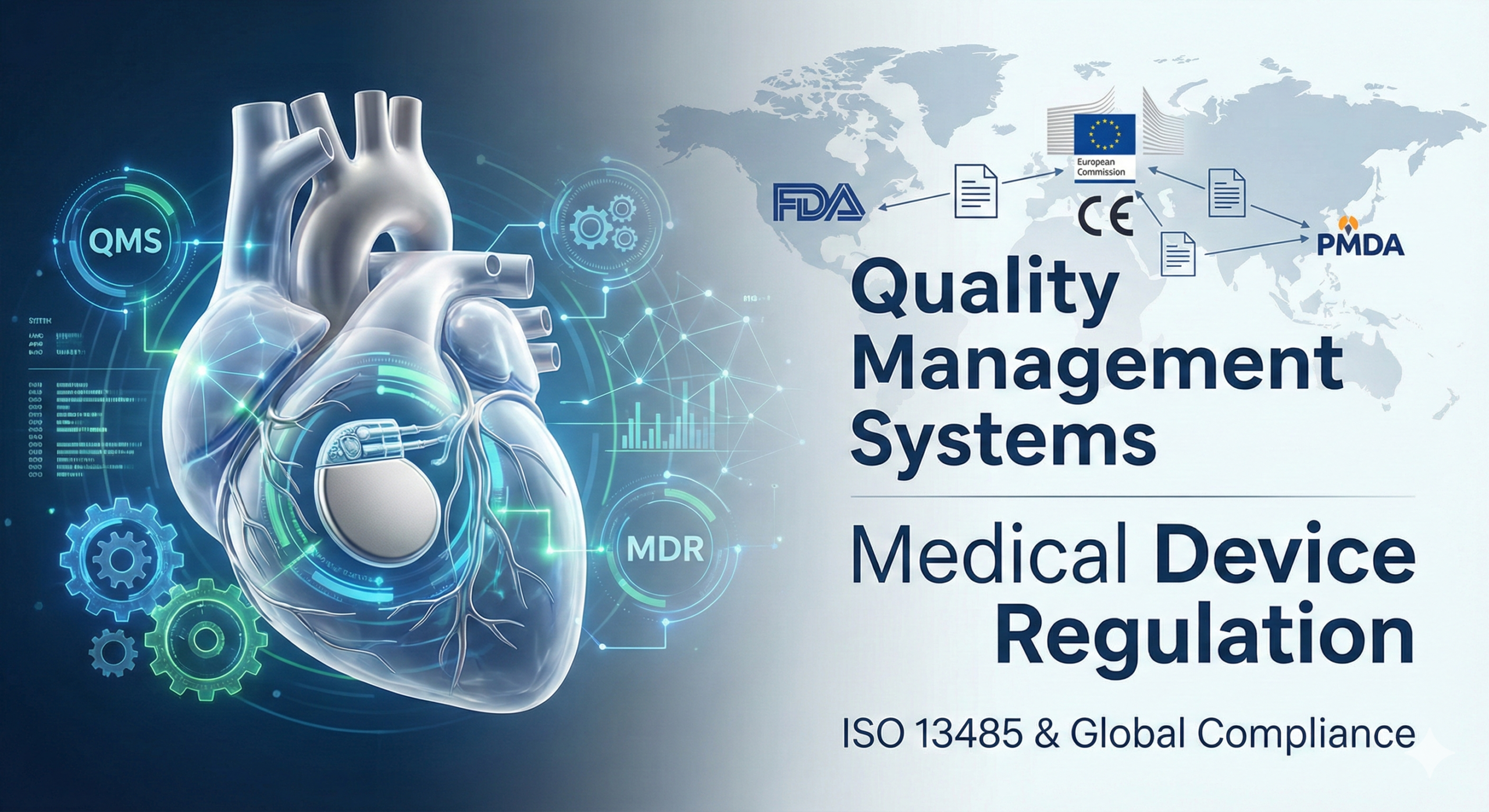
Quality Management Systems in Medical Device Regulation
Understanding Quality Management Systems
ISO 13485:2016 Chapter 4 establishes the requirements for Quality Management Systems. The specification identifies the following key elements:
ISO 13485:2016 Chapter 4 establishes the requirements for Quality Management Systems. The specification identifies the following key elements:…
ISO 13485:2016 Section 4 – Quality Management System
- 4.1 General Requirements
- 4.2 Documentation Requirements
- 4.2.1 General
- 4.2.2 Quality Manual
- 4.2.3 Device Master Record
- 4.2.4 Document Control
- 4.2.5 Record Control
Chapter 4 represents arguably the most critical section of ISO 13485, as it contains the essential requirements that form the foundation for the entire quality management framework. It is important to note that terminology varies by regulatory jurisdiction: the FDA refers to this as the “Quality System” (QS), while ISO standards use “Quality Management System” (QMS). Despite the different nomenclature, the regulatory intent and fundamental principles are identical.
Definitions and Core Concepts
ISO 9000:2015 (and subsequent revisions) provides the following definitions relevant to QMS:
Quality Management
The coordinated activities and controls directed toward guiding and sustaining an organization’s efforts to achieve and maintain the quality of its products and services. Quality management typically encompasses the establishment of quality policies and quality objectives, quality planning, quality control, quality assurance, and quality improvement.
Quality Control
That component of quality management focused specifically on fulfilling quality requirements. Quality control represents a systematic approach to economically producing goods or services that meet customer requirements with respect to quality, cost, and delivery schedule.
In the context of ISO 13485, quality management takes on a broader interpretation than traditional quality control (QC). The standard defines quality management as “the totality of coordinated activities to direct and control an organization with regard to quality” across multiple dimensions:
- Ensuring that products and services delivered to customers meet the specified quality standards (Quality), competitive pricing (Cost), and committed delivery timelines (Delivery)
- Enabling each department and functional area to provide products or services more efficiently, cost-effectively, and rapidly than competitors
- Implementing statistical and analytical management techniques across the entire organization, complementing technical expertise
- Extending quality control beyond products and services to encompass the processes that create them, thereby establishing enterprise-wide quality management
This comprehensive approach is similar to concepts such as Total Quality Management (TQM) or Total Quality Control (TQC). ISO 13485 mandates that quality management activities be performed across all functions that influence product quality: customer requirement analysis, product planning, research and development, design, manufacturing transfer, purchasing, outsourcing, production, inspection, distribution, sales, and post-market support.
The PDCA Cycle in Quality Management Systems
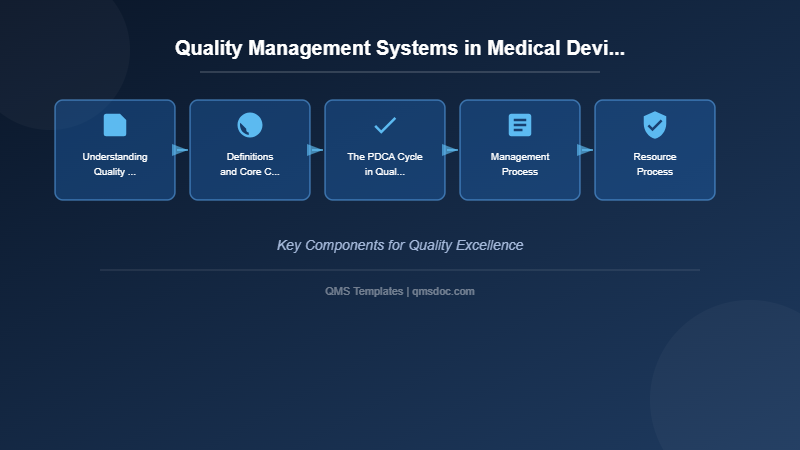
A well-established QMS is typically structured around four interconnected Plan-Do-Check-Act (PDCA) cycles:
- Management Process – Strategic direction and oversight
- Resource Process – Allocation of human, material, and financial resources
- Product Realization Process – Execution of product development and production activities
- Measurement, Analysis, and Improvement Process – Data collection, analysis, and continuous improvement
These four processes work in concert to create a dynamic system where quality continuously improves through systematic feedback and corrective action.
Management Process
In the Management Process, executive leadership establishes the quality policy and defines annual quality objectives. Quality objectives must possess two critical characteristics: they must be achievable with realistic resources and timelines, and they must include explicit, measurable criteria for success. Examples might include reducing customer complaints by three percentage points, decreasing deviations by five percentage points, or increasing customer satisfaction scores by ten percentage points. Management must conduct periodic management reviews and issue appropriate directives for quality improvement initiatives based on performance data and emerging risks.
Resource Process
The Resource Process requires that executive leadership allocate appropriate resources—personnel, equipment, infrastructure, and financial resources—to support quality improvement initiatives. Simply providing verbal directives without allocating actual resources renders quality improvement impossible to execute. Examples include hiring qualified personnel, providing training and educational programs, engaging external consultants for specialized expertise, investing in equipment and systems, and maintaining facilities suitable for conducting operations according to established procedures.
Product Realization Process
The Product Realization Process encompasses the execution of all activities necessary to create products and services that meet customer and regulatory requirements. This includes research, development, design, manufacturing, distribution, and service activities, all conducted in accordance with the QMS. The objective is to deliver products to the market that satisfy user needs and requirements, thereby achieving customer satisfaction while maintaining compliance with applicable regulatory requirements.
Measurement, Analysis, and Improvement Process
The Measurement, Analysis, and Improvement Process focuses on the collection and analysis of data from multiple sources—including customer complaints, adverse events, quality incidents, and internal observations—to identify areas requiring corrective action or preventive measures. Corrective actions address the root causes of identified problems to prevent recurrence, which is fundamentally different from implementing temporary corrections or workarounds. Identifying and eliminating root causes is the essential characteristic that distinguishes effective corrective action.
Internal audits constitute a critical component of this process. Often referred to in regulatory contexts as “Self-Inspection,” internal audits enable organizations to proactively discover and address latent risks and deficiencies without waiting for regulatory agency inspection. It is important to note that the Japanese translation of Self-Inspection as “自己点検” (self-inspection) may not adequately capture the full scope of the concept, which encompasses comprehensive internal audit and continuous improvement activities. Self-Inspection requires that organizations systematically discover, document, and address risks through regular internal audit processes—a proactive approach that prevents problems from reaching the stage where regulatory agencies would identify them during compliance inspections.
The results from corrective actions, preventive actions, and internal audits feed back into the Management Process, enabling executives to issue improvement directives and establish quality objectives for the following year. This feedback mechanism ensures continuous improvement and risk reduction over time.
The Quality Management System as Integrated Framework
The quality improvement mechanisms described above collectively constitute the “Quality Management System” (QMS). The PDCA cycle serves as the foundational methodology for a functional QMS. When an organization maintains a robust QMS with functional PDCA cycles operating across all four processes, it creates a system of continuous improvement wherein quality progressively increases—from today to tomorrow to the day after tomorrow. This represents a meaningful assurance that the organization’s products and services will become increasingly reliable, safe, and compliant over time.
FDA Quality System Inspections and Modern Regulatory Approaches
The FDA identifies the establishment of a Quality System as a fundamental responsibility of executive leadership and top management. As medical device manufacturers increasingly operate on a global basis, they encounter more frequent inspections from regulatory authorities worldwide, including the FDA, European competent authorities, and national regulators. Regulatory agencies have correspondingly increased the frequency of international inspections to monitor compliance across their distributed supply chains.
However, regulatory authorities face significant resource constraints in conducting inspections. Traditional inspection approaches relied on investigators identifying specific violations and manufacturers implementing corrective actions. This reactive model contains an inherent limitation: during a typical inspection (FDA inspections of medical device manufacturers in Japan typically occur over approximately four days), inspectors can reasonably identify only a limited number of deficiencies and risks. Consequently, corrective action addressing only those deficiencies discovered during inspection cannot reasonably assure the protection of public health and safety.
In response, regulatory authorities including the FDA have evolved toward a risk-based inspection methodology that focuses less on identifying and enumeration of specific violations and more on whether the company has established a functional Quality System under management governance that ensures systematic identification and mitigation of risks without waiting for regulatory inspection. Modern inspections assess whether the organization independently identifies issues and implements improvements at a level of rigor comparable to regulatory agency inspection capabilities.
To achieve this level of operational excellence, the organization must secure and maintain highly qualified audit and quality personnel. Companies that have effectively established a robust Quality System represent “low-risk” organizations from a regulatory perspective—they can be relied upon to identify and address compliance issues proactively and systematically, thereby providing meaningful assurance of product safety and quality.
This approach aligns with the Risk-Based Metrics (RBM) initiative and other modern regulatory frameworks that recognize that public health protection is more effectively achieved through organizations that maintain strong internal systems rather than through the frequency of external agency inspections alone.
Regulatory Alignment and International Perspective
The QMS concepts established in ISO 13485 have achieved broad international adoption. Similar requirements appear in:
- FDA Quality System Regulation (21 CFR Part 820)
- EU Medical Device Regulation (MDR 2017/745)
- EU In Vitro Diagnostic Regulation (IVDR 2017/746)
- MDSAP (Medical Device Single Audit Program) guidelines
- IMDRF (International Medical Device Regulators Forum) guidance documents
The consistency across these frameworks underscores the universal recognition that a well-designed Quality Management System, centered on management commitment, resource allocation, and continuous improvement, represents the most effective approach to ensuring medical device safety and performance throughout the product lifecycle.
Conclusion
The Quality Management System represents far more than a documentation exercise or a checklist for regulatory compliance. It constitutes a living, dynamic framework that enables organizations to systematically improve their processes, identify and mitigate risks proactively, and ultimately deliver increasingly safe and effective medical devices to patients worldwide. Organizations that view QMS as a strategic management tool—rather than merely a regulatory requirement—position themselves for long-term success in an increasingly complex and demanding regulatory environment.
Related FDA QMSR Templates
Streamline your FDA QMSR compliance with our professionally crafted templates:
Related Articles
- Complaint Management in Medical Device Quality Systems
- Proper Japanese Translation of “Review” in Medical Device Regulatory Requirements: Clarifying Terminology in Quality Management Systems
- Data Analysis in Medical Device and Pharmaceutical Quality Management Systems
- Understanding Quality Systems in Pharmaceutical and Medical Device Industries
- FDA Design Control Guide: Foundation of Medical Device Quality Management
- Complaint Management in Medical Device Regulation
