
Resource Operational Management (Part 1)
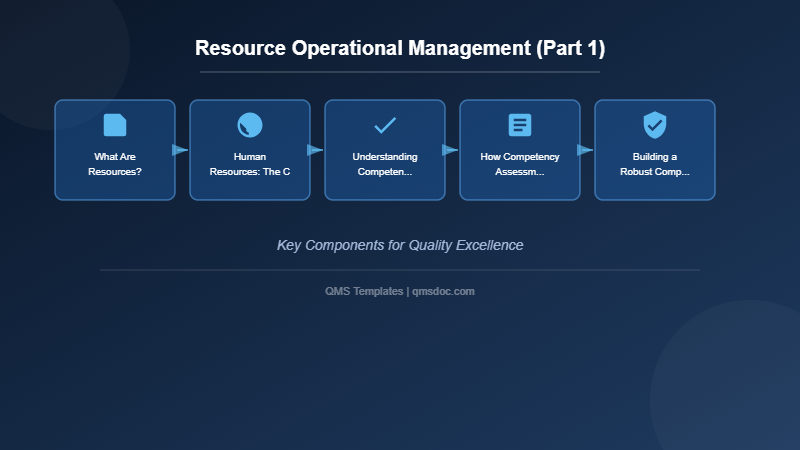
What Are Resources?
Resources—often referred to as inputs or assets in quality management—consist fundamentally of people, materials, and finances. ISO 13485:2016 Section 6 addresses “Operational Planning and Control of Resources,” encompassing human resources (Section 6.2), infrastructure (Section 6.3), and the work environment including contamination control (Section 6.4). This framework reflects a shift in emphasis from the 2013 version, where contamination management was integrated within work environment requirements. In the 2016 and subsequent versions—including the clarifications provided in ISO 13485:2016-1:2023—contamination management became an independent subsection, reflecting the growing recognition of environmental controls in medical device manufacturing.
Resources—often referred to as inputs or assets in quality management—consist fundamentally of people, materials, and finances. ISO 13485:2016 Section…
The structure of Section 6 in ISO 13485:2016 is organized as follows:
- 6.1 Provision of Resources
- 6.2 Human Resources
- 6.3 Infrastructure
- 6.4 Work Environment and Contamination Control
- 6.4.1 Work Environment
- 6.4.2 Contamination Control
Human Resources: The Cornerstone of Quality Management
Implementing ISO 13485 effectively and ensuring the safety and quality of medical devices requires far more than creating documentation. Many organizations fall into the trap of treating quality management systems as box-checking exercises—developing quality manuals and QMS documents that remain inert, failing to drive meaningful change. This approach fundamentally misses the point. The relationship between process and people is symbiotic; quality management systems are only as effective as the people who execute them. Like a vehicle requiring both wheels to move forward, a QMS requires both well-designed processes and competent personnel. When either element is insufficient, the desired outcomes remain unattainable.
Within the medical device industry, most organizations have developed some form of competency matrix or skills map. However, the experience of consultants working across multiple organizations reveals a troubling pattern: the meaning of “competence” is poorly understood, and competency assessments often fail to capture what the standard actually requires.
Understanding Competence: The ISO Definition
ISO defines competence—or more precisely, “competency”—as “the ability to apply knowledge and skills to achieve intended results.” This definition contains critical nuances that are frequently overlooked. Competence is not synonymous with knowledge alone; it requires the integration of both knowledge and skill. Knowledge—the theoretical understanding of concepts, principles, and requirements—can be acquired through classroom instruction, reading, and study. Skill, by contrast, requires hands-on training, practice, and accumulated experience.
Consider the analogy of learning to drive an automobile. Classroom instruction imparts knowledge: understanding traffic signs, memorizing traffic laws, and learning the theoretical principles of vehicle operation. This knowledge is essential but wholly insufficient. Competent driving requires practical skill developed through supervised training on actual roadways, combined with the experiential learning that comes from managing real traffic situations over time. A person who has memorized traffic rules but never sat behind a steering wheel—often called a “paper driver”—is not a competent driver. Similarly, someone with extensive driving experience but no formal knowledge of traffic regulations would not be considered competent.
A critical final element of the ISO definition deserves emphasis: competence requires achieving intended results. Even an individual possessing both knowledge and skill may lack competence in a particular domain if they consistently fail to produce the desired outcomes. This outcome-focused dimension transforms competence from a static attribute into a dynamic, measurable capability.
How Competency Assessment Often Falls Short
During consulting engagements, competency matrices from numerous medical device companies are frequently reviewed. A persistent pattern emerges: competency statements are phrased as understanding, rather than as capability. Examples include “understands QMS regulations,” “understands standard operating procedures,” and “is familiar with risk management principles.” These statements describe the outcome of training or education—the acquisition of knowledge—not competence itself.
This represents a fundamental misunderstanding of the standard. QMS regulations and standard operating procedures are baseline expectations; understanding them should be assumed. The question is not whether personnel have received training, but whether they can reliably perform job functions and achieve quality outcomes. Competency statements should reflect this capability-based perspective.
Properly constructed competency assessments employ action-oriented language: “can conduct risk analysis,” “can perform solder joints meeting process specifications,” “can identify complaints and classify them according to regulatory criteria,” “can troubleshoot equipment malfunctions,” or “can prepare regulatory submissions.” Each statement describes an observable, verifiable capability—not knowledge acquisition, but skill demonstrated and results achieved.
Building a Robust Competency Framework
Establishing meaningful competency across a medical device organization requires a multi-layered approach. First, competency requirements must be clearly defined for each role. For technical roles—such as design engineers, manufacturing technicians, quality inspectors, and regulatory specialists—these requirements should specify the combination of knowledge and hands-on skill necessary to perform the role successfully.
Second, assessment methods must move beyond checkbox-style training completion records. True competency assessment involves direct observation of performance, evaluation of work products, and demonstration that intended results are consistently achieved. Practical demonstrations—whether conducting a risk analysis, executing a manufacturing process, or drafting a regulatory document—provide more reliable evidence of competence than attendance records or examination scores.
Third, development pathways for personnel should be structured to support both knowledge acquisition and skill development. This typically involves a combination of formal training, mentoring relationships, structured on-the-job training (OJT), and opportunities for supervised practice before full responsibility is assigned.
Finally, competency maintenance and periodic reassessment ensure that knowledge remains current and skills remain sharp. In a regulated industry where standards, regulations, and technologies evolve continuously, competency is not a static achievement but an ongoing commitment.
Competency in the Context of Quality Systems
The emphasis on human resources and competency in ISO 13485 reflects a fundamental principle: well-designed processes alone do not guarantee quality outcomes. Quality results from the competent execution of those processes by knowledgeable, skilled personnel working within a supportive organizational environment. When companies encounter quality failures—manufacturing defects, inadequate risk assessments, missed regulatory obligations, or poor complaint investigation—the root cause often traces not to flawed procedures but to inadequate competency of personnel executing those procedures.
This understanding transforms how organizations approach quality management. Instead of viewing ISO 13485 compliance primarily as a documentation exercise, it becomes recognized as a framework for building organizational capability. The human resources section of the standard exists not as a bureaucratic requirement but as essential foundation for delivering safe, effective medical devices to patients.
To be continued in Part 2
Related Articles
- Infrastructure Resource Operational Management (Part 2)
- Lack of Management Understanding and IT Department Resistance: Key Challenges for Japanese Companies
- ISO 14971:2019 Revisions – Part 2: Management Responsibility, Risk Analysis, and Risk Management File
- 【medical equipment】Risk Management Course Part 1.
- 【translation into Japanese】FDA Part 820 QMSR(Quality Management System Regulation)revised plan
- The Birth of 21 CFR Part 11: A Historical Perspective
