
QMS Regulatory Amendment in Japan
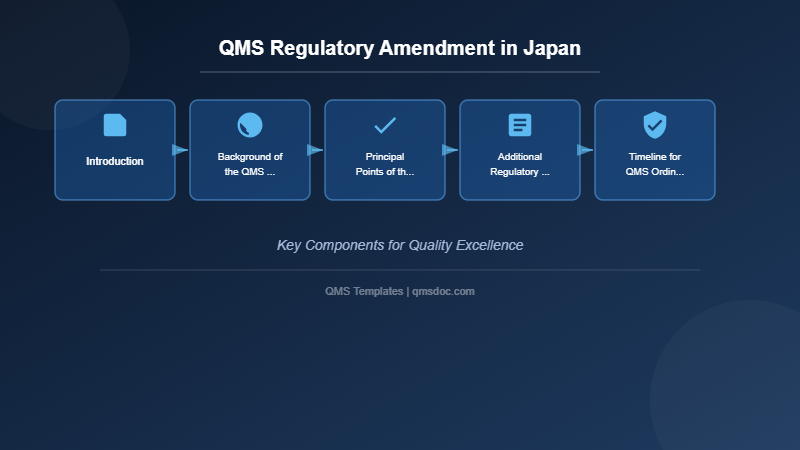
Introduction
On November 25, 2014, the Pharmaceutical Affairs Law was partially amended, and the “Law on Ensuring Quality, Efficacy, and Safety of Pharmaceutical Products and Medical Devices” (the Pharmaceuticals and Medical Devices Act, or PMDA, hereafter referred to as the “Medicinal Products Act”) came into effect. The “Law Partially Amending the Pharmaceutical Affairs Law” that effectuated this amendment contains Article 66, which provides as follows:
On November 25, 2014, the Pharmaceutical Affairs Law was partially amended, and the “Law on Ensuring Quality, Efficacy, and Safety of Pharmaceutical P…
Article 66 (Review)
The Government shall, five years after the enforcement of this Law, review the implementation status of the provisions as amended by this Law and, when deemed necessary based on such review, take necessary measures based on the results thereof.
In accordance with this review provision, around 2019, approximately five years after the enforcement of the Medicinal Products Act, the Ministry of Health, Labour and Welfare conducted a comprehensive policy review. Within this context, the overhaul of the regulatory system for medical device manufacturing quality management became a significant policy theme, and in particular, the revision of the regulatory ordinance governing the quality management system (QMS: Quality Management System) for medical devices came under review.
Behind this policy overhaul lay an important motivation for international harmonization. In particular, following the publication of the revised version of the ISO 13485 standard (ISO 13485:2016), there emerged a requirement for Japan’s medical device QMS regulations to align more closely with this international standard. A similar initiative proceeded in parallel with revisions to GMP (Good Manufacturing Practice for pharmaceutical products), and these initiatives collectively represented a comprehensive policy approach to reforming the Medicinal Products Act framework.
Background of the QMS Ordinance Amendment and Review Structure
During fiscal year 2017 (Heisei 29), under a research project titled “Research on International Harmonization of Guidelines for GMP, QMS, and GCTP” (principal investigator: Shingo Sakurai), a detailed review was conducted on proposed revisions to the QMS ordinance and draft clause-by-clause explanations. This research initiative also simultaneously advanced the development of guidance concerning the management of computerized systems and electromagnetic documents and records utilized in medical device manufacturing.
As the role of computerized systems in medical device manufacturing environments has expanded, consideration was given to imposing validation requirements on software utilized in quality management systems. In this connection, the experience from the “Guideline for Proper Management of Computerized Systems in Pharmaceutical GMP” was referenced as the foundation for developing new guidelines tailored to medical device QMS.
The revised QMS ordinance was initially scheduled for enforcement in October 2018; however, as policy discussions progressed, the enforcement date was subsequently postponed.
Principal Points of the Revised QMS Ordinance Amendment
Under the revised QMS ordinance, Chapter 2 of the quality management regulations was determined to align with ISO 13485:2016. This revision encompasses the following principal amendment points:
(1) Application of Risk-Based Approach
A risk-based approach to quality management is being incorporated systematically across all medical device manufacturing processes and quality assurance activities. This signifies that rather than applying uniformly stringent measures to all medical devices, organizations are expected to design rational and efficient quality assurance activities proportionate to the level of risk that a given medical device may pose to patients. For instance, manufacturing processes for components that do not directly contact patients would be subject to different levels of management controls compared to processes for components bearing safety-critical functions.
(2) Application of Validation Requirements to QMS Software
New requirements for CSV (Computer System Validation) are being imposed on various software systems utilized in quality management operations, such as document management systems and record management systems. Following the precedent established in pharmaceutical GMP regulations, systematic verification is now required to confirm that these systems accurately perform their intended functions.
(3) Determination of Sample Size Based on Statistical Methods
The determination of sample sizes for testing and inspection activities within quality management is being strengthened to move away from empirical rules or formulaic standards toward the application of statistically grounded methodologies. This advancement promotes quality assurance with greater scientific rigor and evidence-based foundation.
Additional Regulatory Requirements Accompanying the Amendment
In addition to the principal amendment points outlined above, the revised QMS ordinance is expected to strengthen existing requirements and introduce additional regulatory provisions as follows:
Requirements concerning the acquisition, management, and reporting of information related to consumer complaints and adverse events associated with medical device use are being strengthened. Particularly, mechanisms for detecting and responding to post-market quality issues are being structured to operate more promptly and systematically.
Requirements specific to sterilized medical devices are also expected to become more concrete and stringent, with more detailed specifications governing the validation of sterilization processes, the storage and management of sterilized products, and the maintenance of appropriate sterilization status during market distribution.
Requirements concerning documentation and record creation are also expected to receive more explicit and operationally effective regulatory specification with respect to format, content, storage, and retention periods.
Timeline for QMS Ordinance Amendment Enforcement
While preparation for the amended QMS ordinance has been proceeding for several years, until the revised ordinance is formally promulgated, disclosure of the full scope of the amendments remains limited. The typical process involves preliminary notice and publication of the proposed amendment in the Official Gazette, followed by a public comment period, then finalization of the amendment, and ultimately promulgation.
For the full-scale implementation of the revised requirements, a multi-year transition period following promulgation and preceding the enforcement date is under consideration to ensure adequate preparation time for medical device manufacturers and related stakeholders.
Key Terminology Frequently Appearing in the Revised QMS Ordinance
Within the text of the revised QMS ordinance and its clause-by-clause explanations, the following terms recur repeatedly and assume particular significance in QMS implementation practice:
Documentation, Risk, Competent Authority, Statistical Methods, and Procedural Manual (yōryōsho, 要領書 in Japanese) represent these critical terms.
Among these, particular attention must be paid to the concept of “procedural manual” (要領書). In current medical device manufacturing practice, emphasis has been placed on the creation of “procedures” (手順書). However, in actual manufacturing environments, factory workers conducting operations rarely continuously refer to procedure documents during their work, and procedure documents typically remain at a general level of principle without extending to detailed specification of concrete operational methods. In other words, “procedures” alone provide limited practical effectiveness in ensuring the quality standards required in the actual manufacturing environment.
The fundamental philosophy of the amended QMS ordinance is to address this limitation in practical effectiveness. A “procedural manual” (要領書) refers not merely to general procedural principles but to documentation that specifies concrete, executable operational methods in detail. For instance, in managing relationships with external suppliers, it is insufficient to merely execute formal “trade agreements” or “contracts.” Rather, organizations must furnish suppliers with “procedural manuals” that specifically delineate quality requirements and operational methods and ensure supplier comprehension and compliance with these requirements.
In the revised QMS framework, the development and operation of such concrete, execution-oriented “procedural manuals” is expected to become central to an organization’s quality culture.
Conclusion
The amended QMS ordinance, within the context of international harmonization of medical device regulations, calls upon Japan’s medical device manufacturing industry to establish more scientifically grounded and operationally effective quality management systems. Particularly through the adoption of risk-based approaches, software validation, strengthened statistical foundations, and execution-oriented documentation, the ordinance aims to further assure the quality, efficacy, and safety of medical devices. For medical device manufacturers, preparation for these amendments should be positioned not merely as regulatory compliance but as representing substantive enhancement of organizational quality management capability.
Related Articles
- The Declining Quality Culture in Japan: A Critical Analysis with Current Regulatory Perspectives
- Understanding Amendment Methods in Regulatory Requirements: The Case of Partial Amendments
- Differences in Regulatory Requirements Between Western Countries and Japan
- Proper Japanese Translation of “Review” in Medical Device Regulatory Requirements: Clarifying Terminology in Quality Management Systems
- Differences in regulatory requirements between Europe, the U.S. and Japan
- Understanding CFR: The Foundation of U.S. Regulatory Framework
