
Revisions to Japan’s Medical Device Quality Management System Ordinance
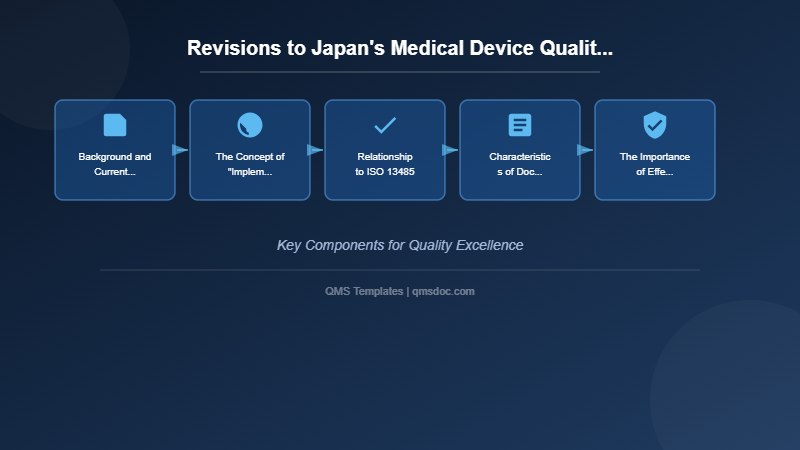
Background and Current Status
Japan’s revised Medical Device Quality Management System Ordinance (QMS Ordinance), formally known as the revised Ordinance on Quality Management Systems for Medical Devices and In Vitro Diagnostic Devices, was initially scheduled to take effect in October 2018. However, the adjustment process within the industry required more time than anticipated. Subsequently, the revised ordinance was promulgated on November 25, 2020, and formally took effect on April 1, 2021. While this delay provided the medical device industry with an extended implementation period, it simultaneously created prolonged uncertainty regarding regulatory expectations and timeline for compliance.
Japan’s revised Medical Device Quality Management System Ordinance (QMS Ordinance), formally known as the revised Ordinance on Quality Management Syst…
A particularly important aspect of this regulatory evolution is that ISO 13485:2016 had been issued in 2016, and its transition period—typically three years—had already elapsed before the revised ordinance took effect. Consequently, prior to April 1, 2021, Japanese medical device manufacturers found themselves in a substantive dual-standard situation, navigating between the international requirements stipulated in ISO 13485:2016 and the domestic regulatory obligations under Japan’s previous Medical Device Quality Management System Ordinance.
The Concept of “Implementation Guidelines” in the Industry Proposal
At a QMS seminar held by the Japan Medical Device Industry Association (Iryo-Kiki-Ren) on July 12, 2018, a draft version of the revised QMS Ordinance was presented to industry stakeholders. A notable aspect of this industry proposal was the introduction and repeated use of the term “implementation guidelines” (jisshi yōryō, 実施要領)—a concept that is not explicitly defined in ISO 13485:2016.
The commentary on the industry proposal’s article-by-article explanation provides the following definition of implementation guidelines:
“Implementation guidelines” refers to documents that define, in addition to quality management system manuals and procedures, matters necessary for the operational implementation of the quality management system, including special agreements or memoranda required by regulatory requirements or procedures during the operation of the quality management system.
As this definition illustrates, implementation guidelines are not a hierarchical level above procedures and manuals. Rather, they serve a complementary function. Whether manufacturing occurs in-house or is outsourced, procedures alone often prove insufficient to ensure consistent and appropriate manufacturing. The purpose of establishing detailed and concrete implementation guidelines is to provide greater assurance that specific operational tasks are executed reliably and consistently across the organization.
Relationship to ISO 13485
The “documented procedures” required by ISO 13485:2016 typically remain at a general and principle-based level of specification. In contrast, Japan’s revised QMS Ordinance requires that implementation guidelines demonstrate more specific and detailed operational methodologies. This difference reflects the variance in implementation approaches between international standards and domestic regulations, and it is crucial for understanding the characteristics of Japan’s regulatory environment.
Characteristics of Documentation in Japan’s Regulatory Culture
A particularly notable feature of Japan’s regulatory approach to medical devices and pharmaceuticals is the detailed documentation requirements exemplified in the GVP Ordinance (Ordinance on Ensuring Quality, Safety, and Efficacy of Pharmaceuticals, Medical Devices, and Regenerative Medical Products). This ordinance requires meticulous creation of communication records and documentation. During regulatory inspections conducted by the Ministry of Health, Labour and Welfare in connection with medical device manufacturing license renewals, regulatory inspectors routinely evaluate whether these documents have been created with appropriate detail and are grounded in actual operational activities.
This is not merely a formal administrative requirement but rather a substantive mechanism designed to ensure the safety and efficacy of medical devices.
The Importance of Effective Documentation
The essence of medical device design and manufacturing is to assure quality and maintain safety. Achieving this objective requires that each element of the QMS not merely exist on paper but be genuinely integrated into actual business processes and function effectively in practice.
The core principle of Japan’s revised QMS Ordinance lies not in demanding formal document creation but in requiring documentation that demonstrates genuine effectiveness and operational relevance. The concept of “implementation guidelines” serves as the concrete mechanism to realize this requirement. Organizations bear the responsibility of creating documents that bridge the gap between regulatory expectations and actual operational realities, tailoring their approach to address the complexity and unique challenges inherent in their manufacturing processes.
For detailed information on the revised QMS Ordinance, readers are encouraged to consult explanatory resources and videos provided by eCompliance and other regulatory experts. In the years since the ordinance’s implementation, numerous organizations have accumulated practical experience in implementing implementation guidelines, and industry best practices continue to develop and mature.
Related Articles
- Complaint Management in Medical Device Quality Systems
- Proper Japanese Translation of “Review” in Medical Device Regulatory Requirements: Clarifying Terminology in Quality Management Systems
- Quality Management Systems in Medical Device Regulation
- Data Analysis in Medical Device and Pharmaceutical Quality Management Systems
- Understanding Quality Systems in Pharmaceutical and Medical Device Industries
- FDA Design Control Guide: Foundation of Medical Device Quality Management
