
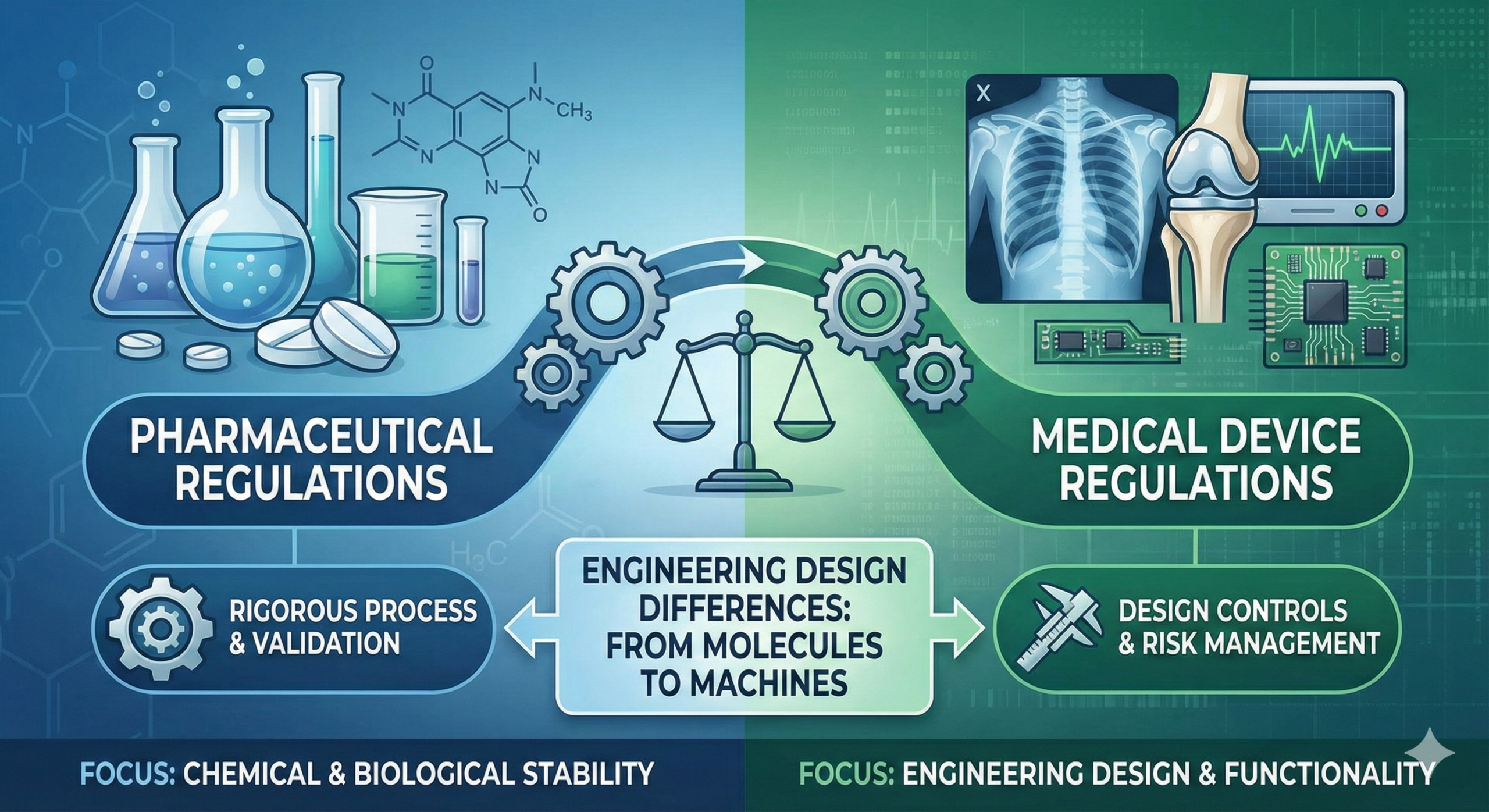
Differences Between Pharmaceutical and Medical Device Regulations Regarding Engineering Design
In recent years, pharmaceutical companies have increasingly expanded into the medical device sector, and I frequently receive consulting requests related to this transition. During such consultations, I often encounter questions about the timing of clinical trials for medical devices and the manufacturing of investigational medical devices. These questions reflect a fundamental misunderstanding of the regulatory frameworks governing these two distinct industries.
In recent years, pharmaceutical companies have increasingly expanded into the medical device sector, and I frequently receive consulting requests rela…
Differences in the Sequence of Development and Clinical Trials
The most significant distinction between pharmaceutical and medical device regulations lies in the sequence of research and development activities and the conduct of clinical trials. This fundamental difference shapes the entire regulatory approach and operational strategy for each sector.
Pharmaceutical Development Process
For pharmaceuticals, the development pathway follows a sequential model: basic research and preclinical testing are followed by clinical trials to verify efficacy and safety. These clinical trials typically progress from small-scale pilot studies through increasingly larger trials. Once clinical trials are completed and an application for approval is submitted in accordance with the Pharmaceutical Affairs Law (PAL), technology transfer to the manufacturing site—that is, industrialization (scale-up)—is performed by the Chemistry, Manufacturing, and Controls (CMC) department. During this stage, the formulation and manufacturing methods confirmed during development are adapted and optimized for actual large-scale production.
Investigational medicinal products (IMPs) must be manufactured in accordance with Good Manufacturing Practice (GMP), specifically Investigational Drug GMP as defined in Japan. These requirements are set forth in the PAL, its implementing regulations, and the GMP Ordinance (Ordinance on the Manufacture and Quality Control of Pharmaceuticals and Quasi-drugs). While investigational drug GMP is less stringent than the GMP standards for marketed pharmaceuticals in some respects, it nevertheless requires compliance with fundamental quality management principles.
Medical Device Development Process
In contrast, medical devices follow a different developmental sequence under the PAL and the Guideline for the Conduct of Clinical Trials of Medical Devices (Medical Device Clinical Trial Guideline). A medical device must complete its development phase and finish the scale-up process (engineering design) before clinical trials are conducted as part of design validation. This sequence represents a fundamental departure from the pharmaceutical development model.
Specifically, process validation (verification that the manufacturing process functions appropriately) is conducted first, while design validation (verification that the final design meets the intended use) is conducted subsequently as part of clinical trials with medical devices. In other words, design validation, including clinical trials, must be conducted using production-equivalent devices or actual production devices.
This distinction stems from the fundamental differences between pharmaceuticals and medical devices. For pharmaceuticals, the efficacy and safety of the active pharmaceutical ingredient itself are the critical factors, and if the active ingredient is identical, the clinical effect is presumed to be the same. In contrast, medical devices are highly dependent on the specific manufacturing process employed, and performance characteristics may differ significantly between production devices and prototypes. Therefore, verification of the performance of the final production device becomes essential.
Manufacturing Requirements for Investigational Medical Devices
Unlike pharmaceuticals, there is no regulation equivalent to investigational drug GMP specifically applicable to medical devices. However, this does not mean that there are no manufacturing requirements for investigational medical devices at the clinical trial stage. Rather, the nature and structure of these requirements differ fundamentally.
When clinical trials are conducted using production-equivalent devices or actual production devices, they must be manufactured at the actual manufacturing facility as a matter of principle. The Medical Device Clinical Trial Guideline and guidance documents from regulatory authorities specify quality requirements for clinical trial medical devices. These requirements are not codified in a separate regulation equivalent to investigational drug GMP, but rather are based on general GMP principles and the quality system regulations for medical devices. (There are some exceptions, for example, in exploratory clinical trials at earlier stages, more limited requirements may apply.)
The registration system for medical device manufacturing facilities also represents an important distinction from pharmaceuticals. While pharmaceutical manufacturers must obtain a manufacturing license, medical device manufacturers operate under a registration system. Within Japan, manufacturers of medical devices must obtain either a permit or certification for medical device manufacturing; however, this regulatory framework differs from the licensing system for pharmaceuticals in its legal structure and implementation requirements.
Regulatory Implications
These differences carry important implications for regulatory strategy. When pharmaceutical companies enter the medical device business, the timing of clinical trial initiation, the preparation of manufacturing facilities, and the establishment of quality management systems require planning fundamentally different from pharmaceutical regulation. Specifically, in the case of medical devices, completing process validation and establishing manufacturing systems using production devices prior to clinical trials are prerequisites for obtaining regulatory approval. This fundamental difference demands careful attention during planning and implementation of regulatory strategies for medical device development.
Related Articles
- Differences Between Pharmaceuticals and Medical Devices
- Differences in Change Application Requirements for Medical Device Regulations Between Japan and the United States
- Pharmaceutical Regulations for Medical Devices in Canada
- Misuse and Use Error: Usability Engineering in Medical Device Design
- Understanding the Difference Between “Design” and “Design Control” in Medical Devices
- Why Should We Focus on Differences from Predicated Devices in Medical Device Design?
