
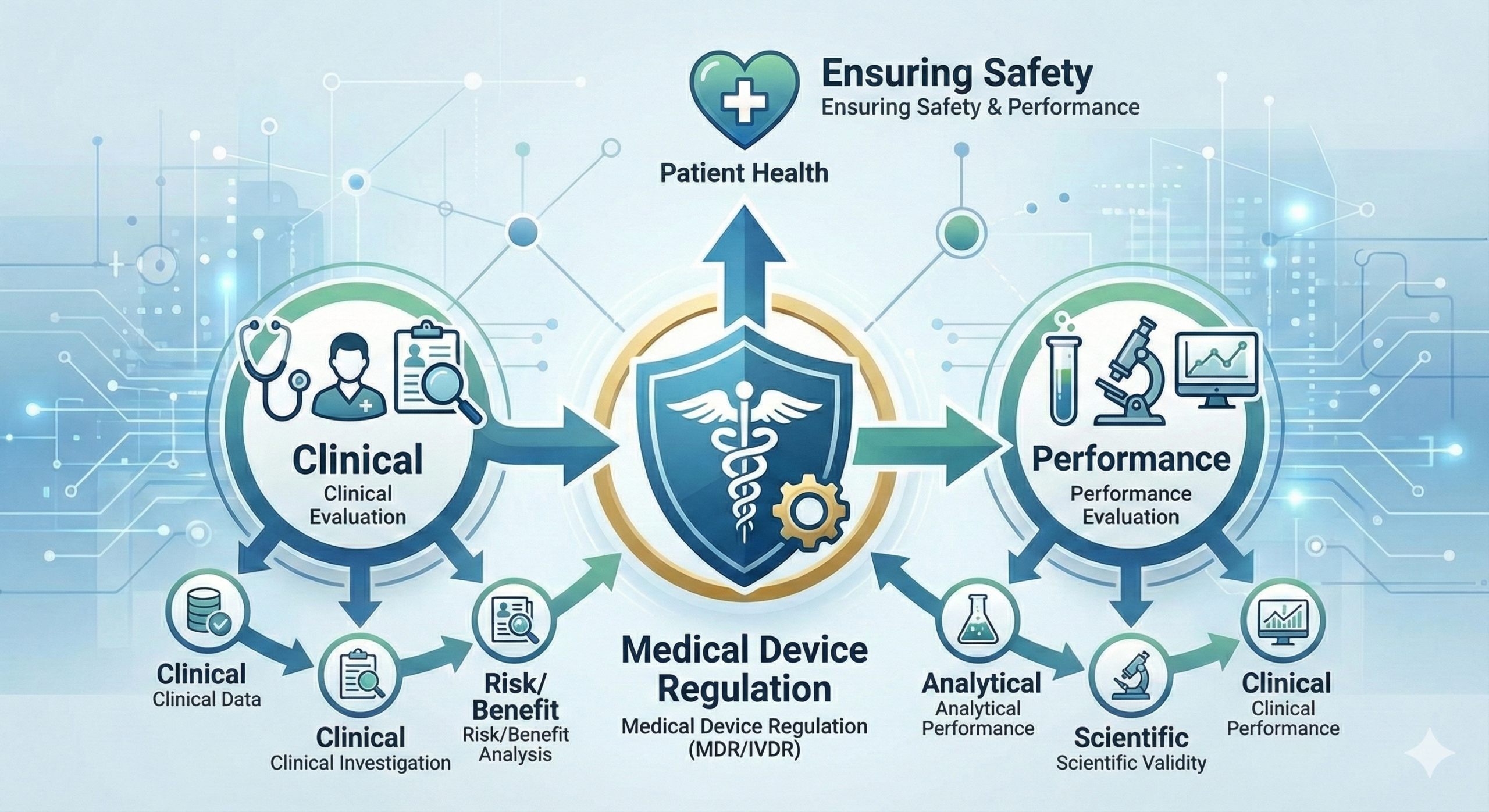
Clinical Evaluation and Performance Evaluation in Medical Device Regulation
A Comprehensive Overview of International Standards and Japanese Regulatory Requirements
Introduction
The development and regulatory submission of medical devices involve critical activities that demonstrate safety and performance to regulatory authorities and ultimately to patients. Two such activities are clinical evaluation and performance evaluation, which are often confused or used interchangeably, particularly in jurisdictions where regulatory guidance has not yet fully harmonized with international standards. Understanding the distinctions between these concepts, their regulatory requirements, and how they differ across jurisdictions is essential for manufacturers seeking to bring devices to market globally.
The development and regulatory submission of medical devices involve critical activities that demonstrate safety and performance to regulatory authori…
This article provides a comprehensive examination of clinical evaluation and performance evaluation as defined in ISO 13485:2016, explores how these concepts are applied in different regulatory frameworks, and clarifies Japanese regulatory requirements for medical device approval and certification.
ISO 13485:2016 Requirements for Design and Development Validation
ISO 13485:2016 is the international standard for quality management systems applicable to medical device manufacturers. Section 7.3.7, “Design and Development Validation,” establishes a fundamental requirement that is applicable across multiple regulatory jurisdictions. The standard requires the following:
“As part of design and development validation, the organization shall conduct clinical evaluation or performance evaluation of the medical device in accordance with applicable regulatory requirements.”
This requirement establishes that both medical devices and in vitro diagnostic devices (IVDs) must undergo some form of clinical or performance evaluation as part of the design validation phase. Notably, the standard uses different terminology for these two categories of products: clinical evaluation for medical devices and performance evaluation for IVDs.
An important regulatory distinction is that devices used for clinical evaluation or performance evaluation are not considered shipments for customer use. This means that clinical or performance evaluation devices operate under a different regulatory status and are not subject to the same market-release requirements as commercial products. Additionally, nonclinical testing, such as biocompatibility or shelf-life studies, constitutes part of design verification rather than design validation.
Clinical Evaluation
Clinical evaluation represents one of the most important concepts in medical device regulation. According to ISO 13485:2016, clinical evaluation is defined as follows:
“The evaluation and analysis of clinical data relating to a medical device to establish or verify the clinical safety and clinical performance when used as intended by the manufacturer.”
In essence, clinical evaluation is a structured assessment of clinical data that demonstrates both the efficacy and safety of a medical device when used in human subjects. This concept is rooted in the European Union’s self-certification approach to medical device regulation and has become increasingly harmonized globally through ISO 13485 adoption.
The rationale for clinical evaluation is straightforward: because medical devices are intended for use in human patients, demonstrating safety and effectiveness in human populations is inherently necessary. Clinical evaluation is therefore a mandatory component of medical device development and regulatory submission.
Approaches to Clinical Evaluation
Clinical evaluation can be conducted through multiple approaches, which manufacturers may combine to develop a comprehensive clinical evidence package. These approaches include literature evaluation, historical use data, adverse event reporting, marketing surveillance, and clinical trials.
Literature evaluation involves a systematic review and analysis of published clinical data from peer-reviewed journals, conference proceedings, and other scientific sources that are directly relevant to the intended use and patient population of the device. Historical use data provides evidence from the marketed use of the device in clinical practice, including accumulated experience with similar or predicate devices. Adverse event reporting, including post-market surveillance data and complaints from healthcare providers or patients, contributes to the overall safety profile. Marketing surveillance data reflects real-world usage patterns and any emerging safety signals. Finally, clinical trials represent prospective studies in which the device is used in actual patients under controlled conditions with informed consent.
Among these approaches, clinical trials, often referred to in Japan as “chiken” (clinical experiments), represent a distinctive category. These are prospective studies conducted in medical institutions where physicians or other healthcare professionals administer the device to actual patients. Clinical trials are conducted with informed patient consent and typically require institutional oversight through ethics committees or institutional review boards. The necessity of clinical trials depends on the device classification, intended use, and the existing clinical evidence base. Some devices may not require clinical trials if sufficient clinical data from other sources can adequately demonstrate safety and efficacy, while others may require prospective clinical trial data to support regulatory approval.
The scope and depth of clinical evaluation required is generally proportionate to the risk classification of the device. Higher-risk devices typically require more robust clinical data, while lower-risk devices may be supported by literature reviews and existing clinical experience.
Performance Evaluation
Performance evaluation is the parallel concept for in vitro diagnostic (IVD) devices. According to ISO 13485:2016, performance evaluation is defined as:
“The analysis and evaluation of data to establish or verify the ability of an in vitro diagnostic device to achieve its intended use.”
In vitro diagnostic devices are used to analyze samples taken from patients, such as blood, urine, saliva, or other bodily fluids, to provide information about disease status, health conditions, or other physiological states. Unlike medical devices, which are applied directly to the patient’s body, IVDs operate on biological samples removed from the body. The term “in vitro” literally means “in glass” (from the Latin “vitro”), referring to testing conducted outside the living organism, typically in laboratory environments such as test tubes or culture dishes.
The distinction between “in vitro” and “in vivo” is important: while “in vitro” refers to testing in laboratory settings outside the body, “in vivo” refers to testing or procedures conducted within living organisms. This linguistic distinction reflects a fundamental regulatory difference: IVDs typically present lower direct risks to patients than invasive medical devices, though they must still provide reliable and accurate diagnostic information.
Performance evaluation for IVDs typically includes analytical performance studies that establish accuracy, precision, analytical sensitivity, and analytical specificity, as well as clinical performance studies that verify the diagnostic accuracy of the device in the intended patient population. The depth of performance evaluation required generally correlates with the risk classification and clinical significance of the diagnostic result.
Clinical Evaluation and Performance Evaluation in Japanese Regulation
The regulatory landscape in Japan presents an interesting case of regulatory evolution and the ongoing process of harmonization with international standards. Japan’s current quality management system requirements for medical devices are established through the Pharmaceutical and Medical Device Agency (PMDA) regulations, which were primarily based on ISO 13485:2003 rather than the more recent ISO 13485:2016.
Because the Japanese regulatory framework was developed from the 2003 version of ISO 13485, the distinctions between clinical evaluation and performance evaluation are not as precisely defined as in the 2016 standard. Furthermore, the term “clinical evaluation” does not explicitly appear in Japan’s Pharmaceutical Affairs Law (PAL), also known as the Law for Securing Quality, Efficacy and Safety of Drugs and Medical Devices (PMDASIA). Therefore, clinical evaluation is not formally mandated as a specific regulatory requirement in Japanese law.
However, the Japanese regulatory framework does impose a mandatory requirement for “performance evaluation” (seino hyoka). According to the Basic Criteria for Medical Devices (Kijun criteria), Article 18 specifically requires that performance evaluation must be conducted for all medical devices, regardless of classification. This represents a broader definition of performance evaluation than that found in ISO 13485:2016, where performance evaluation is specifically applicable to IVDs.
Therefore, in the Japanese context, performance evaluation is best understood as a comprehensive concept that encompasses both nonclinical testing (such as biocompatibility, sterility, shelf-life, and mechanical properties) and clinical testing to comprehensively demonstrate that a device is safe and performs as intended. This broader interpretation means that performance evaluation in Japan includes not only the types of clinical data emphasized in ISO 13485:2016, but also the full spectrum of preclinical safety and performance testing.
Despite the absence of an explicit “clinical evaluation” requirement in Japanese law, manufacturers seeking approval for higher-risk devices (classified as Class III or IV, or subject to pre-market approval requirements) are required to submit clinical trial data or clinical evidence data as part of the manufacturing and marketing approval (MM approval) application. This requirement is specified in the PMDA’s guidance document “Concerning Manufacturing and Marketing Approval Applications for Medical Devices,” which establishes specific data submission requirements based on device type and classification.
Comparison of Regulatory Requirements Across Jurisdictions
| Framework | Clinical Evaluation | Performance Evaluation |
| ISO 13485:2016 | Mandatory for medical devices; assessment of clinical safety and efficacy in human subjects | Mandatory for IVDs; analysis of data to establish diagnostic accuracy and reliability |
| EU MDR (European regulations) | Explicitly required; comprehensive Clinical Evaluation Report (CER) required for approval | Applies to IVDs under IVDR; requirements parallel those for medical device clinical evaluation |
| FDA (United States) | Required through clinical data in premarket submissions (PMA or 510(k)); scope depends on device classification | IVD Clinical Laboratory Improvement Amendments (CLIA) validation and FDA submission requirements apply |
| Japanese PAL / PMDA | Not explicitly mandated in statute; however, clinical trial data required for Class III/IV devices and approval applications | Broadly defined and mandatory for all devices (Article 18, Basic Criteria); encompasses both nonclinical and clinical testing |
Determining the Necessity of Clinical Trials in Japan
In Japan, the determination of whether clinical trials are necessary for a particular medical device is governed by specific regulatory guidance. The PMDA has issued a detailed notification titled “Regarding the Scope of Clinical Trial Data Necessary for Medical Devices” (PMDA notification), which provides manufacturers with a systematic framework for making this determination.
Manufacturers should consult this guidance to evaluate whether their specific device requires prospective clinical trial data or whether adequate clinical evidence can be assembled from other sources, such as literature, post-market surveillance, or predicate device comparisons. The determination is typically made in consultation with the PMDA during the pre-application consultation process, which allows manufacturers to align their clinical evaluation strategy with regulatory expectations before submitting the formal approval application.
This collaborative approach has become increasingly important as Japan moves toward greater alignment with international standards while maintaining its distinctive regulatory framework and commitment to comprehensive device evaluation. Understanding both the global standards and Japan-specific requirements is therefore essential for manufacturers pursuing regulatory approvals in the Japanese market.
Conclusion
Clinical evaluation and performance evaluation are foundational concepts in medical device regulation that reflect the fundamental principle that devices intended for human use must be demonstrated to be safe and effective. While ISO 13485:2016 provides clear international definitions distinguishing clinical evaluation (for medical devices) from performance evaluation (for IVDs), Japanese regulations operate under a somewhat different framework rooted in ISO 13485:2003.
For manufacturers navigating the Japanese regulatory environment, understanding these distinctions and the specific requirements for clinical trial data submissions to the PMDA is critical for developing effective regulatory and clinical strategies. As Japan continues to evolve its regulatory framework toward greater international harmonization, these concepts will likely become more precisely aligned with ISO 13485:2016 definitions, though maintaining the distinct features of the Japanese regulatory system that have proven effective in protecting public health and ensuring device quality.
Related Articles
- The Importance of Clinical Evaluation in Medical Device Development
- Why Objective Evidence Matters: Performance Evaluation and Regulatory Requirements in Medical Devices
- Clinical Evaluation and Performance Evaluation
- Evaluation Standards for Medical Device Programs with Behavioral Intervention Components
- Procurement Management and QCD Evaluation in Medical Devices
- FMEA Must Not Be Used in Medical Device Design for Risk Evaluation Purposes
