
The European Commission’s Proposal for Extension of the IVDR Transition Period
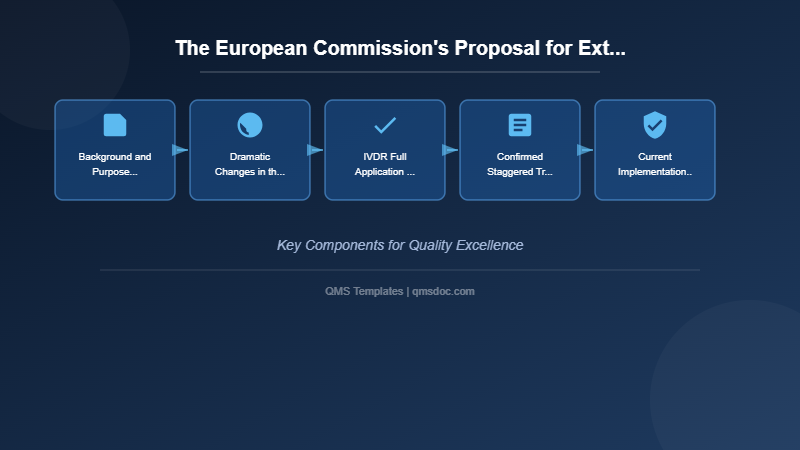
Background and Purpose of the Proposal
On October 14, 2021, the European Commission announced a proposal to extend the IVDR transition period. This measure was designed to ensure the continued supply of in vitro diagnostic devices (IVDs) within the EU while enabling a phased transition to the IVDR, taking into account multiple factors including the large number of products affected by the full application of IVDR, the insufficient number of designated Notified Bodies (NBs), and the restrictions on international travel due to the COVID-19 pandemic at that time. Under this proposal, a staged transition period was established for IVDs that had not required NB involvement under the IVDD, with different timelines specified according to device classification.
On October 14, 2021, the European Commission announced a proposal to extend the IVDR transition period. This measure was designed to ensure the contin…
Dramatic Changes in the Regulatory Environment Due to IVDR Implementation
The transition from IVDD to IVDR results in a dramatic increase in the number of products requiring NB certification. Under IVDD, approximately 8% of IVDs marketed in the EU required third-party assessment, whereas under IVDR, approximately 80% of IVDs marketed in the EU become subject to NB assessment. This nearly eighty-fold expansion represents an extremely significant transformation in the regulatory landscape for the IVD industry.
While the vast majority of products require new certification upon transition to IVDR, the initial challenge was the severe shortage of certification bodies. As of October 2021, only six Notified Bodies were designated, and all of them were located in just three countries (Germany, France, and the Netherlands). NB assessors must frequently travel abroad to conduct inspections at manufacturing facilities; however, such a small number of organizations would find it practically impossible to process thousands of new certification applications.
The combination of a large number of products requiring new certification and the restriction on international travel during the COVID-19 pandemic made it clear that without proper measures, there was a high risk of significant disruption to the stable supply of IVDs to the EU market. This proposal aimed to achieve a smooth transition to IVDR by establishing staggered transition periods according to device classification, ensuring uninterrupted supply of IVDs to the EU market, while also providing an opportunity to increase the number of NBs during the transition period.
IVDR Full Application Date and Immediate Implementation of Key Requirements
An important point to note is that the full application date of IVDR (May 26, 2022) remains unchanged. However, it is crucial to recognize that the following requirements apply immediately from the IVDR full application date, regardless of the transition period status of individual IVDs.
Post-market surveillance constitutes a systematic process of continuously monitoring the safety and effectiveness of products after market placement, collecting, analyzing, and reporting data on adverse events. Vigilance requirements mandate that serious adverse events or device defects reported by healthcare professionals and patients be received and addressed promptly.
The registration system for economic operators (manufacturers, importers, and distributors) requires all parties conducting business in the EU market to register with EUDataBank, administered by the European Medicines Agency (EMA). The device registration system requires that basic information about all IVDR-applicable IVDs be registered in a designated database.
It is equally important to emphasize that even IVDs that do not require NB involvement must achieve full compliance with IVDR regulatory requirements starting from May 26, 2022. This encompasses the implementation of quality management systems, preparation of technical files, risk management, performance evaluation, and creation of labeling and instructions for use. The transition period represents a grace period limited solely to obtaining third-party certification by an NB; compliance of the device itself with IVDR requirements remains an absolute requirement throughout the transition period.
Confirmed Staggered Transition Schedule
Based on the European Commission’s proposal, the following staggered transition schedule has been established. It is important to note that all IVDs in the respective classes must achieve full IVDR compliance by the deadline for each phase; once a deadline passes, IVDD certifications expire, and market placement becomes impossible thereafter.
The complete application deadline for IVDs classified as Class D is May 26, 2025. Class D typically encompasses low-risk products with minimal regulatory requirements.
The complete application deadline for IVDs classified as Class C is May 26, 2026. Class C includes moderate-risk products.
The complete application deadline for IVDs classified as Class B is May 26, 2027. Class B encompasses moderate to high-risk products, including some high-risk devices.
The complete application deadline for Class A IVDs supplied in sterile condition is also May 26, 2027. While Class A typically contains products with minimal regulatory requirements, devices supplied in sterile condition entail additional requirements, necessitating a separate deadline.
Current Implementation Status and Outlook
This proposal has been approved by the European Parliament and the Council, making the current transition schedule an established regulatory requirement. The post-market surveillance and vigilance requirements that came into force immediately on May 26, 2022 have become increasingly understood by manufacturers through several years of implementation experience, deepening overall industry knowledge of IVDR requirements.
The number of designated NBs has increased from the initial six organizations identified in 2021; however, the situation remains one of shortage relative to industry-wide needs. Current information on designated NBs is made publicly available through the NANDO (New Approvals Notified and Designated Authorities) system operated by the European Medicines Agency, and regular consultation of this database is essential.
With the Class D deadline of May 26, 2025 rapidly approaching, manufacturers of Class D devices face an urgent need for action; missing this deadline would result in withdrawal of Class D products from the EU market. Manufacturers that achieve transition compliance early may gain advantages in regulatory relationships and NB selection, positioning themselves favorably in the competitive landscape.
Related Articles
- Public Comment Period for Revised Guideline on Quality Risk Management
- Why the Transition from CSV to CSA is Necessary
- What are EN Standards (European Norm)?
- The Transition from Medical Device GMP to QSR: Background and Rationale
- The Latest Timeline and Implementation Status of the Medical Device Regulation (MDR) and In Vitro Diagnostic Regulation (IVDR)
- MDCG 2021-13 MDR第31条およびIVDR第28条の対象となる製造業者、欧州代理人および輸入業者以外の関係者のEUDAMEDへの登録に関する義務および関連規則に関する質問と回答
