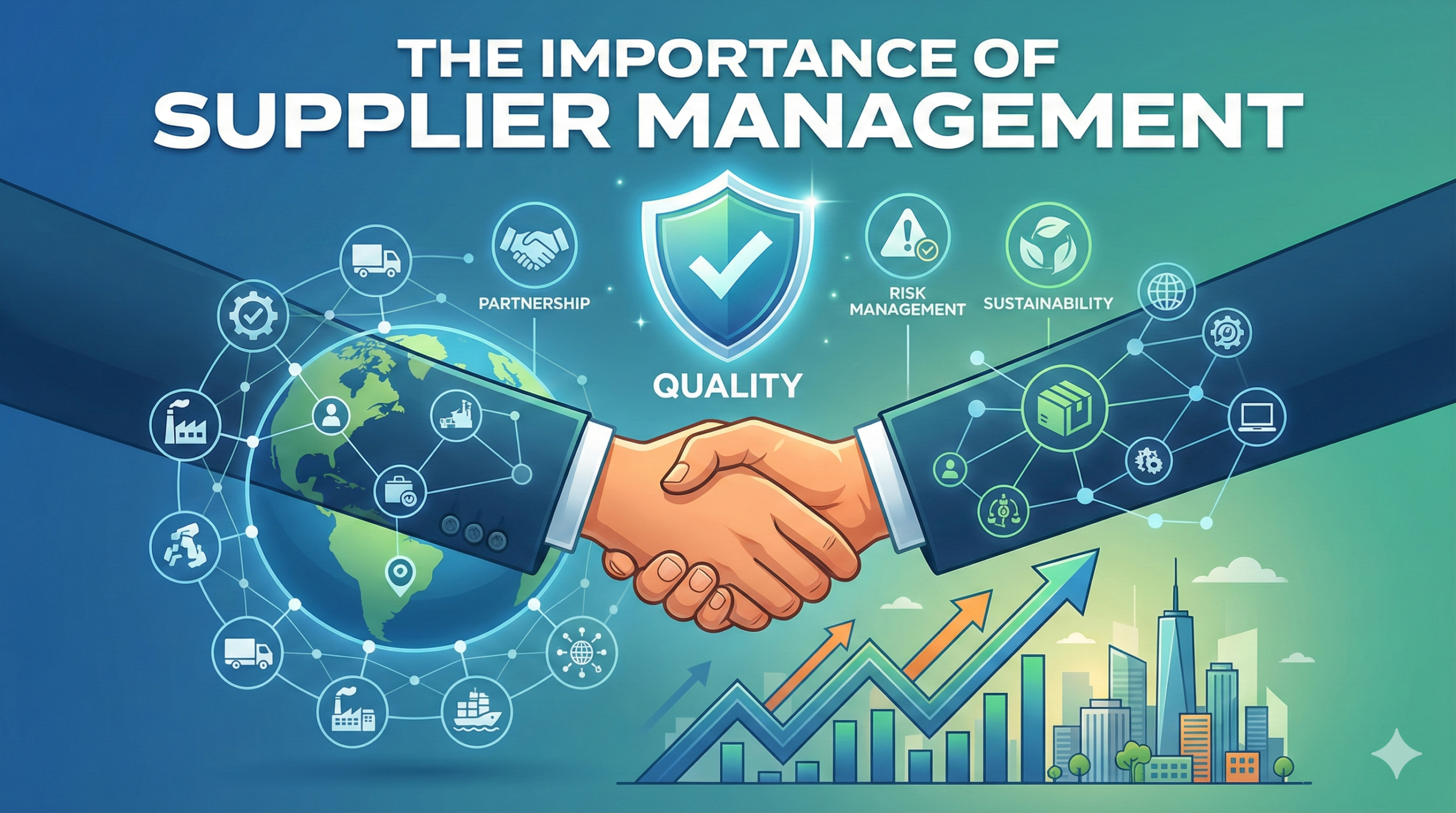
The Importance of Supplier Management
Introduction
Products manufactured by companies contain various purchased materials and components. The purchasing process is a critical process for ensuring the quality of these purchased products. For pharmaceutical companies, risk management is essential when importing active pharmaceutical ingredients (APIs) and other critical materials.
Overview of the Purchasing Process
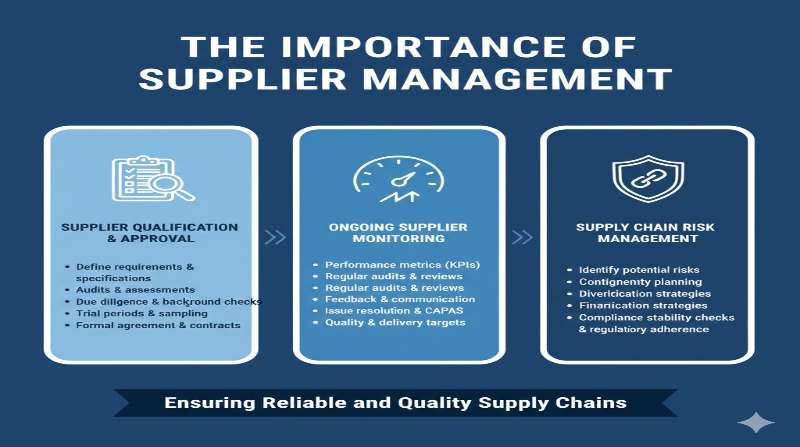
The purchasing process generally proceeds as illustrated in the following framework:
1. Supplier Evaluation
New potential suppliers undergo comprehensive evaluation. Audits are conducted as necessary to verify compliance with quality management system requirements. This evaluation should assess the supplier’s quality management system (QMS) implementation, documented procedures, and overall capability to meet specified requirements consistently.
According to ISO 9001:2015 Clause 8.4 and the anticipated ISO 9001:2026 revision, organizations must determine and apply appropriate criteria for the evaluation and selection of external providers based on their ability to provide processes, products, or services in accordance with requirements. For pharmaceutical companies, this aligns with ICH Q7 Good Manufacturing Practice Guidance for Active Pharmaceutical Ingredients, which provides the globally recognized standard for API manufacturing.
2. Supplier Selection
Based on the evaluation results, suppliers are selected and contracts are established. The selection should be documented, showing clear evidence of how the supplier met the established criteria. Supplier qualification documentation should be retained as part of the quality records.
3. Purchasing
Purchase information is communicated clearly to the supplier, and product procurement is executed. ISO 9001:2015 Clause 8.4.3 requires organizations to communicate their requirements to external providers, including:
- Products and services to be provided
- Approval or release of products and services
- Competence requirements, including necessary qualifications of persons
- Interactions between the organization and the external provider
- Control and monitoring of the external provider’s performance
- Verification or validation activities that the organization or its customer intends to perform at the external provider’s premises
4. Monitoring and Performance Management
Incoming inspection of purchased products is performed. When quality issues arise, a Supplier Corrective Action Request (SCAR) is issued to demand quality improvements. The SCAR process is a formal mechanism used extensively in regulated industries, including pharmaceuticals and medical devices, to address non-conformances systematically.
The SCAR process typically includes:
- Problem Identification: Clear documentation of the non-conformance with supporting evidence
- Root Cause Analysis: The supplier must investigate and identify the underlying cause(s)
- Corrective Action Plan: Development of specific actions to address the root cause
- Preventive Measures: Implementation of controls to prevent recurrence
- Verification: Follow-up to confirm effectiveness of corrective actions
Progress on improvement initiatives should also be monitored continuously. Additionally, compliance with contractual obligations such as delivery schedules should be verified as necessary. Ongoing monitoring may include tracking key performance indicators (KPIs) such as on-time delivery rate, defect rate, and response time to quality issues.
5. Re-evaluation
Suppliers are periodically re-evaluated and reviewed on a regular basis. Supplier audits are conducted when necessary. The frequency of re-evaluation should be risk-based, with critical suppliers or those with quality issues receiving more frequent assessments. ISO 9001 requires organizations to retain documented information as evidence of supplier evaluation results and any necessary actions arising from the evaluations.
Supplier Evaluation Methodology
Suppliers must be selected appropriately based on the results of supplier evaluation and audit. Many companies develop supplier evaluation forms for this purpose.
At a minimum, supplier evaluation must assess Quality, Cost, and Delivery (QCD):
Quality
Quality is the primary consideration. It must be verified that the supplier has established a Quality Management System (QMS) and maintains appropriate records. For pharmaceutical suppliers, compliance with Good Manufacturing Practices (GMP) is mandatory. ICH Q7 specifies that API manufacturers must maintain a quality unit independent of production, with responsibility for approving or rejecting materials and ensuring investigations are conducted.
For suppliers with existing delivery track records, results from previous incoming inspections should be incorporated into the evaluation.
Cost
Cost represents pricing. Generally, quality and price are correlated—higher quality tends to command higher prices. However, costs must be controlled as much as possible. The evaluation should consider total cost of ownership, not just unit price, including factors such as quality costs (rework, scrap, warranty), transportation costs, and inventory carrying costs.
Delivery
Delivery refers to adherence to delivery schedules. Even if quality and cost meet requirements, problems arise if delivery deadlines are not met. Delivery reliability affects production planning, inventory management, and ultimately customer satisfaction.
The critical principle is achieving an appropriate balance among Quality, Cost, and Delivery.
Common Evaluation Mistakes to Avoid
In companies I have audited, there are not infrequently cases where Quality, Cost, and Delivery scores are totaled, and suppliers are approved if they exceed a certain threshold.
For example, a supplier might pass even with poor quality if costs are low and delivery schedules are met. This approach is fundamentally flawed.
In principle, all three factors—Quality, Cost, and Delivery—must individually exceed the established minimum standards.
Summing Quality, Cost, and Delivery scores is equivalent to adding together height, weight, and blood pressure—it produces a meaningless number that obscures critical deficiencies in any single area.
Best Practices for Supplier Evaluation
To implement effective supplier evaluation:
Establish Clear Minimum Thresholds
Set minimum acceptable scores for each of the QCD criteria independently. A supplier must meet or exceed all three minimum thresholds to be approved. This ensures that deficiencies in one area cannot be compensated by strengths in another.
Use Weighted Scoring Appropriately
After confirming that all minimum thresholds are met, weighted scoring can be used to differentiate among qualified suppliers. For example:
| Criterion | Minimum Threshold | Weight | Example Score | Weighted Score |
| Quality | 70% | 50% | 85% | 42.5 |
| Cost | 60% | 30% | 75% | 22.5 |
| Delivery | 65% | 20% | 90% | 18.0 |
| Total | All must pass | 100% | – | 83.0 |
Risk-Based Approach
The level of evaluation rigor should correspond to the criticality and risk associated with the purchased item. Critical materials such as APIs or components affecting patient safety require more stringent evaluation than general office supplies.
Document and Review
All evaluation criteria, scoring methods, and decisions must be documented. Regular review of the evaluation process ensures it remains effective and aligned with current regulations and organizational needs.
Current Regulatory Trends and Standards
ISO 9001:2026 Revision
The revision of ISO 9001 is currently underway, with the Draft International Standard (DIS) issued in August 2025 and final publication expected around September 2026. Expected refinements include:
- Enhanced supplier and lifecycle assurance language
- Stronger integration of risk management into supplier selection
- Greater emphasis on supply chain resilience and digital supply chains
- Sustainability and Environmental, Social, and Governance (ESG) considerations
Pharmaceutical Industry Standards
For pharmaceutical companies:
- ICH Q7: Remains the global standard for API GMP
- ICH Q10: Pharmaceutical Quality System provides the framework for managing quality throughout the product lifecycle
- FDA 21 CFR Part 211: Current Good Manufacturing Practice for Finished Pharmaceuticals requires identity testing of components from each supplier
Industry-Specific Initiatives
Organizations such as Rx-360 (The International Pharmaceutical Supply Chain Consortium) have developed practical guidance for SCAR programs, providing standardized templates and best practices specifically for the pharmaceutical industry.
The USP Ingredient Verification Program for APIs offers third-party verification of API quality, helping pharmaceutical companies qualify suppliers and reduce inspection costs.
Conclusion
Effective supplier management extends beyond simple procurement—it is a strategic quality function that directly impacts product quality, regulatory compliance, and business success. By implementing rigorous evaluation methodologies that properly assess Quality, Cost, and Delivery as independent criteria, and by maintaining ongoing monitoring and improvement processes including SCAR when necessary, organizations can build resilient supply chains that consistently deliver high-quality products.
The key principles to remember:
- Never compromise on quality—it cannot be offset by low cost or good delivery
- Evaluate Quality, Cost, and Delivery independently against minimum thresholds
- Implement risk-based approaches appropriate to the criticality of purchased materials
- Maintain robust documentation and regular re-evaluation
- Stay current with evolving regulatory requirements and industry standards
Related Articles
- Is Senior Management Responsible for GMP Compliance?
- The Importance of Supplier Management (Revised Edition)
- The Future of Japan’s GDP (Good Distribution Practice)
- Revision of Japan’s GMP Ministerial Ordinance
- Quality Manuals in Pharmaceutical Manufacturing: A Comprehensive Guide
Related FDA QMSR Templates
Streamline your FDA QMSR compliance with our professionally crafted templates: