
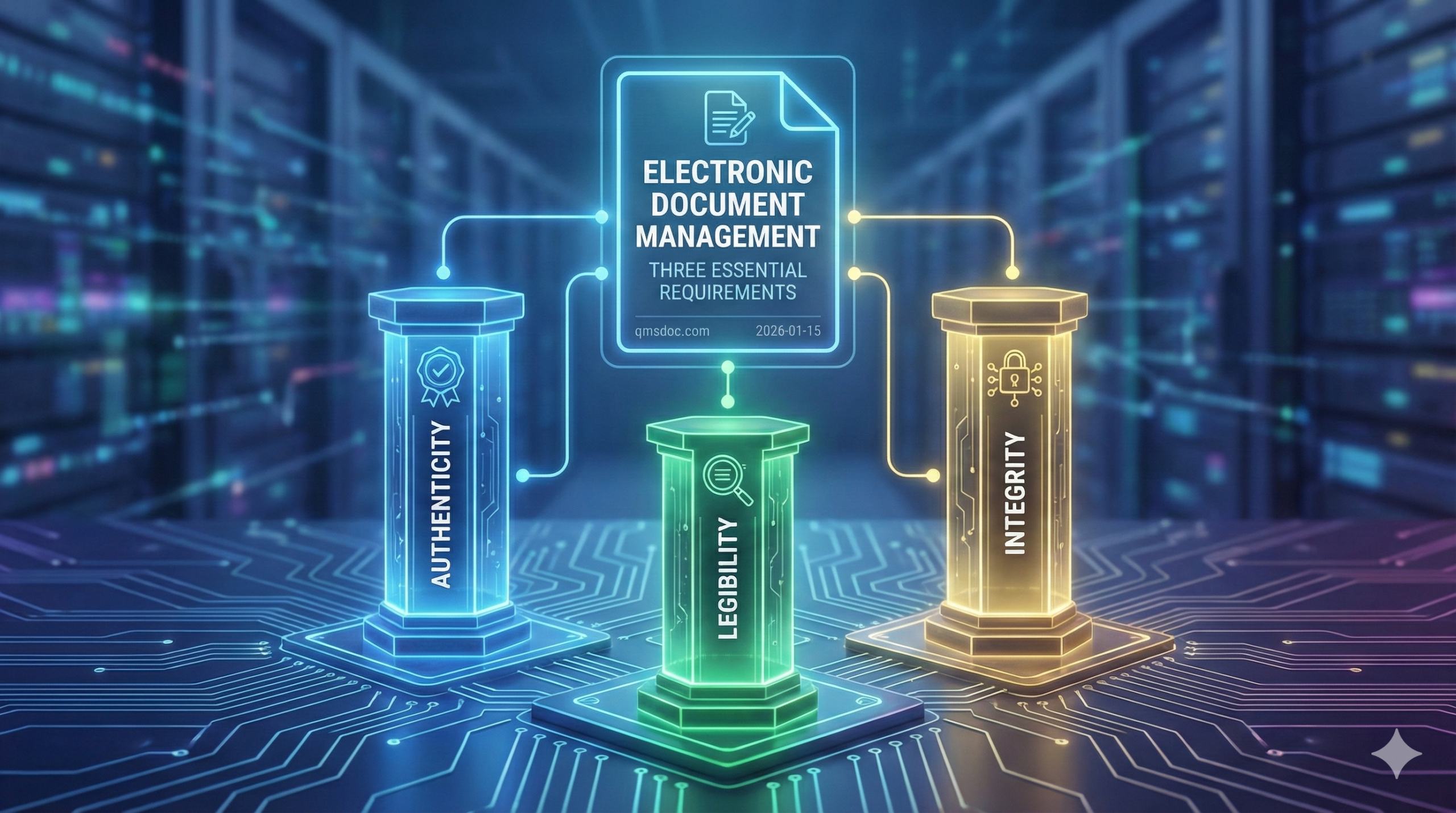
Authenticity, Legibility, and Integrity: The Three Essential Requirements for Electronic Document Management
Introduction
When companies digitize documents, simply going paperless is not sufficient. Particularly for documents that require legal evidentiary capability or those subject to mandatory long-term retention, it is necessary to meet the three requirements set forth in the “ER/ES Guidelines”: authenticity, legibility, and integrity. As of 2025, with the promotion of Digital Transformation (DX) and revisions to laws such as the Electronic Book Preservation Act in Japan, the importance of electronic document management has reached unprecedented levels. This article explains what these requirements mean and why they are important in a manner accessible to beginners.
Understanding the ER/ES Guidelines
The ER/ES Guidelines refer to the “Guidelines for the Safety Management of Medical Information Systems” established by Japan’s Ministry of Health, Labour and Welfare as guidelines for handling digitized medical information. While the concept originated in the medical field, its principles have been widely applied to general corporate document management. ER stands for “Electronic Records” and ES stands for “Electronic Signatures.”
The three requirements emphasized by these guidelines serve as standards for ensuring that electronic documents possess the same reliability as paper documents. Paper documents exist physically, and tampering leaves traces. However, electronic data can be easily copied or modified, so without intentionally designed mechanisms, their reliability cannot be guaranteed.
It should be noted that similar principles have been adopted internationally. The ISO 15489 series (Records Management) and ISO/IEC 27001 (Information Security Management) incorporate comparable requirements for electronic record keeping. In the United States, regulations such as 21 CFR Part 11 (FDA regulations for electronic records) and the Uniform Electronic Transactions Act (UETA) address similar concerns.
Authenticity: Proving “This is Genuine”
What is Authenticity?
Authenticity refers to the property that ensures an electronic document was “created by a person with legitimate authority and has not been tampered with.” Simply put, it means being able to prove “this document is genuine.”
With paper documents, creators could be identified and tampering detected through seals, signatures, and handwriting. For electronic documents, mechanisms equivalent to these must be technically implemented.
Concrete Methods for Ensuring Authenticity
Representative technologies for ensuring authenticity include the following:
Utilization of Electronic Signatures
This is a technology that proves the creator’s identity and guarantees that the document has not been tampered with. By using electronic certificates, it becomes possible to clarify who created or approved the document and when. Modern electronic signature technologies comply with standards such as the eIDAS regulation in the European Union and the ESIGN Act in the United States. Advanced Electronic Signatures (AdES) and Qualified Electronic Signatures (QES) provide different levels of legal recognition depending on the jurisdiction.
Application of Time Stamps
This is a technology that proves a document existed at a specific time. By applying a time stamp issued by a trusted third-party authority, it is possible to prove that the document has not been tampered with since that point in time. Time stamp authorities typically comply with RFC 3161 standards and provide cryptographic proof using protocols like TSA (Time Stamp Authority) services. In Japan, time stamp services are provided by organizations accredited by the Ministry of Internal Affairs and Communications.
Access Rights Management
Operations such as creating, viewing, editing, and deleting documents are restricted to only those with authority. By recording operation logs, it becomes possible to track who did what and when. Modern systems implement role-based access control (RBAC) and attribute-based access control (ABAC) to provide granular permission management. Audit trails should be immutable and tamper-evident, often using blockchain or similar technologies for enhanced security.
Blockchain Technology
Increasingly, organizations are adopting blockchain-based solutions for document authentication. By storing document hashes on a distributed ledger, companies can create an immutable record of document existence and integrity. This approach is particularly valuable for multi-party transactions and cross-border business operations.
Risks When Authenticity is Lacking
Electronic documents without ensured authenticity may not be recognized as evidence when legal disputes arise. For example, if it cannot be proven that a contract has not been tampered with, you may find yourself in a disadvantageous position in disputes with business partners. Additionally, if the authenticity of electronic books is questioned during a tax audit, there is a risk of additional taxation. In recent years, courts have increasingly scrutinized the authenticity mechanisms of electronic evidence, making robust authentication systems essential for legal admissibility.
Legibility: Maintaining an “Always Readable” State
What is Legibility?
Legibility refers to the property that ensures electronic documents can be “displayed and output in a human-readable form, in the necessary format, when needed.” For example, imagine data saved on floppy disks. In modern times, floppy drives no longer exist, and the data cannot be read.
Furthermore, data created in MS-Excel 97 cannot be reliably opened in current versions of MS-Excel without potential formatting issues or data loss. This illustrates a critical point: it is not sufficient for data to merely exist; it must be maintained in a state where it can be properly viewed.
Concrete Methods for Ensuring Legibility
Adoption of Standardized File Formats
Rather than proprietary formats that can only be opened by specific software, data should be saved in standard formats such as PDF/A, XML, or CSV that are viable for long-term use. Even if software support ends in the future, the likelihood of being able to read the data remains high.
The PDF/A standard (ISO 19005) is specifically designed for long-term archiving and is widely accepted by regulatory authorities worldwide. For structured data, formats like XML with documented schemas or JSON provide better longevity than proprietary binary formats. The Library of Congress maintains a registry of recommended formats for different content types, which serves as an excellent reference for format selection.
Implementation of Search Functionality
Search functions should be established that enable rapid retrieval of necessary information from large volumes of electronic documents. When specific transaction records are requested during a tax audit, a system must be in place to promptly present them. Modern search capabilities should include full-text search, metadata-based filtering, and faceted navigation. Advanced systems incorporate natural language processing and AI-powered semantic search to improve document discovery.
Support for Both Screen Display and Printed Output
It is necessary to maintain a state where documents can not only be viewed on system screens but also printed on paper and submitted when necessary. During audits or investigations, counterparties may request paper submissions. However, it is important to note that regulatory trends are increasingly moving toward accepting electronic-only submissions, particularly in jurisdictions with advanced digital governance frameworks.
Resolution and Quality Standards
Documents must be readable at appropriate resolution levels. For scanned documents, minimum resolution standards typically range from 200 to 300 DPI (dots per inch) depending on the content type. Color depth, contrast ratios, and text clarity must meet industry standards to ensure long-term legibility.
Risks When Legibility is Lacking
When legibility is lost, data exists but becomes “unreadable.” For example, there are cases where electronic books saved in a proprietary format 10 years ago cannot be opened due to the developer’s bankruptcy. For documents with legally mandated retention periods, loss of legibility can constitute a legal violation and may result in penalties. In 2024, several companies faced regulatory sanctions specifically due to their inability to produce readable records during audits, highlighting the real-world consequences of poor legibility management.
Integrity: Creating a Mechanism to “Reliably Preserve”
What is Integrity?
Integrity refers to the property that ensures electronic documents can be “stored safely and reliably for the required period.” It requires preventing data loss and degradation and maintaining a usable state over the long term. In information security contexts, integrity also encompasses protection against unauthorized modification, complementing the authenticity requirement.
Concrete Methods for Ensuring Integrity
Establishing a Backup System
Data should be backed up regularly and stored in multiple distributed locations. A system should be established that enables recovery even if data is lost due to server failures or ransomware attacks. Modern backup strategies follow the 3-2-1 rule: maintain at least three copies of data, store two backup copies on different storage media, and keep one copy off-site. Cloud-based backup solutions with geo-redundancy provide additional protection against regional disasters.
Advanced backup systems implement the 3-2-1-1-0 rule, which adds one offline/air-gapped copy and zero errors in backup verification. This approach has become particularly important given the rise in ransomware attacks targeting backup systems.
Regular Migration of Media
Storage media (hard disks, SSDs, optical discs, etc.) have limited lifespans. By regularly migrating data to new media, data loss due to physical degradation can be prevented. Industry standards suggest migrating critical data every 3-5 years for magnetic media and every 5-7 years for optical media. Organizations should maintain a media migration schedule as part of their records management policy.
Additionally, the concept of “bit rot” or silent data corruption has gained attention. Modern storage systems should implement regular integrity checking through checksums, hash verification, or error-correcting codes to detect and correct corruption before it becomes catastrophic.
Management of Retention Periods
Retention periods mandated by law should be accurately understood, and storage should be ensured until the period expires. Simultaneously, rules should be established for appropriately disposing of documents once their retention period has passed. Retention schedules vary significantly by document type and jurisdiction:
| Document Type | Typical Retention Period (Japan) | International Comparison |
| Tax documents | 7 years (10 years for certain items) | EU: Varies by country (generally 5-10 years) |
| Corporate books | Permanent | US: Permanent for certain corporate records |
| Personnel records | 3-5 years after employment ends | US: Varies (EEOC records: 1 year minimum) |
| Financial statements | 10 years | EU/US: Generally 7-10 years |
| Contracts | 5 years after contract end | Varies by contract type and jurisdiction |
Cryptographic Hash Verification
Modern integrity preservation systems employ cryptographic hash functions (such as SHA-256 or SHA-3) to create digital fingerprints of documents. These hashes can be periodically recalculated and compared against the original to detect any unauthorized changes or data corruption. Hash values can be stored in tamper-evident logs or blockchain systems for additional security.
Risks When Integrity is Lacking
Without ensured integrity, data loss not only constitutes a legal violation but can also develop into a corporate credibility issue. For example, if transaction records with customers are lost, it becomes impossible to prove past contract contents, increasing litigation risks. Additionally, data loss due to disasters or cyberattacks can threaten business continuity itself.
In 2023-2024, several high-profile cases demonstrated the severe consequences of inadequate integrity measures. Companies that lost customer data due to inadequate backup systems faced not only regulatory penalties but also significant reputational damage and customer lawsuits. The average cost of a data breach, according to IBM’s 2024 report, exceeded $4.5 million globally, with much of this cost stemming from inadequate integrity preservation measures.
Interrelationship of the Three Requirements
Authenticity, legibility, and integrity are not independent requirements but are interrelated. Even if authenticity is ensured, without legibility, documents cannot be verified and become meaningless. If integrity is lacking, data does not exist in the first place, so neither authenticity nor legibility become issues.
Only by satisfying all three requirements in a balanced manner does an electronic document management system become highly reliable. If even one is missing, there is a possibility of legal or operational risks arising.
The following table illustrates how these requirements work together:
| Scenario | Authenticity | Legibility | Integrity | Outcome |
| Proper implementation | ✓ | ✓ | ✓ | Reliable system |
| Missing authenticity | ✗ | ✓ | ✓ | Cannot prove document genuineness |
| Missing legibility | ✓ | ✗ | ✓ | Cannot access or read documents |
| Missing integrity | ✓ | ✓ | ✗ | Documents may be lost |
| Missing multiple requirements | ✗ | ✗ | ✗ | System failure |
Practical Implementation Approach
Step 1: Review Current Document Management Systems
First, identify which documents are being digitized within your organization and what documents have legally mandated retention periods. Evaluate whether the current management methods satisfy the three requirements and clarify issues. This assessment should include:
- Inventory of all document types and their current storage methods
- Gap analysis comparing current state to regulatory requirements
- Risk assessment identifying high-priority areas for improvement
- Stakeholder interviews to understand practical usage patterns
Step 2: Implement Measures with Priorities
It is difficult to bring all documents to a perfect state at once. Measures should be implemented with priority given to documents with high legal risk or high operational importance. For example, start with documents that serve as evidence of transactions, such as contracts and invoices.
A typical prioritization matrix might consider:
High Priority: Legal/regulatory documents, financial records, contracts, intellectual property documentation
Medium Priority: Operational records, correspondence with external parties, project documentation
Low Priority: Internal memos, routine communications, temporary working files
Step 3: Establish a Continuous Improvement System
Electronic document management is not finished once constructed. It is important to respond to technological evolution and legal revisions and conduct regular reviews. Additionally, continuous employee education should be implemented to maintain appropriate operation throughout the organization.
Modern electronic document management systems should incorporate:
- Regular audits of the three requirements (recommended: at least annually)
- Technology refresh cycles to adopt new security and storage technologies
- Training programs for employees on proper document handling
- Incident response plans for data breaches or system failures
- Compliance monitoring dashboards for real-time visibility
Emerging Technologies and Future Trends
As of 2025, several emerging technologies are transforming how organizations approach the three requirements:
Artificial Intelligence and Machine Learning
AI-powered systems can automatically classify documents, detect anomalies that might indicate tampering, and optimize storage strategies based on usage patterns. Natural language processing enables sophisticated search capabilities that improve legibility for large document repositories.
Quantum-Resistant Cryptography
With quantum computing on the horizon, organizations are beginning to implement quantum-resistant cryptographic algorithms to ensure long-term authenticity and integrity of documents that must be preserved for decades.
Decentralized Storage Systems
Technologies like IPFS (InterPlanetary File System) and decentralized cloud storage provide new approaches to ensuring integrity through distributed, redundant storage without reliance on single providers.
Zero-Knowledge Proofs
These cryptographic techniques allow verification of document authenticity without revealing the document contents, enabling privacy-preserving compliance with regulatory requirements.
Regulatory Landscape in 2025
The regulatory environment for electronic documents continues to evolve globally:
Japan: The Electronic Book Preservation Act amendments of 2024 have further relaxed requirements for small and medium enterprises while strengthening accountability for large corporations. The tax authority now accepts cloud-based storage with appropriate controls.
European Union: The eIDAS 2.0 regulation, fully implemented in 2024, has established a framework for European Digital Identity and trust services, significantly impacting how electronic documents are authenticated and preserved across member states.
United States: Various sector-specific regulations (healthcare HIPAA, financial SOX, etc.) continue to evolve. The increasing adoption of state-level privacy laws has created additional complexity for document retention and integrity requirements.
International Standards: ISO 15489-1:2024 (Records Management) provides updated guidance on managing electronic records in cloud environments and addresses AI-generated content management.
Conclusion
The three requirements of authenticity, legibility, and integrity form the foundation for electronic documents to possess reliability equivalent to paper documents. By ensuring these three, it becomes possible to achieve both efficiency through digitization and compliance.
As of 2025, with the evolution of AI and cloud technologies, the technical hurdles to meeting these requirements have lowered. However, technology alone is insufficient; it is required that the entire organization understand the importance of electronic document management and establish appropriate operational rules.
Digitization is a means, not an end. By satisfying the essential requirements of authenticity, legibility, and integrity, electronic documents become not merely data but important assets supporting corporate credibility. In the era ahead, the quality of electronic document management will be one of the factors determining corporate competitiveness.
Organizations that invest in robust electronic document management systems aligned with the three requirements will find themselves better positioned to navigate regulatory audits, legal challenges, and business transformation initiatives. The cost of implementation is increasingly viewed not as an expense but as an investment in organizational resilience and operational excellence.
The convergence of regulatory requirements, technological capabilities, and business needs has created an environment where excellence in electronic document management is no longer optional but essential for organizational success. Companies that recognize this reality and act decisively to implement comprehensive solutions addressing authenticity, legibility, and integrity will gain significant competitive advantages in the digital economy of 2025 and beyond.

Comment