
Fundamental Concepts of Large Language Models (LLMs)
As of 2025, Large Language Models (LLMs) are rapidly permeating our daily lives and business environments. However, surprisingly few people have an accurate understanding of “what LLMs really are.” This article provides an accessible yet professionally informed explanation of fundamental LLM concepts for both beginners and those seeking deeper insights.
Understanding LLMs: Their Essential Nature
Definition and Basic Structure
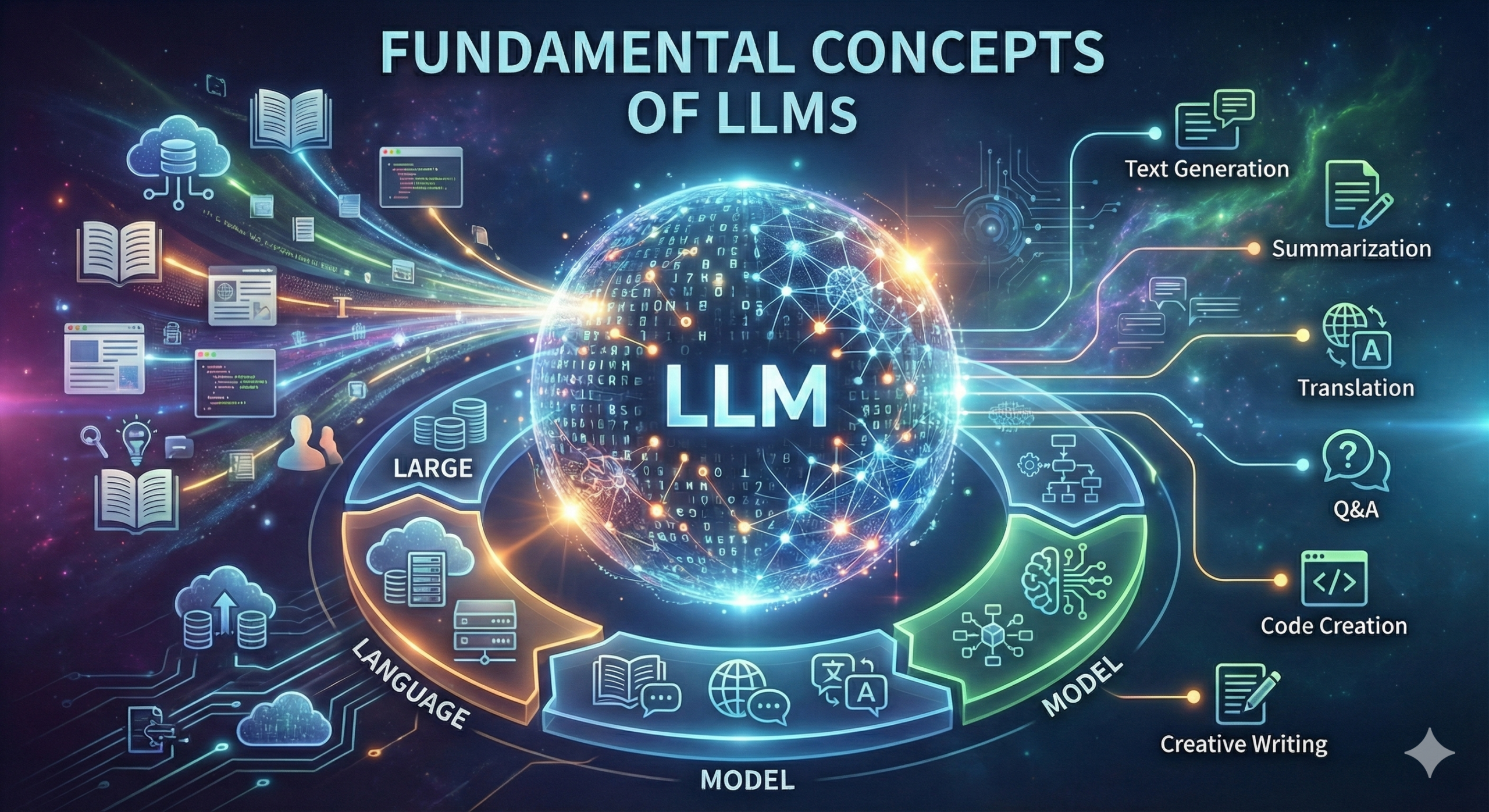
An LLM is an artificial intelligence system trained on vast amounts of text data. As the name suggests, it consists of three elements: “Large,” “Language,” and “Model.”
Specifically, by learning from hundreds of billions to trillions of tokens (minimal units such as words and symbols) from sources including internet text, books, and academic papers, LLMs achieve human-like natural language generation and comprehension. This process resembles how humans acquire language abilities through extensive linguistic exposure from early childhood.
As of 2025, representative LLMs include OpenAI’s GPT-4 and GPT-4.5, Anthropic’s Claude (Opus, Sonnet, and Haiku variants), Google’s Gemini series, and Meta’s Llama models. These models differ in parameter count, training methodologies, and specialized capabilities, but all share the fundamental architecture of large-scale language modeling.
Distinction from Traditional AI
Traditional AI systems were “specialists” dedicated to specific tasks. For example, translation AI performed only translation, and image recognition AI only image recognition. In contrast, LLMs can be considered “versatile generalists” with comprehensive language capabilities.
The revolutionary characteristic of LLMs is their ability to handle a wide range of language-related tasks—including document creation, summarization, translation, programming, data analysis, and question answering—within a single model.
How LLMs Work: Their Functional Mechanisms
Transformer Architecture
Most modern LLMs are built upon a technical foundation called the “Transformer.” This technology, introduced in 2017, enabled efficient learning of relationships between words within text.
The core of the Transformer is the “attention mechanism.” This is a system that automatically determines which words in a sentence are strongly related to which other words. For example, in the sentence “He went to the bank,” it can determine from context whether “bank” refers to a financial institution or a riverbank.
(Note: In Japanese, “ginko” (銀行) can mean both “bank” (financial institution) and “riverbank,” though the latter usage is extremely rare in modern Japanese, where “kashi” (河岸) or “kawagishi” (川岸) are typically used instead.)
Learning Process
LLM training proceeds primarily through the following stages:
Pre-training Phase: This is the stage where the model learns fundamental language patterns and knowledge from massive text datasets. During this phase, the model repeatedly performs the task of predicting the next word in a sentence, thereby acquiring statistical regularities of language.
Fine-tuning Phase: This stage involves further adjusting the model for specific applications or quality standards. For example, techniques such as Reinforcement Learning from Human Feedback (RLHF) are employed to generate more human-like responses.
In recent years, additional training methodologies have gained prominence, including Constitutional AI (a framework for training AI systems according to specified principles), Chain-of-Thought prompting (encouraging step-by-step reasoning), and instruction tuning (optimizing models to follow human instructions more precisely).
What LLMs Can Do: Practical Applications
Business Domain Applications
Document Creation Support: LLMs assist in creating business documents such as reports, proposals, and emails. When humans provide an outline, LLMs can develop detailed text.
Data Analysis and Insight Extraction: LLMs discover important trends and patterns from large volumes of text data, providing information useful for decision-making. For example, they can extract key issues from customer feedback.
Customer Service Automation: In inquiry handling and customer support, LLMs offer the advantage of 24/7/365 availability. However, response quality varies depending on input content and configuration, making human monitoring and appropriate design essential.
Applications in Creative Activities
LLMs are not merely administrative processing tools. They serve as powerful partners in creative activities such as novel and blog writing assistance, marketing copy creation, and idea brainstorming.
However, content generated by LLMs represents statistical output based on training data. Truly original ideas and deep insights remain the domain of human capability.
LLM Limitations: Constraints to Understand
Knowledge Scope and Currency
LLM knowledge depends on the data used for training. Consequently, they may lack awareness of events occurring after their training data collection period. Additionally, specialized current information is not always up-to-date.
However, recent integration with search functionality and RAG (Retrieval-Augmented Generation) has made practical implementation possible, allowing LLMs to supplement current information. These technologies enable partial overcoming of knowledge cutoff constraints.
Hallucination
LLMs sometimes confidently present factually incorrect information—a phenomenon called “hallucination.” This occurs because LLMs generate statistically “plausible” text rather than retrieving information from knowledge databases.
For important judgments and decision-making, it is essential that humans verify LLM outputs rather than accepting them uncritically.
To mitigate hallucination risks, several approaches have emerged including fact-checking mechanisms, citation of sources, confidence scoring, and multi-model verification systems. Organizations deploying LLMs in critical applications typically implement validation workflows where human experts review outputs before final use.
Limitations in Logical Reasoning
LLMs may be less accurate than humans in complex logical reasoning and mathematical calculations. Particular caution is necessary in scenarios requiring multi-step logical thinking or precise calculations.
Recent developments in this area include the integration of symbolic reasoning systems, code execution environments for mathematical computation, and tool-use capabilities that allow LLMs to invoke specialized calculators or reasoning engines for enhanced accuracy.
Working with LLMs: Effective Utilization
Prompt Engineering
To obtain optimal results from LLMs, appropriate “questioning methods” are crucial. This skill is called “prompt engineering.”
Key points for effective prompt creation include providing clear and specific instructions, offering examples when necessary, and encouraging step-by-step thinking. Advanced techniques include few-shot learning (providing example inputs and outputs), role-playing (asking the LLM to adopt a specific perspective), and structured output formatting (requesting responses in JSON, XML, or other formats).
Human-LLM Collaboration
The most effective way to utilize LLMs is to combine human creativity and judgment with LLM processing capabilities. It is important to clearly distinguish between parts to “delegate” to LLMs and parts for humans to “handle.”
For example, research and information gathering can be delegated to LLMs, while final judgments and strategic decision-making are performed by humans. This represents a practical division of labor that leverages the complementary strengths of both human intelligence and artificial intelligence systems.
Future Outlook: Where Are LLMs Heading?
Evolution of Multimodal LLMs
LLMs capable of integrated processing of multiple data types—including not only text but also images, audio, and video—have emerged. This enables richer communication and execution of more complex tasks.
As of 2025, models such as GPT-4V (Vision), Google Gemini, and Claude with vision capabilities demonstrate sophisticated multimodal understanding. These systems can analyze charts, interpret diagrams, describe images, and even generate images from text descriptions, representing a significant expansion beyond text-only processing.
Development into Agent-Based AI
LLMs are evolving beyond simply answering questions into “agent-based AI” that autonomously formulates plans and executes tasks using necessary tools once given a goal. This signifies a shift in LLMs from something we “use” to something we “delegate to.”
However, current systems have not yet achieved the autonomy or reliability to operate entirely without human supervision. In practical deployment, agent systems are primarily utilized under human supervision, with humans maintaining oversight of critical decisions and validating agent actions.
Societal Impact and Challenges
The proliferation of LLMs affects various aspects of society, including education, labor markets, and information veracity assessment. We must address emerging challenges including AI ethics, privacy protection, and intellectual property rights.
Regulatory Developments: As of 2025, significant regulatory frameworks have been established globally:
| Region/Country | Key Regulation | Main Requirements |
| European Union | EU AI Act (2024) | Risk-based classification system; high-risk AI systems require conformity assessments, transparency obligations, and human oversight |
| United States | AI Executive Order (2023) & subsequent guidelines | Safety and security standards for AI systems; watermarking of AI-generated content; reporting requirements for large-scale models |
| China | Generative AI Measures (2023) | Content security requirements; algorithm registration; data protection and user rights |
| International | ISO/IEC Standards (ongoing) | AI management systems (ISO 42001); risk management; transparency and explainability guidelines |
Organizations deploying LLMs must consider these regulatory requirements, particularly regarding transparency, accountability, data governance, and bias mitigation. The regulatory landscape continues to evolve, with increasing emphasis on responsible AI development and deployment practices.
Ethical Considerations: Beyond regulatory compliance, the AI community has developed frameworks for responsible LLM deployment including:
- Fairness assessments to identify and mitigate biases in model outputs
- Transparency mechanisms including model cards and documentation of training data
- Privacy-preserving techniques such as differential privacy and federated learning
- Security measures against adversarial attacks and prompt injection
- Environmental considerations regarding the carbon footprint of training large models
Summary
LLMs represent innovative technology that learns from massive text datasets and acquires human-like language processing capabilities. Their potential is vast, yet limitations and challenges exist simultaneously.
What is crucial is not blind faith in LLMs as universal solutions, but rather understanding their characteristics properly and utilizing them as tools that complement human capabilities. By leveraging each other’s strengths, humans and LLMs can enable richer value creation.
Beyond 2025, LLM technology will undoubtedly continue evolving and integrating more deeply into our lives and businesses. Harnessing this wave of technological transformation and pioneering new possibilities will be key to thriving in the coming era.
As we move forward, success will require balancing innovation with responsibility—embracing LLM capabilities while maintaining critical oversight, ethical standards, and human judgment. The organizations and individuals who master this balance will be best positioned to benefit from the transformative potential of large language models while mitigating their risks.

Comment