
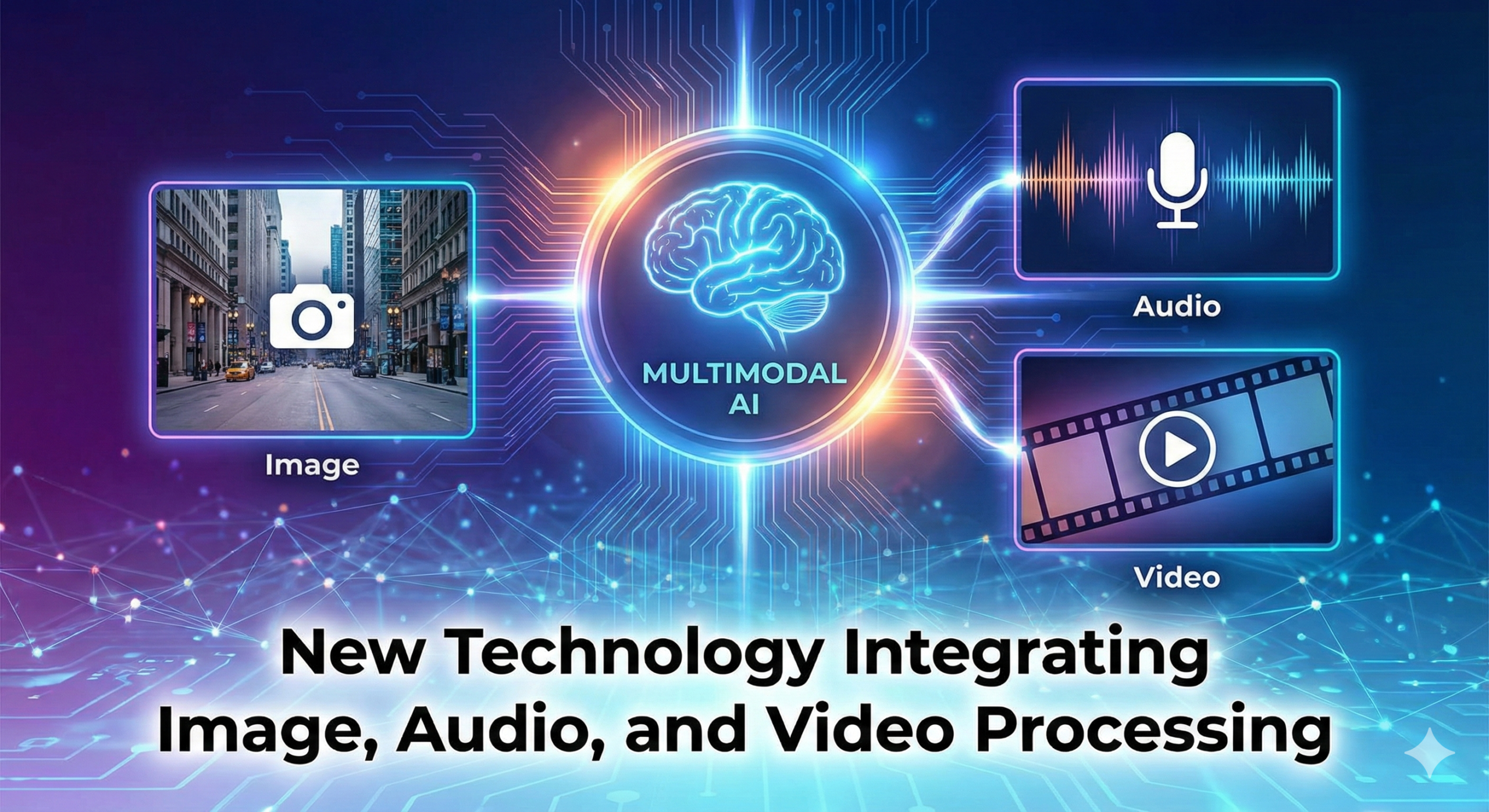
Multimodal AI – New Technology Integrating Image, Audio, and Video Processing
What is Multimodal AI?
Traditional AI systems could only handle one type of information. Text-based AI processed written content, while image recognition AI analyzed photographs. Each operated independently, unable to combine and understand different types of information together.
Multimodal AI, which has seen practical implementation accelerating from 2024 onwards, possesses the capability to simultaneously process and comprehensively understand text, images, audio, and video. For example, in customer support scenarios, these systems can autonomously execute a complete workflow: understanding verbal explanations, identifying problem areas from product photographs sent by customers, referencing manuals, and proposing solutions. This represents AI’s realization of the “integrated understanding across multiple senses” that humans naturally perform.
Mechanism of Integrated Processing
Multimodal AI achieves integrated processing by converting various data types into a common “semantic space.” By transforming information in different formats—text, images, and audio—into numerical vectors that AI can understand, and learning the relationships between them, comprehensive understanding becomes possible.
For instance, the phrase “red apple,” an actual photograph of an apple, and the sound of biting into an apple are all connected to the concept of “apple” for humans. Similarly, multimodal AI learns and associates that these pieces of information refer to the same concept. As the technical foundation for this capability, most contemporary multimodal AI systems adopt an architecture called Transformers. This enables efficient processing of long contexts and complex relationships.
Additionally, a technique called cross-modal learning is crucial, where knowledge learned from one data format is applied to understanding another format. By applying linguistic knowledge learned from large volumes of text data to image understanding, high accuracy can be achieved even with less data.
Practical Applications
In medical diagnostic support, systems can simultaneously analyze patients’ verbal symptom descriptions, X-ray and MRI images, and text information from electronic medical records, providing physicians with reference information for diagnosis. By integrating multiple information sources that physicians previously had to review sequentially, these systems can reduce the risk of oversight and are expected to improve diagnostic accuracy.
In construction site safety management, integrated analysis of site videos captured by drones, verbal reports from workers, and design blueprint data enables real-time detection and warning of safety risks.
In online education platforms, services have emerged that assess learners’ comprehension levels from their facial expressions and voice, then propose optimal learning methods by combining text materials, videos, and diagrams. This enables dynamic adjustment based on learner states, moving beyond traditional one-way material delivery.
In the pharmaceutical and medical device industry, multimodal AI shows significant potential in regulatory authority compliance scenarios. During FDA unannounced inspections, inspectors’ questions can be input via voice, and AI can search relevant SOPs, manufacturing records, and validation documents to provide answers audibly, enabling real-time interpretation support. Even in technical Q&A sessions containing specialized terminology, accurate translation and explanation can be provided while immediately referencing relevant sections of documents.
In data integrity verification work, handwritten manufacturing record sheets can be scanned to automatically check consistency of entries, appropriateness of correction history, and omissions of required fields. This enables detection of potential findings during FDA mock inspection preparation stages, allowing corrective actions to be implemented. Tasks that previously relied on manual visual inspection are streamlined by combining image recognition and text analysis, contributing to the establishment of more reliable compliance systems.
Technical Considerations
Multimodal processing requires significantly more computational resources compared to single-format data processing. Organizations need to consider utilizing cloud services or introducing dedicated hardware. When handling personally identifiable information from videos and images, or biometric information such as voiceprints, appropriate consent acquisition and strict data management are required.
Due to multiple input formats, test case design and quality assurance processes become more complex. Proper operational verification is necessary for each combination of modalities.
According to current regulatory frameworks, particularly under GDPR (General Data Protection Regulation) in Europe and similar privacy regulations globally, biometric data is classified as a special category of personal data requiring enhanced protection measures. Organizations implementing multimodal AI must ensure compliance with applicable data protection regulations, including conducting Data Protection Impact Assessments (DPIA) where required.
For medical device applications, regulatory bodies such as the FDA and regulatory authorities in other jurisdictions have begun establishing frameworks for AI/ML-based medical devices. The FDA’s proposed regulatory framework emphasizes the importance of predetermined change control plans and algorithm change protocols, which are particularly relevant for multimodal AI systems that may require updates based on diverse data inputs.
Future Outlook
Currently, real-time multimodal processing is advancing in practical implementation, accelerating its application in fields requiring immediate judgment such as autonomous driving and robot control. Development of lightweight multimodal AI models that can operate on smartphones and edge devices is also progressing, enabling sophisticated processing without cloud dependence.
The integration of multimodal AI with emerging technologies presents new possibilities. The convergence with Extended Reality (XR) technologies—including Virtual Reality (VR), Augmented Reality (AR), and Mixed Reality (MR)—enables more immersive and intuitive human-AI interaction experiences. In industrial settings, maintenance technicians wearing AR glasses can receive real-time guidance from multimodal AI that analyzes equipment conditions through visual inspection, thermal imaging, and acoustic analysis simultaneously.
The development of explainable AI (XAI) techniques for multimodal systems is becoming increasingly important. As these systems make decisions based on multiple data sources, the ability to provide transparent explanations of how different modalities contributed to a particular output is crucial for building trust, especially in high-stakes applications such as medical diagnosis or regulatory compliance.
Industry standards are evolving to address multimodal AI deployment. ISO/IEC JTC 1/SC 42, the international standardization committee for artificial intelligence, is developing standards that encompass multimodal systems, including considerations for data quality, system robustness, and ethical guidelines. These standards aim to ensure that multimodal AI systems are developed and deployed responsibly across different sectors.
Conclusion
Multimodal AI is a technology that brings to AI the integration of multiple senses that humans naturally perform. It is important to position it not merely as an efficiency tool, but as a partner that extends human capabilities and opens new possibilities. As the technology matures and regulatory frameworks evolve, organizations must balance innovation with responsible implementation, ensuring that multimodal AI systems are developed with appropriate safeguards, transparency, and accountability mechanisms in place.
Table: Key Application Areas and Benefits of Multimodal AI
| Application Area | Input Modalities | Key Benefits | Regulatory Considerations |
| Medical Diagnostics | Voice, Medical Images, Electronic Records | Reduced oversight risk, Improved diagnostic accuracy | FDA/PMDA medical device regulations, Clinical validation requirements |
| Construction Safety | Video, Voice, Design Documents | Real-time risk detection, Proactive safety management | Occupational safety regulations, Data privacy for workers |
| Online Education | Video (facial expressions), Voice, Text Materials | Personalized learning, Adaptive content delivery | Student data privacy (FERPA, GDPR), Accessibility standards |
| Regulatory Compliance (Pharma) | Voice, Document Images, Manufacturing Records | Efficient inspection response, Automated data integrity checks | FDA 21 CFR Part 11, EU GMP Annex 11, Data integrity guidelines |
| Customer Support | Voice, Product Images, Text (Manuals) | Faster resolution, Comprehensive problem analysis | Consumer data protection, Service quality standards |
This table illustrates the diverse applications of multimodal AI across industries, highlighting the integration of different data types and the corresponding regulatory frameworks that organizations must consider during implementation.

Comment