
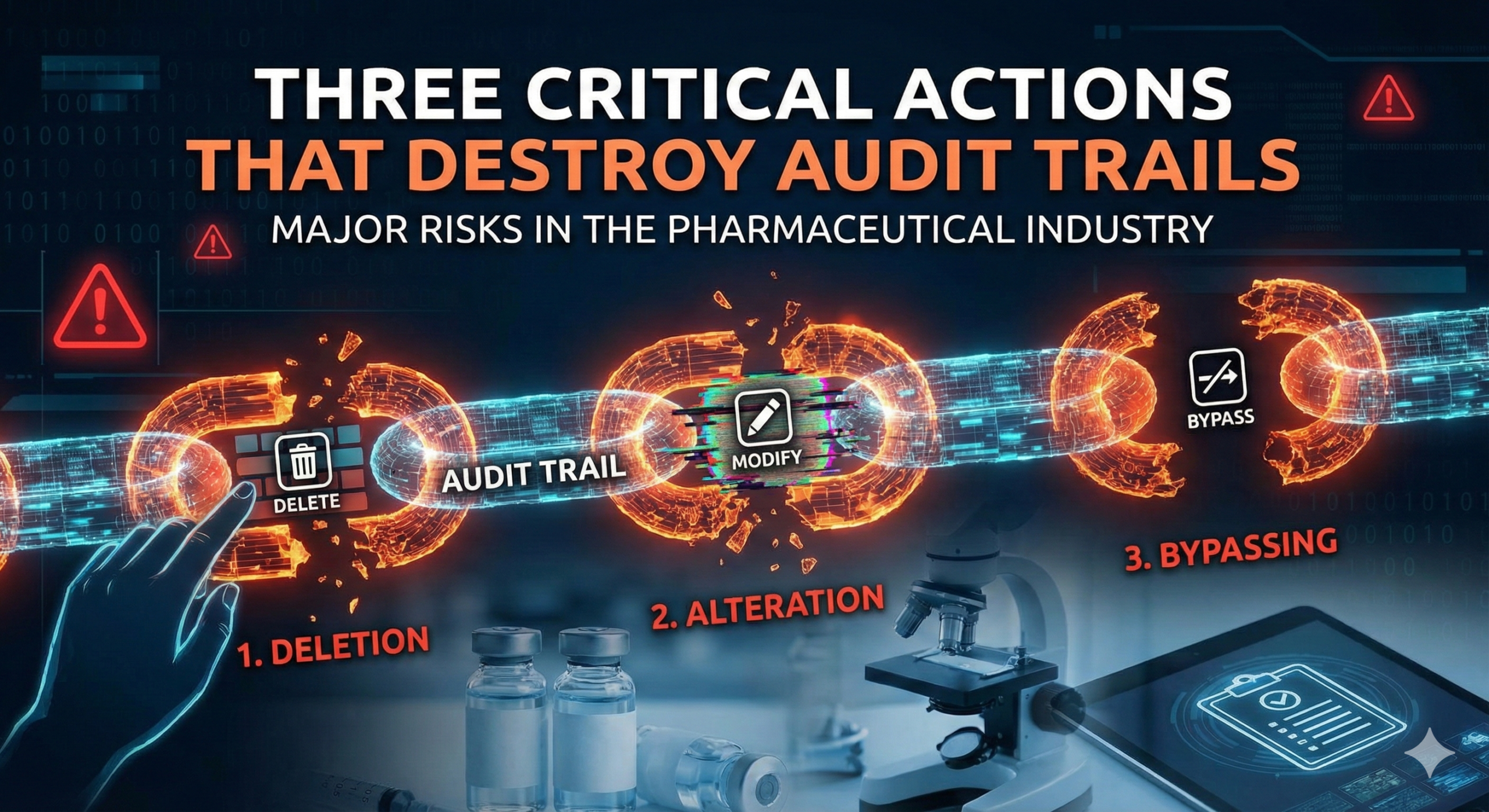
Three Critical Actions That Destroy Audit Trails: Major Risks in the Pharmaceutical Industry
What is an Audit Trail?
An audit trail is a chronological record of work and operations in pharmaceutical manufacturing and quality control. It contains information about “when, who, what, and how” actions were performed, serving as the most critical evidence for demonstrating GMP compliance during FDA and PMDA inspections. The maintenance of audit trails for electronic records is explicitly required by 21 CFR Part 11 and the Japanese ER/ES guidelines, forming the foundation of data integrity (ALCOA+ principles). However, many pharmaceutical companies inadvertently lose audit trails during routine business operations.
First Critical Action: Inadequate Backup During Disasters
When disasters such as fires, floods, earthquakes, or cyberattacks involving ransomware occur at manufacturing facilities, insufficient backup systems can result in the loss of all audit trails, including manufacturing records, test records, and analytical data.
If a disaster occurs at a manufacturing facility and batch records can be recovered but audit trails such as manufacturing instructions, deviation management, and change control approval histories are lost, it becomes impossible to prove the qualification of the relevant batches.
When audit trails cannot be provided upon request during FDA inspections, there is a high probability of receiving serious administrative actions such as Warning Letters or Import Alerts. In fact, many Warning Letters issued for data integrity violations include deficiencies in audit trails as cited observations.
Many pharmaceutical companies focus on backing up manufacturing records and test data, but “behind-the-scenes data” such as audit logs in electronic record systems, analytical instrument usage histories, and approval workflows tend to receive lower priority. Even when backups are performed, problems often exist such as storing backups only within the same building as the manufacturing facility, performing weekly rather than daily backups, or failing to conduct recovery tests.
As a countermeasure, implementing the “3-2-1 rule” is fundamental: maintain three copies of data, store them on two different types of media, and keep one copy at a remote location. For audit trails, the use of Write Once Read Many (WORM) storage should be considered to prevent tampering. Audit trails for manufacturing records and analytical data should be automatically backed up in real-time or multiple times per day, with recovery drills conducted at least annually. Facilities manufacturing FDA-regulated products are particularly required to develop and regularly verify Disaster Recovery Plans.
Key Backup Requirements
| Requirement | Standard Practice | Regulatory Basis |
| Backup frequency | Real-time or multiple times daily | 21 CFR Part 11, FDA Data Integrity Guidance |
| Storage locations | At least one off-site location | 3-2-1 rule, business continuity standards |
| Recovery testing | Minimum annually | ICH Q7, PIC/S guidelines |
| Media type | Minimum two different types | ISO 27001, cybersecurity best practices |
| Retention period | Product shelf life + 5 years (Japan), minimum 3 years from manufacturing or 1 year from distribution (US), typically 10+ years for litigation protection | GMP regulations, industry practice |
Second Critical Action: Data Migration Failures During Analytical Instrument Replacement
Replacement of core systems (QMS, LIMS, ERP) and analytical instruments (HPLC, GC, mass spectrometers, etc.) in pharmaceutical companies represents the greatest risk factor for audit trail loss. During system renewals, while migration of manufacturing records and test result data may succeed, cases frequently occur where migration of audit trails such as approval processes, deviation handling histories, and change control records is overlooked.
When replacing analytical instruments, one of two approaches must be selected to preserve audit trails: the time capsule approach or the migration approach.
The time capsule approach maintains the old instrument’s system in read-only mode, preserving access to historical data as needed. However, this approach presents serious problems including failure risk, termination of manufacturer maintenance support, and OS or database vulnerability responses. In particular, when analytical instrument manufacturers discontinue maintenance services, hardware failures become irreparable, leading to permanent inaccessibility to audit trails.
The migration approach, on the other hand, involves transferring all data including audit trails to the new instrument. While ideal, this is extremely difficult technically when data formats and database structures differ between old and new instruments. Although the analytical data itself can be migrated, transferring metadata such as measurement condition change histories, remeasurement rationales, and approver electronic signatures requires custom development, incurring costs ranging from several million to tens of millions of yen. Furthermore, the challenge of how to verify data integrity after migration remains, making complete migration practically difficult in many cases.
At one Japanese pharmaceutical company, during HPLC equipment updates, ten years of stability test data were migrated to the new system, but audit trails such as analyst approval histories and remeasurement justifications associated with each data point were not transferred. During an FDA inspection several years later, when inquiries were made regarding past lots, the company could not prove data reliability and received data integrity citations.
As a countermeasure, quality assurance and regulatory affairs departments must be involved from project inception to clearly define which audit trails will be preserved and how. When adopting the time capsule approach, equipment maintenance contract periods, data backup frequency, and emergency data recovery procedures must be clearly established. When adopting the migration approach, a data migration verification protocol must be created to demonstrate that data integrity has been maintained.
Comparison of Audit Trail Preservation Approaches
| Approach | Advantages | Disadvantages | Best Use Case |
| Time Capsule | Original data preserved intact; lower initial cost; faster implementation | Hardware failure risk; maintenance support termination; security vulnerabilities; ongoing costs | Short to medium-term preservation (5-7 years); systems with proprietary formats |
| Migration | No legacy hardware dependency; unified system; better searchability | High cost; technical complexity; validation burden; potential data loss risk | Long-term preservation; standardized data formats; ongoing system use |
| Hybrid (PDF/A export) | Format independence; long-term stability; regulatory compliance | Loss of dynamic functionality; larger storage requirements; manual review more difficult | Critical records; long-term archival; regulatory submission packages |
Since neither approach is perfect, it is recommended to separately export critical audit trails in long-term preservation standard formats such as PDF/A and store them in archival storage. This method ensures that even if equipment becomes completely unusable in the future, evidence can be presented to regulatory authorities.
Third Critical Action: Printing to Paper Media and Deleting Original Data
In the pharmaceutical industry, the culture of printing manufacturing records and test records on paper and storing them in binders remains strong. However, printing electronic records on paper and then deleting the original digital data constitutes a serious GMP violation.
At one pharmaceutical company, manufacturing records were printed and bound on paper monthly, with the original electronic records regularly deleted to reduce server capacity. During an FDA inspection, when the inspector requested presentation of approval histories and change histories for a specific batch’s manufacturing record, only the final manufacturing results were recorded on paper, and audit trails showing who approved which process when and what changes occurred during the process were lost. This constituted a violation of 21 CFR Part 11 and was cited as a data integrity violation.
This problem arises from insufficient understanding of the fundamental differences between digital data and paper media. Electronic records contain rich metadata including creation date/time, creator, update history, electronic signatures, and timestamps, but all this information is lost the moment it is printed on paper. Printouts retain “what is recorded” but lack the information regulatory authorities value most: “who approved when” and “why changes were made.”
Additionally, while 21 CFR Part 11 and ER/ES guidelines require implementation of tampering detection functions for electronic records, objective authenticity verification through hash values or digital signatures is impossible with paper media. Furthermore, when presentation of batch records from ten years ago is requested during FDA inspections, finding the relevant records from paper storage requires enormous time, whereas electronic records can be searched in seconds.
As a countermeasure, compliance with Japan’s Electronic Books Preservation Act and ER/ES guidelines is necessary. For data created as electronic records, electronic preservation is the principle, and mere printing on paper does not satisfy requirements. The habit of “feeling secure by printing and storing on paper” must be changed to the mindset of “store electronically and print as needed.”
Specifically, electronic records stored in QMS or LIMS should be preserved electronically including audit trails, with appropriate access control and backup systems established. Infrequently accessed historical data can be migrated to low-cost archival storage, and through proper lifecycle management, long-term preservation can be achieved while controlling costs.
Additionally, regular education for manufacturing site and quality control department staff regarding the differences between electronic records and digital data, the importance of audit trails, and data integrity principles is essential.
Electronic Records vs. Paper Records: Critical Differences
| Aspect | Electronic Records | Paper Records |
| Audit trail | Complete history of creation, modifications, approvals with timestamps | Only final state visible; no modification history |
| Searchability | Instant search across millions of records | Manual search; extremely time-consuming |
| Integrity verification | Hash values, digital signatures, automated checks | Visual inspection only; no objective verification |
| Metadata | Creator, timestamps, approver, reason codes, environmental data | Limited; manually written notes only |
| Regulatory compliance | 21 CFR Part 11, ER/ES compliant when properly implemented | Does not meet electronic record requirements |
| Storage efficiency | Minimal physical space; infinite copies possible | Large physical space; single copy unless duplicated |
| Disaster recovery | Multiple backup locations; rapid recovery | Single location vulnerability; slow recovery |
Common Underlying Problem
These three actions share a common problem: “an organizational culture that deprioritizes audit trails.” Pharmaceutical companies focus on protecting “business data” such as manufacturing records and test data, but “audit trails” that record how these were created and modified tend to be relegated to secondary importance. However, what FDA and PMDA emphasize most in inspections is not the data itself, but the audit trail of how the data was created, who approved it, and how it has been managed.
Additionally, short-term cost reductions such as backup storage cost savings and data migration cost reduction during system replacements lead to audit trail loss. However, the consequences of audit trail loss—Warning Letters, Import Alerts, manufacturing shutdowns, and product recalls—result in losses far exceeding the costs saved.
Furthermore, there is a shortage of personnel who understand the importance of audit trails and can manage them appropriately. Many companies operate with quality assurance, IT, manufacturing, and quality control departments working in silos, lacking company-wide control of data integrity.
Future Outlook
Technologies using AI to automatically detect abnormal patterns from vast audit trails are becoming practical. For example, machine learning can detect patterns of analytical data tampering or unnatural deletion and remeasurement, enabling early detection of data integrity violation risks.
Additionally, blockchain technology, which provides guaranteed tamper-proof characteristics, is increasingly being applied to audit trail storage for GMP records in the pharmaceutical industry. It is particularly attracting attention as a mechanism for sharing reliable audit trails in clinical trial data management and quality information sharing among multiple contract manufacturing organizations.
Furthermore, the FDA has issued “Data Integrity and Compliance With Drug CGMP: Guidance for Industry,” and regulatory requirements regarding data integrity are becoming increasingly stringent annually. The European EMA and WHO have similarly issued data integrity guidance, making proper storage and disclosure of audit trails a lifeline for pharmaceutical companies globally.
Recent Regulatory Developments (2024-2025)
The regulatory landscape continues to evolve with increasing emphasis on data integrity:
- FDA Guidance Updates: The FDA has reinforced expectations around data lifecycle management, emphasizing that audit trails must be preserved throughout the entire data lifecycle, from creation through archival or destruction.
- EMA Annex 11 Revision Discussions: The European Medicines Agency is discussing updates to Annex 11 (Computerized Systems) to strengthen requirements for cloud-based systems and hybrid data environments.
- ICH Q12 Implementation: The implementation of ICH Q12 (Technical and Regulatory Considerations for Pharmaceutical Product Lifecycle Management) has implications for change control documentation and audit trail requirements during post-approval changes.
- PIC/S PI 041-1: The Pharmaceutical Inspection Co-operation Scheme’s updated guidance emphasizes risk-based approaches to data integrity and audit trail management.
- Cybersecurity Considerations: Regulatory authorities increasingly view audit trail integrity as part of cybersecurity posture, with CISA and FDA issuing joint guidance on medical device and pharmaceutical manufacturing cybersecurity.
As preparation, companies need to develop company-wide data integrity policies that clearly define what to preserve, how, and for how long. GMP document retention periods are defined as product shelf life plus five years (plus ten years for biological products) in Japan, and a minimum of three years from manufacturing or one year from distribution (whichever is longer) in the US, but in practice, preservation for ten years or more is recommended considering litigation risks.
Establishing a system where quality assurance, IT, manufacturing, and quality control departments collaborate to manage audit trails, with company-wide data governance oversight by positions such as Data Integrity Officer or Chief Data Officer (CDO), is effective.
Implementing Comprehensive Audit Trail Management
A robust audit trail management program should include the following elements:
Governance Structure: Establish clear roles and responsibilities with a Data Integrity Officer or CDO overseeing cross-functional teams from QA, IT, manufacturing, and quality control. Regular audit trail review meetings should assess risks and monitor key performance indicators.
Technology Infrastructure: Implement validated electronic systems with built-in audit trail capabilities. Ensure systems generate automatic, secure, computer-generated timestamps. Use WORM or blockchain-based storage for critical records. Deploy automated backup solutions with redundancy and geographic distribution.
Policies and Procedures: Develop comprehensive SOPs covering audit trail generation, review, retention, and archival. Define clear criteria for what constitutes a critical audit trail requiring enhanced protection. Establish procedures for audit trail review during investigations and inspections.
Training and Culture: Conduct regular training for all personnel on data integrity principles and audit trail importance. Foster a culture where data integrity is viewed as everyone’s responsibility, not just a compliance requirement. Implement scenario-based training using real-world examples of audit trail failures and their consequences.
Monitoring and Continuous Improvement: Perform periodic self-inspections focusing on audit trail integrity. Use metrics such as audit trail completeness, backup success rates, and recovery time objectives. Implement corrective and preventive actions when gaps are identified. Benchmark against industry best practices and regulatory expectations.
Summary
Audit trails are the lifeline proving GMP compliance for pharmaceutical companies. The three actions—inadequate backup during disasters, data migration failures during analytical instrument replacement, and printing to paper media with deletion of original data—are risks lurking within routine business processes. It is essential that all stakeholders, from executive management to manufacturing floor workers, understand the importance of audit trails and practice appropriate management.
Protecting audit trails is not just about preserving past records; it is about protecting the company’s future. Through proper audit trail management, regulatory inspection risks can be reduced, product quality reliability can be ensured, and responsibilities to patients can be fulfilled. Continuing to uphold the basic GMP principle of “accurately recording and appropriately preserving records” becomes the foundation for sustainable growth of pharmaceutical companies.
In an era of increasing regulatory scrutiny, digital transformation, and global supply chains, audit trails have evolved from mere compliance requirements to strategic assets. Companies that view audit trail management as an investment rather than a cost will be better positioned to navigate inspections, respond to quality incidents, and maintain market access. The integration of emerging technologies—artificial intelligence for anomaly detection, blockchain for tamper-proof recordkeeping, and cloud-based solutions for global accessibility—offers new opportunities to enhance audit trail robustness while improving operational efficiency.
Ultimately, the integrity of audit trails reflects the integrity of the organization itself. By embedding data integrity principles into corporate culture, investing in appropriate technologies and training, and maintaining unwavering commitment to accurate recordkeeping, pharmaceutical companies can fulfill their fundamental obligation to patients: ensuring that every medication reaching them has been manufactured, tested, and released with the highest standards of quality and traceability.
This article provides general guidance on audit trail management in pharmaceutical manufacturing. Specific regulatory requirements may vary by jurisdiction and product type. Companies should consult with regulatory affairs experts and quality assurance professionals to develop audit trail management strategies appropriate for their specific circumstances.

Comment