
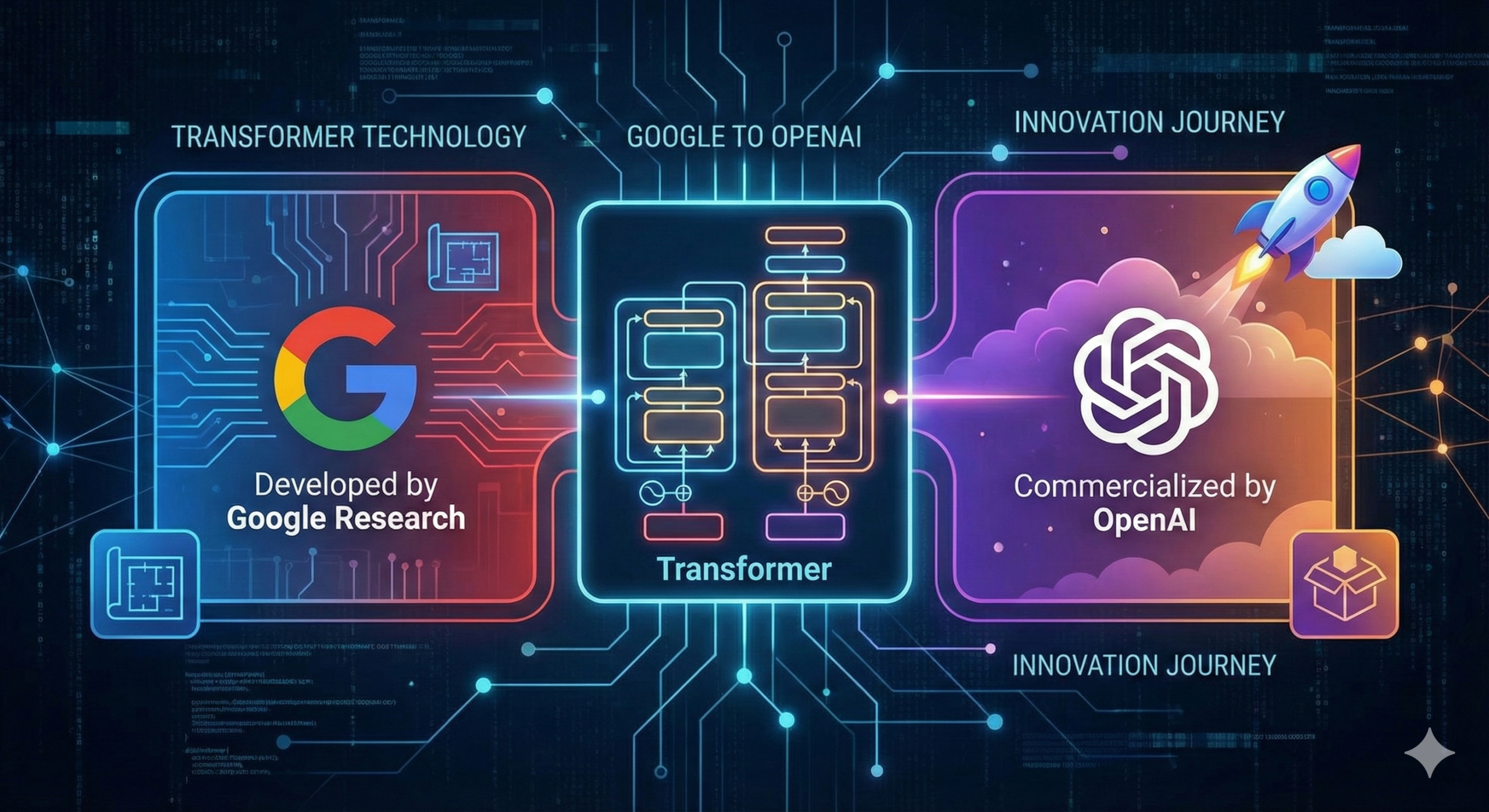
Transformer Technology: Developed by Google, Commercialized by OpenAI
The “Transformer,” a core technology supporting the modern AI revolution, was created by Google’s research team, but it was OpenAI that demonstrated its true value to the world. This story of technology transfer goes beyond mere corporate competition and offers important insights into the essence of innovation.
The Birth of Transformers: Google’s Innovation
The Turning Point of 2017
In 2017, a paper titled “Attention is All You Need” published by the Google Brain team became a monumental moment in the history of AI research. The Transformer architecture proposed in this paper was a completely new approach that solved fundamental problems inherent in traditional Recurrent Neural Networks (RNNs).
Key Authors and Context: The paper was authored by eight researchers from Google Brain and Google Research, including Ashish Vaswani, Noam Shazeer, Niki Parmar, Jakob Uszkoreit, Llion Jones, Aidan N. Gomez, Łukasz Kaiser, and Illia Polosukhin. This collaborative work emerged from Google’s research into improving machine translation systems.
Points of Technical Innovation
The most distinctive feature of Transformers is the “attention mechanism.” While traditional RNNs processed sentences sequentially from beginning to end, Transformers can view the entire sentence simultaneously and dynamically evaluate relationships between words.
For example, the system can automatically determine from context the different meanings of the word “bank” in expressions like “bank account” and “river bank.” This capability dramatically improved the accuracy of machine translation and text understanding.
Technical Deep Dive: The self-attention mechanism allows the model to weigh the importance of different words in relation to each other, regardless of their distance in the sequence. This parallel processing capability not only improved performance but also made training more efficient by eliminating the sequential bottleneck of RNNs. The architecture introduced positional encodings to maintain information about word order while processing sequences in parallel.
Commercialization by OpenAI: From Theory to Product
The Emergence of the GPT Series
The year after Google announced Transformers, OpenAI released GPT (Generative Pre-trained Transformer) based on this technology. What’s important here is that OpenAI didn’t simply imitate the technology but expanded its possibilities from a unique perspective.
Timeline and Evolution:
- GPT-1 (June 2018): 117 million parameters, demonstrated the effectiveness of pre-training and fine-tuning
- GPT-2 (February 2019): 1.5 billion parameters, initially withheld due to concerns about misuse
- GPT-3 (June 2020): 175 billion parameters, introduced few-shot learning capabilities
- GPT-3.5 (March 2022): Optimized for instruction-following and dialogue
- GPT-4 (March 2023): Multimodal capabilities, significantly improved reasoning
OpenAI’s approach had the following characteristics:
Thorough Commitment to Scaling: With each generation—GPT-2, GPT-3, and beyond—the model size was dramatically increased. GPT-3 constructed a model with 175 billion parameters, demonstrating that quantitative expansion brings qualitative change. This approach validated the “scaling hypothesis” that became central to modern AI development.
Pursuit of Generality: Rather than specializing in specific tasks, OpenAI aimed for general-purpose AI capable of handling any language task. This direction led to the later success of ChatGPT and demonstrated the value of foundation models that can be adapted to various applications.
ChatGPT as a Turning Point
In November 2022, ChatGPT released by OpenAI shocked the world. It acquired one million users in just five days, creating an opportunity for AI to become familiar to the general public.
The success factors of ChatGPT were not just technical superiority:
- Intuitive interface design that made AI accessible to non-technical users
- Natural conversational format for information delivery
- Response to a wide range of use cases, from creative writing to code generation
- Continuous improvement and incorporation of user feedback through Reinforcement Learning from Human Feedback (RLHF)
Market Impact: ChatGPT became the fastest-growing consumer application in history, reaching 100 million monthly active users by January 2023. This unprecedented adoption rate catalyzed a global conversation about AI’s role in society and work.
Why OpenAI Led in Commercialization
1. Differences in Organizational Culture
Google had a research-oriented culture that pursued diverse research projects in parallel. On the other hand, OpenAI focused from the beginning on a clear mission of “realizing safe and beneficial AI.” This concentration enabled rapid decision-making in the commercialization of Transformer technology.
Research Philosophy: Google’s approach emphasized publishing foundational research for the broader scientific community, while OpenAI increasingly focused on applied research aimed at deployable products. This difference in priorities affected the pace of productization.
2. Risk-Taking Attitude
Being a relatively small organization, OpenAI was in an environment where bold experiments were easier to conduct. It could quickly execute decisions that a large corporation like Google would have to be cautious about, such as the public release of GPT-3 through an API.
Strategic Agility: OpenAI’s structure allowed for faster iteration cycles and more aggressive deployment strategies. The decision to release ChatGPT as a free product, despite significant computational costs, exemplified this willingness to take calculated risks for market positioning.
3. Partnership Strategy
Through its partnership with Microsoft, OpenAI secured massive computational resources while simultaneously achieving enterprise deployment via Azure. This strategic alliance accelerated the democratization of the technology.
Microsoft Partnership Details: Microsoft’s multi-billion dollar investments (including a reported $10 billion investment in 2023) provided OpenAI with access to Azure’s supercomputing infrastructure. In return, Microsoft gained exclusive licensing rights to integrate OpenAI’s models into its product suite, including Bing, Microsoft 365, and GitHub Copilot.
Google’s Counterattack: The Emergence of Gemini
Advantages of Being a Latecomer
In response to OpenAI’s success, Google announced Gemini in December 2023. As a latecomer, Google was able to leverage the following advantages:
Early Implementation of Multimodal Capabilities: The ability to process text, images, audio, and video in an integrated manner was built in from the start. Gemini was designed as natively multimodal, trained jointly on different data types rather than combining separate models.
Integration with Existing Services: Close integration with services used by billions of people, including Google Search, Gmail, and Google Docs, was realized. This ecosystem advantage allowed for seamless deployment across Google’s vast user base.
Technical Specifications: Google announced three versions of Gemini—Ultra, Pro, and Nano—optimized for different use cases from cloud-based applications to on-device processing. This tiered approach addressed various deployment scenarios and computational constraints.
Lessons from Technology Development and Commercialization
The Two-Stage Structure of Innovation
The history of Transformers clearly demonstrates that innovation consists of two stages: “invention” and “commercialization.” Only when both are in place can technology have a true impact on society.
This pattern is not unique to AI. Historical examples include Xerox PARC’s invention of the graphical user interface, later commercialized by Apple, and the development of touchscreen technology, eventually popularized by smartphones.
The Importance of Open Research Culture
By publishing their paper, Google enabled researchers worldwide, including those at OpenAI, to develop this technology. This scientific openness supports the rapid progress of AI technology.
Open Source Contributions: The original Transformer implementation was made available, accelerating research. This collaborative approach has become standard in AI research, with major breakthroughs typically shared through publications and code releases, though increasingly, detailed implementation specifics and training data remain proprietary.
The Value of Continuous Competition
The competition between Google and OpenAI is accelerating the development of AI technology. When one announces a groundbreaking feature, the other adds further improvements. This healthy competition ultimately benefits users.
Current Competitive Landscape: The field now includes multiple major players—Anthropic (Claude), Meta (Llama), Microsoft/OpenAI (GPT), Google (Gemini), and others—each pushing different aspects of capability, safety, and efficiency. This diversity drives innovation across multiple dimensions.
Impact on Practice and Future Outlook
Implications for Business
The development process of Transformer technology provides important lessons for corporate management:
The Importance of Investment in Basic Research: Just as Google’s basic research benefited the entire industry, long-term research and development investment is essential. Companies must balance near-term product development with fundamental research that may take years to bear fruit.
The Value of Execution: Having excellent technology alone is insufficient; the execution capability to deliver it to the world as a product determines success. The gap between prototype and production-ready system often requires as much innovation as the original research.
Outlook for 2025 and Beyond
Specialization in Specific Fields
As the next stage of general-purpose AI, development of Transformer models optimized for specific fields such as medicine, law, and education is progressing.
Domain-Specific Applications: Specialized models for medical diagnosis, legal document analysis, and educational tutoring are showing superior performance to general-purpose models in their respective domains. This trend reflects growing understanding that targeted optimization can achieve better results than pure scaling.
Pursuit of Efficiency
Research on “lightweight Transformers” that achieve high performance with fewer computational resources is becoming active. The goal is to achieve both environmental impact reduction and cost reduction.
Technical Approaches: Methods such as model distillation, pruning, quantization, and efficient attention mechanisms (like linear attention) are reducing computational requirements. Efforts focus on making advanced AI accessible on edge devices and reducing the carbon footprint of large-scale training.
Regulatory Context: Growing environmental concerns and emerging AI regulations in the EU (AI Act) and other jurisdictions are driving focus on energy-efficient AI systems. Companies are increasingly reporting the carbon footprint of model training and inference.
Deepening Multimodal Integration
Development is advancing not just in processing text, images, audio, and video, but in deeply understanding and creatively combining them.
Next-Generation Capabilities: Systems that can generate coordinated outputs across modalities—such as creating synchronized video, audio, and text content—represent the frontier. Understanding context across modalities enables more sophisticated applications in robotics, autonomous systems, and creative industries.
Regulatory and Ethical Considerations
Global AI Governance
As Transformer-based systems become more powerful and widespread, regulatory frameworks are emerging worldwide:
European Union AI Act (2024): The world’s first comprehensive AI regulation, categorizing AI systems by risk level and imposing requirements for high-risk applications including transparency, human oversight, and safety assessments.
United States Executive Order on AI (October 2023): Established safety and security standards for AI development, particularly for models trained with significant computational resources. Includes requirements for reporting training runs exceeding certain thresholds.
China’s Generative AI Regulations (2023): Requires registration and review of large language models, with emphasis on content alignment with socialist values and national security.
Safety and Alignment Research
The rapid advancement of Transformer capabilities has intensified focus on AI safety:
Technical Alignment: Research on ensuring AI systems behave according to human intent, including work on interpretability, robustness, and value alignment. Constitutional AI, RLHF refinements, and mechanistic interpretability represent active areas of development.
Red Teaming and Evaluation: Systematic testing for harmful outputs, biases, and security vulnerabilities has become standard practice. Organizations increasingly employ dedicated teams to probe model limitations before deployment.
Responsible AI Practices
Industry standards are evolving around responsible development and deployment:
Model Cards and Documentation: Standardized reporting of model capabilities, limitations, training data, and intended use cases helps users understand system boundaries.
Bias Mitigation: Techniques to identify and reduce biases in training data and model outputs are becoming integral to development pipelines.
Environmental Sustainability: Measurement and reduction of computational costs, with some organizations committing to carbon-neutral AI training.
Comparison of Major Transformer-Based Systems (2025)
| System | Developer | Key Strengths | Primary Focus | Notable Features |
| GPT-4 | OpenAI | Reasoning, versatility | General purpose, enterprise | Multimodal, plugin ecosystem |
| Gemini Ultra | Multimodal integration | Ecosystem integration | Native multimodal training | |
| Claude | Anthropic | Safety, helpfulness | Long context, analysis | 200K+ token context window |
| Llama 3 | Meta | Open source, efficiency | Research, customization | Community-driven development |
Conclusion
The story of Transformer technology symbolizes the complexity of modern innovation. Google’s revolutionary invention, OpenAI’s bold commercialization, and subsequent continuous evolution through competition have shaped today’s AI revolution.
What’s important is not which is the “winner,” but that both companies’ contributions work complementarily to advance the technology as a whole. The lessons that basic research is important, commercialization has value, and healthy competition accelerates innovation have universal meaning not only in the AI field but in all technological development.
Looking Forward: As we enter an era where AI systems built on Transformer architecture are becoming infrastructure for society, several challenges remain: ensuring equitable access to AI capabilities, managing the societal impacts of automation, addressing the environmental costs of large-scale computation, and maintaining human agency in increasingly AI-mediated environments.
In the coming AI era, we need a perspective that views technological development not merely as corporate competition but as the accumulation of intellectual assets for all humanity. The history of Transformer technology eloquently tells us this importance.
The collaborative and competitive dynamics between research institutions and companies, the balance between openness and proprietary development, and the relationship between technological capability and societal readiness will continue to shape how Transformers and their successors transform our world. Understanding this history helps us navigate the complex landscape of AI development and deployment responsibly.
Final Reflection: The Transformer architecture’s journey from a 2017 research paper to the foundation of a global technological revolution demonstrates that breakthrough innovations require both brilliant insights and sustained efforts across multiple organizations. As we build on this foundation, maintaining the spirit of open research while addressing legitimate safety and ethical concerns remains our collective challenge and opportunity.

Comment