
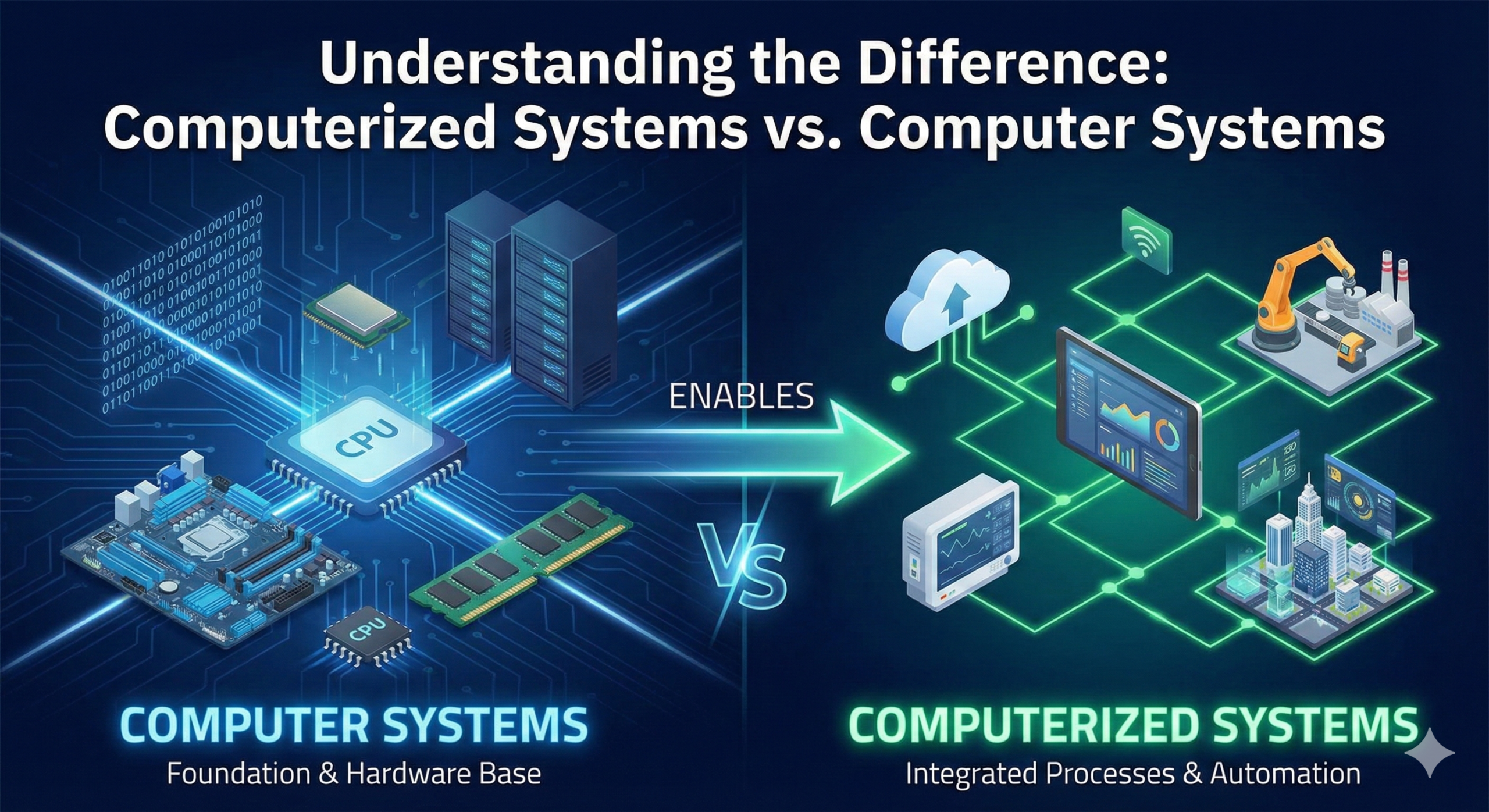
In today’s society, we frequently encounter the terms “computerized system” and “computer system.” However, surprisingly few people accurately understand the distinction between these terms.
This difference is particularly important in the pharmaceutical manufacturing industry, where it is clearly distinguished in international guidelines such as GAMP (Good Automated Manufacturing Practice). This article will clarify the differences between the two and deepen understanding through their characteristics and practical examples.
What is a Computerized System?
A computerized system refers to a system where processes originally performed manually or through mechanical methods have been replaced by computer control. The key premise is that “an existing system is already in place.”
In English, it is written as “Computerized System.” Particularly in the pharmaceutical industry’s GAMP guidelines and PIC/S (Pharmaceutical Inspection Co-operation Scheme) guidelines, this term is used with the connotation of “computerization of existing processes.”
Example: Microcomputer-Controlled Rice Cooker
The most familiar example is a microcomputer-controlled rice cooker. Traditionally, the act of cooking rice in a pot involved humans adjusting the heat and timing. This is the “rice cooking system.” By incorporating a microcomputer and linking it with temperature sensors and timers, a rice cooker can automatically perform optimal cooking. In other words, the “system” of rice cooking itself remains unchanged; only the control method has been replaced by a computer.
Other Familiar Examples
The following are everyday examples of computerized systems:
Automated ticket gates: The station attendant’s ticket checking system has been computerized.
ATMs (Automated Teller Machines): The bank teller’s deposit and withdrawal system has been computerized.
Factory production lines: Manual assembly systems have been replaced by robots and computer control.
Electronic medical records: Transition from paper charts to electronic records.
Automatic temperature recording systems: Change from manual temperature checks to automatic monitoring.
What is a Computer System?
On the other hand, a computer system is one that has been designed and constructed from the beginning with computers as a prerequisite. It refers to a system that is purely based on digital technology and cannot function without computers.
The term “Computer System” is widely used in both the IT industry and the pharmaceutical industry, and its characteristic is being “digitally native.”
Representative Examples
The following are typical examples of computer systems:
Websites: Exist only on the internet and cannot function without computers.
Database management systems: Systems specialized in managing digital data.
Cloud services: Virtualization technology premised on distributed computing.
Artificial Intelligence (AI) systems: Technologies such as machine learning and deep learning that assume computer computational power.
Blockchain: Distributed ledger technology achievable only in digital environments.
Fundamental Differences Between the Two
The table below summarizes the key differences between computerized systems and computer systems:
| Aspect | Computerized System | Computer System |
|---|---|---|
| Origin | Analog origin (existing non-digital system as starting point) | Digital origin (designed from the outset assuming digital technology) |
| Purpose | Main objective is efficiency improvement and automation of existing processes | Creation of new value achievable only with computers |
| Design Philosophy | Digitalization of analog processes | Digitally native design |
| Historical Context | Replacement or enhancement of manual/mechanical operations | No pre-existing analog equivalent |
| Validation Focus | Demonstrating equivalence to traditional methods | Verifying system functionality and performance |
Specific Examples in Pharmaceutical Manufacturing
In the pharmaceutical manufacturing industry, this distinction is especially important. The GAMP guidelines and FDA (U.S. Food and Drug Administration) guidance frequently use the term “Computerized System,” emphasizing the importance of validation and risk assessment.
Examples of Computerized Systems
Manufacturing Execution System (MES): Digitalization of traditional paper-based manufacturing records.
Temperature management systems: Replacement of manual temperature checks with automatic monitoring.
Inventory management systems: Transition from ledger management to barcode management.
Electronic batch records: Transition from paper manufacturing records to electronic records.
Examples of Computer Systems
LIMS (Laboratory Information Management System): Designed from the beginning assuming digital data management.
PAT (Process Analytical Technology): Quality management through real-time data analysis.
Electronic signature systems: Approval processes utilizing digital authentication technology.
Statistical analysis software: Systems premised on complex statistical calculations.
Why is This Distinction Important?
1. Differences in Validation Strategy
Computerized Systems: It is important to prove equivalence with traditional methods. For example, it is necessary to verify that electronic records hold the same information accurately as paper records.
Computer Systems: Verification focuses on the system’s reliability and performance. The goal is to prove that the system functions as designed.
2. Risk Assessment Perspective
Computerized Systems: Assessment of migration risk is crucial. During the transition from traditional methods, it is necessary to evaluate whether data loss or errors will occur.
Computer Systems: System-specific risks (security risks, availability risks, data integrity risks, etc.) are the main evaluation targets.
3. Differences in Regulatory Response
Computerized Systems: Compliance is addressed as an extension of existing regulations. The challenge is how to meet traditional regulatory requirements in a digital environment.
Computer Systems: New regulatory frameworks may apply. For example, cloud systems and AI systems may be subject to special regulatory requirements.
Latest Regulatory Trends
GAMP 5 Second Edition (2022)
The International Society for Pharmaceutical Engineering (ISPE) published the second edition of GAMP 5 in 2022. This update reflects technological evolution since the first edition in 2008 and addresses the following points:
- Enhanced emphasis on service providers and cloud computing
- Alignment with FDA’s Computer Software Assurance (CSA) approach
- Expanded appendices covering blockchain, AI/ML, and open-source software
- Stronger focus on data integrity throughout the system lifecycle
- Greater emphasis on critical thinking by subject matter experts
FDA 21 CFR Part 11 Recent Developments
FDA’s 21 CFR Part 11, established in 1997, sets criteria for electronic records and electronic signatures. Recent updates include:
October 2024: FDA published final guidance “Electronic Systems, Electronic Records, and Electronic Signatures in Clinical Investigations: Questions and Answers” addressing:
- Scope clarifications for real-world data and foreign trials
- Risk-based validation approaches
- Service provider agreements
- Digital health technologies in clinical investigations
- Electronic signature requirements including non-repudiation letters
2003 Guidance: FDA’s “Part 11, Electronic Records; Electronic Signatures – Scope and Application” remains foundational, emphasizing risk-based approaches and exercising enforcement discretion on certain requirements while maintaining focus on data integrity, accuracy, and reliability.
EU Annex 11 and PIC/S Revision (2025-2026)
In July 2025, the European Commission and PIC/S released draft revisions to EU GMP Annex 11 (Computerised Systems), representing the most significant update since 2011. Key features include:
- Expansion from 5 to 19 pages with enhanced detail
- Comprehensive lifecycle management requirements
- Mandatory application of Quality Risk Management (QRM) principles throughout all lifecycle stages
- Enhanced supplier and service provider oversight (including cloud services)
- Strengthened data integrity controls for “data in motion” and “data at rest”
- Detailed system alarm requirements and management
- Enhanced security requirements including penetration testing for critical systems
- Comprehensive archiving and backup requirements
- Alignment with ISO 27001, GAMP 5 Second Edition, ICH Q9(R1), and FDA CSA
The consultation period closed in October 2025, with final publication expected mid-2026.
New EU Annex 22 on Artificial Intelligence (Draft 2025)
Simultaneously with the Annex 11 revision, the EU and PIC/S released a draft Annex 22 specifically addressing AI and machine learning in pharmaceutical manufacturing. This groundbreaking guidance covers:
- Selection, training, and validation of AI models
- Definition of intended use and performance metrics
- Quality requirements for training data
- Lifecycle management for AI systems
- Integration with existing GMP frameworks
This represents the first comprehensive GMP-specific guidance on AI systems in pharmaceutical manufacturing.
Points to Note
1. Confusion of Terminology
In Japanese, there may be cases where a strict distinction between “computerized system” and “computer system” is not made. Additionally, because the English term “Computerized System” is sometimes simply translated as “computer system,” attention to context is necessary.
2. Ambiguity of Boundaries
In actual practice, the boundary between the two may become ambiguous. For example, ERP systems begin as computerization of existing business processes but, as new functions are added, may come to include elements of pure computer systems.
3. Alignment with International Standards
Especially in regulated industries, understanding aligned with international guidelines such as GAMP is important. To respond to global audits and inspections, it is necessary to understand these standard definitions.
4. Evolution of Hybrid Systems
With the advancement of digital transformation, many modern systems represent hybrid architectures that combine both computerized system and computer system characteristics. Organizations must carefully analyze each system component to determine appropriate validation and compliance strategies.
5. Cloud Computing Considerations
Cloud-based systems present unique challenges in categorization. A cloud-based LIMS, for example, is fundamentally a computer system, but when it replaces a paper-based laboratory notebook system, it also functions as a computerized system. The latest regulatory guidance from FDA, EU, and PIC/S now provides specific requirements for cloud service providers and their validation.
Summary
The difference between computerized systems and computer systems is not merely a difference in terminology. Understanding the characteristics of each enables appropriate system design, risk management, and regulatory compliance.
The important thing is to understand the fundamental difference: “computerization” aims to improve the efficiency of existing systems, while “computer systems” create new value achievable only through digital technology.
Especially in regulated industries such as pharmaceutical manufacturing, this distinction is not merely an academic discussion but an important practical concept. When conducting validation activities based on GAMP guidelines, the approach differs significantly depending on which category the target system falls into.
As Digital Transformation (DX) progresses, this distinction will become increasingly important. The choice between being satisfied with computerization of existing operations or aiming to create new value through computer systems is an era where this decision influences a company’s competitiveness.
Practical Implementation Considerations
For Computerized Systems
Organizations implementing computerized systems should:
- Document the original manual or mechanical process thoroughly before computerization
- Establish clear acceptance criteria demonstrating equivalence to the traditional method
- Implement parallel testing where feasible to verify consistency
- Maintain procedures for manual operation as a contingency
- Focus validation efforts on demonstrating “same or better” performance
- Consider user acceptance and change management extensively, as users may be familiar with the old method
For Computer Systems
Organizations implementing computer systems should:
- Define system requirements based on business needs rather than replicating manual processes
- Focus validation on demonstrating fitness for intended use
- Implement robust data integrity controls from the design phase
- Plan for scalability and future enhancements
- Ensure adequate training for users who may have no analog reference point
- Consider security requirements appropriate for digital-native systems
Risk-Based Approach
Both categories benefit from risk-based approaches aligned with ICH Q9(R1):
- Identify critical functionality impacting patient safety, product quality, and data integrity
- Scale validation efforts proportionate to risk
- Leverage supplier documentation and certifications where appropriate
- Implement ongoing monitoring and periodic review
- Maintain a quality risk management approach throughout the system lifecycle
Future Outlook
As pharmaceutical manufacturing continues its digital transformation journey, several trends are evident:
Increased Regulatory Harmonization: The alignment between FDA, EU/PIC/S, and other major regulatory bodies on computerized system requirements is improving, facilitating global operations.
AI and Machine Learning Integration: The introduction of Annex 22 and similar guidance signals regulatory readiness to address AI-powered systems, which represent a new category beyond traditional computerized and computer systems.
Continuous Compliance: Moving from periodic validation to continuous verification and monitoring, enabled by advanced data analytics and automation.
Enhanced Data Integrity Focus: All major regulatory bodies now emphasize data integrity (ALCOA+ principles: Attributable, Legible, Contemporaneous, Original, Accurate, plus Complete, Consistent, Enduring, and Available) across both computerized and computer systems.
Cloud-First Architectures: Increasing acceptance and specific guidance for cloud-based systems, with clear requirements for service provider qualification and data sovereignty.
Understanding the distinction between computerized systems and computer systems, along with staying current on evolving regulatory expectations, positions organizations for successful implementation of digital technologies while maintaining compliance with GxP requirements. This knowledge is fundamental for quality assurance professionals, IT personnel, validation specialists, and regulatory affairs staff working in pharmaceutical and other regulated industries.

Comment