
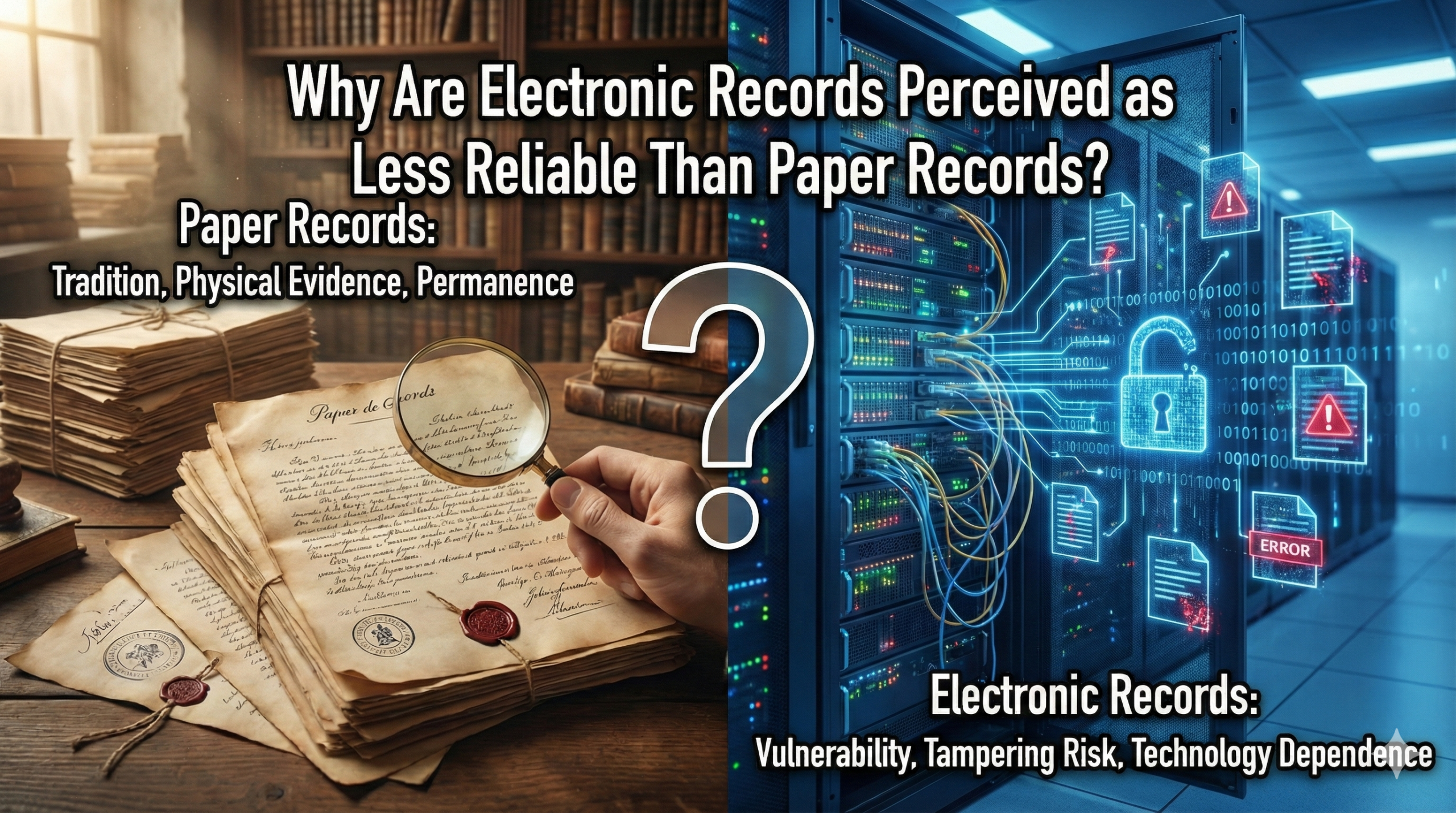
Why Are Electronic Records Perceived as Less Reliable Than Paper Records?
In today’s increasingly digital society, many records are transitioning from paper to electronic formats. However, for important contracts and official documents, paper documentation is still often trusted. Why haven’t convenient and efficient electronic records gained the same level of trust as paper records? The answer to this question relates to the fundamental challenge of how to ensure the “authenticity” of records.
The Source of “Evidentiary Power” in Paper Records
Handwriting as Unique Proof
Paper records, especially handwritten signatures, retain the unique “handwriting” of an individual. Authenticity can be determined through the specialized technique of handwriting analysis. For example, when signing an important contract by hand, the handwriting becomes physical evidence that “this person certainly wrote it.”
Specifically, subtle characteristics such as pen pressure variations, individual quirks in characters, and stroke order are recorded as unique personal traits. However, handwriting analysis is not perfect. According to scientific research, even trained examiners may misidentify handwriting from different individuals as being from the same person with a probability of approximately 3%. Nevertheless, while not as accurate as fingerprint authentication (which has a false acceptance rate of approximately 1 in 1 million), it functions as an effective means of individual identification.
It should be noted that the 3% error rate represents laboratory conditions. In real-world forensic scenarios, the reliability of handwriting analysis can vary significantly depending on the quality and quantity of samples available, the examiner’s experience, and the distinctiveness of the handwriting in question. Modern forensic document examination has also evolved to incorporate additional analytical methods beyond traditional visual comparison, including ink analysis, indentation examination, and digital imaging techniques.
Physical Characteristics That Leave Traces of Tampering
Because paper documents are physical entities, any tampering will inevitably leave traces. Differences in ink color, changes in paper condition, marks from correction tape, and other evidence of subsequent alterations remain physically present. Furthermore, the degree of paper deterioration and storage conditions also serve as clues for estimating when a document was created.
For example, if a portion of a contract that is several years old from the contract date has clearly been rewritten with new ink, that would be evidence of tampering. In this way, paper records benefit from “the passage of time” itself serving as a guarantee of authenticity.
Advanced forensic techniques can detect even sophisticated attempts at alteration. For instance, infrared and ultraviolet spectroscopy can reveal erasures, additions, or substitutions that may not be visible to the naked eye. Chemical analysis of ink composition can establish whether different portions of a document were created at different times. Electrostatic detection apparatus (ESDA) can reveal indented writing that indicates the order in which documents were created.
Reliability Challenges Faced by Electronic Records
Absence of Handwriting: Difficulty in Identifying the Creator
The greatest challenge with electronic records is the difficulty in proving “who created them.” Documents created on computers or smartphones lack the physical uniqueness of handwritten signatures. If the same font and text are used, it is nearly impossible to distinguish who created the document.
For example, consider an important email that someone sent. However, anyone who can log into that email account could create and send a similar email. In other words, proving that “this email was definitely created by Person A” is technically very difficult.
This challenge extends beyond simple authorship. Metadata associated with electronic files (such as creation dates, modification dates, and author information) can be easily manipulated. While operating systems and applications typically record this information automatically, it can be altered using readily available software tools or even simple manual editing of file properties. Unlike the physical aging of paper and ink, which occurs naturally and is difficult to falsify, digital timestamps rely entirely on the integrity of the system clock and file system, both of which can be compromised.
Risk of Impersonation
The risk of “impersonation” with electronic records is significantly higher compared to paper records. If passwords are leaked or accounts are hijacked, third parties can impersonate the legitimate user and create records.
As a real-world example, “business email compromise” scams, in which fake payment instructions are issued via emails impersonating company accounting staff, have become a global problem. Because they appear to be sent from the legitimate staff member’s email address, recipients believe them to be genuine. According to the FBI’s Internet Crime Complaint Center (IC3), business email compromise scams resulted in losses exceeding $2.7 billion in 2022 alone, affecting organizations worldwide.
The sophistication of these attacks has increased dramatically. Attackers use social engineering, spear phishing, and even AI-generated voice synthesis to impersonate executives or trusted colleagues. Multi-factor authentication (MFA) has emerged as a critical defense mechanism, but even MFA can be bypassed through techniques such as SIM swapping, session hijacking, or MFA fatigue attacks where attackers flood users with authentication requests until they approve one out of frustration.
Perfect Tampering is Possible
Electronic data can be tampered with without leaving traces. Even the date and time information of document files can be rewritten, making the information about “when it was created” potentially unreliable.
For example, if important meeting minutes are stored as electronic files, the content can be altered later without leaving traces if appropriate technical skills are applied. While countermeasure technologies such as timestamps exist, they are not applied to all electronic records.
The malleability of digital data presents unique challenges. Unlike paper, where any alteration disturbs the physical medium, digital files can be modified at the bit level with perfect fidelity. Sophisticated attackers can edit documents, adjust metadata, and even manipulate backup systems to create a consistent false record across multiple storage locations. This is particularly concerning for long-term record retention, where the integrity of historical data must be maintained over decades.
However, it’s important to note that modern digital forensics has developed sophisticated techniques to detect tampering. File system journals, write-once storage systems, cryptographic hash verification, and blockchain-based audit trails can provide strong evidence of document integrity. The key difference is that these protections must be intentionally implemented, whereas paper’s physical properties provide inherent (though not infallible) protection against undetected alteration.
Efforts to Bridge the Reliability Gap
Evolution of Digital Signature Technology
To enhance the reliability of electronic records, a technology called “digital signatures” has been developed. This is a mechanism that uses cryptographic technology to prove “who,” “when,” and “what content” was signed in a document.
Digital signatures use a “private key” possessed only by the signer to generate the signature, making impersonation difficult. Additionally, if the document content is tampered with even slightly, signature verification will fail, enabling detection of tampering.
Modern digital signature implementations rely on Public Key Infrastructure (PKI), which establishes a trust hierarchy through certificate authorities (CAs). These trusted third parties verify the identity of key holders and issue digital certificates that bind public keys to specific individuals or organizations. The most widely used standard is X.509, which forms the basis for secure communications on the internet (SSL/TLS certificates) as well as document signing.
Digital signatures offer several advantages over handwritten signatures. They provide non-repudiation (the signer cannot later deny having signed the document), integrity verification (any alteration to the signed document can be detected), and authentication (the signature proves the identity of the signer). The cryptographic strength of modern digital signatures, typically using algorithms such as RSA with 2048-bit keys or elliptic curve cryptography (ECC) with 256-bit keys, makes them computationally infeasible to forge with current technology.
Advanced digital signature standards such as PAdES (PDF Advanced Electronic Signatures), XAdES (XML Advanced Electronic Signatures), and CAdES (CMS Advanced Electronic Signatures) provide long-term validation capabilities. These standards address the challenge that cryptographic algorithms may become vulnerable over time as computing power increases, by incorporating timestamp authorities and archival mechanisms that can prove a signature was valid at the time it was created, even if the underlying cryptographic algorithm later becomes compromised.
Utilization of Blockchain Technology
In recent years, attempts have begun to prevent tampering with electronic records using blockchain technology. Blockchain is a mechanism that stores records as a “distributed ledger” in multiple locations and mutually verifies them.
Using this technology, tampering with records becomes virtually impossible. This is because even if one record is rewritten, a discrepancy arises with records stored in many other locations, and the fraud is immediately detected.
Blockchain technology has evolved significantly since Bitcoin’s introduction in 2009. Modern enterprise blockchain platforms such as Hyperledger Fabric, Ethereum for enterprise applications, and specialized document integrity platforms provide robust solutions for record management. These systems create an immutable audit trail where each transaction or document update is cryptographically linked to previous entries, forming a chain that cannot be altered retroactively without detection.
The application of blockchain to records management extends beyond simple tamper-evidence. Smart contracts (self-executing code stored on the blockchain) can automate complex business processes, enforce compliance rules, and manage multi-party workflows without requiring a central authority. For example, supply chain documentation, land registries, academic credentials, and medical records are increasingly being managed using blockchain-based systems that provide transparency, traceability, and tamper-resistance.
However, blockchain is not a panacea. The technology faces challenges including scalability limitations, energy consumption concerns (particularly for proof-of-work systems), privacy issues related to the permanent and public nature of some blockchain implementations, and the “oracle problem” (ensuring that data entered into the blockchain accurately represents real-world events). Newer consensus mechanisms such as proof-of-stake and permissioned blockchain architectures are addressing some of these concerns.
Development of Legal Frameworks
In addition to technical measures, legal frameworks are also being developed. Many countries have enacted “electronic signature laws,” and electronic signatures that meet certain requirements are now recognized as having the same legal validity as handwritten signatures.
In Japan, the Electronic Signatures Act was enacted in 2001, establishing the legal foundation for electronic contracts and electronic applications. This has expanded the use of electronic records in business settings.
The legal landscape for electronic records has become increasingly sophisticated globally. The European Union’s eIDAS Regulation (electronic IDentification, Authentication and trust Services), which came into effect in 2016, established a comprehensive framework for electronic signatures, seals, timestamps, and other trust services across EU member states. This regulation recognizes three levels of electronic signatures: simple electronic signatures, advanced electronic signatures, and qualified electronic signatures, with the latter having the same legal status as handwritten signatures.
In the United States, the Electronic Signatures in Global and National Commerce Act (ESIGN, 2000) and the Uniform Electronic Transactions Act (UETA, adopted by 47 states) provide legal recognition for electronic signatures and records in most contexts. These laws establish that electronic signatures and records cannot be denied legal effect solely because they are in electronic form.
The United Nations Commission on International Trade Law (UNCITRAL) Model Law on Electronic Signatures (2001) and the Model Law on Electronic Transferable Records (2017) provide frameworks that countries can adopt to harmonize their laws internationally. This harmonization is crucial for cross-border transactions and international commerce.
However, legal frameworks continue to evolve. Emerging issues include the legal status of blockchain-based records, the enforceability of smart contracts, liability for compromised digital signatures, data sovereignty and cross-border data transfers, and the intersection of electronic records with data privacy regulations such as GDPR and similar laws worldwide.
Industry-specific regulations also impose particular requirements. For example, the U.S. FDA’s 21 CFR Part 11 governs electronic records and signatures in pharmaceutical and medical device industries, requiring stringent validation, audit trails, and controls. Financial services face regulations such as SEC Rule 17a-4 regarding electronic record retention. Healthcare records must comply with HIPAA in the U.S. and similar regulations globally.
Future Outlook: From Coexistence to Integration of Paper and Electronic Records
Changes in Awareness Due to Generational Shifts
Younger generations tend to have less resistance to electronic records. For digital natives, electronic records are the “norm,” and with appropriate technical measures in place, they are increasingly perceived as having equal or greater reliability than paper.
Research supports this generational shift. Studies show that individuals born after 1990 are significantly more likely to trust digital authentication methods and are more comfortable with entirely paperless processes. This demographic is also more aware of the vulnerabilities of paper records (loss, fire, flood, physical deterioration) and appreciates the accessibility, searchability, and backup capabilities of electronic systems.
Educational institutions and government agencies are accelerating this transition. Many universities now issue digital diplomas with blockchain verification, governments offer digital identity systems, and businesses increasingly operate with digital-first or digital-only processes. This normalization of electronic records in everyday life builds familiarity and trust that extends to more critical applications.
Importance of Hybrid Approaches
For the time being, a “hybrid approach” that combines paper and electronic records is practical. It is effective to maintain paper originals for high-importance records while utilizing electronic records for routine operations.
For example, contracts can be concluded on paper with the original stored, while electronic copies are referenced for business operations. This enables both efficiency and reliability to coexist.
The hybrid approach acknowledges that different types of records have different risk profiles and regulatory requirements. Critical legal documents, long-term archival records, and items requiring multiple original signatures may benefit from paper originals. Meanwhile, transactional records, operational documents, and collaborative work products are often better managed electronically.
Organizations implementing hybrid systems must establish clear policies regarding which records require paper originals, how long electronic and paper versions must be retained, procedures for creating certified copies, and protocols for migrating records between formats when necessary. The goal is not to maintain duplicate systems indefinitely but to transition systematically as technology, regulations, and organizational capabilities mature.
New Trust Created by Technological Evolution
In the future, electronic records may surpass paper in reliability through technologies that combine biometric authentication with digital signatures and the development of AI-based fraud detection technologies. For example, digital signatures linked with fingerprints or facial recognition could enable identity verification that exceeds handwritten signatures.
Emerging technologies promise to address current limitations of electronic records:
Biometric Integration: Modern smartphones and devices incorporate fingerprint sensors, facial recognition, and even behavioral biometrics (such as typing patterns or gait analysis). When these are cryptographically bound to digital signatures, they provide strong multi-factor authentication that is extremely difficult to forge or transfer.
Zero-Knowledge Proofs: Advanced cryptographic techniques allow parties to prove they possess certain information (such as authorization to sign a document) without revealing the underlying credentials. This enhances privacy while maintaining authentication strength.
Quantum-Resistant Cryptography: As quantum computing advances, current encryption methods may become vulnerable. Post-quantum cryptographic algorithms are being standardized by NIST and other organizations to ensure long-term security of digital signatures and encrypted records.
Artificial Intelligence for Fraud Detection: Machine learning systems can analyze patterns in document creation, signing workflows, and access patterns to detect anomalies that may indicate fraud or unauthorized access. These systems can identify subtle indicators that human reviewers might miss, such as unusual signing times, atypical document routing, or statistical anomalies in document content.
Continuous Authentication: Rather than authenticating once at the beginning of a session, emerging systems continuously verify user identity through behavioral biometrics, ensuring that the person who initiated a transaction is the same person who completes it.
Decentralized Identity Systems: Self-sovereign identity frameworks allow individuals to control their own digital identities without relying on centralized authorities, using blockchain or distributed ledger technology to provide portable, verifiable credentials.
International Standards and Regulatory Developments
The convergence of international standards is facilitating global acceptance of electronic records. Key standards include:
ISO/IEC 27001: Information security management systems that provide frameworks for protecting electronic records.
ISO 14533: Processes, data elements and documents in commerce, industry and administration for long-term signature profiles, ensuring that digital signatures remain verifiable over extended periods.
ISO 32000 (PDF/A): Archival standards for electronic documents ensuring long-term preservation and accessibility.
ETSI Technical Specifications: European standards for advanced electronic signatures, seals, and timestamps that complement the eIDAS regulation.
Industry consortiums and standards bodies such as the Internet Engineering Task Force (IETF), World Wide Web Consortium (W3C), and various sector-specific organizations continue to develop protocols and best practices that enhance interoperability and trust in electronic records systems.
Practical Considerations for Implementation
Organizations transitioning to electronic records must address several practical considerations:
Change Management: Successful adoption requires training, clear communication about benefits and risks, and addressing concerns from stakeholders accustomed to paper processes.
Technology Infrastructure: Robust systems for electronic signature management, secure storage, backup and disaster recovery, access control, and audit logging are essential.
Vendor Selection: Organizations must carefully evaluate electronic signature and document management vendors based on security certifications, compliance with relevant regulations, long-term viability, and integration capabilities with existing systems.
Legacy Record Conversion: Strategies for digitizing existing paper records while maintaining their legal validity and evidentiary value require careful planning and execution.
Cross-Border Considerations: International operations must navigate varying legal requirements across jurisdictions, data localization laws, and mutual recognition of electronic signatures.
Conclusion
The main reasons electronic records are perceived as less reliable than paper records are the absence of unique evidence such as handwriting, and the higher risk of impersonation and tampering. However, these are challenges related to current technology and social maturity, and they are not inherent flaws in electronic records themselves.
Through various initiatives such as digital signatures, blockchain, and legal framework development, the reliability of electronic records is steadily improving. What is important is to appropriately implement technical measures and for users to understand how these mechanisms work.
It will take time for electronic records to gain the trust that paper records have built over many years. However, electronic records backed by appropriate technology and systems will balance efficiency and reliability, becoming the foundation of a richer digital society. We are called upon to adopt an attitude not of fearing new technology, but of correctly understanding its characteristics and appropriately utilizing them.
The future is not about choosing between paper and electronic records, but rather about understanding the strengths and appropriate applications of each medium. As technology continues to advance and as legal frameworks mature to accommodate new capabilities, electronic records will increasingly become the primary means of documentation for most purposes. However, this transition will be successful only if it is accompanied by robust security measures, clear legal frameworks, user education, and continued vigilance against evolving threats.
The journey from paper to electronic records represents more than a change in medium; it represents a fundamental transformation in how we create, authenticate, preserve, and trust information. By embracing this transformation thoughtfully and implementing it responsibly, we can build systems that are not only more efficient but ultimately more secure and reliable than what came before.
Summary Table: Comparison of Paper and Electronic Records
| Aspect | Paper Records | Electronic Records | Future Outlook |
| Authentication Method | Handwriting, signature | Digital signatures, biometrics | Multi-factor biometric integration |
| Tampering Detection | Physical traces (ink, paper) | Cryptographic verification | AI-enhanced detection, blockchain |
| Impersonation Risk | Moderate (handwriting forgery ~3% error) | High without proper security | Low with advanced authentication |
| Long-term Preservation | Physical deterioration, disaster risk | Digital obsolescence, media degradation | Cloud-based, redundant storage |
| Accessibility | Physical location required | Remote access possible | Ubiquitous access with security |
| Search & Retrieval | Manual, time-consuming | Instant, automated | AI-powered semantic search |
| Legal Status | Universally recognized | Increasingly recognized with proper implementation | Full equivalence expected |
| Cost | Storage space, physical security | IT infrastructure, cybersecurity | Decreasing with cloud solutions |
| Environmental Impact | Paper consumption, physical storage | Energy consumption for servers | Improving with green technology |
This comparison illustrates that while paper records have traditional advantages, electronic records offer significant benefits that, when properly implemented with modern security measures, can meet or exceed the reliability of paper while providing superior efficiency and accessibility.

Comment