
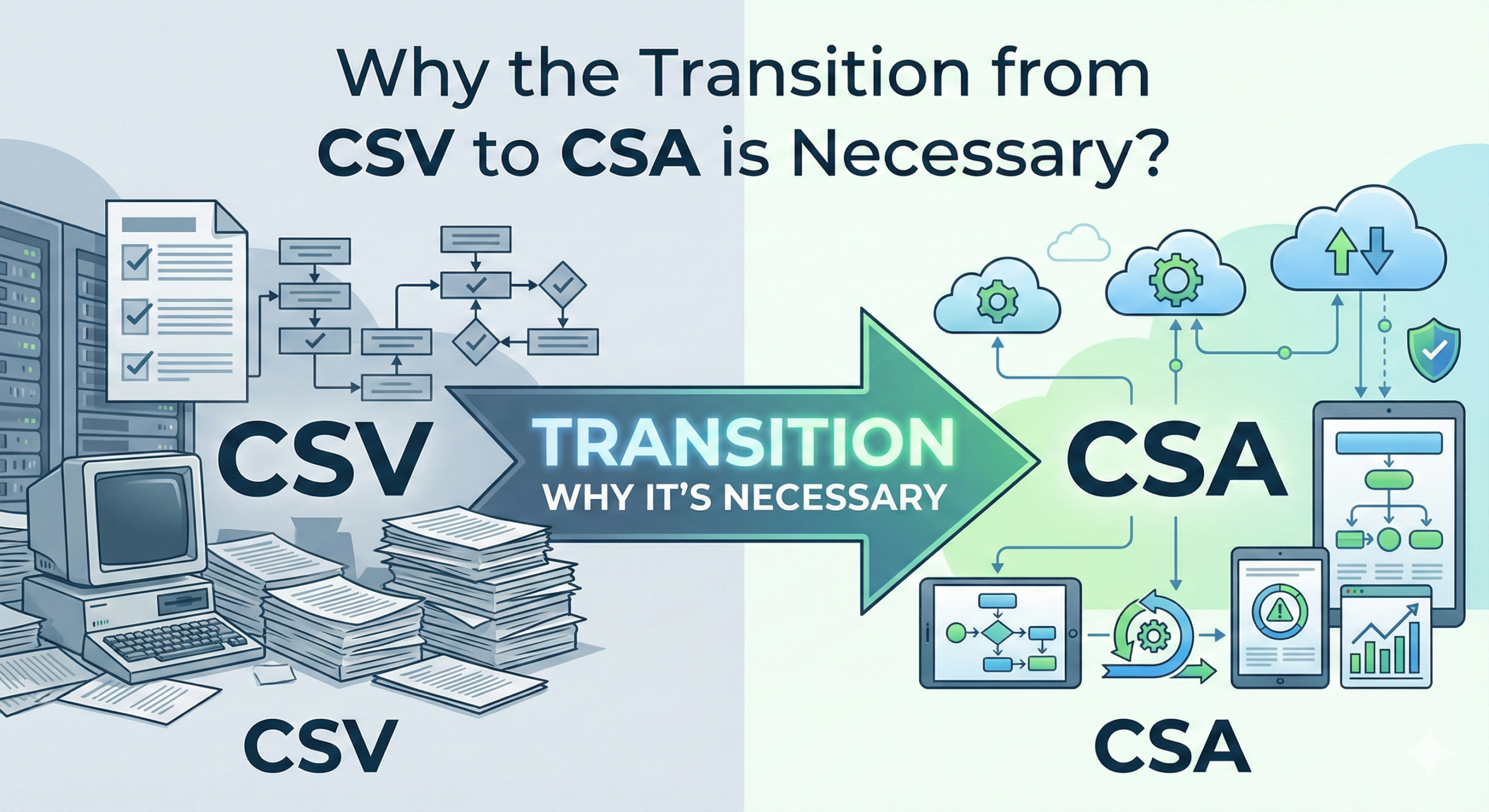
The transition from traditional Computer System Validation (CSV) to the new Computer Software Assurance (CSA) approach represents a critical transformation that significantly improves the efficiency and effectiveness of quality assurance activities in the pharmaceutical industry. By shifting from a documentation-centric approach to an actual verification and testing-centric approach, this evolution enables true quality assurance while maintaining regulatory compliance.
The Need for Transformation
Problems with the Traditional CSV Approach
The Reality of Documentation Burden
Traditional CSV has long been criticized for creating an overwhelming documentation burden that consumes approximately 70-80% of validation time and resources, leaving only 20-30% for actual testing and verification activities. This imbalance has been widely recognized across the pharmaceutical industry as a fundamental problem that affects all personnel responsible for validation work.
The excessive focus on formal documentation has led to a situation where form often takes precedence over substance. The sheer volume of paperwork required does not necessarily correlate with actual product quality, data integrity, or patient safety. Instead, the documentation-heavy approach can obscure critical quality issues beneath layers of procedural compliance activities.
Long-standing Industry Challenges
The traditional CSV approach has resulted in several persistent challenges. Limited resources are consumed inefficiently through excessive documentation requirements. The quantity of documentation does not necessarily correlate with the effectiveness of quality assurance. Compliance-focused activities can cause organizations to lose sight of the fundamental purpose of validation – ensuring that systems perform as intended and protect product quality and patient safety.
Furthermore, the rigid, one-size-fits-all approach to validation creates inflexibility that struggles to accommodate modern software development practices such as Agile methodologies, cloud computing, Software-as-a-Service (SaaS) platforms, and continuous integration/continuous deployment (CI/CD) approaches. These modern technologies demand a more adaptive and risk-based validation framework.
Characteristics of the CSA Approach
Fundamental Shift in Philosophy
The CSA approach represents a fundamental reversal of resource allocation priorities. Rather than dedicating the majority of effort to creating validation documentation, CSA emphasizes:
- Testing and verification activities: 70-80%
- Documentation activities: 20-30%
This shift enables organizations to focus resources on activities that directly contribute to quality assurance rather than on generating extensive documentation that may provide limited value in identifying actual quality risks.
Adoption of Risk-Based Principles
CSA is built on scientific risk assessment principles that recognize not all systems and functions carry equal risk to product quality, data integrity, or patient safety. The approach requires organizations to:
- Establish validation depth and rigor appropriate to the system’s importance and risk level
- Concentrate resources on high-risk areas where failures could significantly impact product quality or patient safety
- Apply scientifically justified and rational verification methods based on critical thinking rather than procedural checklists
- Scale assurance activities proportionally to the actual risk posed by the software function or operation
This risk-based approach aligns with broader quality management principles articulated in ICH Q9 (R1) Quality Risk Management and represents a more mature, thoughtful approach to computerized system validation.
Regulatory Authority Policy Shifts
FDA’s New Direction
The U.S. Food and Drug Administration (FDA) has been at the forefront of this regulatory evolution. On September 24, 2025, the FDA finalized its guidance document “Computer Software Assurance for Production and Quality System Software,” which had been in draft form since September 2022. This guidance represents a major departure from traditional validation expectations and supports the pharmaceutical industry’s adoption of innovative manufacturing technologies.
The FDA guidance:
- Explicitly recommends moving away from the traditional documentation-centric approach
- Supports more scientific and rational risk-based approaches to validation
- Acknowledges that Computer Software Assurance supersedes Section 6 (“Validation of Automated Process Equipment and Quality System Software”) of the FDA’s earlier “General Principles of Software Validation” guidance
- Recognizes that advances in manufacturing technologies, including automation, robotics, simulation, and digital capabilities, require more flexible validation frameworks
- Aligns with the FDA’s broader “Case for Quality” initiative, which promotes a shift from compliance-by-checklist to genuine quality-focused practices
The CSA guidance provides detailed frameworks for determining appropriate assurance activities based on risk assessment, including guidance on intended use definition, risk evaluation, and the establishment of appropriate records. It explicitly supports unscripted testing, exploratory testing, and reliance on vendor documentation where appropriate, rather than requiring exhaustive internally generated test protocols for all scenarios.
International Regulatory Alignment
The shift toward risk-based validation approaches is not limited to the United States but represents a global trend toward regulatory harmonization:
European Union: The European Commission and Pharmaceutical Inspection Co-operation Scheme (PIC/S) released draft revisions to EU GMP Annex 11 “Computerised Systems” on July 7, 2025, with the consultation period running through October 7, 2025. The revised Annex 11 expands from 5 pages to 19 pages and includes 17 sections, representing a comprehensive modernization effort. Key updates include:
- Enhanced requirements for lifecycle management of computerized systems
- Mandatory application of Quality Risk Management principles throughout all lifecycle stages
- Strengthened controls for data integrity, audit trails, electronic signatures, and system security
- Explicit requirements for qualifying and auditing system providers and external service providers
- Comprehensive cybersecurity requirements including firewalls, patch management, virus protection, penetration testing, and disaster recovery
- Recognition of hybrid systems (combined paper and electronic) with appropriate controls
- Introduction of system alarm management requirements
- Detailed requirements for periodic review of computerized systems
The draft also introduced Annex 22 “Artificial Intelligence,” establishing specific requirements for AI and machine learning systems used in pharmaceutical manufacturing – a regulatory milestone acknowledging these emerging technologies.
ISPE GAMP® 5 Second Edition: The International Society for Pharmaceutical Engineering (ISPE) published the GAMP® 5 Second Edition in July 2022, providing comprehensive industry guidance that bridges regulatory expectations with practical implementation. The Second Edition explicitly acknowledges and integrates CSA principles, emphasizing:
- Critical thinking as a core pillar of the validation framework
- Flexibility in applying Agile and iterative development methodologies
- Recognition of modern technologies including cloud computing, AI/ML, and blockchain
- Risk-based approaches to determine appropriate validation strategies
- Leveraging supplier capabilities and documentation where appropriate
- Focus on fitness-for-intended-use rather than rigid procedural compliance
The GAMP® 5 Second Edition clarifies that the V-Model should be viewed as a conceptual illustration of traceability rather than a mandatory sequential development process, enabling more flexible approaches that accommodate modern software development practices.
Quality Management System Regulation (QMSR): In February 2024, the FDA issued a final rule amending 21 CFR Part 820 to align more closely with ISO 13485:2016 “Medical devices – Quality management systems – Requirements for regulatory purposes.” This harmonization takes effect on February 2, 2026, and further supports the adoption of internationally recognized quality management principles, including risk-based approaches to validation.
Japan’s Response and Initiatives
Industry Association Activities
The Japan Pharmaceutical Manufacturers Association (JPMA), which represents research-based pharmaceutical companies operating in Japan, has been actively engaged in understanding and promoting the adoption of CSA principles. JPMA’s activities include:
- Conducting ongoing research and surveys related to CSA implementation
- Facilitating discussions within the industry regarding CSA adoption approaches
- Engaging in constructive dialogue with Japanese regulatory authorities (the Pharmaceuticals and Medical Devices Agency – PMDA and the Ministry of Health, Labour and Welfare – MHLW)
- Promoting understanding of international regulatory trends and their implications for Japanese pharmaceutical companies
Current Japanese Regulatory Framework
Japan’s current regulatory framework for computerized systems is based on the “Guideline on Management of Computerized Systems for Marketing Authorization Holders and Manufacturers of Drugs and Quasi-drugs,” issued by the Ministry of Health, Labour and Welfare in 2010 and effective from April 1, 2012. This guideline replaced an earlier 1992 guideline and was deliberately aligned with global standards including GAMP® 5, EU GMP Annex 11, and FDA 21 CFR Part 11.
The Japanese guideline:
- Applies to systems carrying out work under the Good Quality Practice (GQP) Ministerial Ordinance and Good Manufacturing Practice (GMP) Ministerial Ordinance
- Uses software categorization concepts consistent with GAMP® 5
- Proposes mechanisms for verifying simple software easily and complex software more rigorously based on risk
- Requires implementation of each computerized system in accordance with company-specific “Computerized System Management Rules”
- Covers system documentation, development, testing, validation, qualification, standard operating procedures, training, maintenance, security, backup and restoration, deviation management, and system retirement
While the current Japanese guideline has served the industry well, it has been in effect for over 13 years and predates many of the technological advances and regulatory thinking that have emerged since 2012. The guideline does not explicitly address modern technologies such as cloud computing, SaaS platforms, AI/ML systems, or Agile development methodologies. As a result, Japanese pharmaceutical companies face increasing challenges in efficiently applying the guideline to contemporary technology environments.
Recognition Within the Pharmaceutical Industry
Japanese pharmaceutical companies widely recognize the need to transition to CSA approaches. Industry professionals understand the burden of traditional documentation-heavy validation and anticipate relief from excessive paperwork requirements. There is growing enthusiasm for building more effective quality assurance systems that focus resources on activities that genuinely contribute to product quality and patient safety.
Industry experts in Japan have noted that while the current guideline provides practical guidance for CSV activities, applying it alone to achieve efficient and adequate validation has become increasingly difficult given technological progress. There is recognition that newer approaches such as CSA must be integrated to keep pace with evolving software technologies and global regulatory expectations.
Expected Benefits of the Transition
Improved Efficiency
Resource Optimization
The transition to CSA enables more effective utilization of limited human and temporal resources. By dramatically reducing the time spent on creating formal validation documentation, organizations can redirect effort toward:
- Actual verification and testing activities that directly assess system functionality
- Critical thinking and risk assessment to identify areas requiring enhanced scrutiny
- Investigation of system behavior under realistic operational conditions
- Timely resolution of issues discovered during testing
This rebalancing of effort allocation represents one of the most tangible benefits of CSA adoption.
Cost Reduction Effects
The reduction in excessive documentation activities yields significant cost savings across multiple dimensions:
- Direct Labor Costs: Fewer person-hours spent creating, reviewing, and approving voluminous validation documents
- Indirect Costs: Reduced printing, storage, and document management infrastructure requirements
- Efficiency Gains: Faster time-to-validation for new systems and system changes, enabling more rapid implementation of improvements
- Long-term Operational Costs: More streamlined processes for ongoing validation maintenance and periodic review activities
Organizations that have piloted CSA approaches report documentation reductions of 50-80% for certain types of systems and changes, with corresponding reductions in validation timelines and costs.
Enhanced Effectiveness of Quality Assurance
True Quality Assurance
CSA shifts focus from demonstrating compliance through documentation to demonstrating quality through actual system performance assessment. This enables:
- Emphasis on verifying actual system operation and behavior rather than confirming document completeness
- Risk-appropriate validation depth ensuring critical functions receive thorough scrutiny while low-risk functions receive proportional attention
- Quality determinations based on scientific evidence and rational assessment rather than procedural checkboxes
- Greater confidence that validated systems will perform reliably in actual operational environments
By focusing on what truly matters – that the system operates correctly and maintains data integrity – CSA delivers genuine quality assurance rather than an illusion of quality through documentation volume.
Promotion of Continuous Improvement
The CSA approach naturally supports ongoing quality enhancement through:
- Continuous improvement based on actual operational data and system performance monitoring
- More rapid identification and response to emerging issues
- Evaluation frameworks based on system effectiveness and actual outcomes
- Flexibility to adapt validation approaches as systems evolve and technologies advance
Rather than treating validation as a one-time activity completed before system deployment, CSA encourages viewing assurance as an ongoing lifecycle activity that continuously reinforces confidence in system performance.
Implementation Challenges and Countermeasures
Organizational Challenges
Mindset Transformation
Perhaps the most significant challenge in transitioning to CSA is the fundamental shift in thinking required:
- Breaking from Documentation-Centric Thinking: Personnel accustomed to equating validation with documentation volume must learn to prioritize actual testing and verification
- Embracing Risk-Based Thinking: Organizations must develop capabilities in risk assessment and learn to apply differentiated validation strategies based on risk rather than uniform approaches
- Recognizing the Essential Value of Quality Assurance: The focus must shift from “checking compliance boxes” to genuine assessment of system fitness-for-intended-use
This cultural transformation cannot be achieved overnight and requires sustained commitment from leadership and quality professionals.
Skills and Knowledge Development
Successful CSA implementation demands enhanced capabilities across the organization:
- CSA Methodology Training: Personnel must understand CSA principles, risk-based approaches, and how to determine appropriate assurance activities
- Risk Assessment Competency: Teams need practical skills in identifying and evaluating risks to product quality, data integrity, and patient safety
- Modern Validation Techniques: Understanding of unscripted testing, exploratory testing, and how to leverage supplier documentation appropriately
- Critical Thinking Development: Ability to apply judgment and scientific reasoning rather than following procedural checklists blindly
Organizations must invest in comprehensive training programs to build these capabilities systematically.
Implementation Strategies
Phased Introduction
A prudent approach to CSA adoption involves staged implementation:
-
Pilot Projects: Select appropriate systems for initial CSA application, ideally systems with:
- Well-understood processes and risks
- Supportive stakeholders willing to try new approaches
- Manageable scope allowing thorough evaluation of CSA principles
-
Learning and Refinement: Capture lessons learned from pilot projects, refine approaches based on practical experience, and document successes and challenges
-
Horizontal Deployment: Expand CSA application to additional systems and processes, leveraging pilot project experiences
-
Organizational Scale-Up: Gradually extend CSA principles throughout the validation program while maintaining regulatory compliance
This phased approach allows organizations to build confidence and competence progressively rather than attempting wholesale transformation immediately.
Ongoing Education and Training
Sustained educational efforts are essential for successful CSA adoption:
- Continuous Education Programs: Regular training on CSA principles, regulatory expectations, and best practices
- Practical Training: Hands-on workshops and exercises applying CSA concepts to realistic scenarios
- Industry Knowledge Sharing: Participation in industry forums, professional associations, and collaborative initiatives to learn from peer experiences
- Regulatory Updates: Ongoing awareness of evolving regulatory guidance and expectations
Organizations should view CSA education as a long-term investment rather than a one-time training event.
Regulatory Engagement
Proactive engagement with regulatory authorities can facilitate successful CSA adoption:
- Early Dialogue: Discuss CSA implementation plans with inspectors during pre-approval inspections or periodic GMP inspections
- Transparency: Clearly document the rationale for CSA approaches and be prepared to explain risk assessments and validation strategies
- Industry Collaboration: Participate in industry associations and regulatory meetings to contribute to evolving guidance and share practical experiences
Conclusion
The transition from CSV to CSA represents a fundamental reform of quality assurance activities in the pharmaceutical industry. This shift from documentation-heavy traditional approaches to verification and testing-focused modern approaches is expected to deliver substantial benefits:
Significantly Enhanced Efficiency: Dedicating 70-80% of resources to actual verification activities rather than documentation creation, enabling more thorough and meaningful assessment of system quality with the same or fewer resources.
Realization of True Quality Assurance: Quality assurance based on actual system operation verification and risk-appropriate validation depth, providing genuine confidence in system performance rather than an illusion of quality through documentation volume.
Maintenance of Regulatory Compliance: Satisfying regulatory requirements while adopting more rational, scientifically justified approaches that align with regulators’ evolving expectations and international harmonization trends.
Continuous Improvement: Sustainable quality enhancement based on actual data, operational performance monitoring, and flexible adaptation to evolving technologies and risks.
This transformation is not merely a change in methodology but rather a return to the fundamental essence of quality assurance – ensuring that systems perform as intended, maintain data integrity, and protect product quality and patient safety. The transition requires commitment, cultural change, skill development, and sustained effort, but the benefits for quality, efficiency, and regulatory compliance justify the investment.
The convergence of FDA’s finalized CSA guidance (September 2025), the EU’s comprehensive revision of Annex 11 and introduction of Annex 22 (consultation through October 2025), ISPE’s GAMP® 5 Second Edition (2022), and the upcoming FDA QMSR harmonization with ISO 13485 (effective February 2026) creates unprecedented momentum for this transformation. Organizations that proactively embrace CSA principles will be better positioned to leverage modern technologies, optimize validation resources, and demonstrate genuine quality assurance to regulators and patients.
Active engagement across the entire pharmaceutical industry is essential to realize the full benefits of this important evolution. Through collaborative efforts involving industry associations, regulatory authorities, and individual companies, the transition from CSV to CSA can deliver on its promise of more efficient, effective, and scientifically sound quality assurance practices.
Note: This document is based on research materials from the Japan Pharmaceutical Manufacturers Association (JPMA), FDA guidance documents (including the finalized “Computer Software Assurance for Production and Quality System Software” from September 2025), ISPE GAMP® 5 Second Edition (2022), draft EU GMP Annex 11 and Annex 22 (July 2025), and insights from industry experts. Organizations implementing CSA approaches should consult the most current regulatory guidance applicable to their specific circumstances and jurisdictions.

Comment