
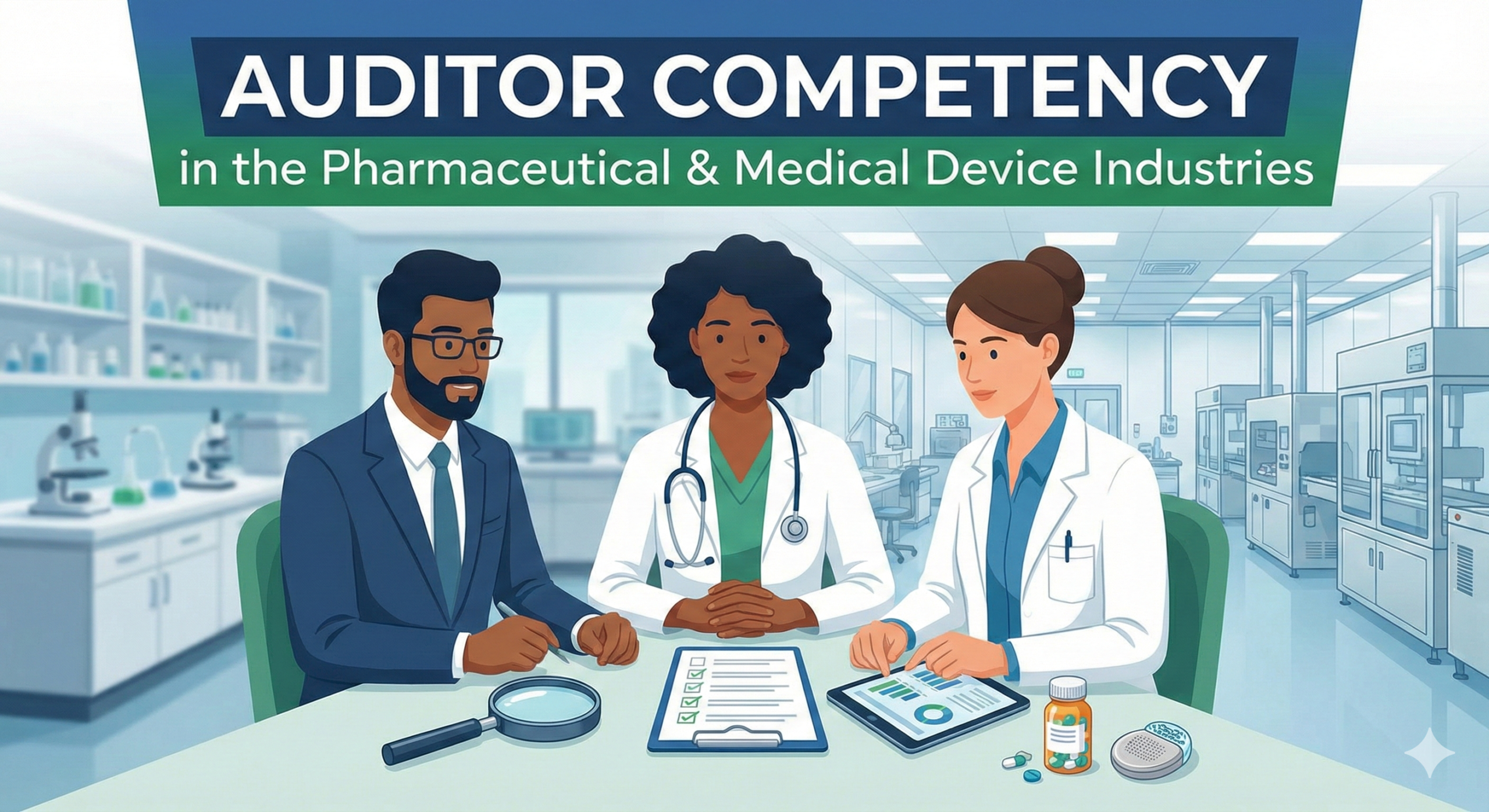
Auditor Competency in the Pharmaceutical and Medical Device Industries
The Role and Responsibilities of Auditors
Auditors are not merely “inspectors.” Beyond evaluating compliance with regulations and standards, they play a crucial role in verifying the effectiveness of an organization’s processes and quality systems, as well as identifying potential risks. In the pharmaceutical and medical device industries in particular, where strict adherence to standards such as GMP (Good Manufacturing Practice) and QMS (Quality Management System) is required, auditor judgment has a significant impact on an organization’s overall quality assurance activities.
The role of auditors has evolved significantly in recent years. Modern auditors are expected to go beyond simple checklist-based compliance verification and adopt a risk-based approach that focuses on areas of highest concern. This evolution reflects regulatory trends such as ICH Q9 (Quality Risk Management) and ICH Q10 (Pharmaceutical Quality System), which emphasize the integration of risk management principles throughout the product lifecycle.
Fundamental Competencies Required of Auditors
1. Specialized Knowledge and Practical Experience
Auditors require deep knowledge in the following areas:
Regulatory Knowledge:
- Relevant laws and regulations (Pharmaceutical and Medical Device Act, GMP/QMS ministerial ordinances, FDA regulations including 21 CFR Parts 210, 211, 820, EU GMP Annex 1, etc.)
- Industry guidelines (ICH guidelines such as Q7, Q9, Q10; ISO standards including ISO 13485 for medical devices; PIC/S guidelines)
- Recent regulatory updates such as Annex 1 revision (effective August 2023), EU GMP Chapter 3 updates, and FDA’s emphasis on data integrity (ALCOA+ principles)
Technical Knowledge:
- Product-specific knowledge and manufacturing process understanding
- Risk management principles including FMEA (Failure Mode and Effects Analysis), HACCP (Hazard Analysis and Critical Control Points), and other risk assessment methodologies
- Data integrity requirements and computerized system validation (CSV) including emerging topics such as cloud computing validation and AI/ML applications in pharmaceutical manufacturing
- Contamination control strategies, particularly for sterile products
These bodies of knowledge form the foundation for properly evaluating the compliance of audit subjects.
What is particularly important is practical experience in the area being audited. For example, auditors examining manufacturing operations need manufacturing experience, and auditors evaluating laboratory testing (QC) require testing experience. Practical experience enables auditors to understand process details and potential risk points, allowing them to identify substantive rather than merely formal issues. Even when documentation appears compliant on paper, the ability to detect “something doesn’t feel right” based on practical experience is a hallmark of an excellent auditor.
This intuition, sometimes called “professional skepticism,” is developed through years of hands-on experience and exposure to various situations. It allows seasoned auditors to notice subtle inconsistencies between documented procedures and actual practices, recognize patterns that may indicate systemic issues, and ask probing questions that reveal underlying problems.
2. Auditing Techniques
Knowledge alone does not make an excellent auditor. Technical skills for conducting effective audits are also necessary:
Core Auditing Skills:
- Interview techniques (constructing appropriate questions that encourage open dialogue and reveal actual practices)
- Record review methods (extracting critical information from vast amounts of documentation)
- Sampling methodologies (determining appropriate sample sizes and selection criteria based on statistical principles and risk assessment)
- Observation skills (discovering anomalies and inconsistencies at the site through careful attention to details)
- Analytical thinking (connecting information and grasping the overall picture to identify systemic issues)
Advanced Techniques:
- Root cause analysis methodologies (5 Whys, Fishbone diagrams, etc.)
- Trend analysis to identify patterns that may indicate systemic weaknesses
- Process mapping and gap analysis
- Effective use of audit trails in computerized systems
Modern auditors must also be proficient in reviewing electronic records and understanding data integrity principles, as the industry increasingly moves toward paperless operations and relies on complex computerized systems.
3. Communication Skills
Auditing is fundamentally a “dialogue.” Without appropriate communication with the auditee, it is impossible to identify true problems:
Essential Communication Elements:
- Presenting clear and concise questions
- Active listening that goes beyond hearing words to understanding context and concerns
- Reading non-verbal communication cues such as body language and tone
- Constructively communicating findings in a way that promotes improvement rather than defensiveness
- Building rapport and trust with auditees to facilitate open discussion
- Adapting communication style to different audiences (operators, managers, executives)
Effective auditors understand that creating a collaborative rather than adversarial atmosphere leads to more productive audits and better outcomes. They know how to balance professional skepticism with respect for the auditee’s expertise and efforts.
4. Ethical Qualities
Auditors must possess high ethical standards and act according to the following principles:
Core Ethical Principles:
- Independence and impartiality (freedom from conflicts of interest and undue influence)
- Confidentiality (protecting sensitive business and proprietary information)
- Integrity and professional skepticism (maintaining objectivity while questioning assumptions)
- Evidence-based judgment (drawing conclusions based on verifiable facts rather than assumptions)
- Objectivity in reporting regardless of organizational pressures
- Continuous professional development and staying current with evolving regulations and industry practices
These ethical principles are particularly critical in situations where commercial pressures may conflict with quality requirements, or where auditors may face pressure to overlook issues or expedite approval processes.
Key Points for Improving Auditor Competency
The Value of Diverse Experience
Experiencing audits of various manufacturing sites, products, and processes broadens an auditor’s perspective and improves judgment. It is desirable to accumulate as many different audit experiences as possible. Each audit provides learning opportunities:
- Different manufacturing technologies and equipment
- Various organizational structures and quality cultures
- Different approaches to meeting the same regulatory requirements
- Diverse CAPA (Corrective and Preventive Action) systems and their effectiveness
- Different levels of automation and computerized system sophistication
This diversity of experience enables auditors to recognize best practices, identify red flags more quickly, and provide more valuable recommendations for improvement.
The Difference Between “Company-Grown” and Job-Changers
Challenges for Company-Grown Auditors: Company-grown auditors face unique challenges. They tend to view their company’s quality system as “the norm,” making it difficult to recognize latent risks. When someone has only known one way of doing things, they may accept practices as standard without questioning whether they represent optimal approaches or even adequate controls.
This phenomenon, sometimes called “organizational blindness,” can result in missed opportunities for improvement and failure to identify risks that would be obvious to someone with exposure to different systems.
Advantages of Job-Changers: On the other hand, those with experience at multiple companies can compare at least two quality systems, giving them an advantage in recognizing risks hidden in practices considered “normal.” They bring fresh perspectives and can more readily identify:
- Practices that create unnecessary complexity or inefficiency
- Controls that are stronger or weaker than industry norms
- Opportunities to adopt proven practices from other organizations
- Assumptions that may not be valid or adequately supported
The Strength of External Experts
FDA inspectors and consultants can conduct effective audits and inspections because they have experience observing the quality systems, deviation cases, and CAPAs of many companies. Knowledge of various cases enables them to compare “good examples” with “bad examples” and accurately point out problems and areas for improvement.
What External Experts Bring:
- Pattern recognition across multiple organizations
- Benchmark understanding of industry best practices
- Experience with diverse regulatory interpretations
- Knowledge of common pitfalls and how to avoid them
- Fresh, unbiased perspective on organizational practices
External auditors and consultants often maintain databases of observations, findings, and best practices gathered across many audits, allowing them to provide valuable comparative insights. They can share anonymized examples that help organizations understand where they stand relative to industry norms.
Team Composition and Competency Development
Understanding the quality systems of multiple companies generates the perspective that “there is not just one correct answer,” enabling more fundamental quality risk assessment. Therefore, it is effective to place personnel with various backgrounds on audit teams.
Benefits of Diverse Audit Teams:
| Team Composition Element | Benefit to Audit Quality |
| Mix of company-grown and external hires | Combines institutional knowledge with fresh perspectives |
| Different functional backgrounds (manufacturing, QC, QA, regulatory) | Ensures comprehensive coverage of all quality system elements |
| Varying experience levels | Balances deep expertise with questioning of assumptions |
| Cross-site or cross-division representation | Enables internal benchmarking and sharing of best practices |
| Inclusion of subject matter experts | Provides deep technical insight for specialized areas |
This diversity of perspective helps audit teams avoid groupthink and ensures more thorough examination of potential risks.
Methods for Improving Competency of Company-Grown Auditors
Even company-grown auditors can enhance their auditing abilities through effective methods. One particularly powerful approach is actively conducting supplier audits. Observing the quality systems of different companies broadens perspective and enables objective evaluation of one’s own company’s system.
Strategic Use of Supplier Audits:
What is crucial here is auditing not only poorly performing suppliers but also high-quality suppliers and learning from their best practices. Suppliers with excellent quality systems provide valuable insights for improvements that can be adopted by one’s own company.
By utilizing supplier audits as “learning opportunities,” even company-grown auditors can significantly expand their perspective and capabilities. This approach offers several specific benefits:
- Exposure to different documentation systems and formats
- Observation of various approaches to process control and monitoring
- Understanding of different organizational structures for quality management
- Learning alternative ways to conduct training and competency assessment
- Seeing different technologies and levels of automation
- Understanding various approaches to managing change control and deviations
Beyond Supplier Audits:
Company-grown auditors can also enhance their competency through:
- Participating in industry conferences and workshops
- Engaging in cross-functional projects that expose them to different parts of the organization
- Pursuing professional certifications (such as ASQ Certified Quality Auditor, RAB/QSA Lead Auditor certifications)
- Mentoring relationships with experienced external auditors
- Reviewing publicly available warning letters, FDA 483s, and consent decrees to learn from others’ compliance failures
- Participating in mock regulatory inspections
- Cross-training in different functional areas within their organization
Continuous Professional Development
The regulatory landscape and industry practices continue to evolve. Effective auditors commit to continuous learning through:
- Regular training on regulatory updates
- Staying current with industry publications and guidance documents
- Participating in professional organizations and networks
- Attending relevant conferences and seminars
- Engaging in peer discussions and case study reviews
- Seeking feedback on their own audit performance and working to improve
Organizations should support auditor development through structured training programs, mentoring systems, and opportunities for varied audit experiences. The investment in auditor competency directly translates to better quality oversight and reduced compliance risk.
Conclusion
Auditor competency is not static but rather a continuously developing capability built through knowledge acquisition, practical experience, skill development, and ethical conduct. Organizations in the pharmaceutical and medical device industries must recognize the critical importance of auditor competency and invest in developing robust audit programs staffed by well-trained, experienced auditors with diverse backgrounds.
The most effective approach combines thorough training in regulatory requirements and audit techniques with extensive practical experience across diverse settings. By fostering auditor development through supplier audits, cross-functional experiences, and continuous learning, organizations can build audit capabilities that truly protect product quality and patient safety while promoting continuous improvement in quality systems.
As regulatory expectations continue to evolve and quality systems become increasingly sophisticated, the role of competent auditors becomes ever more critical. Organizations that prioritize auditor competency development position themselves for sustained compliance and quality excellence.

Comment