
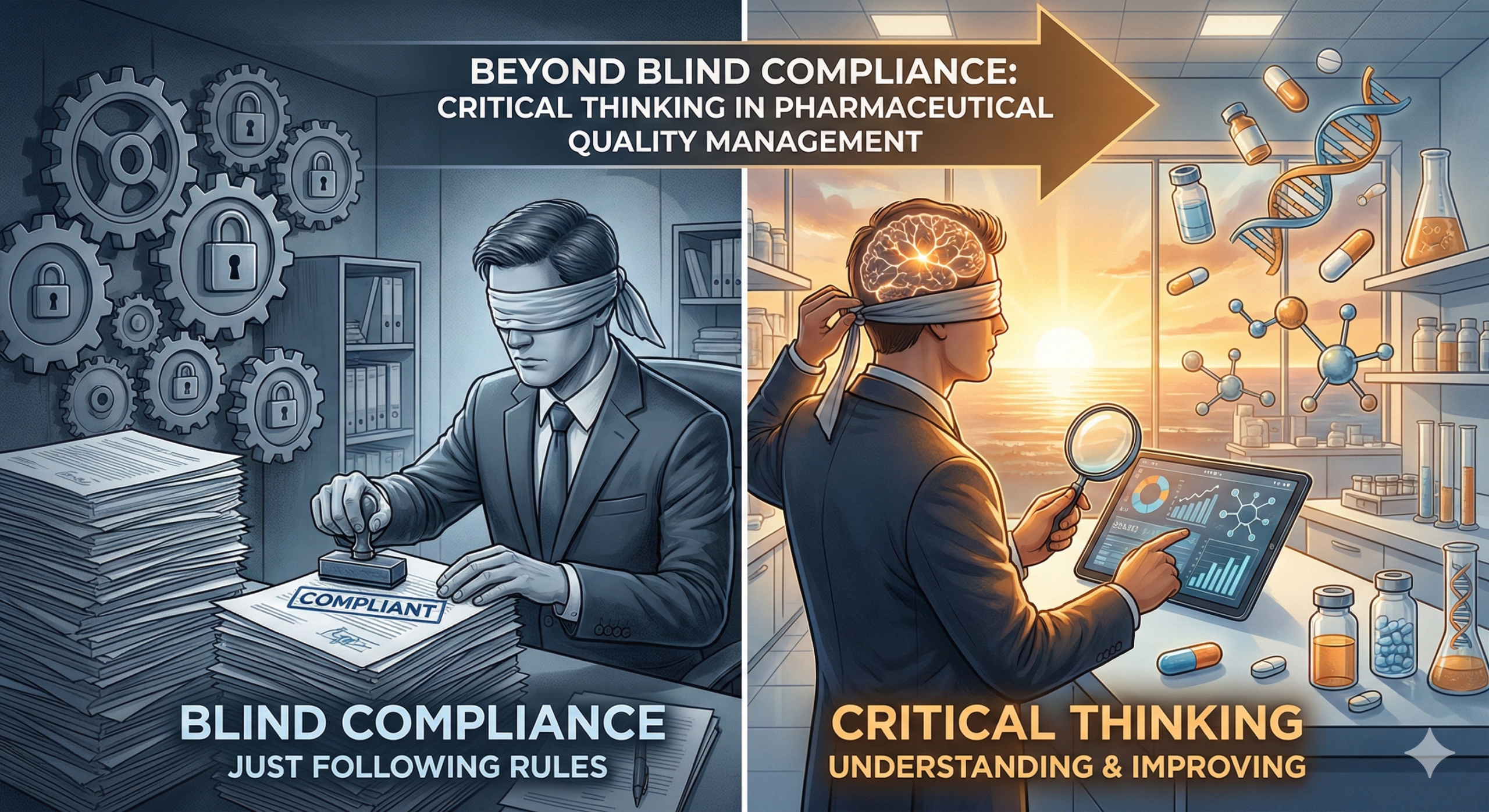
Introduction to Blind Compliance
Throughout my consultations with pharmaceutical and medical device companies, I have frequently observed a phenomenon in Japanese enterprises that I call “Blind Compliance” – the tendency to follow rules without questioning their purpose or applicability.
There is a characteristic trait among Japanese professionals: once a standard or criterion is established, they find comfort in its existence and tend to follow it blindly. Put simply, Japanese people are fond of prescribed standards.
In Japan, GMP is officially titled “Standards for Manufacturing Control and Quality Control of Drugs” (医薬品の製造管理及び品質管理に関する基準). However, despite this nomenclature, if you examine any provision within the GMP regulations, you will find that no specific numerical standards or criteria are actually prescribed. The regulations provide principles and requirements, but not rigid benchmarks.
During seminars and consultations, I frequently receive questions such as “Is there a good criterion for making this judgment?” People seem to prefer being given standards because it makes decision-making easier. However, this represents an abandonment of critical thinking. They have stopped using their own minds to evaluate situations.
The Era of Risk-Based Approaches
We are now in the era of risk-based approaches. Each company must allocate time, effort, and cost toward compliance differently based on the risks associated with their products and processes. Furthermore, these judgments must be supported by documented rationale and scientific evidence.
The Ministry of Health, Labour and Welfare’s “Guideline for Appropriate Management of Computerized Systems” (コンピュータ化システム適正管理ガイドライン), issued on October 21, 2010 and implemented on April 1, 2012, presents a category classification system. The guideline stipulates that different deliverables should be created depending on the category assigned to a system.
However, there are virtually no examples of category classification being used in the regulatory requirements for computerized system validation (CSV) in other countries. Most regulatory authorities require a risk-based approach instead of rigid category systems.
In this manner, when Japanese companies are provided with any kind of standard or criterion, they immediately comply with it and attempt to implement it exactly as written. This demonstrates that Japanese enterprises are extremely uncomfortable with independent thinking and decision-making.
When I conduct consultations and review Standard Operating Procedures (SOPs), I often ask “Why is this process structured this way?” The typical response is “I’m not sure, but this is how we’ve always done it at our company.” This reveals that people are not thinking about the purpose or goal of their work and operations.
The Importance of Critical Thinking
Japanese companies also struggle with critical thinking. A fundamental aspect of critical thinking is questioning assumptions and premises. It is essential to constantly consider the purpose of each process or task.
What is truly important in pharmaceutical and medical device manufacturing is assuring product quality and ensuring patient safety. It is not about creating extensive documentation simply for the sake of documentation. Most records created are never used afterward and are generated merely to satisfy regulatory inspections.
Companies should not be working for the sake of inspections. Rather, they must execute their operations for the benefit of patients and end users.
I also frequently receive questions such as: “Which records require signatures?” “Is a handwritten signature necessary for approval?” “Must we show signed records during FDA inspections?” These questions are fundamentally nonsensical. Signatures do not directly impact product quality or patient safety. What matters is not the procedural formality but the results achieved. Since you are professionals in your own business processes, you should be able to explain your approach confidently with proper justification.
If an FDA inspector requests copies of records, you can simply provide photocopies of the original signed documents. There is no requirement to physically retrieve paper-based signed records during an inspection to show signatures to the inspector.
Scottie Tissue Design: A Case Study in Critical Thinking
The design of Scottie tissue paper packaging serves as an excellent example of how critical thinking can challenge conventional assumptions and lead to superior outcomes.
In 1986, Sanyo Scott (now Nippon Paper Crecia) organized an international design competition to redesign their tissue paper packaging. Approximately 20 designers from around the world were invited to participate in this unprecedented competition for tissue paper packaging.
The competition brief established two mandatory conditions: “The design must feature a floral pattern” and “The provided logo must be used.”
Mr. Makoto Matsunaga, a renowned Japanese graphic designer, faced a dilemma. While he personally loved flowers, he recognized that floral patterns are not universally appropriate. In a simple, minimalist room with no decorations, a floral pattern might be acceptable. However, in a typical cluttered Japanese living space, a tissue box with an assertive floral pattern would be visually intrusive. What he genuinely wanted for himself was a simple, pure white box that could be discreetly placed in a corner of any room.
Mr. Matsunaga understood that following the competition rules exactly would not win. Therefore, he decided to interpret the floral requirement creatively by using stripes – a neutral pattern that belongs to everyone and no one simultaneously. In retrospect, he realized he was intuitively mimicking the layered cross-section of tissues inside the box, which naturally forms a striped pattern.
Having decided on the box design, the logo remained. The logo needed to be carefully crafted to match the simple box design, making its form critically important. However, the logo provided by Sanyo Scott did not meet the standards required for this concept. Mr. Matsunaga spent six months creating an entirely new logo from scratch. He designed a soft, flowing logo that embodied the “gentleness” and “smoothness” that tissue paper must possess.
Mr. Matsunaga ultimately won the competition, and his design was adopted for Scottie tissue paper. This design has remained virtually unchanged for nearly 40 years and continues to be loved by consumers today.
Mr. Matsunaga later reflected: “Breaking the competition rules was not my objective. Breaking rules is very risky. Therefore, you should only break rules when you have something that transcends those rules.” These words embody the pride and spirit of a true professional designer.
Implications for Regulatory Compliance
This case study from the design world offers profound insights for pharmaceutical and medical device industries operating under complex regulatory frameworks.
The key lesson is that true compliance is not about blindly following every written rule or standard. Rather, it requires understanding the underlying purpose and intent of regulations, then applying professional judgment to achieve the actual objectives – product quality and patient safety.
Modern regulatory frameworks, including ICH Q9(R1) Quality Risk Management (revised in 2023) and PIC/S GMP Annex 11 Computerised Systems (issued in 2011, with revision currently under development), all emphasize risk-based approaches. These guidelines explicitly recognize that:
-
Formality should be proportional to risk: Not all situations require the same level of documentation, validation, or procedural rigor. The level of effort should correspond to the criticality of the system or process.
-
Professional judgment is essential: Regulations provide principles and frameworks, but professionals must apply these intelligently within their specific contexts.
-
Context matters: What is appropriate for one product, process, or organization may not be appropriate for another.
| Traditional Approach | Modern Risk-Based Approach |
|---|---|
| Apply maximum controls to everything | Apply controls proportional to risk |
| Follow written procedures exactly | Understand intent and apply appropriately |
| Extensive documentation for all activities | Documentation commensurate with risk |
| One-size-fits-all validation | Validation strategy based on system criticality |
| Focus on procedural compliance | Focus on outcomes and patient safety |
Practical Applications
How should pharmaceutical and medical device professionals implement this more thoughtful approach to compliance?
Ask “Why?” Constantly: When implementing or following any procedure, understand its purpose. If you cannot articulate why a specific requirement exists, investigate until you can. If the requirement no longer serves its intended purpose, question whether modification is appropriate.
Document Your Rationale: When making risk-based decisions, document not just what you decided, but why you made that decision. This demonstrates that choices were deliberate and based on sound reasoning rather than arbitrary or blind compliance.
Distinguish Between Principles and Examples: Regulatory guidance often provides examples of acceptable approaches. Remember that examples are not requirements – they are illustrations. If you have a scientifically sound alternative that achieves the same objective, it may be equally or more appropriate.
Embrace Professional Responsibility: As professionals, you have the responsibility and authority to make informed decisions about your processes and products. This requires maintaining current knowledge, understanding scientific principles, and having the courage to justify your approaches.
Balance Compliance with Innovation: The goal of regulation is to ensure quality and safety, not to stifle innovation or create unnecessary burden. When faced with new technologies or novel approaches, consider how regulatory principles apply rather than abandoning innovation because no specific guidance exists.
Addressing Common Misconceptions
Several misconceptions perpetuate blind compliance behavior:
Misconception 1: “More documentation always means better compliance.” Reality: Documentation should be meaningful and proportional to risk. Excessive documentation can obscure important information and waste resources that could be better spent on quality assurance activities.
Misconception 2: “We must do exactly what regulators did in previous inspections.” Reality: Inspections examine specific situations at specific times. What was examined or questioned in one inspection does not create universal requirements. Each company must justify its own approach based on its specific circumstances.
Misconception 3: “If guidance provides an example, we must follow that example.” Reality: Guidance examples are illustrative, not prescriptive. You may use different approaches if they achieve the same objectives and are scientifically justified.
Misconception 4: “Changing our approach shows we were wrong before.” Reality: Continuous improvement is expected and encouraged. Updating practices based on new knowledge, technology, or understanding demonstrates professional maturity and commitment to quality.
The Role of Regulators and Industry Associations
Both regulatory authorities and industry organizations have responsibilities in moving beyond blind compliance culture:
Regulatory Authorities Should:
- Emphasize principles over prescriptive requirements
- Provide clear explanations of regulatory intent
- Recognize and commend innovative, scientifically sound approaches
- Avoid creating de facto standards through enforcement actions
Industry Associations Should:
- Promote education on regulatory intent and risk-based thinking
- Share case studies demonstrating successful risk-based approaches
- Facilitate dialogue between regulators and industry
- Develop guidance that explains principles rather than prescribing specific methods
Individual Companies Should:
- Invest in employee education on scientific principles and critical thinking
- Create a culture that encourages questioning and continuous improvement
- Document the rationale for risk-based decisions
- Share knowledge and best practices within their organizations
International Perspectives and Harmonization
The global nature of pharmaceutical and medical device industries makes harmonization efforts critical. ICH guidelines, including ICH Q9(R1), provide internationally agreed frameworks that emphasize:
Quality Risk Management Principles: Risk assessment, risk control, risk communication, and risk review should be integrated throughout the product lifecycle. The level of formality applied should be commensurate with the magnitude of risk.
Data Integrity: The focus should be on ensuring data is attributable, legible, contemporaneous, original, and accurate (ALCOA principles) – the fundamental principles matter more than specific procedural requirements.
Knowledge Management: Systematic approaches to acquiring, analyzing, and using knowledge should guide decision-making. This requires critical thinking rather than rote compliance.
Supply Chain Management: As supply chains become increasingly complex and global, risk-based approaches become even more essential for ensuring product availability and quality.
The upcoming revision of PIC/S GMP Annex 11 (draft expected in 2025, finalization in 2026) will likely address emerging technologies including cloud services, artificial intelligence, machine learning, and agile development methodologies. These revisions will further emphasize the need for principles-based regulation and risk-based compliance.
Conclusion
The path forward for pharmaceutical and medical device industries is not blind compliance with written standards, but rather thoughtful application of regulatory principles to achieve the true objectives: product quality and patient safety.
Like Mr. Matsunaga’s approach to the Scottie tissue design, we must sometimes challenge conventional approaches when we have something better – when our alternative more effectively achieves the fundamental objectives. However, this requires deep understanding of those objectives, professional competence, and the courage to justify our decisions.
The pharmaceutical and medical device industries bear responsibility for human health and life. This responsibility demands not blind followers of rules, but thinking professionals who understand why rules exist and can apply them intelligently. When we encounter situations where established approaches do not make sense for our specific circumstances, we have the professional obligation to question them – not to avoid compliance, but to achieve genuine quality and safety.
As the regulatory landscape continues to evolve with new technologies and increasing globalization, the ability to think critically about compliance requirements will become even more essential. Companies that develop this capability will not only meet regulatory requirements more effectively but will also create better products, operate more efficiently, and ultimately better serve patients and society.
The choice before us is clear: we can continue to blindly follow prescribed standards, creating mountains of meaningless documentation and missing the forest for the trees. Or we can embrace our roles as professionals, think critically about what truly matters for product quality and patient safety, and make informed, justified decisions that achieve regulatory objectives in the most effective manner possible.
The future of pharmaceutical and medical device quality assurance lies not in blind compliance, but in intelligent application of risk-based principles by competent professionals who understand both the science and the spirit of regulation.
Note: This article reflects perspectives on quality management and regulatory compliance in the pharmaceutical and medical device industries. Companies should consult with qualified regulatory professionals and legal counsel regarding specific compliance requirements applicable to their operations and jurisdictions.

Comment