
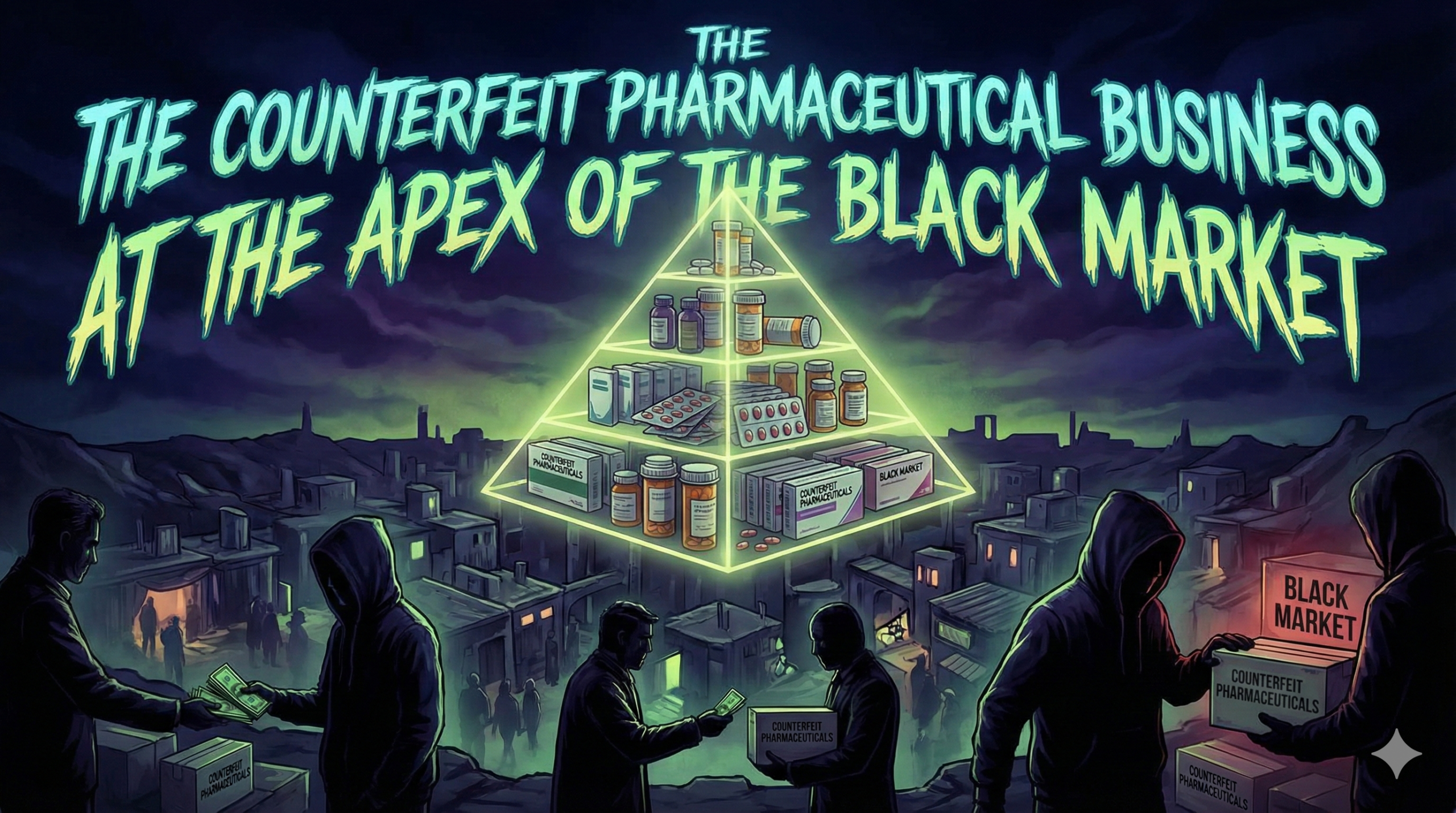
The Counterfeit Pharmaceutical Business at the Apex of the Black Market
Introduction
In the modern black market, one of the most lucrative illegal trades is counterfeit pharmaceuticals. According to estimates from the World Health Organization (WHO) and pharmaceutical associations across various countries, the market size is estimated at approximately $75 billion to over $200 billion globally, positioning it among the highest-ranking illegal trades worldwide. This figure exceeds the national budgets of many countries, demonstrating the severity of the issue. This article examines the reality of the counterfeit pharmaceutical business, its social impact, and countermeasures.
What Are Counterfeit Pharmaceuticals?
Counterfeit pharmaceuticals refer to products that intentionally contain false information regarding the manufacturer, ingredients, or efficacy of medicines. Specifically, they include the following types:
Products with Inactive Ingredients: Products that contain no active ingredients at all, or significantly less than the stated amount.
Products Containing Harmful Ingredients: Products that contain harmful substances or impurities.
Imitation Products: Products that mimic the appearance of genuine products but have not undergone quality control.
Repackaged Products: Products whose expiration dates have been falsified or that have been improperly stored during distribution.
The WHO uses the term “substandard and falsified (SF) medical products” to categorize these products more precisely. Substandard products are authorized medical products that fail to meet quality standards or specifications, while falsified products deliberately misrepresent their identity, composition, or source.
Factors Behind the Formation of This Massive Market
Why has the counterfeit pharmaceutical market grown to such enormous proportions? Several factors contribute to this phenomenon.
Economic Factors
The high prices of legitimate pharmaceuticals stimulate the counterfeit product market. Expensive anticancer drugs and cutting-edge therapies are particularly targeted for counterfeiting. Additionally, the lack of developed healthcare insurance systems in developing countries creates demand for cheaper alternatives.
Supply-Side Factors
Low manufacturing costs combined with high-profit margins make the counterfeit pharmaceutical business attractive. Compared to other counterfeit goods such as luxury watches or brand-name bags, counterfeit pharmaceuticals have extremely low production costs. Counterfeiting luxury watches requires precise mechanical components, and counterfeiting brand-name bags requires materials of a certain quality. However, pharmaceuticals in tablet or liquid form can be easily manufactured with inexpensive materials such as powder and coloring agents if the goal is merely to create a visual resemblance. This low cost of production further increases the profit margins of the counterfeit pharmaceutical business. Furthermore, the difficulty of international enforcement and relatively light penalties lower the barriers to entry into this business.
Technological Factors
Advances in sophisticated printing and packaging technologies have made it difficult for the untrained eye to distinguish between genuine and counterfeit products. Additionally, internet-based sales have increased contact points between producers and consumers, making it difficult to trace distribution channels.
Social Impact
The proliferation of counterfeit pharmaceuticals has serious impacts across multiple areas.
Impact on Public Health
According to WHO estimates, approximately 1 million people die annually due to the use of counterfeit pharmaceuticals. In Africa specifically, reports indicate that about 100,000 people lose their lives each year due to counterfeit medicines. Ineffective antimalarial drugs and antibiotics delay treatment and contribute to the development of drug resistance. Direct health damage from products containing harmful ingredients has also been reported.
Recent studies have also highlighted the impact on treatment outcomes for chronic diseases. Patients with conditions such as diabetes, hypertension, and cardiovascular disease who unknowingly use counterfeit medications may experience deterioration in their conditions, leading to preventable hospitalizations and complications.
Economic Losses
The pharmaceutical industry estimates annual revenue losses due to counterfeit products to reach tens of billions of dollars. These losses lead to reductions in research and development budgets, becoming a factor that delays the development of new drugs. Additionally, social costs such as decreased tax revenue and increased healthcare expenses are enormous.
Connection to Organized Crime
Profits from the counterfeit pharmaceutical business serve as funding sources for other criminal activities. Connections to international criminal organizations and terrorist organizations have been noted, making this a concern for international security.
Current State of Countermeasures and Challenges
International Initiatives
The WHO established the “Global Surveillance and Monitoring System for Substandard and Falsified Medical Products” (previously known as IMPACT – International Medical Products Anti-Counterfeiting Taskforce until 2013) to advance international countermeasures. Interpol also conducts an international operation called “Operation Pangea” to crack down on illegal pharmaceutical sales sites on the internet. The 2023 operation (Pangea XVI) resulted in over 1,800 arrests and the seizure of pharmaceuticals worth over $55 million, demonstrating steady progress.
The Pharmaceutical Security Institute (PSI) reports that in 2023, over 6,000 incidents of pharmaceutical crime were documented globally, representing a continuing trend of sophisticated counterfeiting operations.
Technology-Based Countermeasures
The following technological countermeasures are being implemented:
Track and Trace Systems: Systems that can track the distribution channels of pharmaceuticals. In the United States, the Drug Supply Chain Security Act (DSCSA) mandates serialization at the unit level, requiring each package to have a unique identifier. The European Union’s Falsified Medicines Directive (FMD) also requires similar verification systems.
Authentication Technologies: Authentication of genuine products using QR codes, RFID tags, and blockchain technology. Blockchain-based systems are increasingly being explored for their ability to create immutable records of pharmaceutical supply chains.
Physical Security Features: Packaging technologies that are difficult to imitate, such as holograms, special inks, and tamper-evident seals.
Artificial Intelligence and Machine Learning: Advanced algorithms are being deployed to detect anomalies in supply chains and identify suspicious purchasing patterns that may indicate counterfeit distribution networks.
Challenges
However, despite these efforts, numerous challenges remain:
Difficulty in International Cooperation: Different regulations and penalties across countries make unified responses difficult.
Disparity in Enforcement Capabilities: Developing countries have limited enforcement capabilities and technical resources.
Low Awareness: Consumer lack of awareness sustains demand for cheap counterfeit products.
E-commerce Expansion: The rapid growth of online pharmaceutical sales, including social media platforms and messaging apps, creates new channels that are difficult to monitor and regulate.
Sophistication of Counterfeiting: Counterfeiters are increasingly employing advanced technologies that make detection more challenging, including the replication of security features.
The Situation in Japan
Counterfeit pharmaceuticals have been confirmed entering Japan, primarily through personal imports and internet purchases. In 2017, counterfeit versions of the hepatitis C treatment drug “Harvoni” circulated, drawing social attention. In this incident, 10 bottles of counterfeit products were seized, and investigation into the distribution channels progressed.
However, the domestic counterfeit pharmaceutical distribution rate in Japan is estimated to be less than 1%, which is relatively low compared to the global situation. Nevertheless, with the expansion of internet purchasing, concerns about increased future risks are growing.
Japan’s countermeasures include warnings from the Ministry of Health, Labour and Welfare (MHLW), strengthened border controls at customs, and efforts to ensure traceability by recording pharmaceutical distribution histories. The Pharmaceutical and Medical Device Act has been amended to strengthen regulations on online pharmaceutical sales and improve supply chain security.
Table 1: Comparison of Counterfeit Pharmaceutical Rates by Region
| Region | Estimated Counterfeit Rate | Primary Distribution Channels |
| Sub-Saharan Africa | 10-30% | Street vendors, unregulated pharmacies |
| Southeast Asia | 10-20% | Online platforms, border crossings |
| Latin America | 10-15% | Unregulated pharmacies, online sales |
| Middle East | 10-25% | Parallel imports, online markets |
| Eastern Europe | 5-10% | Internet, parallel trade |
| North America | 1-2% | Internet, diverted supply chains |
| Japan | <1% | Personal imports, internet |
| European Union | 1-2% | Internet, illegal online pharmacies |
Note: Rates vary significantly by product category and specific location within regions. These are approximate estimates based on WHO and industry data.
The Harvoni Counterfeit Distribution Incident
The 2017 Harvoni incident in Japan revealed vulnerabilities in the pharmaceutical distribution system. The counterfeit products were sophisticated enough to pass initial visual inspection but contained no active pharmaceutical ingredients. This case led to enhanced verification procedures in Japanese hospitals and pharmacies, including lot number verification systems and more stringent supplier auditing processes.
What Consumers Can Do
General consumers can take several measures to protect themselves from counterfeit pharmaceuticals:
Choose Trustworthy Purchase Sources: Use legitimate pharmacies or authorized online sales sites. In many countries, regulatory authorities maintain lists of verified online pharmacies. In the United States, the National Association of Boards of Pharmacy (NABP) operates the Verified Internet Pharmacy Practice Sites (VIPPS) program.
Be Wary of Unusual Cheapness: Pharmaceuticals that are significantly cheaper than market prices are highly likely to be counterfeit. As a general rule, prices that are more than 30-50% below the standard retail price should raise immediate suspicion.
Check Appearance: Verify that there are no unnatural aspects to the packaging or tablet appearance. Look for poor print quality, misspellings, unusual coloring, or inconsistent tablet shapes and sizes.
Monitor Side Effects: Pay attention to unexpected side effects or lack of effectiveness. If a medication that previously worked well suddenly seems ineffective, or if unexpected reactions occur, consult a healthcare professional immediately.
Verify Packaging Authenticity: Check for security features such as holograms, special seals, or QR codes that can be verified through manufacturer websites or official applications.
Purchase Only with Prescription: Avoid purchasing prescription medications without a valid prescription from a licensed healthcare provider. Websites that offer prescription drugs without requiring a prescription are almost certainly operating illegally.
Report Suspicions: If you suspect a product may be counterfeit, report it to local health authorities or regulatory agencies. In Japan, reports can be made to the MHLW or regional health departments.
Conclusion
The counterfeit pharmaceutical problem is becoming more serious as a negative aspect of globalization and technological progress. The market size of $75-200 billion demonstrates the deep-rooted nature of this problem. Countermeasures require international cooperation, technological innovation, and increased consumer awareness. To protect the safety of pharmaceuticals that relate to human life, efforts by society as a whole are required.
This problem is not a distant concern. Through the internet, counterfeit pharmaceuticals can cross borders and potentially infiltrate our lives. To protect our health and safety, today’s consumers are required to have correct knowledge and vigilance.
As we move forward, the integration of advanced technologies such as blockchain, artificial intelligence, and enhanced serialization systems offers hope for more robust pharmaceutical security. However, technology alone cannot solve this problem. It requires a comprehensive approach involving regulatory harmonization across borders, capacity building in developing nations, public education campaigns, and sustained commitment from pharmaceutical companies, governments, and international organizations.
The fight against counterfeit pharmaceuticals is ultimately a fight for global health equity and human rights. Every counterfeit medicine represents not just an economic crime, but a direct threat to human life and dignity. As the global community continues to grapple with this challenge, the collective determination to prioritize patient safety over criminal profit will determine our success in protecting public health worldwide.

Comment