
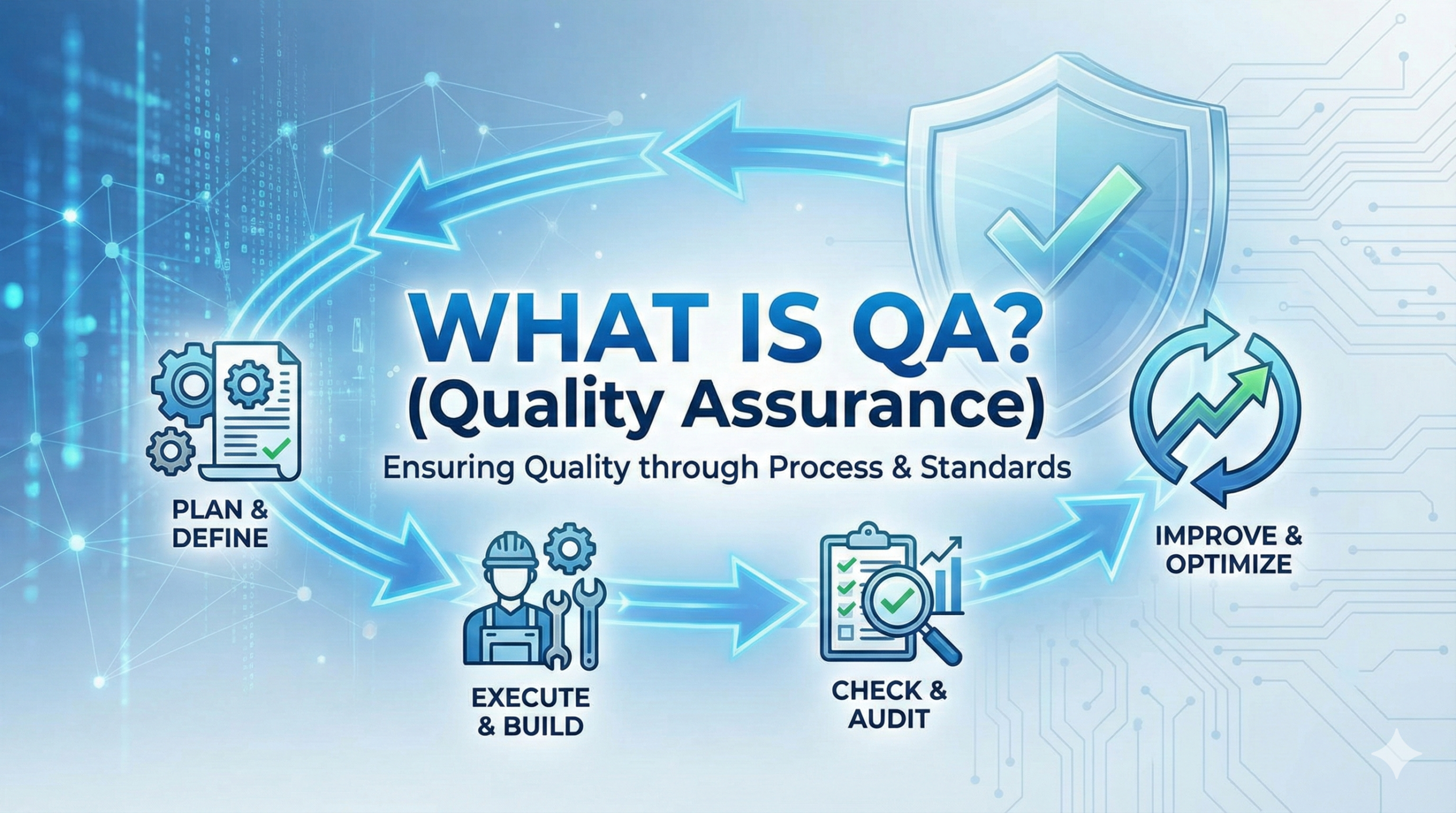
What is QA (Quality Assurance)?
This article explains Quality Assurance (QA). The term “assurance” is quite complex and often misunderstood.
In some companies, they conduct only an annual audit yet consider this to constitute quality assurance. Should such activities not be called “quality audit” instead? What exactly does assurance mean?
The True Meaning of Assurance
In fact, assurance means that experienced and knowledgeable individuals guide and instruct those who are inexperienced or less suited to a task as they proceed. These experienced individuals with specialized skills are called SMEs (Subject Matter Experts), meaning experts in their respective domains.
Assurance means that SMEs provide guidance and advice to lead others to success. To accomplish this, it is extremely important to be deeply involved in the relevant process and to provide endorsement on behalf of the department concerned.
The attitude of assurance is: “Create your plan as I instruct you. Execute the plan as I guide you. If you can execute it as I guide you and write your report accordingly, I will guarantee your work on your behalf.” This represents the essence of assurance.
QA’s Accountability to External Stakeholders
A critical role of the QA department is to bear accountability toward customers and regulatory authorities.
Let me explain with an example. Suppose you purchase a product as a consumer and find some defect in it. You would naturally lodge a complaint. At that moment, if a manufacturer’s representative says, “I’m sorry, this was manufactured by someone inexperienced (a newcomer) at our company, so the quality is poor…” how would you feel?
You would think, “I don’t care who manufactured it—as a company, please guarantee it properly.” In other words, rather than making it an individual worker’s responsibility, you would expect the company to guarantee quality on behalf of whoever manufactured the product. This is the concept of assurance.
Historical Origin: GLP as the Pioneer
Actually, it was GLP (Good Laboratory Practice) that first introduced the concept of Quality Assurance in the pharmaceutical industry. GLP studies are complex, and newcomers or inexperienced individuals may not be able to conduct them successfully.
For example, suppose two people are responsible for ten GLP studies—one is a newcomer and the other is a veteran. In such a case, half of the ten studies might fail while the other half succeed, resulting in significant variability.
Therefore, in GLP, experienced and skilled individuals step back and guide unsuitable, inexperienced, or new staff from behind. They give instructions such as: “Write the study protocol this way,” “Conduct the test this way,” “Analyze the results this way and write the report accordingly.” This person is called the Study Director. This is the essence of assurance.
In other words, assurance means guaranteeing quality on behalf of the responsible party, on behalf of the department concerned.
QA’s Authority: Release Determination
The greatest authority of the QA department is release determination, and the most stringent measure within this authority is stopping shipment.
If “you did not follow my guidance,” “I am not satisfied,” “I cannot provide endorsement on your behalf,” or “there is no basis for me to explain to customers, patients, healthcare professionals, or regulatory authorities on your behalf,” then the QA department exercises its greatest authority by refusing to permit release.
A Concrete Example: The LASIK Surgery Analogy
Let me explain this with a specific episode. Suppose you are going to undergo LASIK surgery (laser surgery for myopia). At the eye clinic you visit, the doctor assigned to you has only about 100 cases of surgical experience and is relatively inexperienced, which makes you anxious.
On the other hand, the clinic director has performed over 10,000 surgeries and is highly experienced. However, the director no longer performs operations personally. Why? Because the director is busy with other duties such as hospital management, attending academic conferences, and handling payroll. Moreover, if the director continues performing all surgeries, junior doctors will never improve their skills.
So, if this junior doctor is to perform your surgery, what would you say? You would likely request: “That junior doctor is acceptable, but please have the director stand by, provide advice, and guide the surgery to success.” This is precisely what Quality Assurance means.
The Misconception About QA Independence
Many people misunderstand QA, believing that the QA department should be an independent department that must not be involved in the relevant process. This is incorrect. Deep involvement in the process to lead it to success is crucial. Otherwise, it would be impossible to guarantee on behalf of the department concerned or to authorize market release of products.
Therefore, it is essential to understand the process, review the content, confirm there are no problems, point out and rectify any issues found, and only then authorize release when one feels confident that accountability can be fulfilled toward regulatory authorities, healthcare professionals, customers, and patients.
QA’s Role in Regulatory Inspections
For instance, when a regulatory inspection occurs, the QA department bears the responsibility of explanation. The QA department must never simply delegate explanations entirely to the relevant department but should respond to regulatory authorities on behalf of the department concerned.
It is important to explain to regulatory authorities and gain their understanding by saying: “Our company follows this process,” “We conduct these operations,” “We provide this type of training,” “The manufacturing site has implemented validation in this manner,” “Regarding release determination, we check these points,” and so forth.
However, for detailed technical matters that may be beyond QA’s immediate knowledge, it is appropriate to request explanations from the implementation department. Nevertheless, completely delegating to the implementation department is not appropriate for a quality assurance department. Providing endorsement on behalf of the implementation department is extremely important.
Documentation and Communication
Furthermore, daily communication with implementation departments, consultation records, and communication records are extremely important. Particularly in Japan, where Marketing Authorization Holders (MAH) and manufacturers are separated, communication records and consultation records between the MAH and manufacturers are crucial for preventing non-compliance with approved matters and deviations. As a result, it is extremely important for the quality assurance department to confirm that there are no problems and to explain this to regulatory authorities and customers.
Modern QA Perspectives: ICH Q10 and Quality Culture
In the context of contemporary pharmaceutical quality systems, the principles described above align closely with ICH Q10 (Pharmaceutical Quality System). ICH Q10 emphasizes that quality assurance should not be limited to fulfilling regulatory requirements but should enable innovation and continual improvement throughout the product lifecycle.
The modern understanding of QA also encompasses the concept of Quality Culture, which has been increasingly emphasized by regulatory authorities worldwide, including the US FDA, EMA, and Japan’s PMDA. Quality Culture refers to the shared values, beliefs, and behaviors within an organization that prioritize quality in all activities. The QA department plays a pivotal role in fostering and maintaining this culture by:
- Promoting transparency and open communication about quality issues
- Encouraging proactive identification and resolution of potential problems
- Supporting a blame-free environment where staff can report issues without fear of reprisal
- Facilitating cross-functional collaboration to enhance quality outcomes
Furthermore, contemporary QA practice increasingly adopts a risk-based approach, as outlined in ICH Q9 (Quality Risk Management). This means that QA resources and attention are focused on areas that present the greatest risk to product quality and patient safety, rather than applying uniform oversight to all activities regardless of their risk profile.
Conclusion: QA as Enabler and Guardian
In summary, Quality Assurance is not merely an auditing or policing function. It is a comprehensive system of guidance, support, and oversight that enables all personnel—regardless of experience level—to consistently produce high-quality products. The QA department acts as both enabler and guardian: enabling success through expert guidance while guarding patient safety through rigorous oversight and the ultimate authority to prevent release of products that do not meet established standards.
The QA professional must deeply understand processes, actively participate in ensuring their successful execution, and stand ready to account for quality to all stakeholders—regulatory authorities, healthcare professionals, patients, and society at large. This is the true essence of Quality Assurance in the pharmaceutical industry.

Comment