
Purpose and Implementation of Operational Qualification (OQ)
Definition and Purpose of OQ
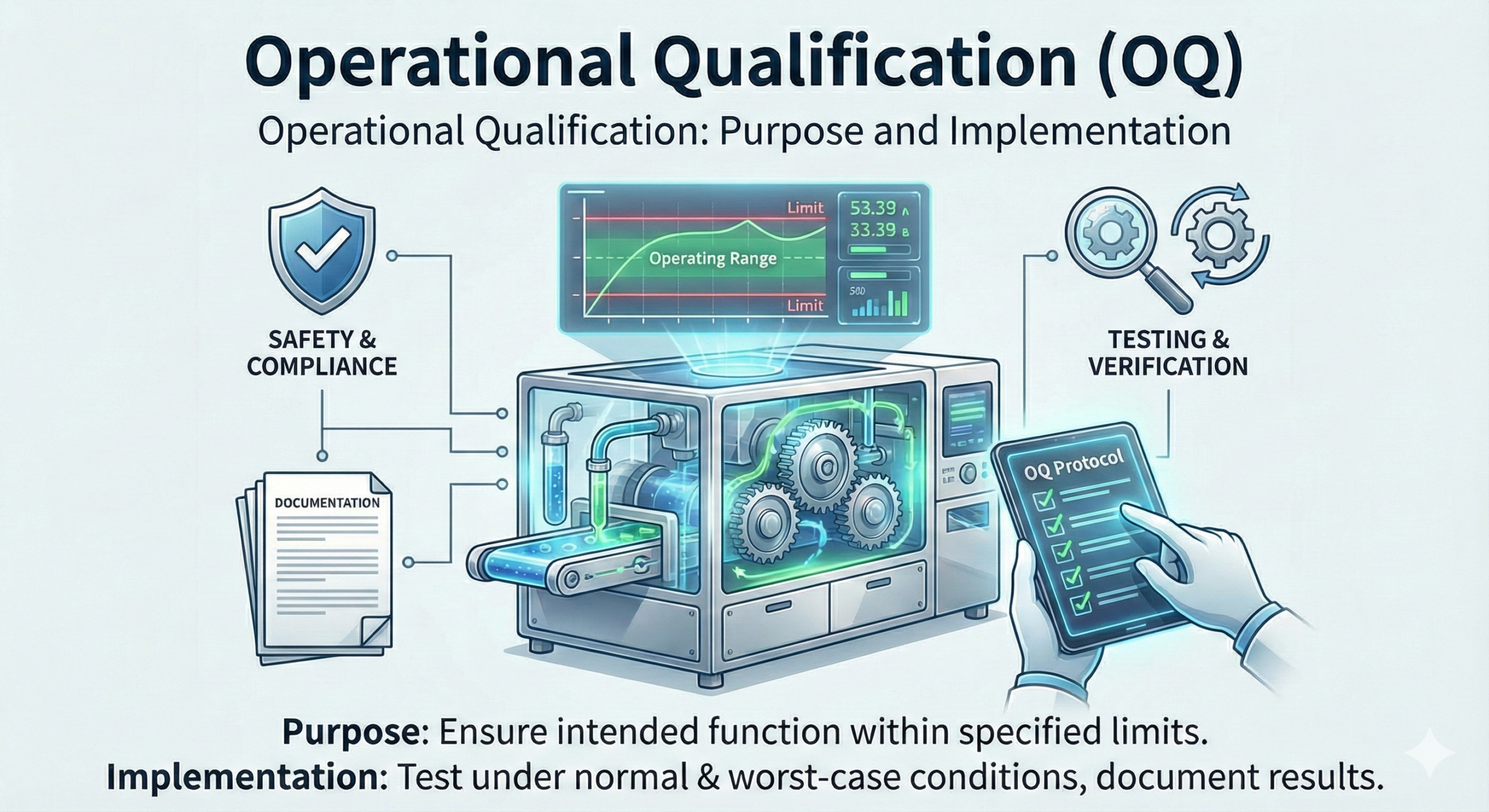
Operational Qualification (OQ) is a critical qualification stage that demonstrates that manufacturing processes consistently produce acceptable results and establish process limits (worst-case conditions). OQ is the process of verifying and documenting that facilities, systems, and equipment operate as intended throughout the anticipated operating ranges following installation or modification.
The definition of Operational Qualification (OQ) in PIC/S GMP Annex 15 is as follows:
Operational Qualification (OQ) is the documented verification that the facilities, systems and equipment, as installed or modified, perform as intended throughout the anticipated operating ranges.
Key Aspects of OQ Implementation
OQ involves the following critical tests and activities:
Worst-Case Testing and Manufacturing Condition Establishment
To ensure process robustness, OQ conducts various tests to determine manufacturing conditions, including worst-case testing. Through these tests, process parameter challenges (preliminary studies) are performed to ensure that products meeting requirements can be manufactured. Worst-case conditions refer to a set of conditions encompassing upper and lower processing limits and circumstances within standard operating procedures, which pose the greatest chance of product or process failure when compared to ideal conditions. However, such conditions do not necessarily induce actual product or process failure.
Establishment of Process Parameters and Control State
Various action levels of the manufacturing process become clear according to product characteristics, and it is demonstrated that the process can be maintained in a state of control. This ensures process robustness and enables consistent quality product manufacturing.
Critical Process Parameters (CPPs) have variability that impacts Critical Quality Attributes (CQAs) and therefore should be monitored or controlled to ensure the process produces the desired quality.
Considerations for OQ Implementation
OQ should be implemented with consideration of the following matters:
Basic Considerations
Process Control Limits: Define the upper and lower limits of the operating range and confirm that the process functions consistently within these limits.
Software Parameters: When using computerized systems, verify that software settings and parameters are correctly configured and function as intended.
Raw Material Specifications: Confirm that raw materials used meet specified requirements and are suitable for the process.
Process Operating Procedures: Demonstrate that Standard Operating Procedures (SOPs) are appropriately documented and operators can execute them correctly.
Material Handling Requirements: Confirm that handling requirements for raw materials, intermediate products, and final products are appropriately defined and implemented.
Change Control and Training
Process Change Control: Establish a systematic change control system to appropriately evaluate, approve, and implement changes to processes, equipment, or materials. Based on ICH Q10 Pharmaceutical Quality System, the impact of changes on product quality must be assessed.
Training: Implement education and training programs to provide appropriate skills and knowledge to perform OQ. Personnel must understand their roles and responsibilities and be able to correctly execute relevant procedures.
Process Capability and Stability
Short-term Stability and Process Capability: Demonstrate that the process shows stable performance in the short term and has the ability to consistently manufacture products meeting specified requirements. It is recommended to calculate process capability indices (Cp, Cpk, etc.) using Statistical Process Control (SPC) methods.
Application of Risk Analysis Methods
Failure Mode Effects, Action Levels and Worst-Case Conditions: Utilize the following risk analysis methods:
Failure Mode and Effects Analysis (FMEA): Identify potential failure modes in processes and evaluate their effects, occurrence probability, and detectability. FMEA calculates the Risk Priority Number (RPN) using three indicators – Severity, Probability/Occurrence, and Detectability – and prioritizes preventive measures or detection controls for high-risk failure modes.
Fault Tree Analysis (FTA): A top-down approach that starts with an undesired event (top event) and logically analyzes events and conditions that could cause it. FTA uses Boolean logic (AND gates, OR gates, etc.) to visualize failure pathways and helps identify root causes and formulate failure prevention measures.
ICH Q9 (Quality Risk Management) provides a systematic process for assessing, controlling, and reviewing risks to pharmaceutical quality, and these tools are essential for implementing a risk-based approach in OQ.
Statistical Methods and Process Optimization
Statistical validation techniques such as screening experiments and Design of Experiments (DOE) can be used to identify key process parameters and optimize processes. These techniques can be utilized in the OQ phase to deepen process understanding and clarify critical variables affecting product quality.
Design of Experiments is an important element of the Quality by Design (QbD) approach recommended in ICH Q8(R2) Pharmaceutical Development and contributes to the establishment of Design Space. Design Space is the multidimensional combination and interaction of input variables (e.g., material attributes) and process parameters that have been demonstrated to provide assurance of quality.
Timing of OQ Implementation and Responsibilities
Relationship with IQ
In PIC/S GMP Annex 15, OQ is normally performed after Installation Qualification (IQ), but depending on the complexity of equipment, IQ and OQ may be performed simultaneously as Installation and Operational Qualification (IOQ).
IQ verifies that equipment, systems, and equipment are correctly installed and positioned according to approved specifications. This includes verification of the correct installation of components and instrumentation against engineering drawings and specifications.
Delegation Possibilities and Final Responsibility
Generally, IOQ can be delegated to suppliers (equipment manufacturers, engineering companies, etc.) for implementation. However, where validation protocols and other documentation are supplied by a third party providing validation services, appropriate personnel at the manufacturing site must confirm their suitability and compliance with internal procedures before approval. Vendor protocols may be supplemented by additional documentation or test protocols before use.
The final responsibility must be retained by the pharmaceutical company. Pharmaceutical companies are responsible for supervising qualification activities performed by contracted suppliers, verifying results, and approving them.
Regulatory Requirements and Guidance References
When implementing OQ, the following regulatory requirements and international guidance should be considered:
PIC/S GMP Annex 15: Qualification and Validation – This is the primary regulatory guidance on OQ definitions, requirements, and implementation methods. The current version became effective on October 1, 2015, and emphasizes a risk-based approach to qualification and validation throughout the product lifecycle.
ICH Q7: Good Manufacturing Practice Guidance for Active Pharmaceutical Ingredients – Specifies requirements for validation and process control in API manufacturing.
ICH Q8(R2): Pharmaceutical Development – Provides guidance on the concept of Quality by Design (QbD) and establishment of Design Space.
ICH Q9(R1): Quality Risk Management – Provides principles and tools (FMEA, FTA, etc.) for assessing and controlling risks to pharmaceutical quality. The revised version (R1) was issued in January 2023.
ICH Q10: Pharmaceutical Quality System – Provides a framework for a comprehensive quality management system throughout the product lifecycle.
FDA Process Validation Guidance: “Process Validation: General Principles and Practices” (2011) – Details the lifecycle approach to process validation, Continued Process Verification (CPV), and the role of OQ.
EU GMP Guidelines: Specifies GMP requirements for pharmaceutical manufacturing in the European Union.
These guidances are mutually complementary and provide a comprehensive framework for ensuring pharmaceutical quality through a consistent approach. When implementing OQ, it is important to consider all applicable regulatory requirements and adopt appropriate methodologies based on scientific rationale.
Summary
OQ is an indispensable stage for ensuring the reliability and consistency of pharmaceutical manufacturing processes. Properly planned and executed OQ demonstrates that processes function as designed and can consistently manufacture products of required quality. By following risk-based approaches, statistical methods, and internationally recognized guidance, companies can not only meet regulatory requirements but also achieve continuous improvement and enhanced product quality.

Comment