
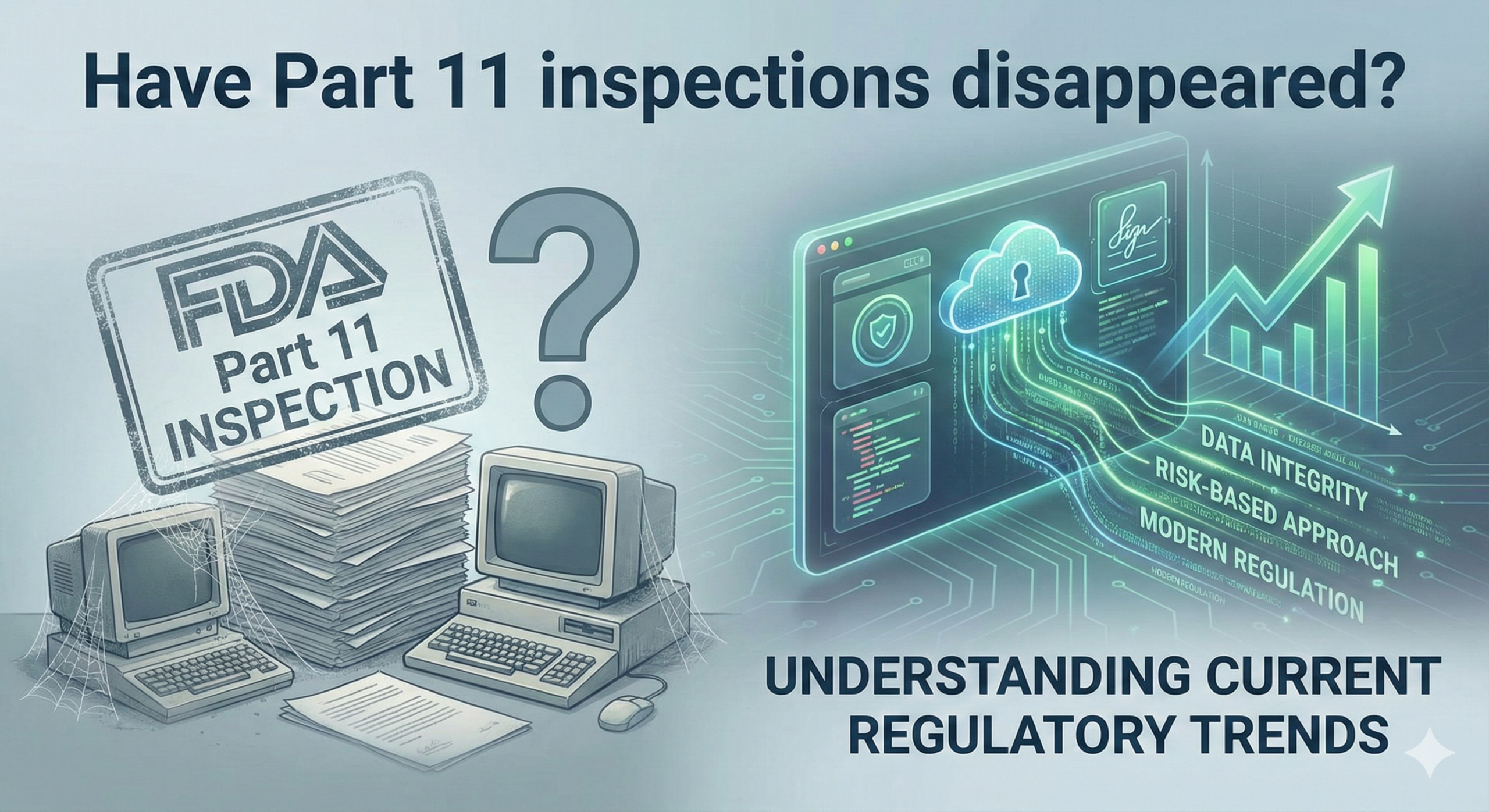
Have Part 11 Inspections Disappeared? Understanding Current Regulatory Trends
Current Status of FDA Warning Letters
The FDA publishes all warning letters on its website. While warning letters explicitly citing 21 CFR Part 11 have indeed decreased since 2011, this does not mean that Part 11 inspections have been discontinued. Rather, FDA’s inspection strategy has evolved toward a more sophisticated approach.
In fiscal year 2024, the FDA issued 111 warning letters, representing a significant increase from 94 letters in the previous year. Critically, approximately 79% of these warning letters contained observations related to data integrity.
FDA Inspection Policy: Emphasis on Predicate Rules
In fact, from its inception, FDA has maintained a clear policy of not conducting inspections focused solely on Part 11. Inspections are conducted according to predicate rules (such as 21 CFR Part 211 for GMP and 21 CFR Part 820 for QSR), and warning letters are also issued based on these predicate rules.
Analysis of recent warning letters reveals that while Part 11 may not be explicitly mentioned, there are extensive observations related to electronic records, Excel spreadsheets, computerized systems, and validation. The most frequently cited regulations include:
- 21 CFR 211.68(b): Regulations regarding automatic, mechanical, and electronic equipment, directly related to electronic record and system access controls, audit trails, and data integrity
- 21 CFR 211.194: Regulations regarding laboratory records, requiring authenticity and integrity of electronic records
- 21 CFR 211.100(a): Regulations regarding written procedures for production and process control
Specific examples from multiple 2024 warning letters include the following issues:
- Data acquisition systems for analytical instruments such as HPLC, GC, and UV-Vis had audit trail functionality disabled or not implemented
- Laboratory staff had administrator privileges enabling deletion or modification of raw data files
- Cell formulas in electronic worksheets (Excel spreadsheets) were not validated, generating erroneous data
- Shared password usage prevented creation of individually attributable audit trails
- Inadequate backup and recovery procedures for electronic records
Reality of Form 483 Observations
Since Form 483 (inspection observations) issued by investigators at the conclusion of inspections are not publicly disclosed, actual observations are presumed to be far more numerous than warning letters suggest. In fiscal year 2024, the FDA issued 561 Form 483s related to drugs alone. When companies provide inadequate responses to these Form 483s, they escalate to warning letters.
Significantly, data integrity violations have become a primary cause of repeated observations. The FDA particularly emphasizes data integrity issues as indicators of broader quality system vulnerabilities, not merely procedural non-compliance.
Importance of Electronic Record Reliability (Data Integrity)
In contemporary operations, conducting business without using electronic records (computerized systems) is inconceivable. However, electronic records carry risks not present with paper records, including falsification, deletion, and unauthorized access.
When conducting inspections, the FDA intensively investigates whether electronic records are trustworthy (Data Integrity). Data integrity is evaluated based on the following principles:
ALCOA+ Principles:
- Attributable: Clear identification of who did what and when
- Legible: Records are readable and understandable
- Contemporaneous: Recording occurs simultaneously with the activity
- Original: Maintains the originally recorded format
- Accurate: Records accurately reflect facts
- Complete: All relevant data is included
- Consistent: No contradictions exist among data
- Enduring: Readable throughout the record retention period
- Available: Rapidly accessible when needed
Evaluation of electronic record systems based on these principles can be considered equivalent to Part 11 inspections.
Historical Background and Current Position of Part 11
Part 11 took effect on August 20, 1997, and has never been revised since. Regulations premised on late-1990s computer technology remain legally valid after more than 28 years.
However, because the initial regulations were too broad and compliance costs were high, the FDA issued “Scope and Application” guidance in September 2003, clarifying the shift to a risk-based approach. This guidance enabled companies to prioritize responses based on risk assessment of three elements:
- Patient Safety: The extent to which system or record failures affect patient health and safety
- Record Integrity: Whether metadata such as audit trails, timestamps, and electronic signatures are completely maintained
- Product Quality: The degree of impact on final product quality
While “patient safety” and “product quality” are relatively clear, “record integrity” may be somewhat difficult to understand. Record integrity refers to the complete maintenance and verifiable availability of metadata such as audit trails, timestamps, electronic signatures, and change history. When record integrity is compromised, investigators cannot trust the electronic records and cannot conduct proper inspections, potentially resulting in approval delays or market withdrawal.
Latest FDA Expectations: PIC/S GMP Annex 11 and Its Revision
In the rapidly evolving world of computer technology, the text of Part 11 created in 1997 alone cannot address modern complex IT environments. Where, then, can we learn about the latest FDA expectations and guidance?
In fact, while Part 11 itself has not been revised, the latest FDA expectations and guidance are reflected in PIC/S GMP Annex 11 “Computerised Systems”. The current Annex 11 was issued in 2011, but a major revision draft was published in July 2025 and is currently in public comment period (July 7 to October 7, 2025). This revised version is scheduled for official implementation in summer 2026.
Key Points of the Annex 11 Revision
The revised Annex 11 (2025 draft) has been significantly expanded from 5 pages to 19 pages and includes the following major changes:
Seven Newly Established Chapters:
- System Requirements
- Alarms
- Cloud Services
- AI/ML Systems
- Enhanced Cybersecurity
- Detailed Handling of Data
- Disaster Recovery and Business Continuity
Enhanced Focus on Cybersecurity:
- Clarification of firewalls, patch management, and antivirus measures
- Requirements for regular penetration testing of high-risk systems
- Alignment with ISO 27001 (Information Security Management Systems)
Response to Cloud Computing:
- Validation requirements for cloud-based systems
- Data sovereignty and data location management
- Supplier qualification and management of service providers
Response to AI/ML Systems:
- Linkage with newly established Annex 22 (Artificial Intelligence)
- Algorithm transparency and traceability
- Model validation and continuous monitoring
Detailed Audit Trail Requirements:
- Audit trails must be uneditable
- Normal users must not be able to disable audit trail functionality
- Clear expectations regarding audit trail review frequency
- Distinction and management of audit trail data and log data
Alignment with Other International Standards
The revised Annex 11 is also aligned with the following latest international standards and guidelines:
- GAMP 5 Second Edition (2022): Validation approach for computerized systems
- ICH Q9(R1) (2023): Quality Risk Management
- FDA Computer Software Assurance Guidance (2022): Risk-based software validation
- OECD GLP 25 (2024): GLP principles on IT security
- ISO 27001: Information Security Management Systems
Regulatory Trends from 2025 Onward
FDA Computer Software Assurance (CSA)
In 2022, the FDA issued “Computer Software Assurance (CSA)” guidance, promoting a shift from traditional Computer System Validation (CSV) to a more risk-based and efficient approach. CSA features:
- Testing focused on critical functions and high-risk areas
- Reduction of non-value-added activities
- Emphasis on critical thinking
- Utilization of vendor-provided test evidence
Development of Data Integrity Guidance
The FDA and regulatory authorities have issued multiple guidance documents on data integrity:
- FDA Guidance on Data Integrity and Compliance (2018): Data integrity in cGMP environments
- MHRA GXP Data Integrity Guidance (2018): Data integrity guidance from UK regulatory authority
- WHO Guidance on Data Integrity (2021): Global perspective on data integrity principles from WHO
Practical Recommendations for Pharmaceutical and Medical Device Companies
In the current and future regulatory environment, companies are recommended to implement the following responses:
Short-term Response (Immediate to 6 months)
- Gap Analysis of Existing Systems
- Compare current computerized systems against Annex 11 (2025 draft) requirements
- Conduct data integrity risk assessments
- Evaluate current state of cybersecurity measures
- Strengthen Audit Trail Implementation and Management
- Verify that audit trails are enabled and uneditable in all critical systems
- Establish regular audit trail review processes (critical systems: weekly/per batch, non-critical systems: monthly/quarterly)
- Implement anomaly detection systems
- Review Access Controls
- Eliminate shared passwords
- Implement Role-Based Access Control (RBAC)
- Consider Multi-Factor Authentication (MFA) implementation
Medium-term Response (6 months to 2 years)
- System Modernization
- Gradual renewal of legacy systems
- Consider migration to cloud-based solutions
- Implement integrated electronic Quality Management Systems (eQMS)
- Establish Cybersecurity Programs
- Build security management systems compliant with ISO 27001
- Conduct regular vulnerability assessments and penetration testing
- Develop and train incident response plans
- Review Validation Strategy
- Adopt CSA approach
- Risk-based validation planning
- Optimize vendor audit programs
Long-term Response (2 years+)
- Digital Transformation
- Implement Industry 4.0 / Pharma 4.0 technologies
- Real-time data analysis and Process Analytical Technology (PAT)
- Appropriate implementation and validation of AI/ML systems
- Cultivate Quality Culture
- Establish data integrity as organizational culture
- Continuous training programs
- Promote whistleblower protection and transparency
- Global Harmonization
- Unified response to PIC/S, FDA, WHO, and national regulatory requirements
- Establish global quality systems
- Unified SOPs and system requirements
Summary: The True Nature of Part 11 Inspections
Part 11 inspections have not “disappeared” but have “evolved.” The FDA focuses not on formal compliance with the specific regulation called Part 11, but rather on ensuring the reliability of electronic records and systems, data integrity, and ultimately patient safety and product quality through predicate rules.
Examining enforcement trends in 2024-2025, FDA inspections have become more systematic and detailed, with significantly reduced tolerance for data integrity issues. Companies must understand and practice not just the text of Part 11, but the principles behind it—namely, the authenticity, reliability, and integrity of electronic records.
The 2025 revision of PIC/S GMP Annex 11 provides an important regulatory framework for addressing modern technological challenges such as cloud computing, AI/ML, and cybersecurity. Pharmaceutical and medical device companies should view this revision not merely as a compliance challenge but as an opportunity to strengthen quality systems and drive digital transformation.
Responding to the latest regulatory requirements and building robust data integrity programs is not simply about preparing for inspections. It forms the foundation for protecting patient safety, ensuring product quality, and achieving sustainable organizational growth.
About the Regulatory Landscape
| Aspect | Details |
| Part 11 Status | Issued August 20, 1997; never revised; risk-based approach clarified September 2003 |
| Current Enforcement | FY2024: 111 warning letters (79% data integrity-related); 561 Form 483s for drugs |
| Key Citations | 21 CFR 211.68(b), 211.194, 211.100(a) most frequently cited |
| Annex 11 | Current: 2011 version; Draft: July 2025; Expected implementation: Summer 2026 |
| Page Count | Original Annex 11: 5 pages → Revised draft: 19 pages (nearly 4x expansion) |
| New Technologies | Cloud services, AI/ML, enhanced cybersecurity, disaster recovery |
ALCOA+ Principles for Data Integrity
| Principle | Meaning | Regulatory Expectation |
| Attributable | Who, when, what is clear | Individual user accounts, no shared passwords |
| Legible | Readable and understandable | Proper formatting, no degradation over time |
| Contemporaneous | Recorded simultaneously | Real-time or near-real-time data entry |
| Original | First recorded format preserved | Original data with audit trail of changes |
| Accurate | Factually correct | Validated systems, appropriate controls |
| Complete | All relevant data included | No selective deletion, all metadata retained |
| Consistent | No contradictions | Cross-system data consistency checks |
| Enduring | Readable throughout retention | Proper archival, migration planning |
| Available | Accessible when needed | Timely retrieval, inspection readiness |
Implementation Timeline for Compliance
| Phase | Timeline | Key Activities |
| Immediate | 0-3 months | Gap analysis, audit trail verification, access control review |
| Short-term | 3-6 months | Remediation of critical findings, training programs, SOP updates |
| Medium-term | 6-24 months | System modernization, cybersecurity programs, validation strategy |
| Long-term | 2+ years | Digital transformation, AI/ML implementation, global harmonization |
Key Regulatory References
- 21 CFR Part 11 (1997): Electronic Records; Electronic Signatures
- FDA Guidance (2003): Part 11 Scope and Application
- PIC/S Annex 11 (2011): Current Computerised Systems guidance
- PIC/S Annex 11 Draft (2025): Revised guidance (consultation period)
- PIC/S Annex 22 Draft (2025): New Artificial Intelligence guidance
- FDA CSA Guidance (2022): Computer Software Assurance
- ICH Q9(R1) (2023): Quality Risk Management
- GAMP 5 (2022): Good Automated Manufacturing Practice, Second Edition
- ISO 27001: Information Security Management Systems

Comment