

Why Human Errors Occur
Human errors occur with a certain probability and are inevitable. So why do human errors happen? The following causes can be considered:
Human errors occur with a certain probability and are inevitable. So why do human errors happen? The following causes can be considered:…
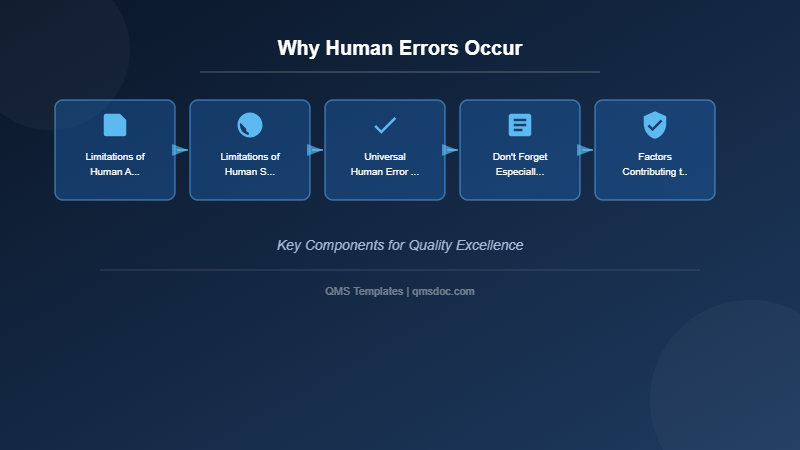
Limitations of Human Attention
Human attention has inherent limitations that contribute to errors:
- Limited scope of attention: The range of what humans can pay attention to at any given moment is finite.
- Selective attention: People do not pay attention to things they perceive as irrelevant to themselves.
- Directional nature of attention: Attention has a specific direction and focus.
- Fluctuation of attention: Attention levels vary and are not constant.
- Rhythmic patterns of attention: Attention follows cyclical patterns.
These characteristics lead to unintended results (mistakes).
Limitations of Human Sensory Perception
Furthermore, human sensory systems have the following limitations:
- Vision: Visual perception cannot always accurately judge all things. What we see may not always represent reality accurately.
- Hearing: Auditory perception cannot always accurately judge direction or distance.
- Touch: Tactile perception cannot always make accurate judgments, depending on the circumstances at that time.
- Time perception: Even for the same duration of time, it may feel longer or shorter depending on the situation.
These sensory limitations also impact error occurrence.
Universal Human Error Tendencies
As a result of these limitations, the following tendencies occur in everyone:
- Inattention: Lapses in attention
- Misperception (illusions): Errors in perception or interpretation
- Shortcuts and omissions: Taking shortcuts or skipping steps
These are universal human tendencies that can affect anyone.
Don’t Forget Especially When Experienced!
Mistakes and accidents are not caused only by beginners. In fact, errors made by experienced workers are more likely to lead to serious consequences.
Factors Contributing to Beginner Errors
- Sensory information overload leading to confusion
- Inability to make decisions, hesitation, and lack of confidence
- Noticing problems too late or only when the worst situation has occurred
- Acting on ambiguous judgments
- Inability to predict dangerous consequences
Factors Contributing to Expert Errors
- Becoming too rigid in approach due to years of repetition
- Many unconscious actions due to over-familiarity
- Not noticing errors because they make few mistakes
- Operations being skipped or omitted because tasks can be completed quickly
Understanding these different error patterns is crucial for developing effective prevention strategies.
Pointing and Calling (Shisa Kanko)
To minimize human errors, the following measures are effective. These are examples of soft countermeasures:
- Work based on procedures and work instructions
- Follow instructions when working
- Record work immediately after completion
- Implement double-checking for important work
- Review and approve completed work records
However, it is not always possible to implement double-checking in all processes. For example, it would not be realistic to always have two conductors on every train. In such cases, pointing and calling is effective.
What is Pointing and Calling?
Pointing and calling is a safety confirmation method performed as part of hazard prediction activities. It involves pointing at work objects, signs, signals, and instruments, and verbally confirming their names and status.
This creates a triple check system: “visual confirmation,” “pointing,” and “vocalization.”
Scientific Evidence of Effectiveness
According to research conducted by the Railway Technical Research Institute in 1994, pointing and calling significantly reduces errors. In an experiment where participants pressed buttons in response to screen displays (100 times × 4 types per person), the following error rates were observed:
| Confirmation Method | Error Rate | Reduction Effect |
| Neither pointing nor calling | 2.38% | Baseline |
| Calling only | 1.0% | 58% reduction |
| Pointing only | 0.75% | 68% reduction |
| Both pointing and calling | 0.38% | 84% reduction (approximately 1/6) |
This demonstrates that pointing and calling reduces errors to approximately one-sixth of the baseline rate.
Recent real-world validation studies published in 2023 have confirmed these laboratory findings in actual industrial settings. Research on transit systems showed that implementing pointing and calling reduced incidents by 30-40%, with some operations achieving reductions of up to 53%.
Important Consideration
However, as the figure shows, even with triple checking, humans still make mistakes approximately 3 times per 1,000 identical operations. This aligns with research by Kaneo Hamada of the Takasaki Manufacturing Technology Institute, which established the widely recognized human error rate of 0.3% (3 errors per 1,000 operations).
In other words, human errors will inevitably occur.
This fundamental understanding has led to the development of modern safety management approaches that focus not just on preventing errors, but on building systems resilient to human error through comprehensive risk management frameworks.
Modern Approaches to Human Error Management
System-Level Safety Management
Contemporary safety management has evolved beyond simply blaming individuals for errors. Modern frameworks such as ISO 45001 (Occupational Health and Safety Management System) emphasize:
- Organizational responsibility: Creating systems that reduce the likelihood of errors
- Risk-based thinking: Identifying and mitigating hazards before incidents occur
- Continuous improvement: Using the Plan-Do-Check-Act (PDCA) cycle for ongoing enhancement
- Worker participation: Engaging employees at all levels in safety initiatives
ISO 45001, published in March 2018, provides an international standard for organizations to proactively improve worker safety and reduce workplace risks. This standard recognizes that human error is a result of system design, not just individual failure.
Safety-I and Safety-II Perspectives
Modern safety science distinguishes between two complementary approaches:
Safety-I: The traditional approach of learning from failures
- Analyzing what went wrong
- Understanding causes of accidents
- Preventing recurrence
Safety-II: The newer approach of learning from success
- Analyzing what goes right
- Understanding how people successfully adapt to varying conditions
- Amplifying successful behaviors
Both perspectives are valuable. While we must learn from incidents (Safety-I), we should also study normal operations to understand how workers successfully manage complexity and prevent problems (Safety-II).
Three Lessons of Human Error
Finally, let us introduce three fundamental lessons about human error:
- People make mistakes: This is an unavoidable aspect of human nature
- Hiding failures is a natural psychological response: Understanding this tendency is the first step to creating open safety cultures
- Create systems to prevent repeated failures: Organizations must design processes and safeguards that reduce error probability and impact
Building Error-Resilient Systems
Rather than expecting perfection from humans, effective safety management involves:
- Designing foolproof systems: Creating processes that make errors difficult or impossible (error-proofing/poka-yoke)
- Implementing fail-safe mechanisms: Ensuring that when errors do occur, they do not lead to catastrophic consequences
- Establishing psychological safety: Creating environments where workers feel safe reporting errors and near-misses without fear of punishment
- Providing adequate training and resources: Ensuring workers have the knowledge, skills, and tools needed to work safely
- Regular system reviews: Continuously evaluating and improving safety systems based on data and feedback
Conclusion
Human error is inevitable due to the inherent limitations of human attention, perception, and cognition. Both beginners and experts are susceptible to different types of errors. While individual countermeasures such as pointing and calling can significantly reduce error rates, no single method can eliminate errors entirely.
The key to managing human error lies in adopting a systems approach that:
- Acknowledges human limitations
- Implements multiple layers of defense
- Learns from both failures and successes
- Fosters a culture of continuous improvement
By understanding why errors occur and implementing comprehensive safety management systems aligned with international standards such as ISO 45001, organizations can create safer working environments and significantly reduce the likelihood and impact of human error.
Remember: The goal is not to eliminate the human element from work processes, but to design systems that work harmoniously with human capabilities and limitations, maximizing safety while maintaining operational effectiveness and worker wellbeing.
Related Articles
- Why do human errors occur?
- Why We Do Not Seek Probability Estimates for Human Errors and Software Errors
- Human Error Is Not a Root Cause
- Mechanisms to Prevent Human Error: 4M Change Management and 3H Management
- AI IQ Scores Range from 120 to 136, Exceeding the Human Average of 100
- Department of Health and Human Services (HHS) Criticizes FDA’s Foreign Inspection Practices
