

The Importance of Communication in Pharmaceutical Quality Management
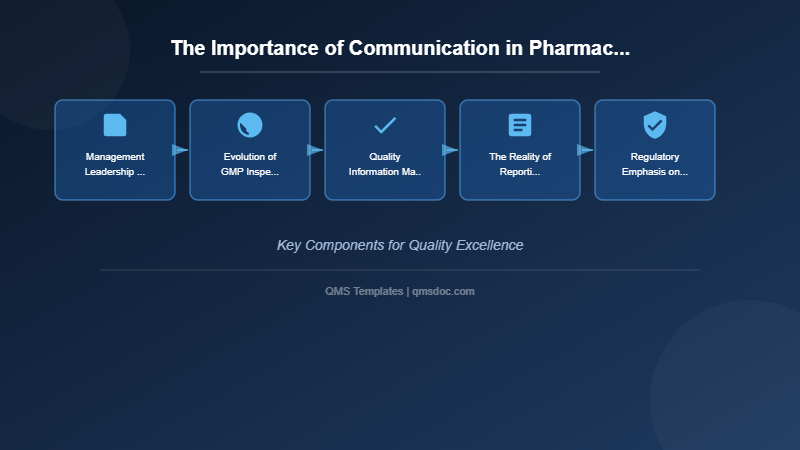
Management Leadership and Compliance Culture
Leadership must continuously and consistently communicate to all employees the imperative of regulatory compliance. This persistent commitment from management serves as the foundation for organizational culture. When management demonstrates genuine dedication to compliance through both words and actions, it creates an environment where employees feel empowered to respond swiftly when quality issues arise and anomalies in product quality are discovered. This leadership approach fosters a deep-seated awareness of regulatory compliance throughout the organization, enabling rapid identification and resolution of potential quality concerns.
Leadership must continuously and consistently communicate to all employees the imperative of regulatory compliance. This persistent commitment from ma…
Evolution of GMP Inspections: Focus on Quality Systems
In recent years, Good Manufacturing Practice (GMP) inspections have undergone significant evolution in their focus and methodology. Contemporary GMP inspections, conducted by regulatory authorities worldwide including the FDA, EMA, PIC/S member authorities, and WHO-affiliated agencies, now place primary emphasis on evaluating the robustness and effectiveness of an organization’s quality system. According to the FDA’s Office of Pharmaceutical Quality and recent revisions to EU GMP Chapter 1 (Pharmaceutical Quality System) published in 2025, inspectors assess not merely procedural compliance but the fundamental strength of the pharmaceutical quality system itself.
The critical evaluation point has shifted from simple documentation review to verification that the quality system is properly cascaded to individual products and that established mechanisms operate effectively in practice. This systematic approach, aligned with ICH Q10 (Pharmaceutical Quality System) guidelines, requires organizations to demonstrate that their quality management framework encompasses all aspects of product lifecycle management—from development through commercial manufacturing and ongoing product surveillance.
Quality Information Management and Product Recalls
Inadequacies in the capture, evaluation, and response to quality information can directly lead to product recalls, regulatory enforcement actions, and most importantly, potential patient harm. The pharmaceutical quality system must incorporate robust mechanisms for identifying, assessing, and acting upon quality signals throughout the product lifecycle. Modern regulatory frameworks, including the revised ICH Q9(R1) Quality Risk Management guideline (effective July 2023), emphasize the importance of systematic quality information management as a cornerstone of product quality assurance.
Field personnel—those working directly in manufacturing, quality control laboratories, warehousing, and distribution—often serve as the first line of detection for quality anomalies. These frontline employees may observe subtle changes in processes, unexpected variations in materials, or unusual patterns in test results. The pharmaceutical quality system must ensure that such observations are promptly communicated to management and shared across the organization. When quality information flows freely throughout all levels of the organization, necessary corrective and preventive actions can be implemented swiftly, minimizing risk to product quality and patient safety.
The importance of organizational information sharing cannot be overstated in maintaining pharmaceutical quality and ensuring patient safety.
The Reality of Reporting Culture
However, we must ask ourselves a fundamental question: Have we truly fostered a culture where reporting problems is not only accepted but encouraged?
Human beings are inherently fallible—mistakes and oversights are inevitable aspects of human nature. Yet in many organizational cultures, reporting errors to supervisors often results in reprimand or disciplinary action. This fear of blame creates a destructive cycle: employees tell small lies to cover minor mistakes. To conceal these initial untruths, they construct larger fabrications. These escalate into even more significant deceptions. By the time the truth emerges, the situation has evolved into a crisis of unmanageable proportions—a pattern observed repeatedly across industries and documented in numerous regulatory warning letters and compliance enforcement actions.
This progression from minor concealment to major crisis represents one of the most significant threats to pharmaceutical quality and patient safety.
Regulatory Emphasis on Communication and Quality Culture
International standards and regulatory frameworks explicitly recognize the critical importance of organizational communication and a supportive quality culture. The current version of ISO 9001:2015 (with Amendment 1:2024 incorporating climate action considerations) emphasizes communication throughout its structure, particularly in:
- Clause 5.2.2: Communicating the quality policy
- Clause 7.4: Communication requirements for internal and external stakeholders
- Clause 10: Improvement through effective information sharing
Similarly, data integrity requirements—as articulated by FDA, MHRA, WHO, and EMA through their respective guidance documents—stress the fundamental importance of organizational culture in maintaining data reliability. The ALCOA+ (and increasingly, ALCOA++) principles, which define that data must be Attributable, Legible, Contemporaneous, Original, Accurate, Complete, Consistent, Enduring, and Available, cannot be effectively implemented without a supportive organizational culture. Recent FDA guidance on data integrity (FDA Guidance for Industry: Data Integrity and Compliance with Drug CGMP, updated December 2018) explicitly states that achieving data integrity requires “a quality culture where personnel understand that data integrity is an organizational core value.”
The revised ICH Q9(R1) guideline (January 2023) further reinforces this concept by emphasizing that effective quality risk management depends fundamentally on organizational culture, knowledge management, and transparent communication systems. The guideline explicitly addresses the need to reduce subjectivity in risk assessments and improve risk-based decision-making—both of which require open communication channels and a blame-free environment where concerns can be raised without fear of retribution.
Rewarding Those Who Report Errors
Organizations must fundamentally reconceptualize their approach to error reporting. Individuals who report mistakes should be recognized and rewarded, not punished. Why? Because they have provided the organization with a valuable opportunity for improvement. They have prevented a minor issue from evolving into a major crisis. They have demonstrated commitment to quality and patient safety over personal comfort.
Given that human error is inevitable, the focus must shift from blaming individuals to improving systems. Organizations must enhance their Quality Management Systems (QMS) to create processes that can both detect and prevent errors. This systematic approach, aligned with contemporary understanding of human factors engineering and human reliability science, recognizes that sustainable quality cannot be achieved through fear and punishment, but rather through robust system design that accounts for human limitations.
System improvements might include:
- Enhanced procedural controls with built-in error prevention mechanisms
- Automated systems that reduce reliance on human memory and vigilance
- Improved training programs that emphasize understanding over rote memorization
- Design of work environments that minimize opportunities for human error
- Implementation of real-time monitoring systems that detect deviations early
- Creation of verification steps at critical process points
Leadership Responsibility: Fostering a Reporting-Friendly Culture
The primary responsibility of management and organizational leadership is to cultivate and maintain a culture where reporting issues is not merely tolerated but actively encouraged and rewarded. This concept, often referred to as a “just culture” or “safety culture” in pharmaceutical quality management, represents a fundamental shift from traditional blame-oriented approaches to modern, system-focused quality management.
Elements of an effective reporting culture include:
Leadership Commitment: Senior management must visibly demonstrate that quality and transparency are organizational priorities through both words and actions. This includes allocating appropriate resources to quality systems, participating in quality reviews, and responding constructively to quality issues.
Clear Communication Channels: Organizations must establish multiple, accessible pathways for employees to report concerns, including direct supervisory reporting, quality assurance contacts, and anonymous reporting mechanisms when appropriate.
Timely and Constructive Response: When issues are reported, management must respond promptly, investigate thoroughly, and implement appropriate corrective actions. Employees must see that their reports lead to meaningful improvements.
Education and Training: Continuous training programs should emphasize the importance of reporting, the organizational commitment to a blame-free environment, and the role of error detection in continuous improvement.
Recognition and Reward Systems: Organizations should establish formal mechanisms to recognize employees who identify and report quality issues, reinforcing the message that such reporting demonstrates commitment to quality and patient safety.
Transparent Investigation Processes: Root cause analysis and corrective action processes should focus on system failures rather than individual blame, consistent with contemporary quality management principles and human factors science.
This cultural transformation represents not merely a compliance requirement but a strategic imperative. Organizations with mature quality cultures—those that successfully implement the principles discussed above—demonstrate better regulatory compliance, fewer product quality issues, enhanced employee engagement, and ultimately, better protection of patient safety.
Conclusion
The pharmaceutical industry operates under the fundamental obligation to ensure that every medicine reaching patients meets the highest standards of quality, safety, and efficacy. Achieving this goal requires more than procedural compliance—it demands a comprehensive quality culture built on open communication, transparent reporting, and continuous improvement.
As regulatory authorities worldwide, including FDA through its Quality Management Maturity (QMM) initiative and international bodies through ICH guidelines, increasingly emphasize the importance of quality culture, organizations must recognize that fostering a reporting-friendly environment is not optional—it is essential to fulfilling our collective responsibility to patients and public health.
The path forward is clear: Management must lead by example, creating an environment where employees feel safe reporting concerns. Organizations must shift from blame-focused reactive approaches to system-focused proactive improvement. And all stakeholders must recognize that the person who reports an error is not the problem—they are part of the solution.
In the words of contemporary quality management thinking: “To err is human, but to hide an error is a system failure.” Building systems that encourage open reporting and continuous improvement represents the most reliable path to sustainable pharmaceutical quality and patient safety.
References and Regulatory Framework:
This article aligns with and incorporates principles from:
- ISO 9001:2015 (with Amendment 1:2024) – Quality Management Systems
- ICH Q9(R1) – Quality Risk Management (January 2023, effective July 2023)
- ICH Q10 – Pharmaceutical Quality System
- FDA Guidance for Industry: Data Integrity and Compliance with Drug CGMP (December 2018)
- MHRA Guidance: GXP Data Integrity Guidance and Definitions (2018)
- EU GMP Chapter 1 – Pharmaceutical Quality System (2025 revision, consultation period)
- PIC/S Guidance: Good Practices for Data Management and Integrity (2021)
- ALCOA+ and ALCOA++ Principles for Data Integrity
- FDA Quality Management Maturity (QMM) Program
- WHO Technical Report Series (TRS) 996 Annex 5: Guidance on Good Data and Record Management Practices
Related Articles
- The Importance of Communication in Pharmaceutical Quality Management
- The Importance of Data Analysis: The Foundation of Quality Assurance in Medical Device and Pharmaceutical Companies
- Quality Risk Management in the Pharmaceutical Industry
- Understanding Risk Assessment in Pharmaceutical Quality Management
- Understanding Self-Inspection in Pharmaceutical Quality Management: A Comparative Analysis of Global Regulatory Approaches
- Beyond Blind Compliance: Critical Thinking in Pharmaceutical Quality Management
