
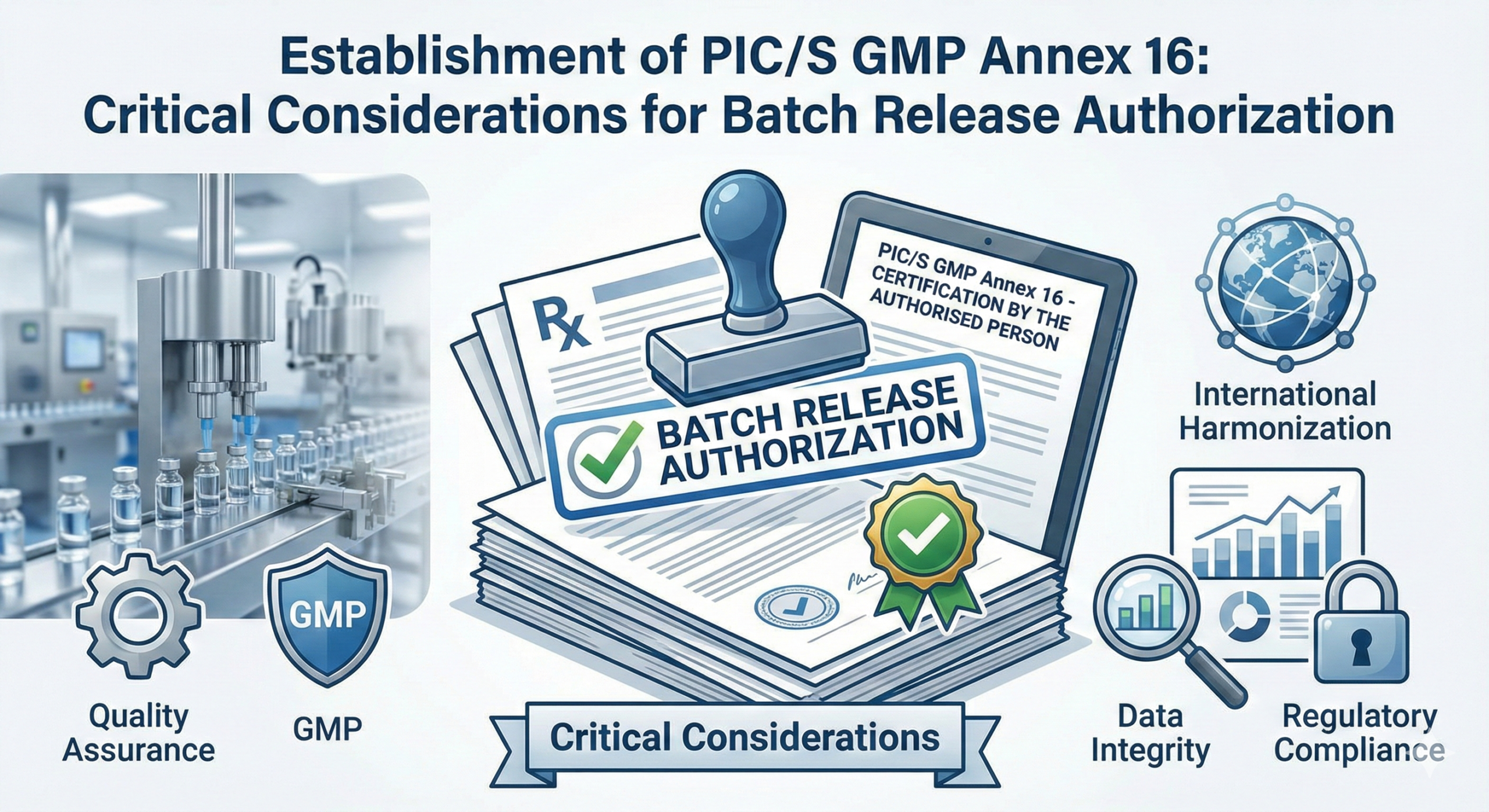
Establishment of PIC/S GMP Annex 16: Critical Considerations for Batch Release Authorization
Background: Why Annex 16 Was Previously Absent from PIC/S
Historically, PIC/S GMP Annex 16 remained vacant. The primary reason was that EU GMP Annex 16 addressed the Qualified Person (QP) system, which was considered a uniquely European regulatory requirement. This specialized qualification framework had not been adopted by other PIC/S member countries, creating a gap in international harmonization.
The Adoption of PIC/S Annex 16
On February 1, 2022, the PIC/S GMP Guide was revised with the introduction of Annex 16 titled “CERTIFICATION BY THE AUTHORISED PERSON AND BATCH RELEASE” (PE 009-16). This marked a significant step toward international harmonization of batch release requirements.
PIC/S actively encourages each member country to incorporate Annex 16 into their national regulations. However, as of early 2026, Japan has not yet officially adopted this annex into its domestic GMP regulatory framework, although Japanese regulations already contain fundamental requirements for batch release.
Japanese GMP Requirements for Batch Release
Under Japan’s GMP ministerial ordinance and QMS (Quality Management System) ministerial ordinance, pharmaceutical and medical device manufacturers must conduct batch release authorization before products can be shipped to market.
The batch release authorization process requires the Quality Assurance department to review manufacturing records and quality testing records, and subsequently approve shipment. However, in many Japanese companies, the actual practice often involves merely stamping or signing release documents when manufacturing records and quality testing records show no apparent deficiencies. This simplistic approach could potentially be performed by part-time staff or temporary workers, which raises concerns about the rigor of the release process.
The True Purpose of Batch Release Authorization
Fundamentally, batch release authorization should involve an independent third party, such as the Quality Assurance department, conducting a thorough and comprehensive investigation of all manufacturing records and quality testing records. Release approval should only be granted when there are absolutely no doubts or concerns about product quality.
Through my professional experience conducting audits at pharmaceutical facilities worldwide, I have observed significant differences in batch release practices. In Europe, only a Qualified Person (QP) – or Authorised Person (AP) in non-EU PIC/S member countries – is permitted to authorize batch release. Even company executives or plant managers cannot approve batch release without holding the QP or AP qualification.
European Best Practices in Batch Release
At European pharmaceutical companies, QPs typically employ a team of four to five qualified staff members who conduct exhaustive investigations of all manufacturing records and quality records. Moreover, these investigations include double-checking mechanisms to ensure accuracy and completeness.
Manufacturing records subject to review include validation records, while quality testing records encompass sampling records and all associated documentation. The review process naturally includes verification of transcription errors, recording mistakes, and calculation errors.
Particular attention must be paid to records of changes made to raw data. For electronic records, verification of audit trails becomes critically important. As needed, additional documentation such as reagent management status, calibration records, and training records may also be referenced during the review process.
Ultimately, the QP or AP authorizes batch release only when they have absolute confidence in the product quality based on comprehensive evidence.
Regulatory Requirements for Electronic Systems in Batch Release
PIC/S GMP Annex 11 Computerised Systems
The current version of PIC/S GMP Annex 11 “Computerised Systems,” which has been in effect since 2011 (not 2013 as sometimes misunderstood), contains the following critical requirement regarding batch release:
Section 15: Batch Release
When a computerized system is used for recording approvals and batch release, the system must permit only Authorised Persons (or Qualified Persons in the EU context) to release batches and must clearly record the identity of the person who released/approved each batch. Electronic signatures must be utilized for this operation.
The name of the QP or AP who authorized batch release must be clearly recorded for each batch. Once a QP or AP has authorized release, the person who made that release decision bears responsibility even if manufacturing or quality departments made errors. Electronic signatures are mandatory for this purpose because, unlike handwritten signatures, they cannot be backdated (as handwritten signatures can be written with any arbitrary date).
Important Note on Annex 11 Revision
It is important to note that PIC/S and the European Medicines Agency (EMA) are currently undertaking a comprehensive revision of Annex 11 to address advances in digital technologies, cloud computing, data integrity requirements, and emerging technologies such as artificial intelligence. A concept paper was released in late 2022, with the revised guideline expected to be finalized in 2026. Additionally, a new Annex 22 on Artificial Intelligence is being developed to provide guidance on AI/ML systems used in pharmaceutical manufacturing.
Additional Requirements in Annex 11
Annex 11 also contains crucial requirements regarding printouts and data retention:
Section 8: Printouts
8.1 It must be possible to obtain clear printed copies of electronically stored data.
8.2 For records that support batch release, it must be possible to generate printouts showing whether data has been changed from the time of original entry.
Electronically stored data includes not only raw data but also metadata such as audit trails. Records supporting batch release (i.e., manufacturing records and quality testing records) must allow verification of whether any changes have been made since the initial data entry. This means audit trails must be printable, as quality assurance personnel, auditors, and regulatory inspectors need to review audit trails. A mechanism to detect data manipulation is therefore essential.
US FDA Requirements: 21 CFR Part 11
The 21 CFR Part 11 Electronic Records, Electronic Signatures regulation, which was implemented in August 1997, contains the following requirement:
Section 11.10(h)
“Use of device (e.g., terminal) checks to determine, as appropriate, the validity of the source of data input or operational instruction.”
This requirement is often misunderstood due to its somewhat ambiguous wording. Few practitioners correctly interpret its meaning. This requirement mandates that during batch release authorization and similar critical operations, the system must verify that inputs are coming from authorized terminals (i.e., authorized personnel) and that unauthorized individuals cannot perform batch release authorization. This is a critical control to prevent unauthorized personnel from releasing batches through unauthorized access points.
Comparison of Global Batch Release Requirements
| Region/Organization | Key Requirement | Authorized Person | Electronic Signature Requirement |
| EU | Annex 16 (2016 revision) | Qualified Person (QP) | Mandatory for batch release |
| PIC/S | Annex 16 (adopted Feb 2022) | Authorised Person (AP) | Mandatory for batch release |
| United States | 21 CFR Part 11 (1997) | Quality Unit personnel | Required for electronic records |
| Japan | GMP Ministerial Ordinance | Quality Assurance dept | Not explicitly mandated |
Note: QP (EU term) and AP (PIC/S term) are considered equivalent designations with the same responsibilities.
The Personal Responsibility of Batch Release Authorization
I once had the opportunity to speak with a former Quality Assurance director from a pharmaceutical company who had been responsible for batch release authorization for many years. Upon his retirement, he remarked that he could finally sleep peacefully at night. The reason was his constant concern that if any product he had authorized for release had quality issues that caused harm to patients, he would feel personally responsible for the consequences.
This profound sense of responsibility underscores the critical nature of the batch release authorization role. The QP or AP literally signs their name to certify that each batch meets all quality standards and is safe for patient use. This is not a clerical function but a professional certification that requires deep expertise, careful judgment, and unwavering integrity.
Current Challenges and Future Directions
Data Integrity and Computerized System Validation
With the increasing use of electronic batch manufacturing records (eBMR), manufacturing execution systems (MES), and laboratory information management systems (LIMS), ensuring data integrity throughout the product lifecycle has become paramount. Regulatory authorities worldwide, including PMDA in Japan, FDA in the United States, and EMA in Europe, have intensified their focus on computerized system validation and data integrity controls.
Risk-Based Approaches to Batch Release
Modern pharmaceutical quality systems increasingly emphasize risk-based decision making aligned with ICH Q9 Quality Risk Management principles. The batch release process should incorporate systematic risk assessment to identify which records and data points require the most rigorous review based on their potential impact on product quality and patient safety.
Continuous Process Verification and Real-Time Release Testing
As pharmaceutical manufacturing advances toward continuous manufacturing and real-time release testing (RTRT) as described in PIC/S Annex 17, the traditional batch release paradigm is evolving. However, the fundamental principle remains unchanged: an authorized person must certify that products meet all quality standards before they reach patients.
Expectations for the Pharmaceutical and Medical Device Industries
It is strongly recommended that pharmaceutical and medical device companies thoroughly understand the true purpose of batch release authorization. Companies should conduct exhaustive record reviews from the patient’s perspective before authorizing release.
The batch release authorization process is not merely a procedural formality but represents the final critical control point ensuring that only products of appropriate quality reach patients. This process requires:
- Qualified and adequately trained personnel with appropriate authority
- Comprehensive review procedures that address all critical quality attributes
- Robust documentation systems that maintain complete and accurate records
- Electronic systems with appropriate controls, audit trails, and security measures
- A culture that prioritizes patient safety above operational convenience
As regulatory harmonization continues through PIC/S and other international initiatives, companies should proactively align their batch release practices with these evolving global standards. Even in countries where specific requirements such as PIC/S Annex 16 have not yet been formally adopted, implementing these best practices demonstrates commitment to quality and prepares organizations for future regulatory developments.
The ultimate goal of batch release authorization is clear: to ensure that every product reaching patients has been manufactured in compliance with all applicable standards and specifications, and that this compliance has been verified by competent, qualified personnel who take personal responsibility for that determination. This commitment to quality must remain the foundation of pharmaceutical and medical device manufacturing worldwide.

Comment