
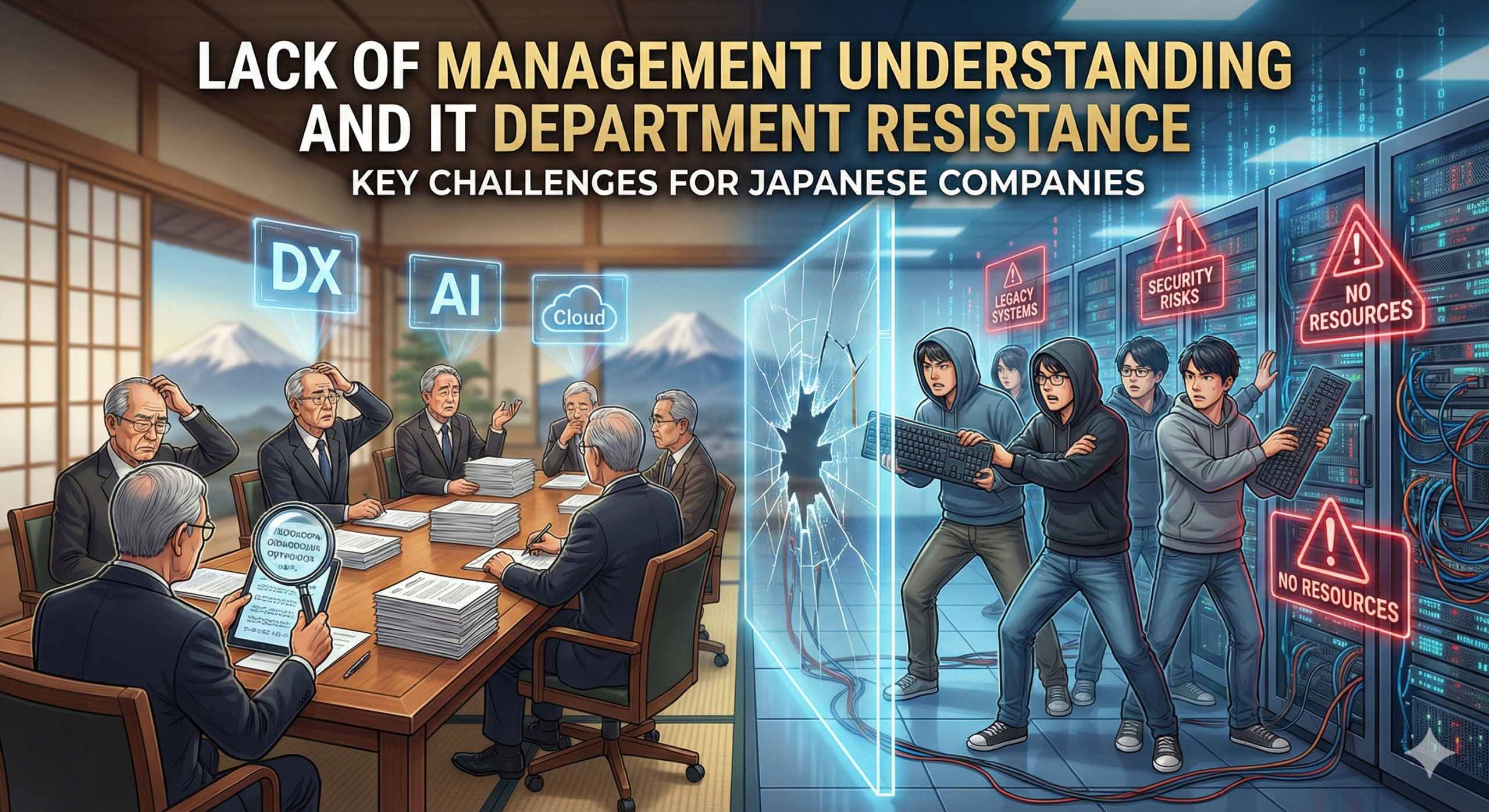
Lack of Management Understanding and IT Department Resistance: Key Challenges for Japanese Companies
In 2025, AI is evolving from something we “use” to something we “delegate to,” poised to significantly transform business operations. However, two major barriers prevent Japanese companies from riding this wave of transformation: “management’s insufficient understanding of AI” and “IT departments’ resistance to change.” This column delves into these challenges in detail and explores pathways to resolution.
Management’s Insufficient Understanding: Why the Essence of AI Isn’t Getting Through
The Perception Gap: From “Tool” to “Partner”
Many executives still perceive AI as an “advanced tool”—similar to image recognition or translation tools that operate as auxiliary functions following human instructions. However, agentic AI systems that are rapidly gaining adoption have evolved into entities that can plan within a defined scope toward given objectives, select necessary tools, and support execution. While not yet achieving complete autonomy, the direction is clear.
This perception gap leads to flawed adoption decisions. As long as executives view “AI as merely an efficiency tool,” AI implementation remains confined to small-scale operational improvements without achieving organization-wide transformation. According to a Ministry of Internal Affairs and Communications survey, only 42.7% of Japanese companies have established policies for generative AI utilization—approximately half the rate of over 90% in the United States and Germany. Paradoxically, approximately 75% of companies expect AI to “improve operational efficiency,” and this gap between recognition and execution exemplifies the lack of understanding at the management level.
Misunderstanding Return on Investment
Another problem arising from executives viewing AI as a “tool” is the evaluation method for return on investment. Traditional IT system implementations allowed for direct effectiveness measurements such as “how many hours this system will save.” However, the true value of agentic AI lies not in simple time reduction but in creating an environment where humans can focus on more creative tasks.
For example, delegating sales meeting material preparation to AI might save only a few hours. However, the value of being able to use that time for relationship building with clients or planning new business ventures cannot be measured by simple labor-hour reduction. This lack of perspective hinders appropriate investment decisions.
Case Study: Failure at Manufacturing Company A
In 2024, mid-sized manufacturing Company A considered implementing AI agents, but because executives insisted on the traditional evaluation criterion of “how many annual hours can be saved,” implementation remained limited to small-scale automation of routine tasks. Meanwhile, competitor Company B set the goal of “doubling the time sales representatives can spend visiting customers” for their AI implementation, leading to significant order increases. This difference stems from how each company perceived AI’s fundamental value.
IT Department Challenges: Disparities in Adaptation Speed to Change
Excessive Concerns About Integration with Existing Systems
One of the primary reasons IT departments take a cautious approach to AI adoption is concern about integration with existing systems. There’s a tendency to be overly cautious about coordination with internal systems built over many years and data compatibility.
System stability is indeed important. However, the situation where even proof-of-concept experiments cannot begin due to demands for perfect integration is counterproductive. In fact, 64.6% of Japanese companies cite “lack of AI literacy and skills” as a challenge, making it urgent to strengthen IT department structures. Rather, a more realistic approach involves starting with small-scale pilot experiments and gradually integrating them.
Challenges in Adapting to Role Changes
As AI agents begin supporting operations, IT departments’ roles undergo significant changes. A shift is required from the traditional role of “building and operating systems” to “optimizing collaboration between AI and humans.”
Adapting to this change takes time. Particularly for engineers who have spent years mastering specific systems or programming languages, adapting to the new skill domain of AI management is not easy. What’s important is recognizing the reality that IT departments are not necessarily “resisting,” but rather that there are significant disparities in adaptation speed between companies. Indeed, manufacturing reports a high adoption rate with 74.1% already using generative AI in operations, indicating growing polarization between leading and lagging companies.
Appropriate Management of Security and Governance
IT departments naturally prioritize security and governance. However, cases are increasing where this stance becomes rigid and actually impedes the introduction of new technologies.
When AI agents access internal data and collect information from the internet, security risks certainly exist. However, it’s impossible to eliminate these risks entirely. What’s important is advancing implementation gradually while establishing appropriate risk management frameworks. According to IBM research, 63% of organizations have not established AI-related governance policies, making the construction of proper governance structures an urgent priority rather than an obstacle.
Case Study: Stalemate at Financial Institution C
A major financial institution began considering AI agent implementation in early 2024, but the IT department insisted that “complete integration with existing core accounting systems cannot be guaranteed” and “comprehensive review of security policies is necessary.” After more than a year, even proof-of-concept experiments have not begun. Meanwhile, another financial institution in the same industry began pilot experiments “limited to the sales support division” and “within a scope that does not handle confidential information,” confirmed results within three months, and is now gradually expanding. This difference arises from disparities in adaptation speed. With 87% of manufacturing companies having initiated AI pilot projects, it’s clear that significant gaps in adaptation speed exist across industries.
Overcoming the Two Barriers
What is Required of Executives
Improving AI Literacy
Executives themselves need to understand the essence of agentic AI. Beyond merely attending seminars, experiencing simple AI agents firsthand is crucial. By personally experiencing “delegation,” they can tangibly understand both possibilities and limitations.
Redefining Evaluation Metrics
Establish a framework that evaluates AI implementation effectiveness not only through “time reduction” but also through multifaceted metrics such as “increased time investment in creative tasks,” “creation of new businesses,” and “improved customer satisfaction.”
Top-Down Decision Making
AI implementation is not merely an IT investment but organizational transformation. It’s essential for executives to present a clear vision and drive implementation from the top down.
What is Required of IT Departments
Mindset Transformation
A shift from a “defensive” stance to “attacking while defending” is necessary. Rather than doing nothing in pursuit of perfection, flexibility is required to start small while managing risks. What’s important is reframing change not as “something to resist” but as “a challenge requiring accelerated adaptation speed.”
Acquiring New Skills
In addition to programming and system building skills, acquiring AI management capabilities is necessary. This involves the ability to set appropriate objectives for AI agents and evaluate their outcomes, requiring not just technical knowledge but also business understanding.
Redefining Roles Within the Organization
IT departments need to proactively embrace the new role of “specialists in optimizing collaboration between AI and humans.” This role is positioned even closer to management than before, actually representing an opportunity to increase IT departments’ importance.
Practical Breakthrough Strategies
Step 1: Establish Regular Dialogue Between Management and IT Department
First, it’s important to regularly establish forums where executives and IT departments can have frank dialogues. Executives share business challenges, while IT departments explain technical possibilities and constraints. Through this two-way communication, realistic implementation plans can be formulated.
Step 2: Rapid Implementation of Small-Scale Pilot Experiments
Rather than waiting for perfect plans, begin pilot experiments rapidly within limited scope. For example, start with areas where risks are limited and outcomes easily measurable, such as routine report preparation in specific departments or market research that doesn’t involve confidential information.
Step 3: Internal Sharing of Success Stories
Share success stories obtained from pilot experiments company-wide. Particularly by emphasizing “what was accomplished using the time created by delegating to AI”—the human-side achievements—it becomes easier to gain understanding and cooperation throughout the organization.
Step 4: Gradual Expansion and Improvement
Once successful patterns are established, gradually deploy to other departments. During this phase, customize according to each department’s characteristics and establish continuous improvement cycles.
Looking Toward the Second Half of 2025
The Arrival of Multi-Agent Systems
In the second half of 2025, multi-agent systems where multiple AI agents collaborate to accomplish complex tasks are expected to become fully practical. With OpenAI and Google adopting the MCP (Model Context Protocol), collaboration between AI agents developed by different companies is becoming possible. An era is coming where sales AI, marketing AI, and customer support AI will collaborate to optimize the entire customer experience.
To prepare for this era, promoting management understanding and strengthening IT department structures must begin now. The gap in adaptation speed with leading companies will expand over time.
The Importance of AI Ethics and Governance
As the scope of what we “delegate” to AI expands, the transparency of its decisions and accountability become increasingly important. ISO/IEC 42001 (AI Management System Standard) was officially published in December 2023, and along with the EU AI Act, is being rapidly examined by companies in 2024-2025. Some countries and regions are moving toward requiring companies above a certain size to establish AI ethics committees.
Executives and IT departments collaborating to build appropriate governance structures will become a source of competitive advantage going forward. Considering that IBM research indicates 63% of organizations have not yet established governance policies, companies that address this early can secure advantages.
International Regulatory Landscape and Standards
The regulatory environment for AI is rapidly evolving globally, requiring companies to stay informed and compliant:
EU AI Act (Artificial Intelligence Act) Adopted in 2024 and beginning phased implementation through 2027, this landmark regulation categorizes AI systems by risk level. High-risk systems (such as those used in critical infrastructure, employment, or law enforcement) face stringent requirements including risk assessments, technical documentation, human oversight, and transparency obligations. Prohibited practices include certain types of social scoring and real-time biometric identification in public spaces. Companies operating in or serving EU markets must ensure compliance.
US Executive Order on AI (October 2023) While the US lacks comprehensive federal AI legislation comparable to the EU AI Act, President Biden’s Executive Order 14110 established standards for AI safety and security, particularly for systems that could pose risks to national security, economy, or public health. The order requires developers of powerful AI systems to share safety test results with the government and establishes guidelines for federal agencies’ use of AI.
ISO/IEC 42001:2023 – AI Management Systems This international standard provides requirements for establishing, implementing, maintaining, and continually improving an AI Management System (AIMS). It helps organizations manage AI-related risks and opportunities responsibly. The standard is designed to be integrated with other management system standards like ISO 9001 (quality management) and ISO/IEC 27001 (information security). Key elements include:
- Organizational context and stakeholder needs assessment
- Leadership commitment and AI policy establishment
- Risk and opportunity assessment for AI systems
- Operational planning and control throughout the AI system lifecycle
- Performance evaluation and continuous improvement mechanisms
Industry-Specific Developments
Financial services have seen particular regulatory attention, with guidelines from bodies like the Bank for International Settlements emphasizing principles of explainability, fairness, and accountability in AI systems used for credit decisions and risk assessment. Healthcare AI faces rigorous requirements around patient safety, data privacy (HIPAA in the US, GDPR in EU), and clinical validation. Manufacturing is developing standards through organizations like ISO TC 184 for AI in automation and robotics, focusing on safety, reliability, and human-machine collaboration.
Comparison of AI Adoption and Regulatory Readiness
| Aspect | Japan | United States | European Union | China |
| Generative AI Policy Adoption Rate | 42.7% | 90%+ | 90%+ | N/A |
| Manufacturing AI Usage Rate | 74.1% | 85%+ | 78% | 80%+ |
| Pilot Project Initiation (Manufacturing) | 87% | 90%+ | 85% | N/A |
| AI Governance Policy Implementation | 37% (est.) | 40%+ | 65%+ | N/A |
| Primary Regulatory Framework | Industry guidelines | Executive Orders, state laws | EU AI Act (comprehensive) | Generative AI regulations |
| Key Challenges Cited | Skills/literacy shortage (64.6%) | Talent competition | Compliance complexity | Data availability |
Conclusion
For Japanese companies to realize transformation in the AI era, they must overcome two barriers: management’s insufficient understanding and IT departments’ adaptation speed disparities. These are not separate problems but are interrelated. If executives push top-down without understanding the essence, IT departments’ cautious stance intensifies; if IT departments are overly cautious, executives’ understanding doesn’t deepen.
What’s important is for both parties to form common understanding through dialogue and adopt an approach of starting small and expanding gradually. Rather than remaining static in pursuit of perfection, courage is required to move forward while managing risks. As data shows, 87% of manufacturing companies have already initiated AI pilot projects, with 74.1% actually using it in operations. The question is not “whether it’s possible” but “how to increase adaptation speed.”
Now that AI is changing from something we “use” to something we “delegate to,” it’s important not to fear this transformation but to embrace it as a new possibility. When executives and IT departments learn and grow together, new organizational forms emerge where humans and AI collaborate. Directing the time and energy created there toward more creative and human activities will be the key to surviving the coming era.
The regulatory landscape is becoming increasingly complex, with the EU AI Act establishing a comprehensive framework, ISO/IEC 42001 providing international standards for AI management systems, and industry-specific guidelines emerging across sectors. Companies that proactively establish robust governance frameworks, ensure compliance with evolving regulations, and maintain ethical AI practices will not only mitigate risks but also build trust with customers and stakeholders, creating a sustainable competitive advantage.
The window for action is narrowing. As multi-agent systems become practical and AI capabilities continue to advance, the gap between early adopters and laggards will widen. Japanese companies must act now—not tomorrow—to bridge the understanding gap at the management level, accelerate IT departments’ adaptation speed, and establish the governance structures necessary for responsible AI deployment. The question is no longer whether to embrace AI transformation, but how quickly and effectively it can be accomplished.

Comment