
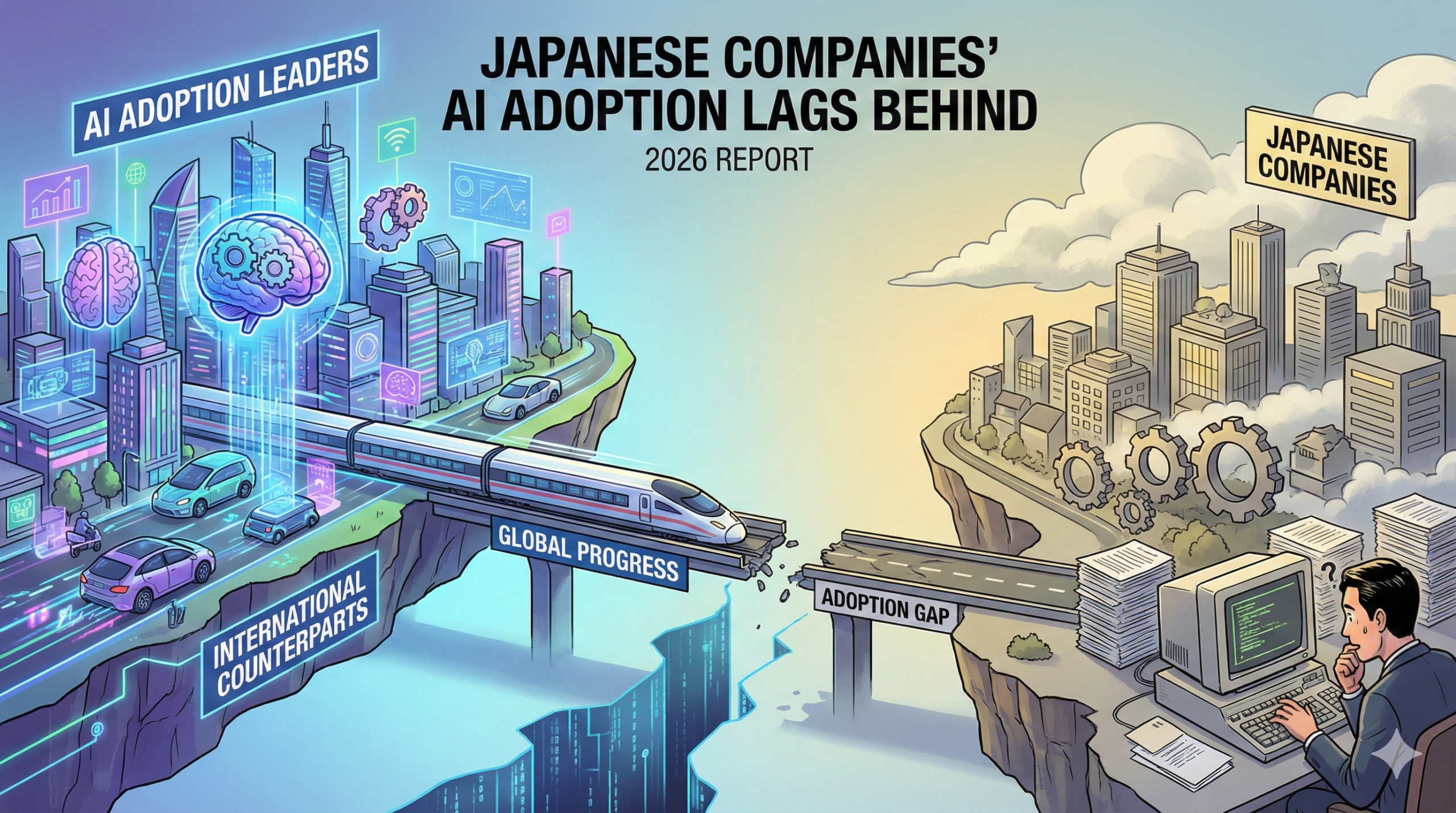
Japanese Companies’ AI Adoption Significantly Lags Behind International Counterparts
As of 2025, while companies worldwide are accelerating their AI adoption, Japanese companies’ initiatives are clearly falling behind compared to other nations. This lag is not merely a matter of timing in technology adoption, but rather a structural challenge rooted in organizational culture, decision-making processes, and fundamental views on labor itself. This column examines the reality and background of this “AI adoption gap,” as well as potential responses moving forward.
The Sobering Reality in Numbers
The Gap Revealed Through Global Comparisons
Multiple international surveys clearly demonstrate the lag in AI adoption among Japanese companies. According to recent studies, while 45% of US companies and 38% of Chinese companies report having “implemented AI technology company-wide,” only 12% of Japanese companies have reached this level.
Even more noteworthy is the percentage of companies “planning to implement AI within the next year.” While many Western companies have aggressive implementation plans, the majority of Japanese companies respond with “under consideration” or “wait and see.” This cautious stance is jeopardizing the position of Japanese companies in global competition.
It should be noted that these survey results vary depending on methodology and sample size. More recent data from 2024-2025 suggests the gap may be even wider in certain sectors, particularly in generative AI adoption, where US and Chinese companies have moved more aggressively into production environments.
Differences in Specific Use Cases
There are significant differences in the specific scenarios where AI is applied between overseas and Japanese companies.
Advanced Examples from Overseas Companies:
- AI agents handling over 80% of customer service interactions
- Fully automated document screening in recruitment processes
- AI integration into product development cycles, halving development time
- Utilization of AI for decision-making support in management
Current State of Japanese Companies:
- AI usage limited to restricted business support tools
- Supplementary positioning premised on final human verification
- Failure to progress from pilot projects to full-scale deployment
- Delayed investment decisions due to insufficient AI understanding among management
It’s worth noting that some leading Japanese companies, particularly in manufacturing and automotive sectors, have made significant strides in AI adoption for specific applications such as quality control and predictive maintenance. However, these successes remain concentrated in technical domains rather than being integrated across entire business operations.
Why Are Japanese Companies Falling Behind?
1. Decision-Making Process Issues
The “ringi system” (consensus-based approval process) and “unanimous consent” decision-making approach unique to Japanese companies are major factors delaying AI adoption. While new technology implementation requires swift decisions, by the time multi-layered approval processes are completed, technology trends have already moved to the next stage.
Overseas companies, particularly US tech firms, enable rapid top-down decision-making. When a CEO or CTO decides to “do it,” company-wide deployment can begin within weeks. This difference in decision-making speed directly correlates with the AI adoption gap.
However, it should be acknowledged that consensus-based approaches can lead to more thorough risk assessment and stakeholder buy-in when successfully executed. The challenge lies not in the consensus model itself, but in the time required and the inability to make bold decisions even after consensus is reached.
2. Culture That Does Not Tolerate Failure
Japanese companies have a strong “pursuit of perfection” culture, creating high psychological barriers to experimental initiatives. While trial and error is essential for AI implementation, companies tend to become overly cautious for fear of being labeled a “failed project.”
In contrast, overseas companies centered in Silicon Valley embrace a “Fail Fast” culture. They learn from small failures and quickly course-correct, ultimately leading to greater success. This cultural difference creates disparities in flexibility and experimental spirit regarding AI adoption.
According to recent research on organizational behavior in AI adoption, companies with higher tolerance for controlled experimentation show 2-3x faster AI integration rates. This suggests that cultural transformation around acceptable risk-taking is a critical success factor.
3. Delays in Personnel Allocation and Education
Shortage of Digital Talent
Japanese companies face an absolute shortage of AI talent and data scientists. More problematic is that even when such talent exists, they are not positioned to actually participate in business decision-making.
Overseas companies have positions like Chief AI Officer or Head of AI established at the executive level, leading company-wide AI strategy. While such movements are gradually appearing in Japanese companies, many remain buried within existing IT departments.
The global competition for AI talent has intensified significantly since 2023, with specialized AI engineers commanding premium salaries. Japanese companies’ traditional salary structures and promotion systems often cannot compete with offers from global tech companies or well-funded startups, exacerbating the talent shortage.
Lack of Company-Wide AI Literacy
From management to frontline employees, there is insufficient understanding of AI technology. Particularly serious is management’s attitude of thinking “we can just leave AI to the experts” and not attempting to learn themselves. Without this, it’s impossible to formulate a company-wide AI utilization strategy.
Recent surveys indicate that only 23% of Japanese executives report having received formal AI training, compared to 67% in the US. This educational gap at the leadership level cascades down through the organization, creating a fundamental barrier to strategic AI adoption.
4. Excessive Concern for Employment Preservation
Japanese companies have strong concerns about “AI taking away jobs,” leading to caution in AI adoption due to fears of backlash from employees and labor unions. Japanese-style employment systems such as lifetime employment and seniority-based systems create resistance to business automation and efficiency improvements.
Meanwhile, overseas companies adopt the mindset of “shifting surplus resources created by AI introduction to higher value-added work.” While some people do lose their jobs, this is accepted as a natural change in a market economy.
It’s important to note that this concern is not entirely unfounded. The EU AI Act and emerging global AI governance frameworks increasingly emphasize the need for human oversight and worker protections. Leading companies are finding success by reframing AI not as job replacement but as augmentation, focusing on upskilling programs and role transformation rather than workforce reduction.
Serious Impacts of the Lag
1. Expanding Productivity Gap
A significant productivity gap is emerging between companies with advanced AI adoption and those without. According to some estimates, AI-advanced companies show 30-50% higher productivity per employee compared to traditional companies.
This productivity gap affects not only corporate profitability but also employee working hours and workplace satisfaction. Companies with advanced AI adoption often show reduced overtime hours and improved employee satisfaction.
Recent productivity studies from 2024 examining the impact of generative AI tools show even more dramatic gains in specific knowledge work tasks, with improvements ranging from 40% to 80% in tasks like code generation, content creation, and data analysis. However, these gains are highly dependent on proper implementation and user training.
2. Declining Global Competitiveness
Companies utilizing AI have advantages in every aspect: product development speed, customer service quality, and marketing effectiveness. While Japanese companies continue to adhere to conventional methods, overseas competitors are successively launching innovative services to the market.
Particularly serious is that in B2B business, Japanese companies’ services are beginning to be perceived as “outdated.” There is a growing tendency for global companies to preferentially choose partner companies with advanced AI adoption.
This competitive disadvantage is becoming measurable in market share data. In several technology-adjacent sectors, Japanese companies have lost 15-25% market share to AI-enabled competitors over the past three years, according to industry analyses.
3. Exodus of Talented Personnel
The phenomenon of talented individuals flowing from Japanese companies with lagging AI adoption to advanced overseas companies or domestic startups is accelerating. Particularly among younger generations, there is a strong tendency to change jobs seeking environments where they can work with cutting-edge technology.
This talent exodus creates a vicious cycle that further delays AI adoption at Japanese companies.
LinkedIn data from 2024 shows a 340% increase in Japanese tech talent relocating to positions in the US, Singapore, and other AI innovation hubs compared to 2020, with AI/ML skills being the top driver of this migration.
Prescriptions for Recovery
1. Management Commitment and Execution Capability
Top-Down AI Strategy Development
First and foremost, top management must understand the possibilities and necessity of AI and have the resolve to promote it as a company-wide strategy. CEOs and CFOs need to declare that “AI utilization is our company’s highest priority” and concentrate resources accordingly.
Establishment of Chief AI Officer
It’s important to establish an executive position overseeing AI strategy with voice in management meetings. This position holder must not only be well-versed in technology but also possess the ability to oversee the entire business.
Best practices from leading companies suggest that effective CAIOs should report directly to the CEO and have cross-functional authority, with budgetary control over AI initiatives across all departments. Organizations that position the CAIO within IT departments typically see 40% lower success rates in company-wide AI transformation.
2. Rapid Deployment Starting Small
Setting Pilot Projects
Rather than immediately aiming for company-wide deployment, it’s important to accumulate successful experiences in limited areas. For example, automate routine tasks in a specific department and produce results within three months.
Rapid Horizontal Deployment of Success Patterns
Once pilot results are achieved, immediately deploy to other departments. At this stage, rather than waiting for a “perfect system,” the courage to proceed with 70-80% completion is necessary.
The “minimum viable AI product” approach has proven effective, allowing companies to iterate and improve based on real-world feedback rather than attempting to achieve perfection before deployment. Companies following this approach show 2.5x faster time-to-value compared to those pursuing comprehensive initial implementations.
3. Organizational Culture Transformation
Treating Failure as a Learning Opportunity
Even when failures occur in AI implementation projects, rather than blaming those in charge, create a culture that emphasizes “what was learned.” Rather, establish mechanisms to share insights learned from failures internally and apply them to the next project.
Company-Wide AI Education Programs
Implement AI education appropriate to positions, from management to new employees. Teach management “strategic AI utilization,” mid-level managers “management in the AI era,” and frontline employees “practical AI tool utilization methods.”
Effective AI literacy programs should be continuous rather than one-time training events. Leading organizations are implementing quarterly learning cycles with hands-on practice, case study analysis, and peer learning components. Investment in education shows strong ROI, with companies spending 3-5% of AI budgets on training seeing 60% higher adoption rates.
4. Appropriate Response to Employment Concerns
Enhancement of Reskilling Programs
Provide opportunities to learn new skills for those in charge of operations affected by AI implementation. Rather than mere classroom learning, practical programs that can be utilized in actual work are required.
Creation of New Roles to Work with AI
Clearly separate tasks handled by AI from those handled by humans, and actively define new roles such as creative work that only humans can do and AI management tasks.
Emerging roles include AI trainers, prompt engineers, AI ethics officers, and human-in-the-loop supervisors. Forward-thinking companies are creating career paths that position AI as a tool that enhances rather than replaces human capabilities, focusing on uniquely human skills like complex problem-solving, emotional intelligence, and strategic thinking.
5. Collaboration with External Partners
Collaboration with Specialized Companies
Progressing AI adoption solely in-house is difficult. It’s efficient to partner with AI implementation support companies and consulting firms, incorporating their expertise while proceeding.
Collaboration with Startups
Where the decision-making speed of large corporations cannot keep up, collaborating with agile AI startups can provide complementary capabilities. Quickly incorporate the latest technology through investment and business partnerships.
The rise of AI-as-a-Service platforms and specialized vertical AI solutions has made it easier for traditional companies to adopt AI without building everything from scratch. Strategic partnerships can provide access to pre-trained models, implementation expertise, and ongoing support, significantly reducing time-to-value and risk.
Outlook for Late 2025 Through 2026
Accelerating Polarization
The gap between companies that have succeeded in AI adoption and those that haven’t is expected to widen further. Particularly with the practical implementation of multi-agent AI systems, the difference in operational efficiency may double.
Even among Japanese companies, a clear gap will emerge between companies that have begun advanced initiatives and those that continue to maintain a wait-and-see attitude.
Industry analysts predict that by mid-2026, the productivity differential between AI-advanced and AI-lagging companies could reach 3-4x in knowledge work sectors. This divergence will manifest not only in operational metrics but also in talent attraction, market valuation, and customer preference.
Establishment of Regulations and Ethical Standards
On the other hand, as AI adoption progresses, appropriate management and ethical considerations become increasingly important. If Japanese companies can leverage their strengths in “meticulousness” and “sense of responsibility” to establish highly reliable AI utilization models, this could become a global differentiation factor.
The regulatory landscape is evolving rapidly. The EU AI Act, implemented in stages from 2024-2025, establishes risk-based classifications for AI systems. Japan’s own AI guidelines, updated in 2024 under the Ministry of Economy, Trade and Industry (METI), emphasize transparency, accountability, and human oversight. Companies that proactively adopt these frameworks can gain competitive advantages in regulated industries and build greater stakeholder trust.
| Regulatory Framework | Key Requirements | Timeline |
| EU AI Act | Risk classification, transparency, human oversight | Phased 2024-2027 |
| Japan METI AI Guidelines | Transparency, accountability, fairness | Updated 2024 |
| ISO/IEC 42001 (AI Management) | AI management systems, risk management | Published 2023 |
| OECD AI Principles | Human-centric values, transparency, robustness | Ongoing adoption |
Furthermore, emerging international standards such as ISO/IEC 42001 for AI management systems provide frameworks that align well with Japanese companies’ traditional strengths in quality management and process discipline. Companies that integrate AI governance into existing quality management systems can turn regulatory compliance into a competitive advantage.
Conclusion
The lag in AI adoption among Japanese companies is serious. However, if we recognize this current situation and seriously commit to it now, there is still a chance for recovery. What’s important is not “waiting for perfection” but “starting right now.”
AI adoption is no longer a choice of “whether to do it or not,” but rather a matter of “when and how to begin.” Management commitment, organizational culture transformation, and execution speed will determine the fate of companies going forward.
Rather than fearing technological evolution, we must view it as an opportunity for growth and create new ways of working where humans and AI collaborate. This is the only path for Japanese companies to once again stand at the forefront of global competition.
The window of opportunity is narrowing but not closed. Companies that act decisively in 2025 can still bridge the gap and potentially leverage Japan’s traditional strengths—attention to detail, quality focus, and stakeholder consideration—to develop distinctive approaches to responsible AI implementation. The question is no longer whether to adopt AI, but how quickly and effectively organizations can transform themselves to thrive in an AI-enabled future.
Note: This analysis is based on data and trends current as of early 2025. The AI landscape continues to evolve rapidly, and readers are encouraged to seek the most current information for strategic planning purposes.

Comment