
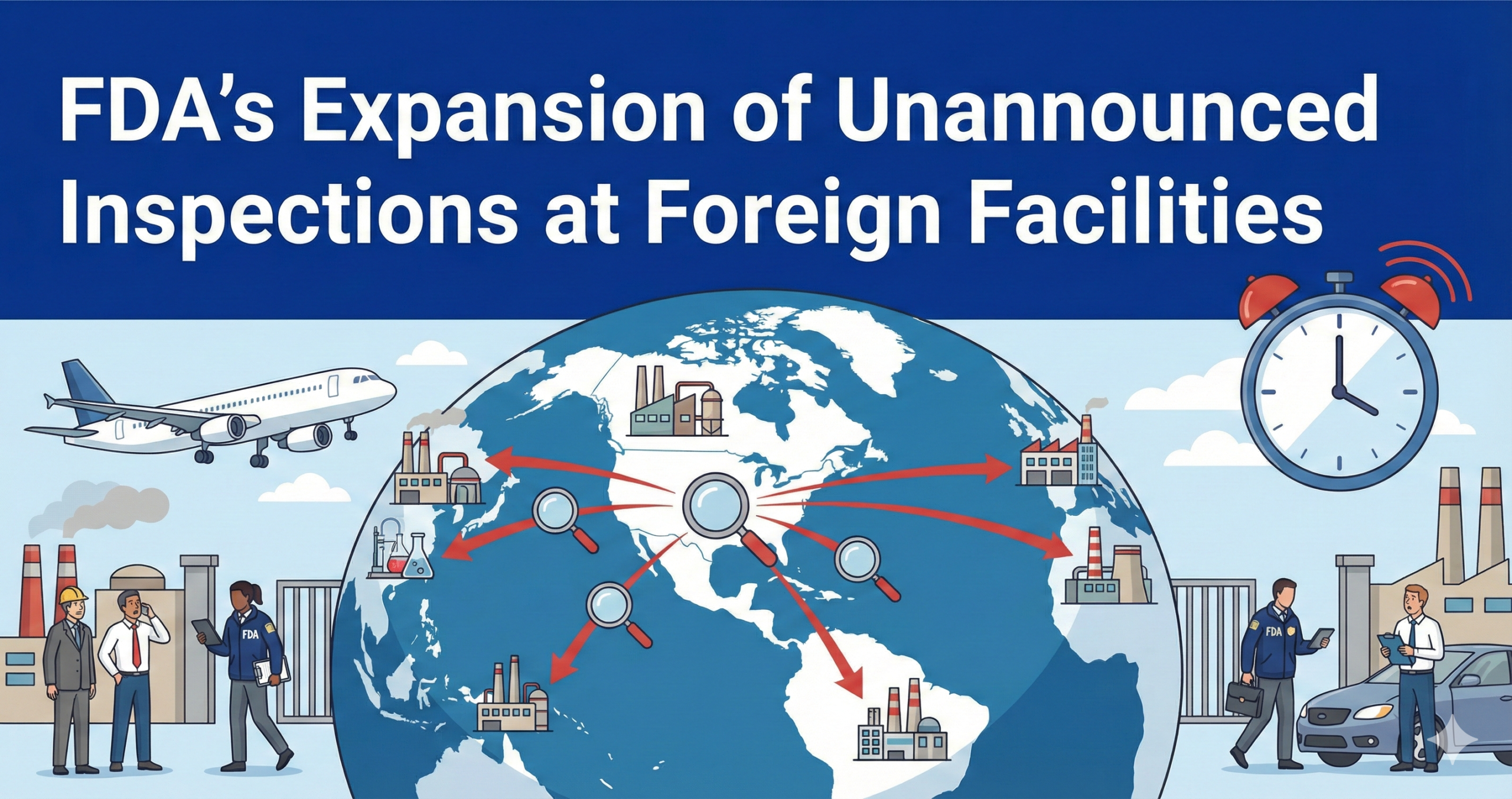
FDA’s Expansion of Unannounced Inspections at Foreign Facilities
On May 6, 2025, the U.S. Food and Drug Administration (FDA) officially announced its policy to expand unannounced inspections (commonly known as “surprise inspections”) at foreign facilities that manufacture food and drugs for the U.S. market. This represents a significant policy shift from the perspective of ensuring food and drug safety. This article examines the background, significance, and challenges of this new policy.
Current State of Inspections and the New Policy
Differences Between Domestic and Foreign Facility Inspections
The FDA has traditionally taken different approaches to inspections for domestic versus foreign facilities. For facilities within the United States, unannounced surprise inspections have been the standard practice. In contrast, for foreign facilities, advance notice has generally been the norm, primarily for the following reasons:
- Coordination requirements for international travel
- Collaboration with local authorities
- Accommodation of language and cultural differences
- Ensuring inspection efficiency
This difference has provided foreign manufacturers with time to prepare for inspections compared to U.S.-based manufacturers, which has been viewed as problematic from a fairness perspective.
Specific Content of the New Policy
Under the new policy, the FDA will expand unannounced inspections to other countries, building upon pilot programs that have been implemented in India and China. This will place foreign facilities under the same inspection environment as domestic facilities. FDA Commissioner Dr. Marty Makary stated, “While foreign companies receive advance notice before facility inspections, U.S. manufacturers receive no such notification. This is an important step as part of a broader strategy to restore FDA’s foreign facility inspections to a normal trajectory.”
Background and Significance
Food Safety Modernization Act (FSMA) Requirements
The Food Safety Modernization Act (FSMA), enacted in 2011, is legislation that strengthens a preventive approach to ensuring food safety. FSMA mandates increased inspection frequency for both domestic and foreign food facilities and requires that foreign facilities meet safety standards equivalent to those in the United States. The new policy aligns with these FSMA requirements.
Specifically, FSMA Section 201 requires that high-risk foreign food facilities that export to the United States be inspected within five years of enactment and at least once every three years thereafter. This legislative framework has created a legal basis for intensifying oversight of foreign facilities.
Strengthening Public Health Protection
The expansion of unannounced inspections enables more accurate assessment of the day-to-day operational realities at foreign facilities. This increases the likelihood of discovering inappropriate manufacturing practices and quality control issues, and is expected to result in improved safety of products circulating in the U.S. market.
Unannounced inspections are particularly effective at revealing the actual state of operations, as facilities cannot temporarily improve conditions or prepare specific documentation in advance. This provides a more authentic picture of compliance with Good Manufacturing Practices (GMP) and other regulatory requirements.
Creating a Level Playing Field
Standardizing inspection methods for domestic and foreign facilities ensures regulatory fairness. This equalizes competitive conditions in terms of compliance costs, creating a more equitable environment for U.S. manufacturers.
The following table illustrates the key differences between the previous and new inspection approaches:
| Aspect | Previous Approach (Foreign Facilities) | New Approach (Foreign Facilities) | Domestic Facilities |
| Advance Notice | Required (typically weeks in advance) | Not required | Not required |
| Preparation Time | Available | Limited/None | Limited/None |
| Inspection Authenticity | Potentially compromised | Enhanced | Enhanced |
| Regulatory Fairness | Questioned | Improved | Baseline standard |
| Compliance Burden | Predictable | Continuous | Continuous |
Implementation Challenges
Personnel and Budget Constraints
Notably, approximately one month before announcing this new policy, the FDA reportedly implemented large-scale personnel reductions (approximately 3,500 employees). These human resource constraints may impact the foreign facility inspection expansion plan. Indeed, there have been reports that pilot programs for unannounced inspections in India and China had stalled due to staffing shortages.
The FDA’s Office of Regulatory Affairs, which is responsible for conducting inspections, has faced ongoing challenges in maintaining adequate staffing levels. The agency conducts thousands of inspections annually across various sectors including food, drugs, medical devices, and tobacco products. Expanding unannounced foreign inspections while managing reduced personnel presents a significant operational challenge.
International Relations Considerations
The expansion of unannounced inspections may also affect diplomatic relations and international trade. Consideration must be given to the cultural backgrounds and legal frameworks of the countries subject to inspection.
Some countries have sovereignty concerns regarding unannounced foreign government inspections of their domestic facilities. The FDA must navigate these sensitivities while maintaining the integrity of its inspection program. Bilateral agreements and mutual recognition arrangements with foreign regulatory authorities may play an important role in facilitating this expansion.
Ensuring Effectiveness
To maximize inspection effectiveness, not only is eliminating advance notice necessary, but efforts to ensure inspection quality and consistency are also required. Additionally, post-inspection follow-up and monitoring of corrective actions are important.
The FDA must ensure that:
- Inspectors are adequately trained in diverse manufacturing environments and international contexts
- Inspection protocols are standardized yet flexible enough to address country-specific circumstances
- Clear criteria exist for risk-based selection of facilities for unannounced inspection
- Effective communication channels exist for addressing urgent safety concerns discovered during inspections
Impact on Industry and Required Responses
Manufacturer Preparedness
Foreign manufacturers must establish systems capable of responding to inspections at any time. Specifically, the following measures become critical:
Daily operation of quality management systems. Quality systems must function as designed on a routine basis, not just during inspection periods. This includes real-time documentation of all critical operations, deviations, and corrective actions.
Continuous compliance with Good Manufacturing Practices (GMP). Facilities must maintain GMP standards as an ongoing operational requirement rather than a temporary state achieved for inspections. This encompasses everything from facility cleanliness and equipment maintenance to personnel hygiene and training.
Thorough document management. All required records must be current, accurate, and readily accessible. This includes batch records, quality control test results, supplier qualifications, change control documentation, and complaint handling records.
Employee education and training. Staff at all levels must understand their roles in maintaining compliance and be able to demonstrate their competence during unannounced inspections. Regular training programs should cover both technical requirements and inspection readiness.
Strengthening internal audit programs. Regular self-inspections using FDA inspection standards can help identify and address gaps before official inspections occur. Mock unannounced inspections can be particularly valuable preparation tools.
Rising Compliance Costs
Responding to unannounced inspections requires the establishment of continuous compliance systems, which may lead to cost increases in the short term. This may be particularly burdensome for small and medium-sized manufacturers.
However, these investments in compliance infrastructure often yield long-term benefits by reducing the risk of costly regulatory actions, product recalls, and reputational damage. Companies should view compliance readiness as a strategic investment rather than merely a regulatory burden.
Future Outlook
While the FDA’s new policy is welcomed from the perspective of public health protection, concerns have also been raised regarding feasibility. Moving forward, the construction of an effective inspection program will require review of personnel and budget allocations and strengthening of international cooperation. Additionally, through dialogue with industry, a balanced approach that achieves safety objectives while avoiding excessive burdens will be necessary.
The success of this initiative may depend on several factors:
Resource allocation. The FDA will need to secure adequate funding and personnel to implement expanded unannounced inspections without compromising its other critical functions. This may require support from Congress and strategic reallocation of existing resources.
International cooperation. Building collaborative relationships with foreign regulatory authorities can facilitate more efficient inspections and information sharing. Mutual recognition agreements and joint inspection programs may enhance overall effectiveness.
Risk-based approaches. Given resource constraints, the FDA will likely need to prioritize facilities for unannounced inspection based on risk factors such as product type, facility history, and public health impact. This targeted approach can maximize the program’s effectiveness.
Technology integration. Leveraging data analytics, artificial intelligence, and other technologies may help the FDA identify high-risk facilities and optimize inspection planning. Digital tools can also streamline the inspection process itself and improve documentation.
Conclusion
The FDA’s expansion of unannounced inspections at foreign facilities represents an important step in terms of public health protection and ensuring regulatory fairness. However, challenges exist in implementation, including human resource constraints and considerations for international relations. Industry is required to advance the establishment of systems capable of responding to inspections at any time while cooperating with regulatory authorities to contribute to the development of an effective food and drug safety assurance system.
For foreign manufacturers exporting to the U.S. market, this policy shift underscores the importance of embedding a culture of continuous compliance throughout their organizations. Rather than viewing FDA inspections as discrete events to prepare for, facilities must adopt the mindset that they are always inspection-ready. This cultural transformation, while challenging, ultimately strengthens product quality and patient safety—benefits that extend well beyond regulatory compliance.
The pharmaceutical and food industries are inherently global, with complex supply chains spanning multiple countries and continents. The FDA’s move toward parity in inspection approaches reflects this reality and the need for consistent quality standards regardless of where products are manufactured. As this policy evolves and matures, it has the potential to elevate manufacturing standards globally and enhance consumer protection worldwide.

Comment