
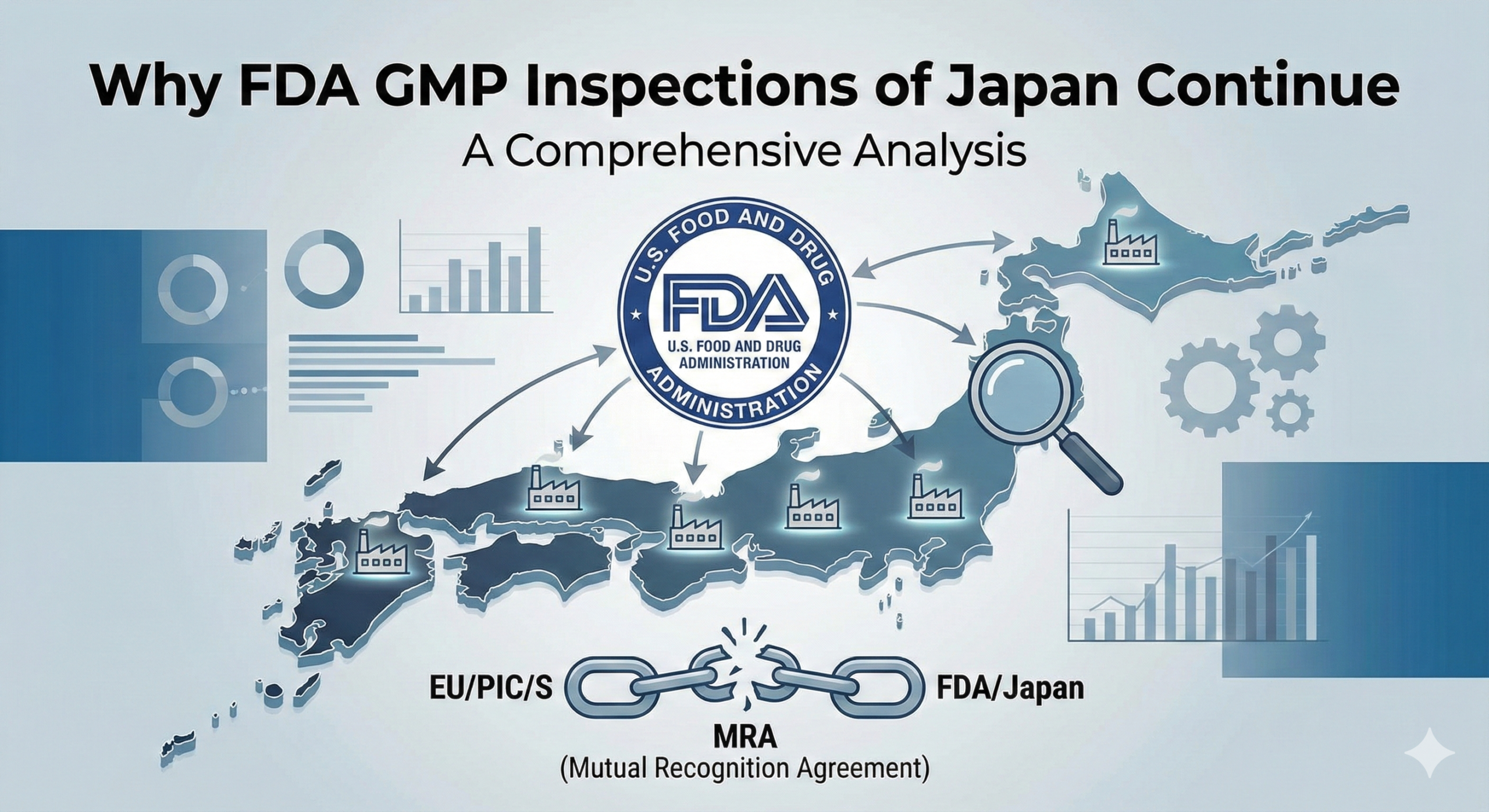
Why FDA GMP Inspections of Japan Continue: A Comprehensive Analysis
On July 1, 2014, Japan’s Ministry of Health, Labour and Welfare (MHLW) officially joined the Pharmaceutical Inspection Co-operation Scheme (PIC/S). This participation in the international framework represented an important step toward promoting international harmonization of Japan’s Good Manufacturing Practice (GMP) regulations and mutual recognition. However, while other PIC/S member countries such as Australia have successfully reduced duplicate inspections by concluding Mutual Recognition Agreements (MRAs) with the U.S. Food and Drug Administration (FDA), Japan has not yet achieved an MRA with the FDA. As a result, FDA inspections of Japanese pharmaceutical companies continue. This article provides a detailed analysis of the background and factors behind this situation.
Significance of PIC/S Membership and Expected Benefits
The primary objective of Japan’s joining PIC/S in 2014 was to promote mutual utilization of GMP inspection results among member countries. The following benefits were anticipated:
Quality improvement through adoption of internationally harmonized GMP standards, streamlining of administrative resources through reduction of duplicate inspections, strengthening the international competitiveness of Japanese pharmaceuticals, and enhanced information sharing and cooperation among regulatory authorities.
Through PIC/S membership, Japan’s Pharmaceuticals and Medical Devices Agency (PMDA) officially joined the international pharmaceutical quality management framework, gaining access to information exchange with regulatory authorities of other countries and participation in training programs. As of early 2025, PIC/S has grown to include 58 participating authorities from 54 countries and regions, making it the most comprehensive international pharmaceutical inspection cooperation scheme.
Precedent: Australia-FDA MRA
Australia’s case provides an excellent example of MRA conclusion between a PIC/S member country and the FDA. The Australia-FDA MRA was initially concluded in the 1990s and updated in 2017. Through this agreement, Australia’s Therapeutic Goods Administration (TGA) and the FDA mutually recognize each other’s inspection results, significantly reducing duplicate inspections. A similar agreement was concluded between the EU and FDA in 2017 and has been implemented in phases.
The EU-FDA MRA, formally known as the sectoral annex on Good Manufacturing Practices (GMP) for human medicines, became operational in November 2017. By 2019, it covered all 28 EU member states (at that time) and has continued to expand its scope. This MRA allows FDA and EU competent authorities to rely on each other’s GMP inspections for human medicines, though certain high-risk situations such as for-cause inspections or product-specific concerns may still trigger independent inspections.
Primary Reasons Why Japan Has Not Concluded an MRA
1. Diversity of Inspection Authorities and Uniformity Issues
The inspection authority for pharmaceutical manufacturing facilities in Japan is distributed among a total of 48 organizations: the Pharmaceuticals and Medical Devices Agency (PMDA) and 47 prefectural governments. This structure is globally unique and makes it structurally difficult to ensure uniformity in inspection quality and quality systems. Specific issues include:
Variations in inspection experience and expertise exist among prefectures, unification of inspector training and inspection approaches is challenging, potential differences in interpretation of inspection findings and assessment of finding severity arise, and information sharing and accumulation and utilization of inspection knowledge are decentralized.
From the perspective of countries with a single inspection authority such as the FDA, this decentralized structure raises questions about consistency in quality assurance. Although PMDA has worked to achieve uniformity through strengthening training programs following PIC/S membership, complete uniformity has not been realized.
The following table illustrates the structural differences in inspection authority systems:
| Country/Region | Inspection Authority Structure | Number of Authorities |
| United States | Centralized (FDA) | 1 |
| European Union | Decentralized but harmonized (National Competent Authorities coordinated through EMA) | 27+ (coordinated) |
| Australia | Centralized (TGA) | 1 |
| Japan | Decentralized (PMDA + Prefectures) | 48 |
2. Specific Regulatory Differences
Despite superficial harmonization, important operational differences exist in GMP regulations between Japan and the United States.
Data Integrity Requirements: The FDA adopts an extremely rigorous approach to data integrity, establishing detailed requirements for audit trails and access controls for electronic record systems. Japan’s GMP ministerial ordinance maintains these requirements in more general terms. The FDA has issued specific guidance documents including “Data Integrity and Compliance With Drug CGMP” (2018), which provides detailed expectations for ALCOA+ principles (Attributable, Legible, Contemporaneous, Original, Accurate, plus Complete, Consistent, Enduring, and Available). Japan’s regulations, while covering similar principles, provide less prescriptive guidance.
Aseptic Manufacturing Standards: The FDA provides more detailed and specific guidance regarding the manufacture of sterile drug products. In particular, it establishes clearer requirements for environmental monitoring and validation methods for aseptic operations compared to Japanese standards. The FDA’s guidance on sterile drug products, including the 2004 guidance “Sterile Drug Products Produced by Aseptic Processing — Current Good Manufacturing Practice” and subsequent updates, provides extensive detail on media fills, environmental monitoring, and contamination control strategies that exceed the specificity found in Japanese regulations.
Validation Approach: Differences also exist in approaches to process validation, with the FDA requiring a more comprehensive lifecycle approach. The FDA’s 2011 guidance “Process Validation: General Principles and Practices” established a three-stage lifecycle approach (Process Design, Process Qualification, and Continued Process Verification) that has become the industry standard but may not be as explicitly required in Japanese regulations.
The following table summarizes key regulatory differences:
| Regulatory Aspect | FDA Requirements | Japanese Requirements | Level of Harmonization |
| Data Integrity | Highly specific guidance (ALCOA+ principles) | General principles | Partial |
| Audit Trail | Detailed requirements for electronic systems | General requirements | Partial |
| Process Validation | Three-stage lifecycle approach mandated | Lifecycle approach encouraged | Moderate |
| Aseptic Processing | Extensive detailed guidance | Less prescriptive guidance | Partial |
| Contamination Control Strategy | Comprehensive requirements | Basic requirements covered | Moderate |
3. Importance of the U.S. Market and Regulatory Rigor
The United States represents the world’s largest pharmaceutical market and is one of the most important export destinations for Japanese pharmaceutical companies. As the regulatory authority overseeing the world’s largest pharmaceutical market, the FDA maintains its own high standards without compromise. In particular, from the perspective of prioritizing patient safety, there is a tendency to emphasize direct inspection of foreign manufacturing facilities.
The U.S. pharmaceutical market represents approximately 40% of global pharmaceutical sales, making FDA approval and continued compliance essential for companies with global ambitions. This market power gives the FDA significant leverage in maintaining its inspection standards and practices regardless of mutual recognition agreements.
4. Specific Past Quality Issues
Quality problems discovered at some Japanese companies in the past have contributed to the FDA’s cautious stance. Specific examples include:
From the late 2000s to the 2010s, FDA inspections identified data integrity issues (such as data falsification and improper record management) at manufacturing facilities of multiple Japanese companies. At some aseptic formulation manufacturing facilities, inadequate management of microbial contamination risks was pointed out. Deficiencies were found in change control and deviation management of manufacturing processes, resulting in the issuance of Warning Letters in some cases.
Notable cases include inspection findings at major Japanese pharmaceutical manufacturers that resulted in import alerts and consent decrees, requiring extensive remediation efforts and ongoing FDA oversight. These historical issues, while not necessarily reflective of current industry practices, have created a legacy of increased scrutiny.
These cases represent barriers to fully gaining the FDA’s trust.
5. FDA’s Risk-Based Approach and Allocation of Inspection Resources
To efficiently conduct inspections within resource constraints, the FDA adopts a risk-based approach. Under this approach, inspection priorities are determined based on the following factors:
Product criticality (whether it is a high-risk product), past inspection history and findings, prevalence of the product in the market, and number of quality problem reports.
When products from Japanese companies, particularly high-importance products such as sterile injectables and biopharmaceuticals, are widely used in the U.S. market, FDA inspection priority becomes higher. The FDA’s risk-based site selection model, implemented in recent years, uses data analytics to prioritize facilities based on multiple factors including product type, manufacturing complexity, inspection history, and compliance signals from adverse event reports and product quality complaints.
Japan-EU MRA Expansion: A Reference Case
In contrast, Japan and the EU expanded their existing MRA in 2016 to broaden the scope of GMP mutual recognition. This successful case demonstrates that effective regulatory harmonization and mutual trust building are possible. Through this agreement, duplicate inspections have been reduced for many pharmaceutical categories between Japan and the EU. However, even in the relationship with the EU, challenges exist regarding Japan’s decentralized inspection system, though these have been overcome through gradual trust building.
The Japan-EU MRA covers a wide range of pharmaceutical products and has proven that systematic approaches to addressing inspection system differences can lead to successful mutual recognition. This serves as a potential model for future Japan-FDA negotiations.
Future Outlook: The Path to MRA Conclusion
Both Japan and the United States continue dialogue on pharmaceutical regulation, and the possibility of future MRA conclusion remains. To achieve this, the following initiatives are important:
1. Further Promotion of Regulatory Harmonization and Uniformity of Inspection Systems
Japanese regulatory authorities need to advance the detailing and clarification of guidance, particularly regarding data integrity and aseptic manufacturing, to bridge differences with FDA requirements. Furthermore, to enhance uniformity of inspections by PMDA and prefectures, it is essential to expand common training programs for inspectors, standardize inspection methods, and strengthen the centralized management system for inspection results. Active participation in international joint inspections also serves as an effective measure.
Specific steps could include:
- Development of detailed guidance documents aligned with FDA expectations on critical topics such as data integrity, computer system validation, and aseptic processing
- Establishment of a national inspection harmonization council bringing together PMDA and prefectural inspectors for regular training and calibration exercises
- Implementation of joint inspection programs with FDA inspectors to demonstrate equivalence
- Creation of a centralized database for inspection findings accessible to all 48 inspection authorities
2. Strengthening Transparency and Information Sharing
Building mutual trust by strengthening information sharing between the regulatory authorities of both countries regarding inspection results and quality issues is important. Additionally, by increasing transparency of the inspection process, understanding of each other’s regulatory approaches can be deepened. Strengthening the information sharing system among the 48 domestic inspection authorities and unifying interpretation of inspection findings and findings is also an important challenge.
3. Initiatives by Japanese Companies
Japanese pharmaceutical companies need to continue focusing on building and maintaining quality systems that comply with FDA’s strict standards. In particular, continuous quality improvement focused on key areas such as data integrity, aseptic manufacturing, and change control is required. Additionally, building a unified quality system that can respond to inspections by both prefectures and PMDA is important.
Companies should consider:
- Implementing company-wide quality management systems that exceed both Japanese and FDA requirements
- Investing in electronic quality management systems with robust audit trail capabilities
- Conducting internal audits using FDA inspection criteria as the benchmark
- Providing comprehensive training to all quality and operations personnel on FDA expectations
4. Consideration of Phased Approach
Similar to the EU-FDA MRA, an approach to gradually building an MRA starting with specific product categories or specific inspection items is also worth considering. For example, it may be practical to start with an MRA limited to manufacturing facilities inspected only by PMDA or specific risk classifications, then gradually expand the scope.
A potential phased implementation could follow this model:
Phase 1: MRA for sterile injectable products manufactured at facilities under exclusive PMDA oversight, representing the highest risk category where Japanese inspection capabilities are most mature.
Phase 2: Expansion to include solid oral dosage forms and other non-sterile products at PMDA-inspected facilities.
Phase 3: Inclusion of select prefectural-inspected facilities that demonstrate consistent compliance with harmonized standards through pilot programs.
Phase 4: Full implementation across all product categories and inspection authorities once system-wide harmonization is achieved.
Conclusion
Japan’s PIC/S membership was an important milestone in international harmonization of pharmaceutical quality regulation, but further efforts are necessary for MRA conclusion with the FDA. Factors such as differences in regulatory details, uniformity issues in inspections by 48 inspection authorities, past quality problems, and market importance are behind the FDA’s continued inspections of Japanese pharmaceutical companies.
However, as demonstrated by the successful expansion of the Japan-EU MRA, MRA conclusion is an achievable goal through appropriate regulatory harmonization and building of mutual trust. The key to opening the path to future MRA conclusion lies in uniformity of the inspection system of MHLW, PMDA, and prefectures, strengthening continuous dialogue and cooperative relationships with the FDA, and Japanese companies’ commitment to quality improvement.
Upon its realization, achievement of the common goal of reducing duplicate inspections, streamlining regulatory resources, and ultimately ensuring stable supply of high-quality pharmaceuticals to patients is expected.
Recommendations for Moving Forward
Based on this analysis, several concrete recommendations emerge:
For Japanese Regulatory Authorities:
- Accelerate the development of detailed technical guidance aligned with FDA expectations, particularly in data integrity and aseptic processing
- Establish formal mechanisms for harmonizing inspection practices across all 48 authorities
- Initiate pilot joint inspection programs with FDA to demonstrate equivalence
- Create transparent metrics for measuring and reporting inspection system performance
For Japanese Pharmaceutical Companies:
- Adopt FDA standards as the baseline for all quality systems, ensuring compliance exceeds both Japanese and FDA requirements
- Invest in modern quality management systems with comprehensive electronic record capabilities
- Participate actively in industry working groups focused on regulatory harmonization
- Share best practices and lessons learned to elevate industry-wide performance
For Both Countries:
- Establish a formal Japan-FDA regulatory cooperation council with regular high-level meetings
- Develop a roadmap with specific milestones and timelines for MRA achievement
- Consider interim confidence-building measures such as mutual participation in training programs and information sharing agreements
- Learn from the successful EU-FDA MRA implementation process
The path to an FDA-Japan MRA is challenging but achievable. With sustained commitment, systematic improvements, and genuine collaboration, the goal of mutual recognition can be realized, ultimately benefiting patients in both countries through more efficient use of regulatory resources and continued access to high-quality medicines.

Comment