
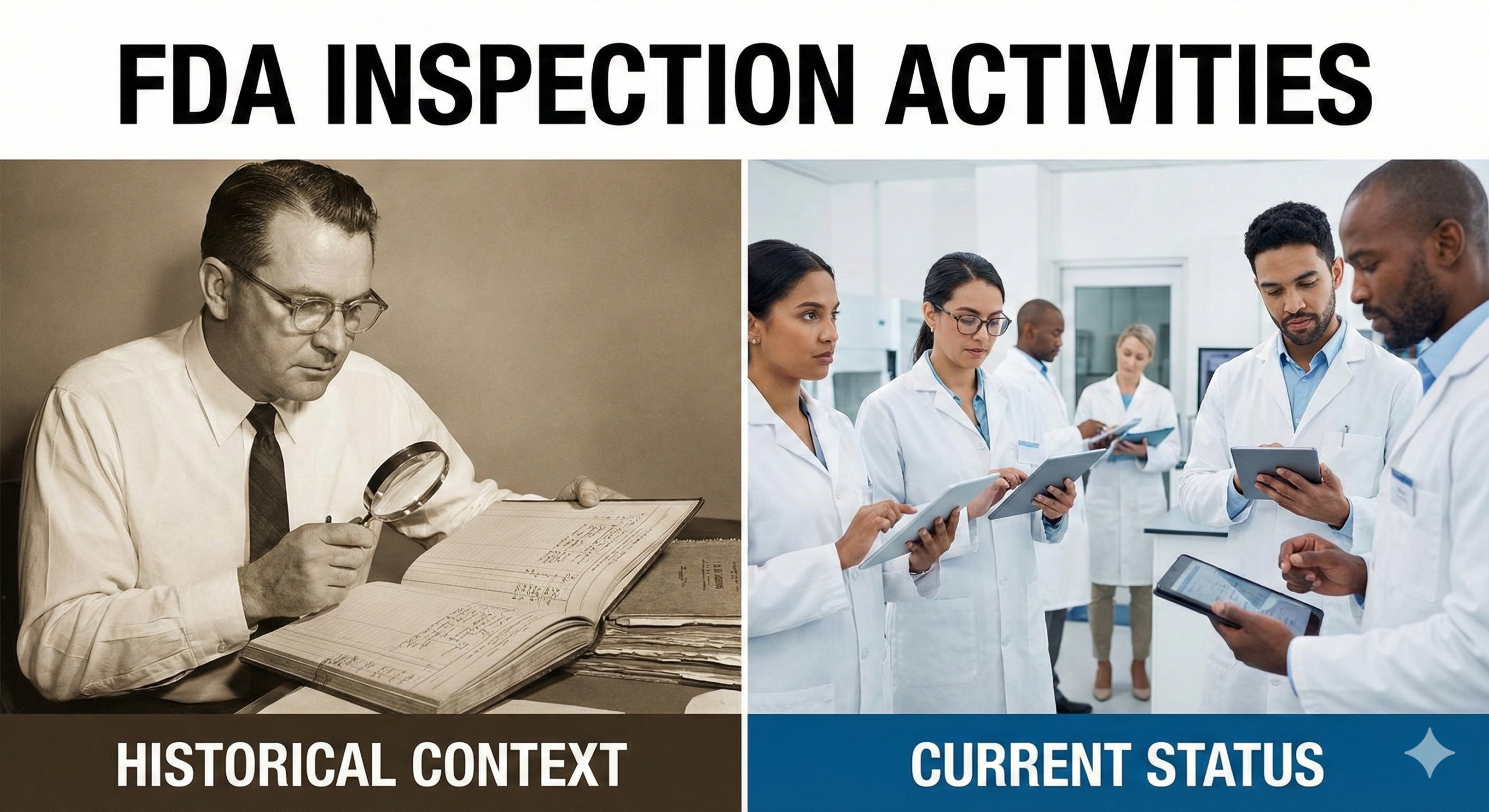
Historical Background: 2022 Inspection Resumption
According to a RAPS (Regulatory Affairs Professionals Society) report from February 2022, the U.S. Food and Drug Administration (FDA) announced the resumption of domestic surveillance inspection operations on February 7, 2022, citing declining COVID-19 case numbers. This decision was communicated to the industry on February 2, 2022, with implementation beginning on February 7, 2022.
FDA spokesperson stated that the agency would “continue to conduct both foreign and domestic mission-critical inspections, and provide effective oversight of foods, drugs, medical products, and tobacco leveraging a variety of tools, including remote assessments.”
Inspection Pause Timeline (2021-2022)
On December 29, 2021, FDA announced a temporary suspension of most inspections to ensure the safety of FDA staff and regulated companies as they adapted to the evolving COVID-19 pandemic and the spread of the Omicron variant. At that time, FDA indicated that except for mission-critical domestic and foreign inspections, all other inspections would be suspended until January 19, 2022, with plans to “re-evaluate as needed.”
Subsequently, FDA extended the inspection suspension to February 4, 2022. The agency then announced on February 2, 2022, that it would resume domestic surveillance inspections beginning February 7, 2022.
Foreign Inspection Policy
FDA spokesperson further stated: “The agency will also continue with previously planned foreign inspections that have received country clearance and are within the Centers for Disease Control and Prevention’s (CDC) Level 1 or Level 2 COVID-19 travel recommendations. Planning for additional foreign inspections is ongoing, with an anticipated goal of conducting prioritized foreign inspections beginning in April 2022.”
Travel Advisory Status: Japan
At the time of the original article (early 2022), Japan was classified at CDC Level 3 (Warning Level – Avoid Nonessential Travel) due to COVID-19. Under FDA’s policy at that time, this meant that except for mission-critical products, FDA inspections would not be conducted in Japan until the travel advisory level was lowered.
Current Status (2025): Japan is now classified at CDC Level 1 (Exercise Normal Precautions) and U.S. Department of State Travel Advisory Level 1, representing a significant improvement from the 2022 pandemic restrictions. This change has enabled the full resumption of FDA inspection activities in Japan.
Current FDA Inspection Landscape (2024-2025)
Post-Pandemic Recovery and Challenges
The COVID-19 pandemic created substantial disruptions to FDA’s inspection program that have had lasting effects. According to a Health Affairs Journal study analyzing FDA inspection data from 2012-2022:
- In 2019, before the pandemic, FDA conducted 954 foreign inspections and 738 domestic inspections
- In 2022, foreign inspections were down approximately 79% compared to 2019 levels
- Domestic inspections decreased by approximately 35% compared to pre-pandemic levels
- Between April 2020 and March 2021, FDA conducted zero inspections in China or India
The reduction in inspection frequency was accompanied by increased inspection intensity. Post-pandemic inspections required significantly more inspector-days per facility, with foreign inspections using 7-15 inspector-days on average (compared to 5-8 inspector-days pre-pandemic), and domestic inspections increasing by more than 70% in average duration.
Inspection Backlog
Multiple government reports have documented the persistent inspection backlog:
Food Safety Inspections: According to a January 2025 Government Accountability Office (GAO) report, FDA has failed to meet its mandated domestic and foreign food facility inspection targets. Under the FDA Food Safety Modernization Act (FSMA), FDA is required to:
- Inspect each high-risk domestic facility at least once every 3 years
- Inspect each non-high-risk domestic facility at least once every 5 years
- Conduct 19,200 foreign food facility inspections annually (target established in 2016)
FDA officials informed the GAO in August 2024 that the agency was continuing to address the backlog of inspections created during the pandemic. The disruptions were attributed to the 35-day government shutdown in fiscal year 2019 and the COVID-19 pandemic that followed.
Drug Manufacturing Inspections: A November 2024 GAO report examining FDA’s drug inspection workforce found that from November 2021 to June 2024, the vacancy rate among drug investigators jumped from 9% to 16%, leading to fewer inspections. Contributing factors included concerns with extensive travel requirements (up to 75% of time), pay, training, workload, and work-life balance issues.
Development of Alternative Inspection Tools
To compensate for reduced on-site inspections during the pandemic, FDA developed and refined several alternative assessment approaches:
Remote Regulatory Assessments (RRAs): FDA issued final guidance on June 26, 2025, entitled “Conducting Remote Regulatory Assessments: Questions and Answers,” which formalized the use of virtual assessments as a complement to traditional on-site inspections. Key features include:
- RRAs can be either mandatory (conducted under Section 704(a)(4) of the Federal Food, Drug, and Cosmetic Act) or voluntary (requiring establishment consent)
- FDA does not consider RRAs to be formal inspections, so Form 482 (Notice of Inspection) and Form 483 (Inspectional Observations) are not issued
- Upon completion, FDA may hold a closeout meeting and provide a written list of RRA observations
- Establishments are encouraged to submit written responses within 15 business days
- RRA observations and responses are subject to Freedom of Information Act disclosure similar to inspection materials
Record Requests and Information Gathering: FDA may request records and information in advance of or in lieu of on-site inspections, particularly for drug, device, and bioresearch monitoring facilities.
International Cooperation: FDA leverages inspection reports from trusted foreign regulatory partners through mutual recognition agreements (MRA) with the European Union and cooperation with authorities participating in the Pharmaceutical Inspection Co-operation Scheme (PIC/S), which includes over 50 countries with comparable inspection standards.
2025 Inspection Intensification
As of 2025, FDA has significantly intensified its inspection and enforcement activities, marking a clear shift from the reduced pandemic-era operations:
Increased Inspection Frequency and Rigor: Industry reports from late 2025 document that regulated companies have experienced:
- Notably increased number of FDA inspections across food, drug, device, and cosmetic industries
- Greater scrutiny and longer inspection durations compared to previous years
- Larger inspection teams
- More environmental swabbing for pathogens
- More detailed documentation reviews
Enhanced Enforcement Actions:
- Between July 1 and December 3, 2025, FDA issued 327 warning letters, representing a 73% increase over the same period in 2024
- In fiscal year 2025, FDA issued 58 untitled letters, a dramatic increase from just 5 in fiscal year 2024 and 4 in fiscal year 2023
- FDA conducted 694 more inspections in fiscal year 2025 compared to fiscal year 2024
AI-Driven Inspection Targeting: In June 2025, FDA launched an internal AI system called “Elsa,” which uses data analysis to identify high-risk facilities based on:
- Patterns in compliance data
- Adverse event reports
- Historical inspection outcomes
This technology has introduced enhanced analytical precision in selecting facilities for inspection and identifying potential compliance issues.
Foreign Facility Inspection Policy Changes: On May 6, 2025, FDA announced expanded use of unannounced inspections at foreign manufacturing facilities, particularly in countries such as China and India that supply significant portions of active pharmaceutical ingredients for the U.S. market. Key aspects include:
- Elimination of the “double standard” between domestic and foreign manufacturers
- Unannounced inspections designed to expose noncompliance that might be concealed during pre-announced inspections
- FDA has emphasized its authority to take regulatory action, including import alerts and criminal penalties, against companies that attempt to delay, deny, or limit inspections
Understanding CDC Travel Health Advisory Levels
The CDC uses a destination-specific approach for international travel health guidance. Travel health notices and advisories are issued for destinations experiencing disease outbreaks or other health threats. CDC’s travel health notice levels include:
Level 1 – Practice Usual Precautions: The destination has some risk of disease transmission, but the risk to most travelers is low. Travelers should follow standard health precautions.
Level 2 – Practice Enhanced Precautions: There is an increased risk in this destination. Travelers should take enhanced measures to protect their health.
Level 3 – Avoid Nonessential Travel: The disease outbreak or other health risk is of significant concern. Only travelers whose presence is essential should go to the destination.
Level 4 – Do Not Travel (used rarely): The situation at the destination is extremely dangerous, and all travel should be avoided.
These classifications are dynamic and subject to change based on evolving disease transmission patterns and local conditions. The COVID-19-specific travel advisory system that was prominent during the pandemic has been replaced with more general health-focused guidance.
As of January 2025, most countries, including Japan, are no longer subject to COVID-19-specific travel restrictions and have returned to standard health advisory classifications. Japan currently holds a Level 1 designation with standard health precautions recommended.
Key Implications for Regulated Companies
Inspection Preparedness in 2025
Companies subject to FDA regulation should maintain heightened inspection readiness:
-
Documentation Review: Ensure all quality records generated during and after the COVID-19 pandemic are complete, accurate, and readily available. Any deviations from standard procedures should be thoroughly documented with appropriate corrective and preventive actions.
-
Staff Training: All personnel, including those hired during the pandemic who may never have experienced an FDA inspection, should be trained on inspection procedures and company policies for responding to FDA inquiries.
-
Systems Verification: Proactively audit quality systems, manufacturing processes, and facility conditions to identify and address potential deficiencies before FDA arrives.
-
Environmental Monitoring: Given FDA’s increased use of environmental swabbing, facilities should have robust environmental monitoring programs in place and ensure cleaning validation is current.
-
Foreign Facility Considerations: Foreign manufacturers should be prepared for unannounced FDA inspections and ensure that access to facilities and records can be provided promptly.
Remote Assessment Readiness
Companies should also be prepared for FDA’s use of remote regulatory assessments:
- Maintain organized, readily accessible electronic records
- Have video conferencing capabilities and document sharing systems available
- Designate personnel who can respond to information requests efficiently
- Understand that while RRAs are not formal inspections, observations can lead to regulatory action
Compliance Culture
The intensified inspection and enforcement environment in 2025 underscores the importance of establishing and maintaining a strong culture of compliance. Companies should:
- Implement proactive compliance programs rather than reactive responses
- Conduct internal audits regularly
- Address findings from internal audits promptly and thoroughly
- Consider engaging third-party consultants for mock inspections and gap assessments
- Monitor FDA warning letters and enforcement trends to understand agency priorities
Conclusion
FDA’s inspection program has undergone significant evolution from the pandemic-era suspensions of 2021-2022 through the recovery period and into the intensified inspection environment of 2025. While the agency faced substantial challenges in addressing the inspection backlog created by COVID-19 disruptions, it has responded by developing alternative assessment tools, leveraging technology including AI-driven targeting systems, and implementing more rigorous inspection and enforcement protocols.
For regulated companies, the current environment requires sustained vigilance and proactive compliance efforts. The combination of increased inspection frequency, longer inspection durations, enhanced scrutiny, and the expansion of unannounced foreign inspections signals FDA’s commitment to strengthening oversight across all regulated industries.
Companies should view this as an opportunity to strengthen their quality and compliance systems, ensuring they not only meet regulatory requirements but also demonstrate a genuine commitment to product quality and patient safety. Those that maintain inspection-ready status, invest in their quality systems, and foster a culture of continuous improvement will be best positioned to successfully navigate FDA oversight in this new regulatory landscape.

Comment