
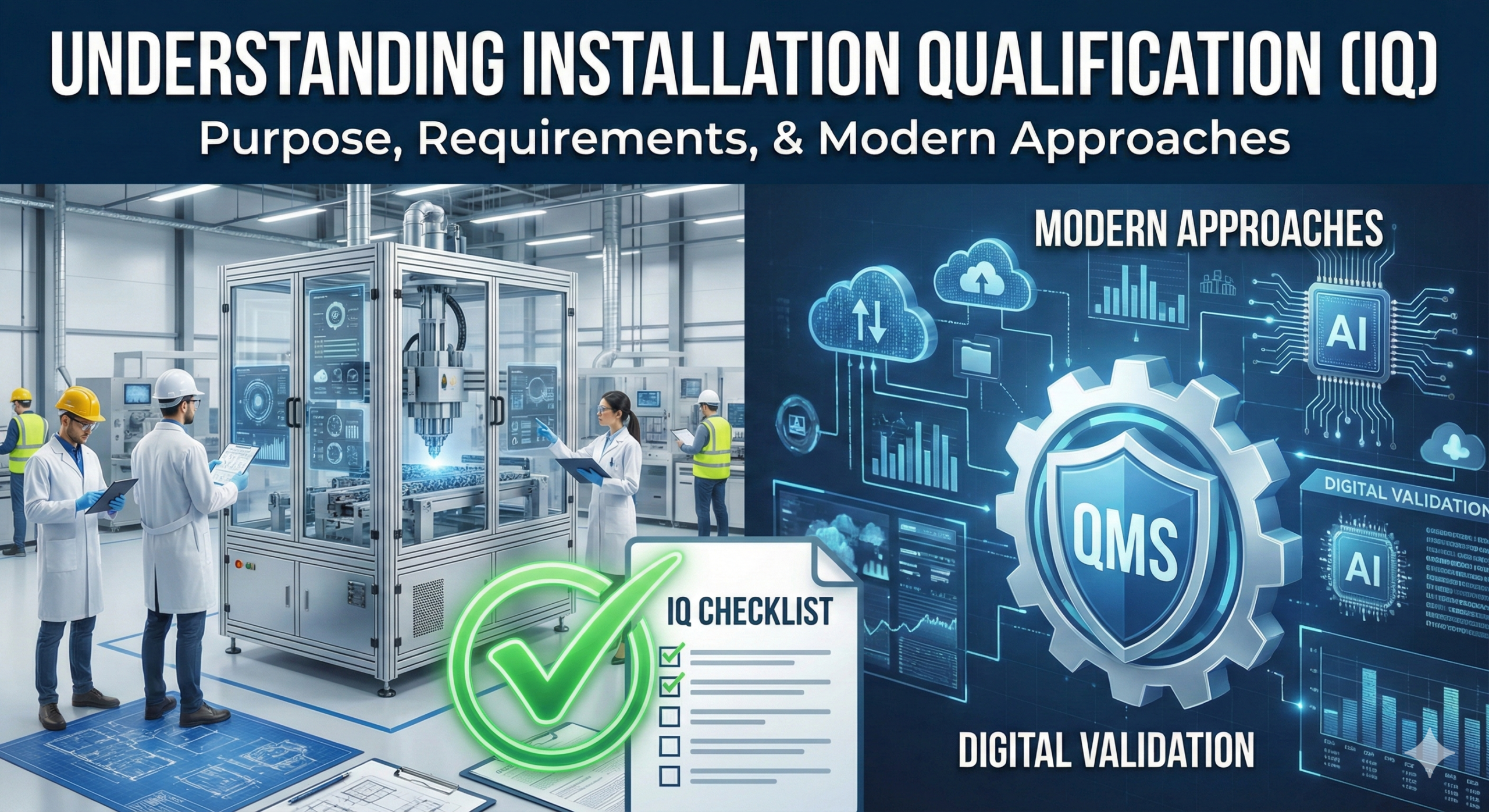
Understanding Installation Qualification (IQ): Purpose, Requirements, and Modern Approaches
Introduction to Installation Qualification
Installation Qualification (IQ) represents the foundational stage of equipment qualification in pharmaceutical manufacturing. It serves as the initial verification activity that confirms whether facilities, systems, and equipment possess the required capabilities and specifications to provide the expected service. In Japanese terminology, this is referred to as “据付時適格性評価” (Suetsuke-ji Tekikakusei Hyōka).
Regulatory Definition and Framework
According to PIC/S GMP Annex 15 (effective October 1, 2015), Installation Qualification is formally defined as:
Installation Qualification (IQ): The documented verification that the facilities, systems and equipment, as installed or modified, comply with the approved design and the manufacturer’s recommendations.
This definition has remained consistent since the 2015 revision of Annex 15, which introduced enhanced requirements aligned with ICH Q8 (Pharmaceutical Development), ICH Q9 (Quality Risk Management), and ICH Q10 (Pharmaceutical Quality System). These ICH guidelines emphasize a lifecycle approach and risk-based thinking throughout all qualification activities.
The Purpose and Scope of IQ
IQ is fundamentally a verification activity that confirms the proper installation of process equipment and facility systems. It ensures that equipment has been correctly positioned, connected, and configured according to approved specifications before any operational testing begins.
The primary objectives of IQ include:
- Physical Installation Verification: Confirming that equipment is installed according to approved design specifications, engineering drawings, and layout plans
- Component Verification: Ensuring all components, instruments, and accessories are correctly installed and match specifications
- Documentation Review: Verifying that supplier documentation, manuals, and technical specifications are complete and accurate
- Support System Confirmation: Validating that utilities (electricity, water, compressed air, etc.) are properly connected and meet requirements
- Safety Assessment: Confirming that safety features and emergency systems are properly installed
- Future Maintainability: Ensuring that equipment can be properly maintained, calibrated, and potentially reinstalled if necessary
Key Elements of IQ Documentation and Execution
IQ Protocol Development
Before conducting IQ activities, organizations must develop a comprehensive IQ protocol. This protocol should include:
Equipment Design Overview:
- Detailed description of the equipment and its intended use
- Identification of Critical Quality Attributes (CQAs) that the equipment affects
- Identification of Critical Process Parameters (CPPs) controlled by the equipment
- GMP-relevant considerations and potential impact on product quality
Installation Verification Checklist:
- Verification of equipment location and positioning
- Confirmation of utility connections (electrical, water, compressed air, vacuum, etc.)
- Verification of materials of construction against specifications
- Confirmation of component installation against engineering drawings
- Verification of safety features and interlocks
Documentation Requirements:
- Supplier documentation review (manuals, specifications, drawings)
- Software documentation (including Computer System Validation considerations per Annex 11)
- Calibration schedules and procedures
- Preventive maintenance schedules
- Cleaning procedures and schedules
- Spare parts lists
Environmental Conditions:
- Operating environment requirements (temperature, humidity, cleanliness classification)
- Verification that the installation site meets these requirements
The Role of Supplier Documentation
A critical aspect of IQ is the thorough review of supplier-provided documentation. The pharmaceutical company must verify that:
- All required maintenance procedures are clearly documented
- Calibration procedures and frequencies are specified
- Operating instructions are complete and accurate
- Safety procedures and emergency shutdown protocols are documented
- Documentation is sufficient to support proper operation throughout the equipment lifecycle
This documentation review ensures that the equipment can be properly maintained, operated, and potentially reinstalled in the future if necessary.
The Relationship Between IQ and OQ
PIC/S GMP Annex 15 explicitly recognizes that while Operational Qualification (OQ) typically follows IQ, there is flexibility in implementation:
Combined IQ/OQ Approach: According to Annex 15 Section 3.11, “Qualification documents may be combined together, where appropriate, e.g. installation qualification (IQ) and operational qualification (OQ).” This combined approach, often referred to as IOQ, is particularly suitable for less complex equipment where separating installation and operational testing provides no additional benefit.
The decision to combine IQ and OQ should be based on:
- Equipment complexity
- Risk assessment results
- Potential for transport or installation to affect functionality
- Organizational procedures and preferences
Modern Approaches: ASTM E2500 and Risk-Based Qualification
The ASTM E2500 Framework
While PIC/S GMP Annex 15 remains the primary regulatory requirement, the industry has increasingly adopted alternative, risk-based approaches. ASTM E2500 “Standard Guide for Specification, Design, and Verification of Pharmaceutical and Biopharmaceutical Manufacturing Systems and Equipment” (first published 2007, current version 2020) provides such an alternative framework.
Key features of the ASTM E2500 approach include:
Risk-Based Focus: Rather than following prescriptive DQ-IQ-OQ-PQ stages, ASTM E2500 emphasizes verification activities targeted at critical aspects that could impact product quality or patient safety.
Good Engineering Practice (GEP): Equipment installed following GEP may require minimal verification beyond design review and documentation, particularly for non-critical systems.
Subject Matter Expert (SME) Involvement: SMEs play a central role in defining verification strategies, identifying critical aspects, and determining appropriate testing.
Factory Acceptance Testing (FAT) and Site Acceptance Testing (SAT): The approach emphasizes conducting appropriate testing at the optimal stage, potentially reducing on-site verification requirements.
Integration of FAT and SAT
PIC/S GMP Annex 15 explicitly addresses FAT and SAT in its current version:
Factory Acceptance Testing (FAT): Section 3.8 states that FAT “could eventually be carried out for equipment, especially if incorporating novel or complex technology.” Where appropriate and justified, documentation review and certain tests conducted during FAT may not need repetition during on-site IQ/OQ, provided that functionality is not affected by transport and installation.
Site Acceptance Testing (SAT): FAT may be supplemented by SAT to confirm that equipment continues to comply with User Requirements Specification (URS) and functional specifications after installation at the pharmaceutical site.
This approach reduces duplication of testing while maintaining quality assurance, provided proper documentation and justification are maintained.
Supplier Responsibilities and Quality Agreements
The Role of Equipment Suppliers
Equipment suppliers play a crucial role in the qualification process. While IQ and IOQ activities are commonly delegated to qualified suppliers, several principles must be observed:
Supplier Qualification: Pharmaceutical companies must qualify their equipment suppliers, verifying that they have appropriate quality systems, technical competence, and GMP understanding.
Delegation with Oversight: IQ/IOQ execution may be delegated to suppliers, but the pharmaceutical company retains ultimate responsibility for ensuring equipment suitability. The company must review and approve supplier-generated protocols and reports.
Quality Agreements: Clear quality agreements should define:
- Respective responsibilities of supplier and pharmaceutical company
- Documentation requirements and formats
- Acceptance criteria and approval processes
- Communication protocols
- Training requirements for supplier personnel
Ultimate Responsibility
Regardless of how much qualification work is performed by suppliers, the pharmaceutical company (equipment user) bears final responsibility for:
- Verifying equipment suitability for intended use
- Ensuring proper qualification has been performed
- Making final acceptance decisions
- Maintaining qualification status throughout the equipment lifecycle
This principle is explicitly stated in PIC/S GMP Annex 15 and is aligned with ICH Q10’s emphasis on pharmaceutical company responsibility for quality systems.
Lifecycle Considerations and Continuous Verification
Integration with ICH Q10 Pharmaceutical Quality System
Modern qualification approaches emphasize lifecycle management aligned with ICH Q10 principles. IQ is not a one-time event but rather the beginning of ongoing verification throughout the equipment lifecycle:
Technology Transfer: Equipment knowledge gained during IQ supports successful technology transfer between sites or from development to manufacturing.
Commercial Manufacturing: IQ documentation provides the foundation for ongoing performance monitoring, preventive maintenance, and change control throughout commercial production.
Change Management: When equipment modifications occur, appropriate re-qualification (potentially including IQ elements) must be performed based on risk assessment.
Continuous Improvement: IQ documentation should support continuous improvement initiatives by providing clear understanding of equipment design and capabilities.
Performance Qualification and Ongoing Verification
While IQ confirms proper installation, Performance Qualification (PQ) demonstrates that equipment can consistently perform according to approved process methods and produce acceptable product quality. Following initial qualification, ongoing process verification (also called continued process verification) ensures that the manufacturing process remains in a state of control.
This lifecycle approach recognizes that qualification is not simply a series of discrete stages (DQ-IQ-OQ-PQ) but rather a continuum of verification activities supporting product quality throughout the equipment’s operational life.
Practical Implementation Considerations
Documentation Best Practices
Effective IQ documentation should be:
Risk-Proportionate: The level of detail and testing should be commensurate with equipment criticality and complexity, as emphasized in ICH Q9.
Clear and Traceable: Requirements should be traceable from URS through design specifications to IQ verification tests and acceptance criteria.
Scientifically Sound: Acceptance criteria should be based on scientific rationale, not arbitrary limits.
Practical and Executable: Protocols should be written by personnel who understand both the equipment and GMP requirements, ensuring tests are practical to execute.
Common Challenges and Solutions
| Challenge | Risk | Solution |
| Incomplete supplier documentation | Inability to properly maintain or operate equipment | Specify documentation requirements in purchase agreements; review documentation before equipment shipment |
| Insufficient design review | Equipment may not meet URS; costly post-installation modifications | Implement formal design review process with SME involvement before equipment fabrication |
| Unclear acceptance criteria | Subjective pass/fail decisions; regulatory observations | Define objective, measurable acceptance criteria based on scientific rationale during protocol development |
| Poor coordination between suppliers and company personnel | Delays, miscommunication, inadequate qualification | Establish clear quality agreements and communication protocols; assign dedicated project managers |
| Inadequate training | Personnel unable to execute IQ properly or understand results | Ensure personnel receive training on equipment, protocols, and GMP requirements before IQ execution |
Regulatory Expectations and Inspection Preparedness
Regulatory inspectors expect to see:
Complete Documentation: All required documentation (drawings, manuals, specifications, test records) properly reviewed and approved.
Clear Rationale: Scientific justification for equipment selection, testing approach, and acceptance criteria.
Traceability: Clear links between URS requirements, design specifications, and IQ verification activities.
Competent Personnel: Evidence that personnel conducting IQ have appropriate qualifications, training, and understanding of GMP requirements.
Proper Approval: Appropriate review and approval of IQ protocols and reports by qualified personnel.
Risk Assessment: Evidence of risk-based decision making in determining the scope and rigor of IQ activities.
Integration with Computer System Validation
For equipment incorporating computerized systems (process control systems, data acquisition systems, automated equipment), IQ must be coordinated with Computer System Validation (CSV) requirements per PIC/S GMP Annex 11.
Key considerations include:
- Software version verification and configuration management
- Validation documentation for software components
- Security controls and access management
- Data integrity controls (audit trails, electronic signatures)
- Interface verification for systems exchanging data
- Backup and disaster recovery verification
The complexity of CSV requirements necessitates early planning and coordination between equipment qualification and CSV teams.
Conclusion
Installation Qualification serves as the critical foundation for all subsequent qualification and validation activities. While regulatory requirements provide the framework, modern approaches emphasize risk-based, scientifically sound verification activities that ensure equipment is truly fit for its intended use.
By properly conducting IQ with appropriate documentation, risk assessment, supplier involvement, and lifecycle perspective, pharmaceutical companies can ensure regulatory compliance while optimizing resource utilization and supporting continuous improvement throughout the equipment lifecycle. The evolution toward risk-based approaches like ASTM E2500, combined with established regulatory requirements in PIC/S GMP Annex 15, provides flexibility for companies to develop efficient, compliant qualification strategies appropriate to their specific circumstances.
Success in IQ requires not just following procedures, but understanding the underlying principles: equipment must be properly installed, thoroughly documented, and demonstrated suitable for its intended use in protecting product quality and patient safety. This principle remains constant regardless of the specific qualification approach adopted.

Comment