
Why is a Backyard (Back Room) Necessary for FDA Inspections?
Understanding the Front Yard and Back Yard Structure
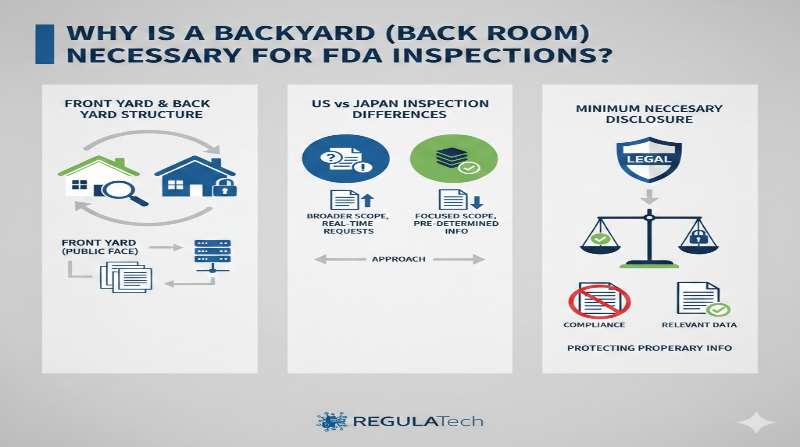
When responding to FDA inspections, organizations typically divide their operations into two distinct areas: the Front Yard (FY), where inspectors conduct document reviews and interviews, and the Backyard or Back Room (BY), where the inspection support team searches for documents, prepares responses, and coordinates subject matter experts (SMEs). This separation of functions has become a fundamental best practice in modern FDA inspection management. But why is this BY structure essential?
💡 FDA査察に備えたバックヤード(バックルーム)の準備は、効率的な査察対応の鍵となります。文書管理の体制を整えましょう。
Different Contexts: United States vs. Japan
The necessity and dynamics of the BY function differ significantly between the United States and Japan, though the underlying principles remain consistent across both contexts.
In the United States: If documents are searched for or internal discussions are conducted directly in front of the inspector in the FY, the internal circumstances and challenges of the organization may become fully transparent to the inspector. This transparency can inadvertently reveal gaps in knowledge, incomplete documentation, or uncertainty about processes that might otherwise have been addressed more strategically. Therefore, in the FY, the designated host should limit their role to receiving questions and requests from the inspector. The detailed work of deliberating on the best response, searching for appropriate documentation, coaching SMEs, and reviewing documents for accuracy and completeness should all be conducted in the BY. Once the optimal response is prepared and verified, it is then delivered to the FY.
In Japan: When Japanese companies host FDA inspections, language barriers may provide some natural buffer against unintentional disclosure of internal deliberations even if discussions occur in the FY. Inspectors who do not speak Japanese are less likely to pick up on nuanced conversations or concerns expressed in Japanese by the company’s staff. However, regardless of this language consideration, it remains crucial that the process of searching for the most appropriate documents, extracting only the minimum necessary materials from binders, and strategic preparation of responses should not be visible to the inspector. The principle of controlled, deliberate information sharing remains paramount.
It should be noted that Japan’s regulatory authority, the Pharmaceuticals and Medical Devices Agency (PMDA), conducts inspections based on principles aligned with the International Council for Harmonisation (ICH) guidelines, particularly ICH Q7 (Good Manufacturing Practice for Active Pharmaceutical Ingredients), ICH Q8 (Pharmaceutical Development), ICH Q9 (Quality Risk Management), and ICH Q10 (Pharmaceutical Quality System). PMDA inspections are comparable in rigor to FDA and European Medicines Agency (EMA) inspections, emphasizing lifecycle control, quality risk management, and data integrity.
The Fundamental Principle: Minimum Necessary Disclosure
The basic principle of FDA inspection management is to provide inspectors with only the minimum necessary documentation to address their specific requests. This is not about hiding information or being deceptive—it is about efficient, focused communication that respects both the inspector’s time and the integrity of the inspection process.
The cardinal error in inspection management is bringing entire binders of documents into the FY without pre-screening. If this occurs, inspectors will naturally and appropriately examine every page in detail, potentially leading the inspection into areas that may not have been initially in scope or raising questions about tangential issues that distract from the core inspection objectives.
In my FDA inspection readiness consulting work, I frequently emphasize the principle: “Don’t open the door!” This means that if you open a door—metaphorically speaking, by providing excess documentation or volunteering information beyond what was requested—the inspector will naturally walk through it. In other words, providing unnecessary materials or offering unsolicited explanations will prompt the inspector to ask deeper, more probing questions. Conversely, if explanations are concise and documentation is limited to exactly what was requested, the inspector has fewer leads to pursue additional lines of inquiry.
I have conducted numerous supplier audits in my career, and I consistently observe that companies whose representatives are overly talkative make it easier to identify problems and deficiencies. The more information volunteered, the more opportunities exist for discovering inconsistencies or gaps in compliance.
Current Inspection Landscape and Trends (2025-2026)
As of 2025, FDA inspection activities have intensified significantly compared to previous years, making thorough preparation more critical than ever:
Increased Inspection Frequency and Rigor: The FDA conducted 694 more inspections in fiscal year 2025 compared to fiscal year 2024. Inspections are characterized by longer durations, larger inspection teams, and more comprehensive facility assessments including increased environmental monitoring through swabbing for pathogens.
AI-Driven Risk-Based Targeting: The FDA launched its internal AI system named “Elsa” in June 2025, which analyzes compliance data, adverse event reports, and historical inspection outcomes to identify high-risk facilities for targeted inspections. This data-driven approach means that companies with past compliance issues or certain risk profiles may face more frequent or intensive scrutiny.
Remote Regulatory Assessments (RRA): Following practices developed during the COVID-19 pandemic, the FDA continues to utilize RRAs as a complement to traditional on-site inspections. In June 2025, the FDA finalized guidance on conducting Remote Regulatory Assessments. While RRAs are not considered formal inspections (they do not involve Form 482 or Form 483), they require similar levels of preparation and document readiness. Organizations should be prepared to manage both on-site and virtual inspection formats.
Heightened Enforcement: Between July and December 2025, the FDA issued 327 warning letters—a 73% increase compared to the same period in the previous year. The agency has also dramatically increased its use of untitled letters, from just 5 in fiscal year 2024 to 58 in fiscal year 2025. This escalation signals intensified regulatory scrutiny across the pharmaceutical, medical device, food, and cosmetic industries.
Data Integrity as Top Priority: Data integrity remains a top enforcement priority for FDA. Inspectors expect organizations to demonstrate robust electronic systems with secure audit trails and procedures aligned with ALCOA+ principles (Attributable, Legible, Contemporaneous, Original, Accurate, plus Complete, Consistent, Enduring, and Available). Any lapse in data governance can undermine the credibility of the entire quality system.
Alignment with ICH Q10 Pharmaceutical Quality System
The preparation and management of FDA inspections should be viewed as an integral component of an organization’s overall Pharmaceutical Quality System (PQS) as described in ICH Q10. ICH Q10 provides a harmonized model for quality systems that encompasses the entire product lifecycle—from development through technology transfer, commercial manufacturing, and product discontinuation.
Key ICH Q10 elements that directly support effective inspection management include:
| ICH Q10 PQS Element | Relevance to Inspection Readiness |
| Process Performance and Product Quality Monitoring | Ensures that organizations have real-time visibility into their operations, enabling them to proactively identify and address issues before inspections. Trend analysis and key performance indicators (KPIs) provide objective evidence of control. |
| Corrective and Preventive Action (CAPA) System | Demonstrates the organization’s ability to identify root causes of deviations and implement effective corrective actions. Inspectors frequently examine CAPA records to assess the maturity of the quality system. |
| Change Management | Provides a systematic approach to evaluating, implementing, and documenting changes to processes, equipment, or systems. Well-managed change control is critical for maintaining consistency between approved processes and actual practice. |
| Management Review | Ensures that senior leadership actively oversees quality performance, reviews inspection findings (both internal and regulatory), and allocates resources to address quality issues. Management commitment is often assessed during inspections. |
| Knowledge Management | Facilitates the collection, analysis, and application of product and process knowledge throughout the lifecycle. This enables more informed decision-making and supports science-based explanations during inspections. |
| Quality Risk Management (ICH Q9) | Provides a proactive framework for identifying, evaluating, and controlling risks to product quality. Inspectors increasingly expect to see evidence that risk assessments have informed control strategies, validation approaches, and CAPA prioritization. |
Organizations that have implemented a robust PQS aligned with ICH Q10 principles are inherently better positioned for regulatory inspections because their systems, documentation, and decision-making processes are built on the same quality management foundations that regulators expect to see.
The Back Room: Strategic Command Center for Inspection Management
The BY serves as the strategic coordination hub during an inspection. It is where all behind-the-scenes work occurs to ensure that the inspection proceeds smoothly and that the organization presents itself in the best possible light while maintaining complete transparency and honesty.
Key Functions of the Back Room
The BY fulfills several critical functions:
1. Document Review and Quality Control: Before any document is provided to the inspector, it should be reviewed in the BY to ensure:
- It directly responds to the specific request
- It is complete, legible, and properly controlled
- No extraneous or potentially confusing information is included
- Any potential issues or concerns are identified and addressed proactively
- The document is consistent with other materials that may have been provided
2. Request Management and Tracking: The BY maintains a comprehensive log of all inspector requests, tracking:
- What was requested and when
- Who is responsible for fulfilling the request
- Status of preparation and delivery
- What was ultimately provided
- Any follow-up questions or clarifications
This tracking system is essential for maintaining consistency throughout the inspection and avoiding the provision of duplicate or contradictory information.
3. SME Preparation and Coaching: When subject matter experts are called to the FY to answer questions or discuss specific topics, they should first be briefed in the BY on:
- The specific context of the request
- What documentation has been provided
- What questions to anticipate
- What information should be emphasized or avoided
- How to respond if they don’t know an answer (e.g., “I will verify that information in our procedures and provide you with an accurate response”)
4. Strategic Response Development: Complex questions or observations from the inspector often require careful consideration of the best response strategy. The BY provides space for the inspection team to:
- Discuss potential responses out of earshot of the inspector
- Consult with technical experts and senior management
- Review relevant procedures and historical precedents
- Develop clear, accurate, and appropriately detailed responses
5. Proactive Anticipation: An effective BY team does not merely react to requests but anticipates likely follow-up questions based on the inspection’s trajectory. For example, if the inspector requests batch records for a particular product, the BY should proactively stage related deviation reports, investigations, and CAPAs so they are immediately available if requested. This “active anticipation” demonstrates preparedness and transparency.
Organizational Structure of the Back Room
A well-organized BY typically includes the following roles:
- Back Room Manager/Coordinator: Oversees all BY activities, prioritizes requests, ensures consistency in responses, and serves as the primary liaison with the FY host
- Document Control Specialist: Locates, verifies, copies, and prepares requested documents according to established procedures
- Request Tracker: Maintains real-time documentation of all requests, their status, and fulfillment
- Subject Matter Experts: Stand ready to provide technical expertise, identify appropriate documentation, and prepare for potential interviews in the FY
- Scribe/Note Taker: Documents all BY discussions, decisions, and strategies for future reference
- Runner: Physically transfers materials between BY and FY, ensuring controlled communication flow
- Senior Quality/Regulatory Leadership: Provides strategic guidance, makes final decisions on complex issues, and escalates critical concerns to executive management
Terminology: “War Room” vs. “Back Room” or “Document Control Room”
Some organizations refer to the BY as the “War Room.” This terminology has become relatively common in the pharmaceutical and medical device industries, appearing in guidance documents, training materials, and industry publications. The term reflects the intense, coordinated effort required during an inspection.
However, as noted in the original perspective shared here, the term “War Room” can be problematic. FDA inspectors are not enemies or adversaries. They are regulatory professionals performing a critical public health function: ensuring that pharmaceutical and medical device manufacturers maintain appropriate quality standards to protect patients. Approaching an inspection with an adversarial mindset—as the term “war” implies—is counterproductive and misaligned with the spirit of regulatory cooperation and transparency.
Recommended alternative terminology includes:
- Back Room or Backyard (BY): Neutral, functional description of the physical space and its role
- Inspection Support Center: Emphasizes the supportive function without martial connotations
- Document Control Room: Highlights the documentation management aspect
- Coordination Center: Reflects the coordinating function for inspection activities
- Strategic Response Team Area: Describes the strategic planning function without suggesting conflict
Organizations should choose terminology that reinforces a culture of professionalism, transparency, and cooperative engagement with regulatory authorities. The goal is not to “defeat” or “battle” the inspector but to demonstrate robust quality systems, honest communication, and genuine commitment to patient safety and product quality.
Best Practices for Back Room Operations
To maximize the effectiveness of the BY during an inspection:
Before the Inspection:
- Designate and train the BY team well in advance
- Establish clear standard operating procedures for BY operations
- Conduct mock inspections to practice BY coordination and document flow
- Prepare a “war book” (or “inspection readiness binder”) containing key documents, organizational charts, key contacts, and frequently requested information
- Set up necessary equipment: computers, printers, secure document storage, communication systems
- Ensure the BY is located away from the FY to prevent inadvertent eavesdropping
During the Inspection:
- Maintain calm, organized operations—stress in the BY can lead to errors
- Use structured communication (e.g., chat systems, forms) rather than verbal shouting to prevent information leakage
- Review every document before sending it to the FY
- Keep leadership informed of inspection progress and any emerging issues
- Conduct end-of-day debriefs to review the day’s events and prepare for the next day
- If possible, address any observations or potential findings immediately with corrective actions
After the Inspection:
- Preserve all inspection documentation, request logs, and notes for future reference
- Conduct a comprehensive lessons-learned review
- Update procedures and training based on inspection experience
- Address any identified deficiencies promptly through the CAPA system
- Prepare thorough, thoughtful responses to any Form 483 observations or inspection findings within the specified timeframe (typically 15 business days)
Conclusion: Inspection Readiness as Quality Culture
The need for a well-structured BY in FDA inspection management reflects a broader principle: inspection readiness should not be a frantic, last-minute scramble but rather an ongoing manifestation of a mature quality culture. Organizations that maintain robust quality systems aligned with ICH Q10, conduct regular internal audits, train their personnel continuously, and manage their documentation with discipline will find that FDA inspections—while still intensive—are manageable and even routine.
The BY is not about hiding information or being evasive. It is about presenting information in the most organized, accurate, and relevant manner possible. It ensures that inspectors receive clear, consistent responses to their inquiries and that the organization speaks with one voice. It demonstrates respect for the inspection process and for the inspectors’ time.
As FDA continues to increase its inspection frequency and sophistication—leveraging AI-driven risk analysis, conducting hybrid on-site and remote assessments, and maintaining heightened enforcement postures—the importance of disciplined, professional inspection management has never been greater. Organizations that invest in inspection readiness, train their teams thoroughly, and maintain the principle of providing minimum necessary information through a well-managed BY process will be best positioned to demonstrate their commitment to quality and compliance.
Remember: FDA inspectors are not adversaries. They are regulatory partners whose job is to ensure that patients receive safe, effective, high-quality products. Approach every inspection with transparency, professionalism, and a genuine commitment to continuous improvement. The BY is simply the operational structure that enables you to present that commitment most effectively.
Note: This article incorporates current regulatory trends as of January 2026 and references ICH guidelines, FDA guidance documents, and industry best practices. Organizations should consult with their regulatory affairs and quality assurance professionals and stay informed of the latest FDA guidance and regional GMP requirements applicable to their specific products and operations.
Related Articles
- The Quality of Interpreters in Regulatory Authority Inspections
- Remote Inspections in the Pharmaceutical Industry: Evolution from Emergency Measure to Permanent Regulatory Tool
- FDA Inspection Activities: Historical Context and Current Status
📌 関連テンプレート: 内部監査キット
Related FDA QMSR Templates
Streamline your FDA QMSR compliance with our professionally crafted templates: