
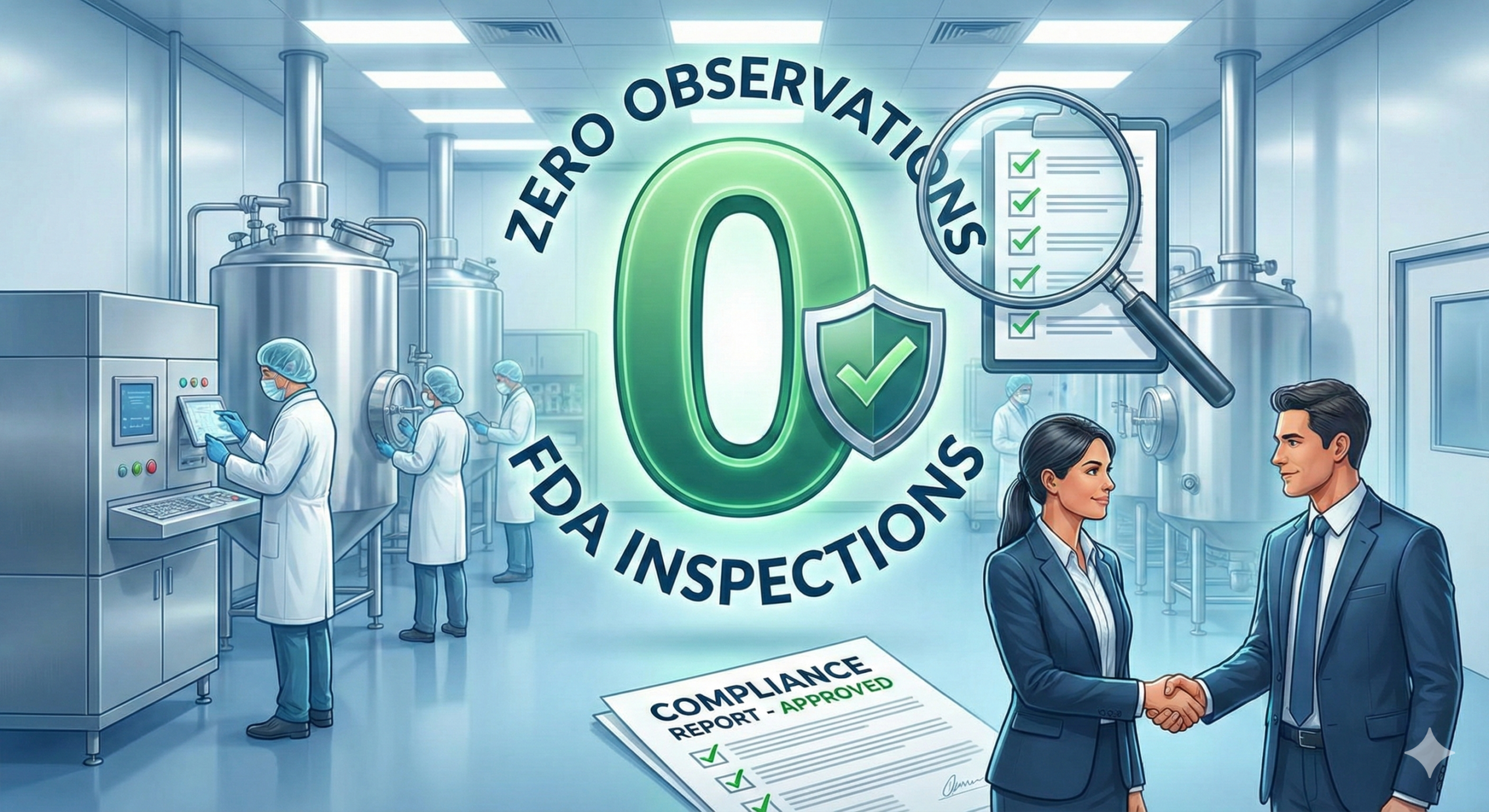
How to Achieve Zero Observations in FDA Inspections
The author had the privilege of supporting a company during an FDA inspection from March 22 to March 26, 2016, spanning one full week. The result was an NAI classification with zero observations. Companies that our firm has supported in FDA inspections have consistently achieved zero observations, and this inspection represented yet another success in our continuous winning record.
Understanding FDA Inspection Classification System
FDA inspections conclude with one of three possible classification outcomes, each reflecting the severity of findings and the required regulatory response:
NAI (No Action Indicated): This represents the highest possible inspection outcome. An NAI classification means that no official observations were documented on FDA Form 483. While inspectors may have noted minor issues during the inspection, none were significant enough to warrant formal documentation. This classification indicates that the facility demonstrates satisfactory compliance with applicable regulations and that FDA does not intend to take any regulatory action.
VAI (Voluntary Action Indicated): This classification indicates that objectionable conditions or practices were identified, but they do not meet the threshold for regulatory action. While no serious regulatory violations were found, the FDA issues Form 483 requesting voluntary corrective measures. Companies receiving a VAI classification should address the observations promptly, as failure to do so could result in escalation during subsequent inspections. The FDA will monitor the facility’s response but does not require immediate regulatory intervention.
OAI (Official Action Indicated): This is the most serious classification, indicating that significant regulatory violations were discovered during the inspection. An OAI classification results in the issuance of FDA Form 483, and subsequently, FDA may take various regulatory actions. Contrary to common belief, a Warning Letter is not always issued immediately following an OAI classification. Depending on the severity and nature of the violations, FDA may pursue different enforcement actions, including Warning Letters, Import Alerts, consent decrees, or injunctions. Typical violations warranting OAI classification include failure to report serious adverse events, misbranding, manufacturing processes that deviate from approved applications, significant data integrity issues, or systemic quality system failures.
| Classification | Form 483 Issued | Severity Level | Regulatory Action |
| NAI | No | None | No action required |
| VAI | Yes | Minor to Moderate | Voluntary correction recommended |
| OAI | Yes | Serious | Regulatory enforcement action initiated |
FDA Form 483: Documentation and Delivery
FDA Form 483 serves as the official documentation of inspectional observations. Federal regulations mandate that FDA investigators must sign and provide this document to the company at the conclusion of the inspection, typically during the closeout meeting. To facilitate this requirement, some investigators carry portable printers to generate the signed Form 483 on-site, ensuring immediate delivery to company management.
In recent practice, particularly since the COVID-19 pandemic, FDA has increasingly adopted electronic methods for delivering Form 483. In some cases, investigators may provide a preliminary electronic version of the Form 483 during the closeout meeting, followed by a final version with electronic signature after the inspection concludes. This hybrid approach allows for more efficient communication while maintaining the formal documentation requirements. However, regardless of the delivery method, the signed Form 483 must be provided to the company before the investigator departs the facility.
Strategic Approach to Achieving Zero Observations
Our consulting methodology for achieving zero observations in FDA inspections encompasses several critical elements that work synergistically to prepare companies for regulatory scrutiny. Let me share key components of our approach that have consistently delivered successful outcomes.
Pre-Inspection Preparation and Risk Assessment
In Japan, FDA typically provides approximately two to three months’ advance notice before conducting routine inspections, although companies should remain prepared for unannounced inspections, which may occur in cases involving serious complaints, recalls, or specific compliance concerns. This advance notice period, when available, provides a valuable opportunity for comprehensive preparation.
Upon receiving inspection notification, we immediately conduct an exhaustive quality audit of the facility using FDA’s perspective and current inspection approaches. This audit is intentionally rigorous and mirrors the methodology employed by FDA investigators, incorporating risk-based assessment principles that FDA has increasingly emphasized in recent years. Our audit focuses on critical areas including data integrity, quality systems, complaint handling, CAPA effectiveness, and compliance with current Good Manufacturing Practices (cGMP).
Comprehensive Quality Audit and CAPA Implementation
During our pre-inspection quality audit, we systematically identify potential vulnerabilities and document them with the same level of detail expected in an FDA Form 483. This approach serves a dual purpose: it allows the company to address issues before FDA discovers them, and it demonstrates to FDA investigators that the company has a proactive quality culture with robust self-inspection capabilities.
For each observation identified during our audit, the company must initiate a formal CAPA (Corrective Action and Preventive Action) process. This is not merely a documentation exercise but a substantive effort to address root causes and implement sustainable improvements. The CAPA system should follow a structured approach:
Root Cause Analysis: Employ appropriate tools such as the “5 Whys” technique, fishbone diagrams, or failure mode effects analysis (FMEA) to identify the underlying cause of the issue rather than merely addressing symptoms.
Corrective Action: Develop specific, measurable actions to remediate the immediate problem. These actions should be documented with clear timelines, responsible individuals, and verification methods.
Preventive Action: Implement system-level improvements to prevent recurrence not only of the specific issue but also of similar issues that might arise from the same root cause. This might include revising procedures, enhancing training programs, or upgrading equipment or systems.
Effectiveness Check: Establish metrics and monitoring systems to verify that corrective and preventive actions have achieved their intended results and are sustainable over time.
Where feasible, companies should complete associated training before the FDA inspection begins. This demonstrates to investigators that the company not only identified and corrected problems but also ensured that personnel understand the changes and can implement them consistently.
Data Integrity as a Critical Focus Area
In recent years, data integrity has emerged as one of FDA’s highest priorities during inspections, reflecting the agency’s increased scrutiny of electronic records, audit trails, and data governance. Our pre-inspection audits place substantial emphasis on data integrity principles, commonly referred to as ALCOA+ (Attributable, Legible, Contemporaneous, Original, Accurate, plus Complete, Consistent, Enduring, and Available).
Companies should ensure that all electronic systems comply with 21 CFR Part 11 requirements, including appropriate access controls, audit trails, electronic signatures, and system validations. Manual records must similarly demonstrate data integrity through proper documentation practices, contemporaneous recording, and appropriate oversight. Common data integrity deficiencies that FDA frequently cites include inadequate audit trail review, inappropriate data deletion or modification, shared login credentials, and failure to investigate data anomalies.
Real-Time Response During the Inspection
The inspection itself requires careful coordination and immediate responsiveness. Our methodology emphasizes transparent communication and demonstrated accountability throughout the inspection process.
When an FDA investigator raises a concern verbally during the inspection, even before documenting it formally, the company’s response becomes critical. At this juncture, we advise companies to immediately acknowledge the concern, demonstrate existing awareness of the issue if applicable, and present the CAPA already developed to address it. This proactive disclosure serves multiple strategic purposes.
First, it demonstrates to the investigator that the company has robust self-inspection capabilities and does not require FDA to identify problems. Second, it shows that the company takes quality seriously and addresses issues promptly rather than waiting for external pressure. Third, and most importantly, it eliminates the future risk that the investigator aims to prevent through Form 483 observations.
FDA investigators do not primarily focus on documenting past errors for punitive purposes. Rather, their mission centers on identifying and mitigating future risks to product quality, patient safety, and regulatory compliance. When a company demonstrates that it has already recognized a problem, investigated its root cause, implemented corrections, and established preventive measures, the investigator may determine that issuing a formal observation is unnecessary because the risk has been adequately addressed. The company has essentially eliminated the reason for the observation by demonstrating that the issue will not recur.
Dynamic Communication and Coordination System
Modern FDA inspections demand sophisticated real-time coordination between the inspection room (often called the “front yard”) where interactions with FDA occur and the support area (the “back yard”) where documents are retrieved, CAPAs are drafted, and procedures are revised.
We have implemented a dual communication system that ensures seamless information flow. First, we maintain a shared Excel spreadsheet that is continuously updated and displayed on screens in both the front yard and back yard. This spreadsheet tracks each topic discussed, documents requested, concerns raised, and responses provided. This systematic tracking prevents any issues from being overlooked and ensures that all team members maintain situational awareness.
Second, and more dynamically, we utilize secure messaging platforms such as LINE or similar encrypted communication tools to provide real-time guidance from the consultant to all relevant personnel. For instance, when an investigator raises a new concern that was not identified during our pre-inspection audit, I immediately communicate through the messaging system, providing specific direction on the root cause analysis to pursue, the corrective actions to implement, and the preventive measures to establish in the CAPA.
The back yard team then immediately initiates the CAPA, documents the root cause analysis, develops corrective and preventive actions, and where feasible, revises relevant SOPs (Standard Operating Procedures) to incorporate the improvements. These documents are printed and delivered to the front yard within hours, allowing the company representative to present them to the FDA investigator while the issue is still fresh and demonstrating the company’s commitment and capability to address concerns immediately.
This rapid response accomplishes several important objectives. It demonstrates organizational agility and a genuine commitment to quality rather than mere compliance. It shows that quality is embedded in the company culture rather than being a reactive response to external pressure. Most importantly, it provides the FDA investigator with confidence that the company can be trusted to identify and correct issues independently, which often results in the investigator choosing not to document the observation formally since the risk has been addressed.
Building Trust Through Transparency and Competence
FDA investigators are experienced professionals who have conducted numerous inspections and have developed keen instincts about organizational quality culture. They can readily distinguish between companies that genuinely prioritize quality and those that merely go through compliance motions. They recognize when management is engaged versus disengaged, when systems are robust versus superficial, and when commitments are genuine versus aspirational.
Companies that accurately understand investigator concerns, respond with technically sound solutions, demonstrate comprehensive root cause analysis, and can implement improvements rapidly earn investigator confidence. This confidence translates directly into inspection outcomes. When an investigator trusts that a company has the systems, culture, and commitment to maintain compliance independently, they are more likely to conclude the inspection with minimal or no observations.
Conversely, companies that provide inadequate responses, demonstrate poor understanding of quality systems, or appear unable to address issues effectively raise red flags for investigators. These companies often receive more extensive observations and face closer scrutiny in future inspections.
Risk-Based Inspection Approach and Company Preparedness
FDA has increasingly adopted risk-based approaches to determine inspection frequency, scope, and focus areas. Companies with strong compliance histories, robust quality systems, and effective management of previous observations generally receive less frequent inspections and may experience more targeted inspection scopes. Conversely, companies with warning letters, import alerts, or patterns of repeated observations face more frequent and comprehensive inspections.
Understanding this risk-based paradigm helps companies appreciate why achieving zero observations is not merely about avoiding immediate regulatory consequences but about establishing a positive compliance trajectory that benefits the company long-term. Each successful inspection with minimal observations strengthens the company’s regulatory profile and demonstrates its reliability as a manufacturer of quality products.
The Quality Culture Imperative
Beyond specific technical compliance with regulatory requirements, FDA has increasingly emphasized the importance of organizational quality culture. This concept extends beyond written procedures and documentation to encompass the behaviors, attitudes, and priorities that characterize how an organization approaches quality in practice.
A strong quality culture manifests in several observable ways: leadership engagement in quality matters, adequate resources allocated to quality systems, transparency in identifying and addressing problems, effective communication across organizational levels, continuous improvement mindset, and empowerment of quality personnel to fulfill their responsibilities without inappropriate production pressures.
During inspections, FDA investigators assess quality culture through various means: observing interactions between quality and production personnel, reviewing how deviations and investigations are conducted, examining whether management reviews are substantive or merely procedural, and evaluating whether quality metrics drive meaningful improvements or simply check compliance boxes.
Companies that cultivate genuine quality cultures find that regulatory compliance becomes more natural and sustainable. Quality is not viewed as an obstacle to productivity but as an essential component of operational excellence. When this culture is evident to FDA investigators, it substantially enhances their confidence in the company’s ability to maintain compliance, often resulting in more favorable inspection outcomes.
Conclusion
Achieving zero observations in FDA inspections is not a matter of luck or concealment of problems. Rather, it results from systematic preparation, comprehensive understanding of regulatory expectations, proactive identification and resolution of issues, rapid response capabilities during inspections, and cultivation of a genuine quality culture throughout the organization.
The methodology we have employed successfully across multiple inspections combines rigorous pre-inspection auditing, immediate CAPA implementation, sophisticated real-time coordination during inspections, transparent communication with investigators, and demonstration of organizational competence and commitment to quality. These elements work synergistically to build investigator confidence that the company can be relied upon to maintain compliance independently, which often results in investigators choosing not to document observations when issues have been adequately addressed.
As FDA continues to evolve its inspection approaches, emphasizing data integrity, risk-based assessment, and quality culture, companies must similarly evolve their preparation and response strategies. The fundamentals remain constant: know your systems thoroughly, identify problems before FDA does, address issues comprehensively rather than superficially, respond rapidly and competently during inspections, and demonstrate genuine commitment to quality throughout your organization. Companies that embrace these principles will consistently achieve favorable inspection outcomes and build strong regulatory relationships that benefit them over the long term.

Comment