
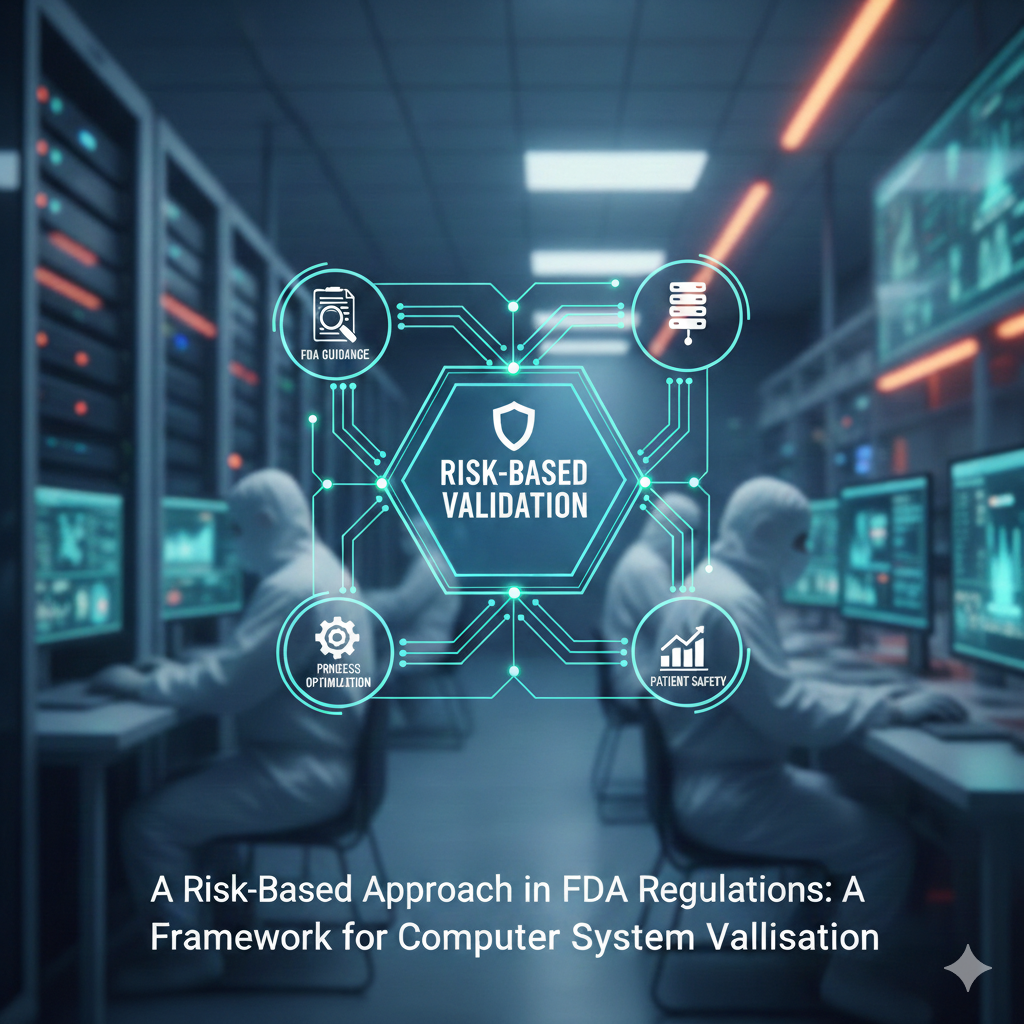
Risk-Based Approach in FDA Regulations: A Modern Framework for Computer System Validation
Understanding the Risk-Based Approach
The U.S. Food and Drug Administration (FDA) strongly advocates for a risk-based approach in current Good Manufacturing Practices (cGMP) and computer system validation. This approach represents a fundamental shift from traditional practices where all electronic systems and their functions were subjected to uniform validation and 21 CFR Part 11 compliance requirements. Instead, the modern risk-based framework prioritizes resources by focusing on systems and functions based on their criticality to product quality, data integrity, and patient safety.
The risk-based approach means that organizations should systematically assess and prioritize their validation efforts, addressing high-risk systems and critical functions first, rather than attempting to validate everything uniformly or sequentially. This strategic prioritization ensures that the most important aspects of quality and safety receive appropriate attention and resources.
The Regulatory Evolution: From CSV to CSA
Computer Software Assurance (CSA) Final Guidance
On September 24, 2025, the FDA published the final guidance document titled “Computer Software Assurance for Production and Quality System Software,” marking a significant evolution in regulatory expectations. This guidance supersedes Section 6 of the earlier document “General Principles of Software Validation” and introduces a modernized, risk-based framework that emphasizes intended use, process risk, and patient safety.
Computer Software Assurance (CSA) is defined as a risk-based approach for establishing and maintaining confidence that software is fit for its intended use throughout its lifecycle. This framework considers the risk of compromised safety and quality should the software fail to perform as intended, and determines the appropriate level of assurance effort and activities based on that risk assessment.
The CSA guidance embodies the “least burdensome approach,” ensuring that validation burden is no more than necessary to address the identified risks. This philosophy supports the efficient use of resources while promoting product quality and fostering the adoption of innovative digital technologies, including cloud-based systems, artificial intelligence, and advanced manufacturing technologies.
Key Principles of CSA
The CSA framework introduces several important concepts that differ from traditional Computer System Validation (CSV):
Focus on Critical Thinking: Rather than relying solely on extensive documentation and scripted testing, CSA emphasizes the application of critical thinking by knowledgeable subject matter experts (SMEs) to define appropriate validation strategies.
Scaled Testing Approaches: CSA recognizes that not all software requires the same level of testing rigor. The guidance outlines multiple testing approaches:
- Scripted Testing: Structured, step-by-step validation with pre-defined expected results, suitable for high-risk systems
- Unscripted Testing: Agile methods such as exploratory or scenario testing for lower-risk systems
- Hybrid Testing: A combination of both approaches, leveraging automation, continuous monitoring, and risk-based prioritization
Leveraging Supplier Documentation: CSA encourages manufacturers to maximize supplier involvement and leverage vendor documentation, certifications (such as ISO 27001, SOC 2, or GAMP 5 compliance), and existing test evidence from the vendor’s software development lifecycle.
Digital Evidence Over Paper: The guidance recommends using electronic records such as system logs, audit trails, and other data generated by the software to document assurance activities, moving away from paper-based documentation where possible.
International Harmonization: ICH Q9(R1)
The International Council for Harmonisation (ICH) published the revised guideline ICH Q9(R1) Quality Risk Management in January 2023, which became effective in July 2023. This targeted revision of the original 2006 ICH Q9 guideline addresses several key areas:
Objective Risk Assessment: The revision aims to reduce subjectivity in risk assessments and create more consistent, objective approaches to quality risk management.
Risk-Based Decision-Making: ICH Q9(R1) provides clearer definitions and guidance on risk-based decision-making, emphasizing that such decision-making is inherent in all quality risk management activities and provides an essential foundation for decision makers.
Formality and Documentation: The guideline clarifies that the level of effort, formality, and documentation applied during quality risk management should be commensurate with the level of risk and uncertainty involved.
Supply Chain Management: A new section addresses quality risk management as part of supply chain control, recognizing that quality and manufacturing factors can affect supply reliability and product availability.
Digitalization and Emerging Technologies: The revision provides clarification on the application of risk management in the use of digitalization and emerging technologies.
This harmonized approach ensures that quality risk management principles are consistently applied across pharmaceutical development, manufacturing, and the product lifecycle, supporting the risk-based validation strategies promoted by the FDA.
Practical Implications for the Pharmaceutical Industry
Why FDA Prioritizes Risk-Based Approaches
The rationale behind FDA’s promotion of risk-based approaches is both practical and strategic. During regulatory inspections, FDA investigators work within limited timeframes, typically ranging from a few days to two weeks. In today’s complex IT environment, where pharmaceutical companies utilize dozens or even hundreds of computerized systems, it is simply not feasible to thoroughly examine every system and every function during an inspection.
Consequently, FDA inspectors focus their attention on systems and functions that pose the highest risk to product quality, data integrity, and patient safety. They prioritize systems that directly impact critical quality attributes (CQAs), those that generate or maintain GxP records, and those that control critical process parameters.
This same principle should guide pharmaceutical companies in their validation strategies. FDA prefers that companies prioritize high-risk systems and critical functions for immediate validation, even if this means that some lower-risk systems remain in the validation queue, rather than companies methodically validating systems sequentially without regard to risk levels. A company that has thoroughly validated its high-risk systems demonstrates a mature quality culture and understanding of patient safety principles, even if some low-risk systems await validation.
Conducting Effective Risk Assessments
Before initiating any validation or 21 CFR Part 11 compliance project, organizations should conduct comprehensive risk assessments. This critical first step ensures that validation resources are allocated appropriately and that the organization’s approach aligns with both regulatory expectations and business priorities.
A thorough risk assessment should consider multiple dimensions:
Patient Safety Impact: What are the potential consequences if this system fails or produces incorrect data? Could it lead to patient harm, either directly or indirectly through compromised product quality?
Product Quality Impact: How does this system influence critical quality attributes? Does it control, monitor, or record data related to product specifications, stability, potency, purity, or identity?
Data Integrity Considerations: Does this system create, modify, maintain, archive, retrieve, or transmit GxP records? What controls exist to ensure data ALCOA+ principles (Attributable, Legible, Contemporaneous, Original, Accurate, plus Complete, Consistent, Enduring, and Available)?
Regulatory Compliance: Which predicate rules (such as 21 CFR Part 11, 21 CFR Part 210/211 for pharmaceuticals, or 21 CFR Part 820 for medical devices) apply to this system? What are the consequences of non-compliance?
Business Continuity: How critical is this system to ongoing operations? What would be the impact of system downtime or malfunction on production, quality assurance, or regulatory submissions?
Risk Assessment Methodologies
Several established methodologies can support systematic risk assessment:
Failure Mode and Effects Analysis (FMEA): This structured approach systematically examines potential failure modes, their causes, and their effects, assigning risk priority numbers (RPNs) based on severity, occurrence, and detectability.
Fault Tree Analysis (FTA): This deductive, top-down approach starts with an undesired event and works backward to identify all possible causes and their relationships.
Hazard Analysis and Critical Control Points (HACCP): Originally developed for food safety, this methodology identifies hazards and establishes critical control points where controls can be applied to prevent or eliminate hazards.
Risk Matrices: These tools provide a visual representation of risk levels based on the likelihood and severity of potential events, facilitating prioritization decisions.
Organizations should select and apply methodologies appropriate to the complexity and criticality of the systems being assessed, documenting both the methodology used and the rationale for risk-based decisions.
The Continuing Importance of 21 CFR Part 11
While the CSA guidance represents a significant evolution in validation approaches, 21 CFR Part 11 (Electronic Records; Electronic Signatures) remains a critical regulatory requirement. This regulation, established in 1997, defines the FDA’s criteria for accepting electronic records and electronic signatures as equivalent to paper records and handwritten signatures.
Core Requirements of Part 11
System Validation (§11.10(a)): Systems must be validated to ensure accuracy, reliability, consistent intended performance, and the ability to discern invalid or altered records.
Audit Trails (§11.10(e)): Systems must use secure, computer-generated, time-stamped audit trails to independently record the date and time of operator entries and actions that create, modify, or delete electronic records. Record changes must not obscure previously recorded information.
Access Controls (§11.10(d) and (g)): Organizations must implement appropriate controls over system access, including unique user identification, reliable identity verification, and authority checks.
Electronic Signatures (Subpart C): Electronic signatures must be linked to their respective electronic records, cannot be readily excised, and must be subject to the same controls as handwritten signatures.
Recent Guidance Updates
In October 2024, FDA finalized guidance on “Use of Electronic Records and Electronic Signatures in Clinical Investigations Under 21 CFR Part 11 – Questions and Answers.” This guidance clarifies expectations for clinical trials, digital health technologies, and remote data acquisition, emphasizing that:
- Data integrity principles apply equally to electronic and paper records
- Real-world evidence and data from wearable devices must meet appropriate controls when used for regulatory purposes
- Risk-based approaches should guide the application of Part 11 requirements
The 2018 FDA guidance “Data Integrity and Compliance With Drug CGMP Questions and Answers” continues to provide essential clarification on data integrity expectations, emphasizing that all data generated to satisfy GMP requirements becomes a GMP record and must be retained, regardless of outcome.
GAMP 5 Second Edition: Industry Best Practice
The International Society for Pharmaceutical Engineering (ISPE) published the second edition of GAMP 5 “A Risk-Based Approach to Compliant GxP Computerized Systems” in July 2022. This widely recognized industry guidance provides a comprehensive framework for implementing risk-based approaches to computer system validation.
Key Updates in GAMP 5 Second Edition
Critical Thinking Emphasis: The second edition strongly promotes the application of critical thinking throughout the system lifecycle, moving away from overly prescriptive, compliance-only approaches toward strategies that genuinely manage risk to products and patients.
Service Provider and Cloud Computing: Updated guidance addresses the increased importance of IT service providers, including cloud service providers, and provides recommendations for leveraging supplier documentation and certifications.
Agile and Iterative Development: The guide explicitly supports agile, incremental, and iterative software development methodologies, providing guidance on how these approaches can be implemented in compliance with GxP principles without requiring modification of standard agile practices.
Emerging Technologies: New appendices address artificial intelligence and machine learning (AI/ML), blockchain, cybersecurity, and data integrity, reflecting the rapid technological changes in the pharmaceutical industry.
Testing Approaches: The guide encourages a balanced approach to testing, including both scripted and unscripted testing methods, and emphasizes that testing should focus on finding defects and confirming fitness for intended use rather than simply generating documentation.
GAMP Software Categories
GAMP 5 continues to use software categories to help scale validation efforts appropriately:
- Category 3: Non-configured products (e.g., established commercial off-the-shelf software with fixed functionality)
- Category 4: Configured products (e.g., commercial systems configured to meet specific business processes)
- Category 5: Custom applications (e.g., bespoke software developed specifically for unique requirements)
These categories guide the appropriate level of validation effort, with Category 3 systems generally requiring less validation effort than Category 5 custom applications, reflecting the lower risk and greater maturity of established commercial products.
Implementing a Risk-Based Validation Strategy
Establishing a Risk Management Framework
Successful implementation of risk-based approaches requires establishing a robust organizational framework:
Risk Management Policy: Develop and document a clear policy that defines the organization’s commitment to quality risk management and establishes the authority and responsibility for risk-based decisions.
Risk Assessment Procedures: Implement standard operating procedures that define how risk assessments will be conducted, what methodologies will be used, and how results will be documented and communicated.
Cross-Functional Teams: Engage subject matter experts from quality assurance, IT, engineering, operations, and regulatory affairs to ensure comprehensive risk assessments that consider all relevant perspectives.
Risk Review and Approval: Establish clear governance processes for reviewing and approving risk assessments, ensuring that risk-based decisions are made at appropriate organizational levels.
Continuous Improvement: Implement mechanisms for periodically reviewing and updating risk assessments based on operational experience, regulatory changes, technological advances, and emerging risks.
Prioritization Criteria
When prioritizing systems for validation, organizations should consider establishing clear, documented criteria such as:
Tier 1 (Highest Priority): Systems that directly impact critical quality attributes, control critical process parameters, or maintain primary GxP records (e.g., Manufacturing Execution Systems, Laboratory Information Management Systems, Electronic Batch Record systems).
Tier 2 (Medium Priority): Systems that indirectly support GxP activities or maintain secondary GxP records (e.g., Training Management Systems, Calibration Management Systems, Document Management Systems).
Tier 3 (Lower Priority): Systems that support but do not directly control or record GxP activities (e.g., general-purpose productivity tools, information portals, systems used exclusively for non-GxP purposes).
This tiered approach should be documented and approved by quality management, and should be periodically reviewed to ensure it remains aligned with business operations and regulatory expectations.
Documentation and Evidence
While CSA and risk-based approaches aim to reduce unnecessary documentation burden, appropriate evidence must still be maintained to demonstrate that systems are fit for their intended use. The key is to focus documentation on what truly matters:
Risk Assessments: Document the methodology used, the risks identified, the risk levels assigned, and the rationale for risk-based decisions. This documentation provides the foundation for the entire validation strategy.
Requirements Specifications: Clearly define the intended use of the system, user requirements, and functional specifications, particularly for high-risk functions. Well-defined requirements facilitate appropriate testing and ongoing maintenance.
Supplier Assessments: For commercial systems, document the evaluation of supplier quality management systems, relevant certifications, and the availability and adequacy of supplier documentation.
Testing Evidence: For high-risk systems, maintain structured test protocols and results demonstrating that critical functions perform as intended. For lower-risk systems, exploratory testing results or operational evidence may suffice.
Change Control Records: Maintain records of changes to the system, including risk assessments of proposed changes, testing performed, and approval decisions.
Addressing Common Challenges
Legacy Systems
Many pharmaceutical companies operate legacy systems that were validated under older paradigms. When applying modern risk-based approaches to legacy systems:
Conduct Retrospective Risk Assessments: Evaluate legacy systems using current risk assessment methodologies to determine their actual risk profile.
Prioritize Remediation: Focus remediation efforts on high-risk gaps, such as missing audit trails on systems maintaining critical GxP records, rather than attempting to bring all legacy systems up to current standards simultaneously.
Consider Retirement or Replacement: For systems that are difficult to maintain in a validated state or that lack essential features like audit trails, consider whether system retirement or replacement might be more cost-effective than remediation.
Balancing Innovation and Compliance
The pharmaceutical industry increasingly adopts advanced technologies such as artificial intelligence, machine learning, cloud computing, and process analytical technology. Risk-based approaches facilitate innovation by:
Enabling Proportionate Validation: New technologies can be validated with effort proportionate to their risk rather than being subjected to overly conservative approaches based on unfamiliarity.
Supporting Iterative Development: Agile and iterative development approaches, when properly controlled, can accelerate time to value while maintaining appropriate quality oversight.
Leveraging Continuous Verification: For certain systems, continuous monitoring and verification during operation can provide greater assurance than traditional validation approaches, particularly for systems using machine learning where static validation may be insufficient.
Global Harmonization
While FDA guidance and US regulations provide the primary focus of this article, pharmaceutical companies operating globally must also consider:
EU GMP Annex 11: The European Medicines Agency’s guidance on computerized systems, which shares many principles with FDA expectations while having some distinct requirements.
WHO Guidelines: World Health Organization guidance on computerized systems, particularly relevant for companies operating in emerging markets.
PIC/S Guidance: The Pharmaceutical Inspection Co-operation Scheme provides guidance recognized by over 50 regulatory authorities worldwide.
Organizations should develop validation strategies that satisfy the most stringent applicable requirements, ensuring global compliance while avoiding unnecessary duplication of effort.
The Path Forward
The evolution from traditional Computer System Validation to Computer Software Assurance, coupled with the harmonized ICH Q9(R1) guideline and the updated GAMP 5 guidance, represents a maturation of regulatory thinking. These developments recognize that:
Quality Cannot Be Inspected In: Extensive documentation and testing alone do not ensure quality. Instead, quality must be built into systems through good design, appropriate controls, and a culture of quality throughout the organization.
Risk-Based Approaches Are More Effective: Focusing resources on areas of highest risk to product quality and patient safety provides better protection than treating all systems and functions uniformly.
Critical Thinking Matters: Knowledgeable subject matter experts applying critical thinking and appropriate scientific and engineering principles provide greater assurance than rigid adherence to prescriptive procedures.
Efficient Compliance Supports Innovation: By reducing unnecessary burden, risk-based approaches free resources that can be directed toward innovation, continuous improvement, and adoption of technologies that enhance pharmaceutical quality and availability.
Conclusion and Recommendations
The risk-based approach advocated by FDA and international regulatory bodies represents a fundamental shift in how pharmaceutical companies should approach computer system validation and compliance. Success requires:
- Conduct Comprehensive Risk Assessments: Before beginning any validation or Part 11 compliance project, invest sufficient time and resources in thorough risk assessment. This foundational step determines the appropriate level of validation effort and ensures resources are allocated where they will have the greatest impact on product quality and patient safety.
- Prioritize High-Risk Systems: Focus validation efforts on systems and functions that pose the highest risk to product quality, data integrity, and patient safety. Do not allow low-risk systems to delay or divert resources from high-risk priorities.
- Embrace Modern Approaches: Consider adopting Computer Software Assurance methodologies, leveraging supplier documentation where appropriate, and implementing a mix of scripted and unscripted testing based on risk.
- Maintain Strong Fundamentals: While approaches evolve, core principles remain constant. Systems must be fit for their intended use, electronic records must maintain their integrity, and data must be complete, accurate, and attributable.
- Foster a Quality Culture: Risk-based approaches work best in organizations with mature quality cultures where subject matter experts are empowered to make risk-based decisions and where quality is genuinely prioritized over convenience.
- Stay Current with Guidance: Regulatory expectations and industry best practices continue to evolve. Organizations should monitor updates to FDA guidance, ICH guidelines, and ISPE GAMP publications to ensure their approaches remain current.
- Document Risk-Based Decisions: While reducing unnecessary documentation burden, ensure that risk assessments, the rationale for risk-based decisions, and evidence supporting fitness for intended use are appropriately documented and available for regulatory inspection.
The pharmaceutical industry stands at an important juncture. The regulatory framework increasingly supports innovation, efficiency, and the adoption of advanced technologies, provided that companies demonstrate appropriate quality risk management and maintain focus on what truly matters: ensuring that medicines reaching patients are safe, effective, and of consistent quality. By embracing risk-based approaches and conducting thorough risk assessments before initiating validation activities, pharmaceutical companies can achieve both regulatory compliance and operational excellence.

Comment