
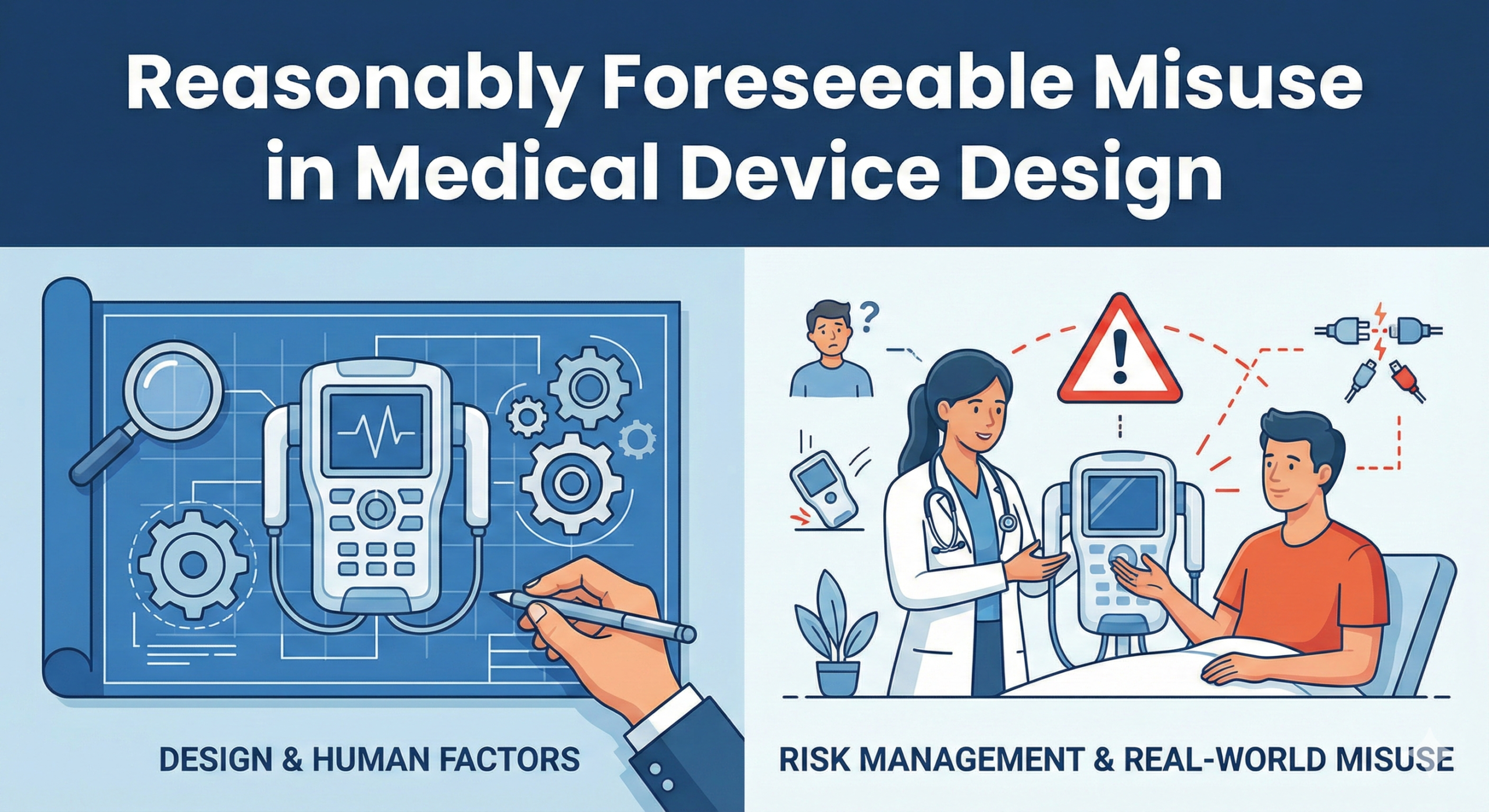
Reasonably Foreseeable Misuse in Medical Device Design
Learning from Errors and Clarifying Responsibility
Introduction
When designing a new product, designers are required to anticipate how users will actually employ the product. One critical aspect of this anticipation is understanding “human error” – mistakes arising from user misoperation. However, not all instances of human error necessarily constitute the designer’s responsibility. This article examines the concept of “reasonably foreseeable misuse” that designers must anticipate and mitigate, explaining its specific meaning, positioning within international standards, and practical application in medical device development.
When designing a new product, designers are required to anticipate how users will actually employ the product. One critical aspect of this anticipatio…
Definition of “Reasonably Foreseeable Misuse”
Reasonably foreseeable misuse refers to the designer’s process of anticipating, based on consideration of typical user skill levels and knowledge, as well as the product’s intended use environment, how users might incorrectly use a product, and implementing design features to mitigate the resulting risks to product safety. This concept is clearly positioned within international medical device regulations. International standards such as IEC 60601-1 (General requirements for basic safety and essential performance of medical devices) and IEC 62304 (Medical device software lifecycle processes) require manufacturers to clearly define both intended use and reasonably foreseeable misuse at early stages of product development. Furthermore, the U.S. Food and Drug Administration (FDA) explicitly incorporated the evaluation of reasonably foreseeable misuse into its Design Control requirements in the 2023 revision of the Quality Management System Regulation (QMSR).
The critical qualifier here is “reasonably.” This means that designers must not arbitrarily limit the scope of misuse to convenient scenarios. Rather, it encompasses errors that users with similar skill levels and knowledge might actually make within the context of using the particular product. This standard-based approach ensures that the evaluation of foreseeable misuse is objective and defensible, particularly during regulatory inspections and post-market surveillance activities.
Understanding Through Concrete Examples
Infusion pumps used in hospital settings represent critical medical devices that deliver medication at prescribed flow rates set by healthcare professionals. When flow rate settings are incorrect, the consequences for patients can be severe, potentially resulting in life-threatening or fatal outcomes.
Consider a scenario where a healthcare worker needs to adjust an infusion pump’s flow rate from 100 mL/h to 10 mL/h, but mistakenly sets it to 1000 mL/h instead. Additionally, incident reports indicate that such misconfigurations occur more frequently in specific contexts: during late-night shifts when fatigue impairs decision-making, during emergency situations requiring management of multiple patients simultaneously, or during system transitions when staff shift from legacy systems to newly implemented platforms. All of these represent foreseeable use conditions that designers should anticipate.
Was this error reasonably foreseeable by the designer? The answer depends entirely on the design of the user interface for flow rate configuration. When properly implemented design safeguards exist – such as those listed below – the potential for such critical misconfigurations can be substantially reduced within the scope of reasonably foreseeable misuse:
- Implementation of incremental setting processes that prevent extreme changes from a single operation, constraining the magnitude of adjustments that can be made in one interaction
- Display of a confirmation screen showing both the current and proposed new values side-by-side when the user changes a flow rate setting
- Provision of warning functions that alert users when proposed settings are medically irrational based on patient weight or medication type
- Physical hardware design features (for example, the resolution settings of rotary encoders) that impose physical constraints on erroneous operations
Conversely, when these safeguards are absent, when large numerical values can be easily entered without constraints, and when the confirmation process is insufficient, the design must be considered inadequate with respect to addressing reasonably foreseeable misuse. This demonstrates that the designer failed to implement appropriate countermeasures against reasonably foreseeable misuse. Consequently, accidents resulting from such design deficiencies may trigger liability questions regarding the adequacy of the design and development process itself.
International Standards and Risk Management Processes
The evaluation of “reasonably foreseeable misuse” in medical device design extends far beyond a design consideration—it is a core requirement of the organization’s risk management system. ISO 14971 (Risk management for medical devices) mandates that during the risk analysis phase, organizations must explicitly enumerate “reasonably foreseeable misuse” alongside intended use scenarios. This rigorous enumeration allows manufacturers to examine all plausible scenarios under which the product may be used, and for each scenario, to identify hazards, the harms that could arise from those hazards, and the probability and severity of those harms occurring.
Similarly, ISO 13485 (Medical devices – Quality management systems) in its current version (2016) and anticipated 2024 revisions, explicitly includes the clear definition of intended use methods and reasonably foreseeable misuse during the design input phase as part of the Design Control process. Furthermore, corresponding design outputs must demonstrably address these identified scenarios. This requirement has become a focal point during regulatory audits and conformity assessments, as competent authorities increasingly scrutinize whether organizations have systematically identified and addressed foreseeable misuse scenarios.
Integration with Usability Engineering
In recent years, addressing “reasonably foreseeable misuse” has become inseparably linked with the practice of Usability Engineering, also termed Human Factors Engineering. IEC 62304 explicitly mandates the incorporation of usability-related risk management processes, which encompass both the theoretical prediction of misuse scenarios during the design phase and their validation through actual use environment testing.
During usability testing, observing and recording how target users (healthcare professionals, patients, caregivers, etc.) actually attempt to use – and potentially misuse – a product serves as a powerful mechanism to strengthen design decisions based on theoretical foresight. Understanding behavioral patterns under real-world conditions – such as use during fatigue states, under conditions of divided attention, and under high cognitive load – frequently reveals reasonably foreseeable misuse scenarios that theoretical analysis alone might overlook. This integration of empirical usability testing with risk management strengthens the organization’s ability to demonstrate comprehensive consideration of foreseeable misuse.
Positioning as a Regulatory Requirement
Regulatory authorities including the FDA (United States), the EMA (European Medicines Agency), and the PMDA (Pharmaceuticals and Medical Devices Agency of Japan) all require medical device manufacturers to clearly evaluate reasonably foreseeable misuse within their design processes. The approach to this requirement, however, reflects evolving regulatory expectations particularly in the United States and Europe.
The FDA’s 2023 revision of QMSR explicitly mandates that “reasonably foreseeable misuse” be included within Design Input specifications for Design Control processes. Furthermore, manufacturers must document and maintain records demonstrating that identified instances of potential non-conformance resulting from foreseeable misuse have been addressed through corrective and preventive action (CAPA) processes. Concurrently, the European Medicines Agency’s guidance documents supporting implementation of the EU Medical Device Regulation (MDR) emphasize that comprehensive evaluation of reasonably foreseeable misuse at the design phase represents a fundamental expectation in the conformity assessment pathway.
Practical Application: Establishing Accountability and Organizational Processes
When an organization systematically integrates “reasonably foreseeable misuse” analysis into its quality management system, several practical benefits emerge:
Strengthened Objectivity in Risk Assessment: By clearly defining and documenting foreseeable misuse scenarios during the design phase, organizations establish a concrete record supporting subsequent accountability inquiries and conformity assessments. Rather than relying on the assertion that “human error is unavoidable,” the organization can substantiate its position with documented evidence: “We identified these specific misuse scenarios and implemented these corresponding design controls.” This distinction proves decisive during regulatory inspection and litigation contexts.
Scientific Prioritization of Design Changes: When multiple potential misuse scenarios exist and organizational resources are constrained, manufacturers can scientifically prioritize mitigation efforts based on the severity of resulting harms and the probability of each scenario’s occurrence. This approach ensures that the highest-risk scenarios receive the most intensive design focus, optimizing resource allocation and reducing residual risk.
Transparency in Audit and Approval Processes: During facility inspections by regulatory authorities and third-party auditors, organizations can clearly demonstrate the rationality of their design decisions. This transparency facilitates more efficient conformity assessment processes and increases the likelihood of straightforward regulatory approval, reducing the iterative exchanges that often characterize interactions with regulatory agencies.
Establishment of Continuous Improvement Mechanisms: By systematically collecting post-market surveillance data on adverse events, organizations can identify novel misuse patterns that were not captured in the original foreseeable misuse analysis. When such patterns emerge, the organization’s quality management system should include formal mechanisms to rapidly update risk assessments and implement additional controls. This dynamic approach to foreseeable misuse analysis demonstrates organizational commitment to ongoing patient safety monitoring.
Conclusion
The concept of “reasonably foreseeable misuse” transcends a mere design principle—it represents a critical framework that integrates an organization’s compliance obligations, risk management processes, quality assurance functions, and paramount commitment to patient safety. As organizations undertake new product design initiatives in 2025 and beyond, explicit incorporation of foreseeable misuse analysis from the design phase onwards enables both risk mitigation and clear delineation of organizational accountability.
In today’s medical device industry, the systematic understanding and organizational application of “reasonably foreseeable misuse” – informed by contemporary human factors theory, aligned with international standards, and responsive to evolving regulatory requirements – is no longer optional. Rather, it represents an essential organizational capability requisite for delivering safe, effective, and compliant medical devices to the patients and healthcare systems they serve.
Related Articles
- Misuse and Use Error: Usability Engineering in Medical Device Design
- The Importance of Design Control in Medical Devices
- FDA Design Control Guide: Foundation of Medical Device Quality Management
- FMEA Must Not Be Used in Medical Device Design for Risk Evaluation Purposes
- Why Do We Confuse the Accelerator and Brake Pedal? Understanding Human Factors in Medical Device Design
- Distinguishing Between Misuse and Use Error: Critical Concepts in Medical Device Safety Evaluation

Comment