
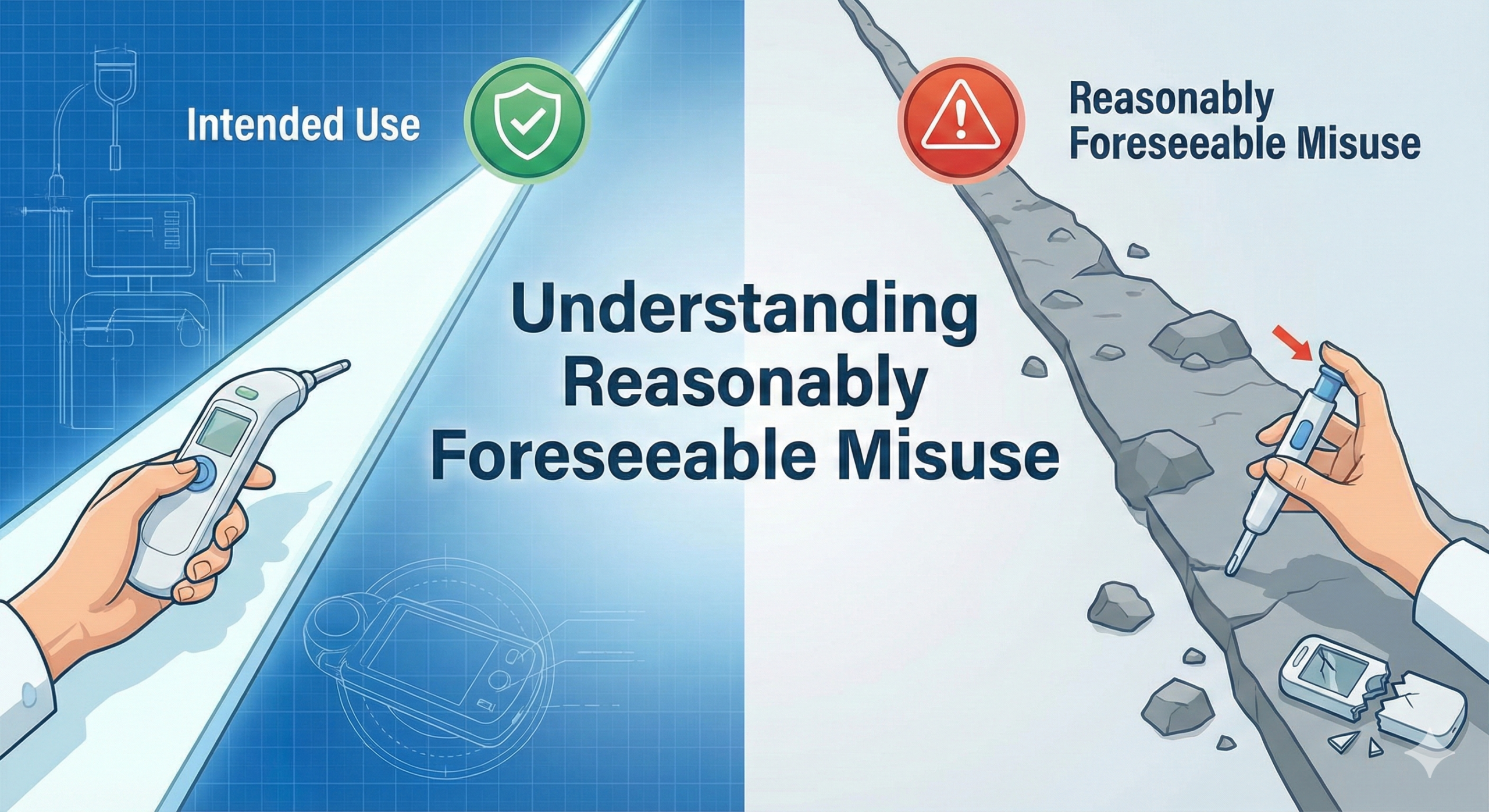
Understanding Reasonably Foreseeable Misuse
In the design of medical devices and industrial equipment, the concept of “reasonably foreseeable misuse” is critically important for ensuring product safety. Manufacturers must design products based on the premise that users will not necessarily operate them according to the instructions for use, and must anticipate possible misuse in their designs. This article explains the definition and practical considerations of this concept based on international standards and regulatory requirements.
In the design of medical devices and industrial equipment, the concept of “reasonably foreseeable misuse” is critically important for ensuring product…
Definition in International Standards
Reasonably foreseeable misuse is a concept clearly defined in clause 3.15 of ISO 14971:2019 (risk management standard for medical devices). It refers to uses that the manufacturer did not intend, but which are readily predictable from human behavioral characteristics.
Importantly, this concept is not merely theoretical—regulatory authorities worldwide have made it a mandatory requirement for product safety evaluation.
Elements Included in Misuse
ISO 14971:2019 and IEC 62366-1:2015/AMD1:2020 (usability engineering standard for medical devices) identify the following elements as major contributors to misuse risk:
Human error includes lack of attention, memory mistakes, and judgment errors. Use environment constraints encompass lighting conditions, noise levels, and time pressure. User attributes involve age, capability, experience, and cultural background. Daily behavioral patterns include shortcuts due to habituation and assumptions based on experience.
Classification and Examples of Misuse
1. Misuse Due to Operational Errors
The most common form of misuse is simple operational error. Examples frequently addressed in actual risk assessments include:
Infusion pump flow rate setting error
A user intends to set 10.0 mL/h but incorrectly enters 100 mL/h (forgetting the decimal point), resulting in the risk of administering 10 times the intended medication. Such order-of-magnitude input errors are highlighted in FDA‘s Human Factors Guidance as matters requiring priority countermeasures.
2. Misuse Arising from User Attributes
IEC 62366-1:2015/AMD1:2020 emphasizes consideration of user diversity.
For elderly users, small text or low-contrast displays are difficult to read, complex operating procedures are hard to remember, and fine hand movements are challenging.
For users with color vision differences, distinguishing between red and green warning lights is difficult, and information communication relying solely on color codes is problematic.
In environments accessible to children, exploratory behavior of pressing all buttons and the characteristic attraction to visually interesting objects must be considered.
3. Misuse Due to Use Environment
In high-stress environments such as medical settings, misuse that would normally be unlikely can occur.
Examples in emergency medical settings include accidentally disconnecting the wrong equipment power during a patient emergency, missing important alarms amid multiple alarm sounds, and incorrect connection of similar-shaped connectors in dark environments.
Practical Approach to Risk Management
1. Ensuring Inherent Safety Through Design (Top Priority)
Safety design principles outlined in ISO 12100 and ISO 14971:2019 prioritize ensuring inherent safety through design. Specific methods include:
Error-proof design employs connector shapes that physically prevent incorrect connection, software restrictions that prevent entry of dangerous setting values, and mandatory confirmation steps for critical operations.
Fail-safe functions include automatic stop functions when abnormal values are detected, default settings that maintain the safest state, and safe stop modes during power loss.
2. Systematic Application of Usability Engineering
Usability engineering process based on IEC 62366-1:2015/AMD1:2020:
Clarification of user profile involves detailed analysis of the capabilities, knowledge, and experience of intended users.
Specification of use environment evaluates lighting, noise, and work load at actual use locations.
Task analysis breaks down all operations performed by users and identifies error points.
Formative evaluation repeatedly implements evaluation by actual users during the development stage.
Summative evaluation verifies that misuse risks have been reduced to acceptable levels in the final product.
3. Warnings and Training as Supplementary Measures
Only for risks that cannot be eliminated through design measures, apply the following supplementary measures:
Warning displays must comply with ISO 3864 with high visibility. User training should provide regular re-education programs. Instructions for use must clearly state anticipated misuse and methods to avoid it.
However, it is important to note that these are not substitutes for design-based countermeasures.
Boundaries with Unreasonable Misuse
Clarification of Judgment Criteria
The boundary between reasonably foreseeable misuse and unforeseeable unreasonable use is comprehensively judged based on the following elements:
Accident case databases for similar products include FDA MAUDE and Japan’s Ministry of Health, Labour and Welfare medical device malfunction reports.
Results of user surveys provide actual user behavior observation data.
Social and cultural factors account for differences in usage habits by region and differences in technological literacy.
Risk-benefit analysis balances countermeasure costs with severity of harm.
Responding to Changes in Boundaries
As exemplified by cases such as “drying a cat in a microwave oven,” acts once considered unreasonable may come to be treated as foreseeable misuse following accident occurrence. Manufacturers must continuously understand new misuse patterns through post-market surveillance.
Relationship with Regulatory Requirements
Major Regulatory Requirements
Regulatory authorities in various countries and regions clearly require response to reasonably foreseeable misuse.
US FDA
The application of human factors engineering is mandatory. Submission of usability evaluation reports is required for 510(k) applications. Validation testing in actual use environments is required. The FDA published draft guidance “Content of Human Factors Information in Medical Device Marketing Submissions” in December 2022, introducing a risk-based categorization approach for human factors documentation.
European MDR (Medical Device Regulation)
Annex I, Chapter I, Section 3(c) requires estimation and evaluation of risks associated with intended use and reasonably foreseeable misuse. Section 5 mandates usability requirements considering user characteristics and use environment. Clinical evaluation must include usability aspects.
European IVDR (In Vitro Diagnostic Regulation)
Similar requirements to MDR are specified in Annex I. Transition periods have been extended, with Class D devices required to comply by 2025, Class C devices by 2026, and Class B and Class A sterile devices by 2027.
Japan PMDA
Basic requirements criteria demand design considering human factors. Explanation of misuse risk evaluation and countermeasures is necessary during approval applications.
Practical Regulatory Compliance
To meet these regulatory requirements:
Integrated approach from early development incorporates usability activities into design and development plans and implements phased risk evaluation and feedback.
Thorough documentation creates usability engineering files and ensures traceability.
Coordination with post-market surveillance collects incident information from actual use and engages in continuous improvement activities.
Three Types of Reasonably Foreseeable Misuse
According to ISO/TR 24971:2020 (guidance for application of ISO 14971:2019), reasonably foreseeable misuse is classified into three types:
1. Use-Error
Unintentional errors that can occur due to poorly designed user interfaces or inaccurate, incomplete, or ambiguous instructions for use. This is the aspect primarily addressed by IEC 62366-1:2015/AMD1:2020.
2. Intentional Acts of Misuse
Actions where users intentionally deviate from intended use without malicious intent, often based on assumptions or convenience. For example, skipping steps in operating procedures or using different methods based on past experience.
3. Off-Label Use
Intentional use of a medical device for medical applications other than those intended by the manufacturer. This is particularly important in clinical settings where healthcare professionals may use devices beyond their cleared indications.
All three types must be considered in risk management, though the approach and available risk controls differ for each type.
Practical Implementation Steps
Organizational Implementation Methods
Organizational structure requires development and recruitment of usability experts and formation of cross-departmental teams.
Process establishment integrates into existing design and development processes and develops checklists and review criteria.
Tool preparation secures usability testing facilities and establishes data collection and analysis systems.
Continuous improvement implements regular effectiveness evaluations and shares best practices.
Summary Table: Key Standards and Requirements
| Standard/Regulation | Key Requirement | Latest Version |
| ISO 14971 | Risk management including reasonably foreseeable misuse | ISO 14971:2019 |
| ISO/TR 24971 | Guidance for ISO 14971 application, defines 3 types of misuse | ISO/TR 24971:2020 |
| IEC 62366-1 | Usability engineering process for medical devices | IEC 62366-1:2015/AMD1:2020 |
| EU MDR | Annex I requirements for use-related risk management | In force since May 2021 |
| EU IVDR | Annex I requirements similar to MDR | Phased implementation through 2027 |
| FDA HF Guidance | Human factors engineering requirements | 2016 (final), 2022 (draft) |
Conclusion
Response to reasonably foreseeable misuse is not merely fulfilling regulatory requirements, but is an important activity for ensuring the inherent safety of products. The modern safety design philosophy of “pursuing designs that make misuse unlikely rather than blaming users” is a fundamental attitude that all manufacturers should possess.
As technology advances, products become more complex, and new patterns of misuse emerge. However, these risks are manageable by appropriately applying the systematic approaches indicated by ISO 14971:2019, ISO/TR 24971:2020, IEC 62366-1:2015/AMD1:2020, and national regulations.
What is important is not treating reasonably foreseeable misuse as “unexpected,” but considering it from the design stage as “something that will naturally occur.” This way of thinking becomes the foundation for creating truly safe and user-friendly products.
Related Articles
- Reasonably Foreseeable Misuse in Medical Device Design
- Understanding the Difference Between Use Error and Misuse
- Understanding CFR: The Foundation of U.S. Regulatory Framework
- Understanding the “Typewriter Excuse” in FDA 21 CFR Part 11 Compliance
- Why Printouts Cannot Be Trusted: Understanding the Vulnerability of Paper-Based Document Management
- Understanding the True Purpose of Performance Qualification (PQ) in Computerized System Validation

Comment