
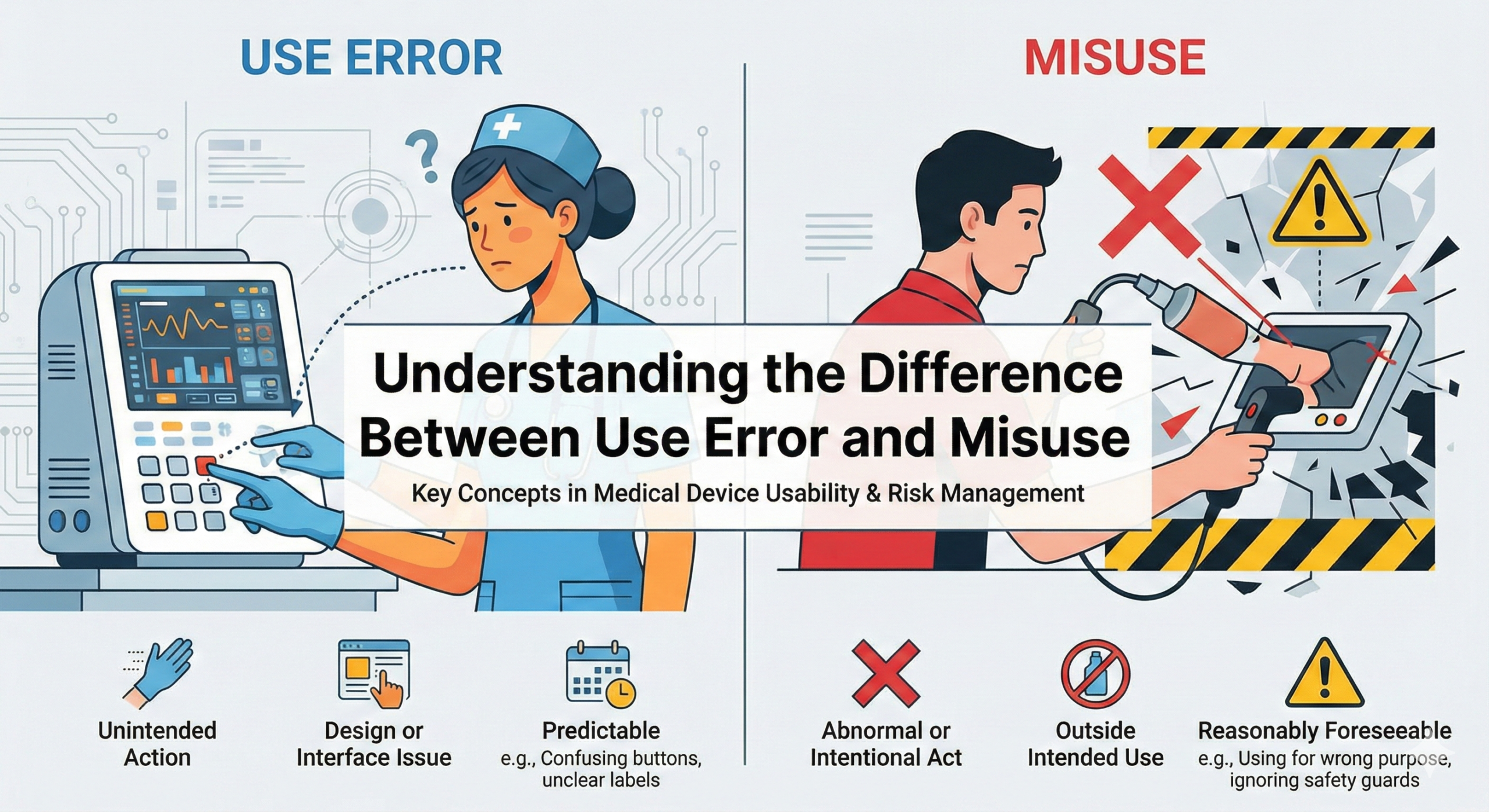
Understanding the Difference Between Use Error and Misuse
In the development of medical devices and industrial equipment, the terms “use error” and “misuse” are often confused. However, these represent distinctly different concepts, each requiring different risk management approaches. This article clarifies the differences between these two concepts and explains them from the perspective of usability engineering, which is particularly important in medical device development.
In the development of medical devices and industrial equipment, the terms “use error” and “misuse” are often confused. However, these represent distin…
What is Use Error?
Use error is an error that occurs when users are attempting to use a product correctly in a normal use situation. The crucial point is that errors occur despite users trying to follow the instructions for use and operate the device correctly.
Primary Causes of Use Error
Use errors are triggered by factors such as the following:
Physical Limitations Elderly users may find device displays difficult to see due to reduced visual acuity. Limited range of motion in joints may prevent users from reaching operation buttons. Hand tremors can make fine operations difficult.
Cognitive Errors Users may be unable to remember complex operation procedures. They might confuse buttons with similar functions. Warning sounds may not be correctly understood.
User Interface Problems Button placement may not be intuitive. Information displayed may be unclear. Insufficient feedback may leave users uncertain about operation results.
Concrete Examples of Use Error
Consider an insulin pen injector as an example. Despite patients attempting to set the correct dose, the following use errors may occur:
The dial numbers are too small to read, causing users to set incorrect units. The rotation direction of the dose-setting dial is counterintuitive, leading users to operate in the opposite direction from what they intend. The click sound indicating completion of setting is inaudible, resulting in injection with incomplete settings.
What is Misuse?
Misuse, on the other hand, is a broader concept. Misuse includes use in ways not described in the instructions for use—in other words, abnormal use. This may be either intentional or unintentional.
Classification of Misuse
Intentional Misuse Skipping safety procedures to save time. Using equipment for purposes different from its intended use. Continuing use while ignoring warnings.
Unintentional Misuse Using equipment without reading the instructions for use. Operating in the same way as other similar devices. Continuing to use without performing maintenance and inspections.
Concrete Examples of Misuse
Considering misuse with the same insulin pen injector example:
Using an insulin cartridge past its expiration date while aware of this fact (intentional). Reusing injection needles multiple times (intentional). Storing insulin that should be refrigerated at room temperature (unintentional). Borrowing and using another person’s insulin pen (intentional).
The Decisive Difference Between the Two
The most important difference between use error and misuse lies in the user’s intent regarding use.
Use Error: Users want to use correctly but cannot. Misuse: Use that deviates from correct usage (whether intentional or unintentional).
This difference significantly impacts risk management approaches.
The Role of Usability Engineering
The international standard IEC 62366-1 “Application of usability engineering to medical devices” specifically defines risk management methods focused on use errors. The current version is IEC 62366-1:2015+AMD1:2020, which incorporates amendments published in 2020 that introduced several important clarifications and updates.
What IEC 62366-1 Addresses
Risk assessment of use errors during normal use. Validation of user interface design appropriateness. Design improvements to minimize use errors.
What IEC 62366-1 Does Not Address
Risks from abnormal use (misuse). Intentional improper use. Use that ignores instructions for use.
IEC 62366-1 clearly states in its scope that it “permits the manufacturer to assess and mitigate risks associated with correct use and use errors, i.e., normal use. It can be used to identify but does not assess or mitigate risks associated with abnormal use.” The 2020 amendment (AMD1:2020) further clarified this relationship through the introduction of Figure A.4 in Annex A, which illustrates how the “types of use” in IEC 62366-1 relate to the concept of “reasonably foreseeable misuse” in ISO 14971.
Understanding the Relationship with ISO 14971
ISO 14971:2019, the international standard for risk management of medical devices, requires manufacturers to consider both intended use and reasonably foreseeable misuse. The relationship between IEC 62366-1 and ISO 14971 can be understood through the following framework:
| Type of Use | IEC 62366-1 Scope | ISO 14971 Scope | Risk Control Approach |
| Correct Use (Normal Use) | Yes | Yes | Usability engineering + risk management |
| Use Error (Normal Use) | Yes | Yes | Usability engineering + risk management |
| Abnormal Use (Misuse) | No (can identify only) | Yes | Risk management only |
| Not Reasonably Foreseeable | No | No | Not required |
IEC 62366-1 focuses exclusively on normal use, which encompasses both correct use and use error. Both are situations where users are attempting to follow instructions and use the device as intended. Abnormal use, where users consciously deviate from intended use or violate instructions, falls outside the scope of usability engineering but remains within the scope of ISO 14971 risk management.
According to ISO/TR 24971:2020, the guidance document for ISO 14971, reasonably foreseeable misuse includes three types: use errors during normal use, intentional use for applications other than intended by the manufacturer (off-label use), and other intentional acts of misuse without malicious intent.
Practical Approaches
In medical device development, addressing both use errors and misuse requires an integrated approach as follows:
Use Error Countermeasures (Usability Engineering) Understanding the use environment through user research. Assessing operational complexity through task analysis. Usability evaluation using prototypes. Iterative design improvements. The usability engineering process should include both formative evaluations (conducted during development to identify and address issues early) and summative evaluation (final validation confirming that usability-related risks have been reduced to acceptable levels).
Misuse Countermeasures (Risk Management) Identification of foreseeable misuse. Prevention of misuse through physical constraints. Appropriate placement of warning displays. Provision of training programs. The 2020 amendment to IEC 62366-1 introduced training as a third-priority risk control measure, alongside information for safety, recognizing its importance in managing certain types of risks.
Current Regulatory Context
Understanding use error and misuse is essential for compliance with current medical device regulations. The European Medical Device Regulation (MDR 2017/745) and In Vitro Diagnostic Regulation (IVDR 2017/746) place stringent requirements on usability, particularly in Annex I regarding general safety and performance requirements. While IEC 62366-1:2015+AMD1:2020 represents the state of the art for many of these requirements, manufacturers must ensure their usability engineering processes address the full scope of regulatory expectations.
The FDA recognizes IEC 62366-1 as a “consensus standard” and has issued specific guidance documents, including the 2016 final guidance “Applying Human Factors and Usability Engineering to Medical Devices.” Manufacturers targeting the U.S. market must also consider ANSI/AAMI HE75:2009 (R2018) “Human Factors Engineering – Design of Medical Devices,” which provides complementary guidance on human factors methods and tools.
Manufacturers should note that while IEC 62366-1 has not yet been harmonized under the MDR/IVDR, it remains an essential standard for demonstrating conformity with regulatory requirements. The harmonization process has encountered challenges, but the validity and applicability of IEC 62366-1 for demonstrating usability and safety remains unaffected.
Summary
Correctly understanding the difference between use error and misuse is the first step in developing safe and user-friendly products. In medical devices particularly, preventing harm to patients from use errors is extremely important, and implementation of usability engineering based on IEC 62366-1 is indispensable.
At the same time, appropriate countermeasures must be taken against misuse. By clearly distinguishing between the two and applying risk management methods appropriate to each, truly safe and effective medical device development becomes possible.
Developers should accept the reality that “users do not necessarily use devices exactly as described in the instructions for use,” while pursuing designs that “enable users who want to use correctly to reliably do so.” This is the essential significance of understanding the difference between use error and misuse.
The integration of usability engineering with comprehensive risk management, supported by clear documentation in the Usability Engineering File and Risk Management File, provides the foundation for bringing safe, effective, and user-centered medical devices to market. As the field continues to evolve, manufacturers must stay current with updates to standards and guidance documents, ensuring their processes address both the technical requirements and the ultimate goal of patient and user safety.
Related Articles
- Difference between misuse and use error
- Understanding the Difference Between Validation and Verification
- Understanding the Differences Between Correction, Corrective Action, and Preventive Action
- Understanding the Difference Between Computerized Systems and Computer Systems
- Understanding the Differences Between FDA Form 483 and Warning Letters: Issuance Processes and Corporate Impact
- The Distinction Between Misuse and Use Error

Comment