
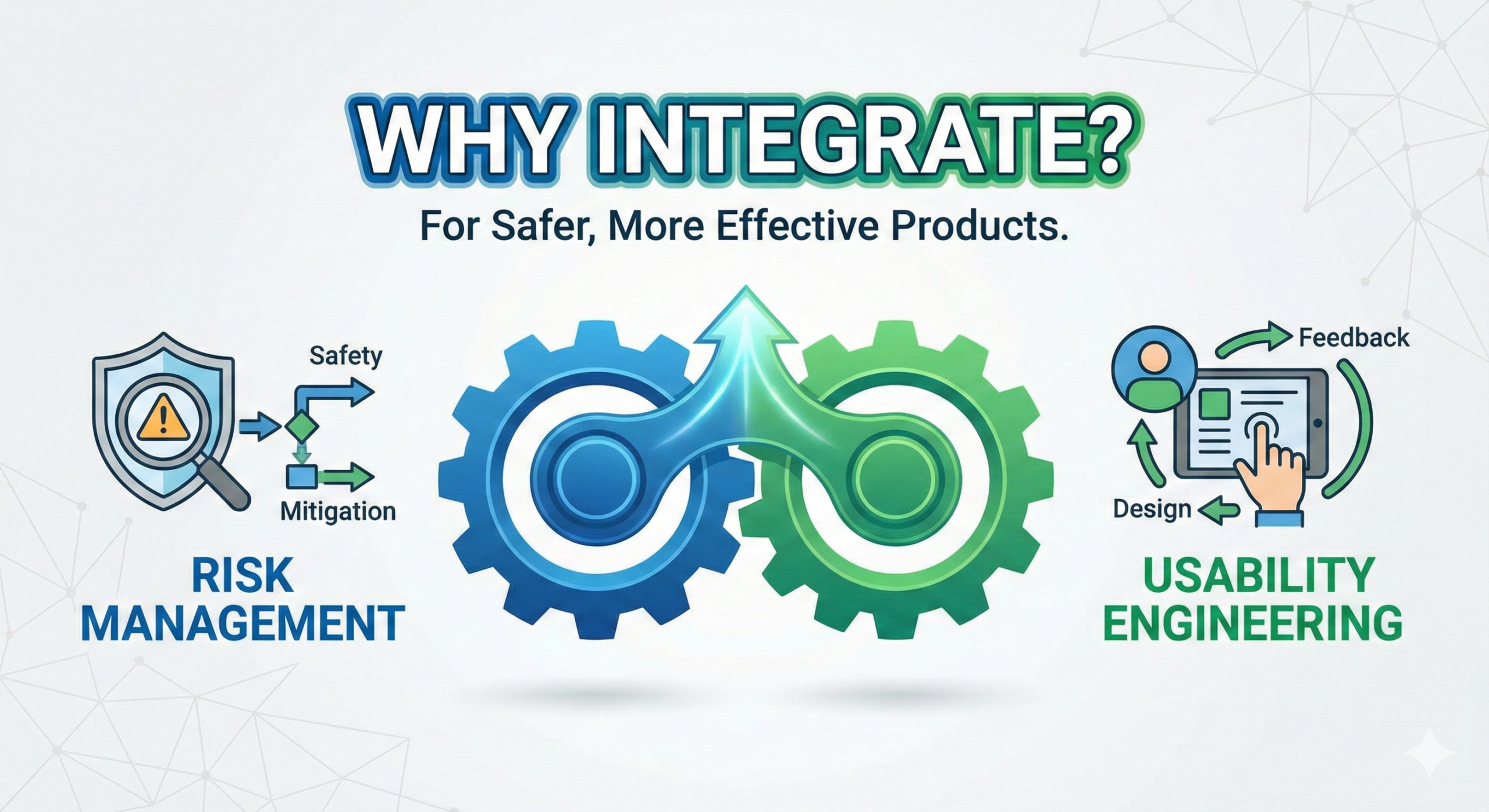
Why Integrate Risk Management and Usability Engineering?
The Growing Importance of Risk Management and Usability Engineering in Medical Device Development
In recent years, across industries—particularly in healthcare and medical device manufacturing—the integration of risk management and usability engineering has gained increasing prominence as a critical success factor for regulatory compliance and patient safety. Both disciplines are governed by international standards: ISO 14971 (Risk Management for Medical Devices) and IEC 62366-1 (Usability of Medical Devices). As regulatory expectations continue to evolve globally, understanding not only these standards independently but also their complementary relationship has become essential for development teams.
In recent years, across industries—particularly in healthcare and medical device manufacturing—the integration of risk management and usability engine…
To establish a foundation for this discussion, it is important to clarify what each discipline encompasses. Risk management, as defined by ISO 14971, is a systematic process that extends far beyond simply preventing adverse events before they occur. It encompasses a comprehensive lifecycle approach that includes identifying potential hazards, analyzing and evaluating associated risks, implementing risk control measures, and evaluating the effectiveness of those controls. When residual risks remain after control measures are implemented, risk management also addresses how to manage and communicate those residual risks through labeling, instructions for use, and training. This systematic methodology has become the cornerstone of quality management in the medical device industry, where the consequences of product failures can directly impact patient safety.
Usability engineering, by contrast, is a structured discipline focused on designing products and services that all users—including those with varying levels of experience, physical abilities, and cultural backgrounds—can operate effectively, safely, and with satisfaction. Formally defined in IEC 62366-1, this standard provides a comprehensive framework for applying human factors engineering principles throughout the medical device lifecycle. Rather than treating usability as a final design consideration or aesthetic feature, IEC 62366-1 positions it as a critical element of the development process that must be validated through empirical evidence. This includes conducting user research, iterative design testing, formative usability evaluations, and summative validation studies with representative users and use environments.
The Regulatory Relationship Between ISO 14971 and IEC 62366-1
The critical question becomes: why are regulators and industry professionals increasingly insisting on the integration of these two disciplines? The answer lies in understanding the specific relationship between these standards and the risks they address.
Within the ISO 14971 framework, “use-related hazards” represent a distinct and significant category of risks. These are hazards that arise from how users interact with medical devices—including potential for misuse, use errors, failures in interpretation of labeling or instructions, and inadequate training. IEC 62366-1 specifically targets these use-related hazards through a rigorous human factors validation process. In essence, the “use-related risks” that form the core of usability engineering are a subset of the broader risk universe that ISO 14971 addresses.
This hierarchical relationship creates both an opportunity and a requirement for integration. When organizations maintain separate risk management and usability processes, they risk creating gaps, duplicating efforts, or—more critically—failing to identify and control important use-related hazards. For example, a hazard identified through usability testing might not be adequately traced into the risk management file, or conversely, use-related risks documented in risk management might not receive sufficient human factors validation. By integrating these processes from the earliest stages of device development, organizations can ensure that use-related hazards are systematically identified, analyzed, controlled, and validated with equal rigor as other risk categories.
The regulatory expectation for integration is reflected in guidance documents from major regulatory bodies. The FDA‘s guidance on design controls emphasizes the importance of user research and human factors in identifying design inputs and validating that designs meet user needs. The European Union’s MDR (Medical Device Regulation 2017/745) and IVDR (In Vitro Diagnostic Regulation 2017/746) similarly require that safety and performance be demonstrated through appropriate usability validation. Japanese PMDA requirements also increasingly expect evidence of human factors consideration in the risk management documentation.
Practical Application and Real-World Benefits
The integration of risk management and usability engineering yields concrete benefits across the device development lifecycle. When implemented effectively from the concept stage forward, this integrated approach leads to several measurable advantages.
First, development efficiency improves significantly. Rather than conducting separate risk analyses and usability evaluations in isolation, integrated processes allow teams to leverage findings from one discipline to inform the other. For instance, usability testing sessions can be designed to systematically evaluate controls for identified use-related risks, and risk assessment workshops can incorporate usability specialists who bring empirical evidence about actual user behaviors rather than relying solely on theoretical hazard scenarios.
Second, product quality and safety outcomes improve. Devices designed with an integrated approach demonstrate fewer use errors in clinical practice because design decisions reflect both theoretical risk analysis and empirical evidence of how real users interact with the device. This translates to fewer adverse events, reduced liability exposure, and stronger post-market surveillance data.
Third, regulatory acceptance accelerates. Regulatory reviewers increasingly expect to see evidence that use-related hazards have been systematically addressed through both risk management and human factors validation. Submission documents that clearly demonstrate how usability validation findings were incorporated into risk control measures and verification activities are more likely to receive approval without major deficiencies.
Fourth, the integration supports lifecycle risk management. Medical devices are not static products; they evolve through software updates, design modifications, and changes in clinical practice. An integrated risk management and usability approach provides a framework for systematically managing risks introduced by these changes throughout the product’s commercial lifecycle.
Contemporary Regulatory Landscape and Emerging Considerations
As of 2024-2025, several important developments in the regulatory landscape reinforce the importance of this integration. The FDA’s Quality Management System Regulation (QMSR) updates emphasize risk-based approaches and the importance of understanding actual use conditions. The EU’s revised MDR/IVDR implementation continues to tighten expectations around clinical evidence and post-market surveillance, with usability-related adverse events increasingly scrutinized. Additionally, emerging technologies—particularly artificial intelligence and machine learning-enabled medical devices—have elevated the importance of usability validation, as these technologies introduce new types of use-related risks (such as user over-reliance on automated suggestions or misinterpretation of algorithmic outputs) that must be carefully managed.
Furthermore, cybersecurity considerations for connected and software-enabled medical devices have created new interfaces between risk management and usability. Users must be able to understand and implement security-related instructions without creating new use-related hazards. This expanded scope of consideration makes integrated risk management and usability engineering not merely beneficial but essential.
Conclusion
Risk management and usability engineering, while distinct disciplines with their own theoretical foundations and methodologies, are inextricably linked in the context of medical device development and regulatory compliance. ISO 14971 and IEC 62366-1 are not competing standards but rather complementary frameworks that, when properly integrated, create a comprehensive approach to identifying, controlling, and validating device safety and effectiveness. In today’s complex regulatory environment, particularly with the advancement of digital health technologies and evolving clinical demands, the ability to seamlessly integrate these disciplines is no longer optional—it is a fundamental requirement for successful device development and market access. Organizations that embrace this integrated approach position themselves not only for regulatory success but also for delivering genuinely safer, more effective, and more usable medical devices that better serve patients and healthcare providers.
Related Articles
- Preventive Action as Risk Management: Understanding CAPA in Pharmaceutical and Medical Device Industries
- Quality Risk Management: Understanding ICH Q9 and the Revised GMP Regulations
- Quality Risk Management in the Pharmaceutical Industry
- Tips for Risk Management
- Understanding Risk Assessment in Pharmaceutical Quality Management
- What is Quality Risk Management (QRM)?

Comment