
Why the FDA Standardized the Term “Human Factors Engineering”: Understanding Terminology, Regulatory Expectations, and Current Trends
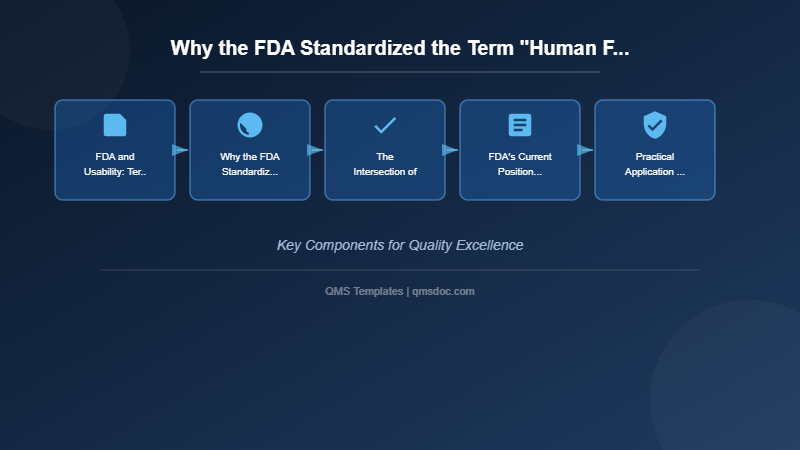
FDA and Usability: Terminology Selection in Medical Device Regulation
The concepts of “usability” and “usability engineering” represent a scientific approach to improving the ease with which users can interact with systems and products, and they are widely adopted in web design and software development. In medical device regulation, by contrast, the U.S. Food and Drug Administration (FDA) has traditionally adopted and emphasized the term “Human Factors Engineering” (HFE) as its standard terminology. This document examines the background of this terminological choice, the relationship between these two concepts, and current regulatory trends.
The concepts of “usability” and “usability engineering” represent a scientific approach to improving the ease with which users can interact with syste…
Why the FDA Standardized “Human Factors Engineering”
The FDA’s adoption of “Human Factors Engineering” as the central terminology in medical device regulation stems from requirements unique to the medical device regulatory context. The safety and effectiveness of medical devices are directly dependent on the extent to which users—whether they are healthcare professionals, patients, or other end users—can operate the device accurately and safely.
The term Human Factors Engineering extends beyond merely pursuing ease of use or user comfort. Rather, it reflects a broader perspective that encompasses a comprehensive understanding of human capabilities, limitations, cognitive processes, and behavioral patterns, which are then integrated into product design. This orientation aligns with the fundamental nature of medical device regulation: devices must reduce the potential for critical errors and maximize clinical efficacy.
Specifically, long before the IEC 62366 series (Usability Engineering of Medical Devices) was established as an international standard, the FDA incorporated this approach into its Design Control process for medical devices. In guidance documents such as 21 CFR Part 11 and Part 820, manufacturers are expected to analyze use cases and use environments, evaluate user characteristics, and conduct risk analyses—thereby reflecting human factors requirements during product design.
The Intersection of Usability Engineering and Human Factors Engineering
In recent years, the term “usability engineering” has become increasingly common throughout the industry. This is driven by the adoption of this concept by the International Organization for Standardization (ISO), the International Electrotechnical Commission (IEC), and industry bodies, which promote this terminology across a broader spectrum of product development sectors, including medical devices. As a result, it has become evident that usability engineering and human factors engineering share many overlapping elements in practical application.
In reality, both terms maintain distinct emphases while converging on a common objective. Usability engineering emphasizes “how efficiently and effectively users can operate a product,” while human factors engineering emphasizes “how human capabilities and limitations can be integrated into product design.” However, in the medical device development environment, the practical distinction between the two has largely diminished, and they are increasingly operationalized as mutually complementary methodologies.
FDA’s Current Position and Future Direction
Through multiple guidance documents released between 2023 and 2024—such as “Developing a Software Precertification (Pre-Cert) Program” and “Good Machine Learning Practice for Medical Device Development”—the FDA advocates for a more comprehensive and flexible Human-Centered Design (HCD) approach. This transition reflects an orientation that prioritizes human involvement and verification throughout the entire design process, rather than distinguishing between Human Factors Engineering and Usability Engineering.
Additionally, the 2024 FDA QMSR guidance revision has made it increasingly common for medical device manufacturers to use the expression “Usability Validation.” This suggests that the traditional concepts of “usability” and “usability engineering” are gradually being treated in the same regulatory context.
However, it is important to note that the FDA still explicitly requires the implementation of Human Factors Engineering within the Design Control framework. Under 21 CFR 820.30(g) and related FDA guidance documents, manufacturers must demonstrate the following:
- Detailed definition of user profiles and use environments
- Performance of human factors risk analysis (usability risk analysis)
- Execution of usability evaluations by representative users
- Iterative design and improvement processes
Practical Application and Regulatory Considerations
For medical device manufacturers and regulatory professionals, the critical imperative is not to become fixated on the strict terminological distinction between usability engineering and human factors engineering, but rather to focus on ensuring—through whichever framework is employed—that end users can safely and effectively use the product in its intended context.
In actual project execution, the following perspectives prove effective: First, based on use case analysis and user research, clarify design requirements. Second, through human factors risk analysis, evaluate the impact that user errors might have on product safety. Third, in addition to functional confirmation during design verification, conduct usability evaluations with actual users to demonstrate the effectiveness of the design.
Furthermore, in the domain of medical devices incorporating artificial intelligence and machine learning, as well as Software as a Medical Device (SaMD), the traditional human factors engineering approach alone proves insufficient. New human-centered design challenges emerge regarding how users understand, trust, and apply the outputs of machine learning models. FDA’s most recent guidance reflects these environmental changes, demanding more comprehensive usability validation that addresses these evolving concerns.
Conclusion
While Usability Engineering and Human Factors Engineering possess subtle differences in the philosophy underlying their respective terminology and their points of emphasis, from the perspectives of medical device regulatory compliance and patient safety, both represent complementary methodologies directed toward the same fundamental objective. What matters most is not the precision of terminology itself, but the reliable implementation of product design and verification processes founded on a genuine understanding of human capabilities and limitations. By embracing this perspective, manufacturers and regulatory professionals can ensure that their medical devices truly serve the safety and well-being of the patients and practitioners who depend on them.
Related Articles
- Have Part 11 Inspections Disappeared? Understanding Current Regulatory Trends
- Part 11: History, Current Trends, and Evolving Regulatory Landscape
- Why Do We Confuse the Accelerator and Brake Pedal? Understanding Human Factors in Medical Device Design
- Proper Japanese Translation of “Review” in Medical Device Regulatory Requirements: Clarifying Terminology in Quality Management Systems
- Applying Human Factors and Usability Engineering to Medical Devices(邦訳版)
- Understanding CFR: The Foundation of U.S. Regulatory Framework

Comment