
Clinical Evaluation and Performance Evaluation
ISO 13485 Section 7.3.7, “Design and Development Validation,” specifies the following requirements:
ISO 13485 Section 7.3.7, “Design and Development Validation,” specifies the following requirements:…
“As part of design and development validation, the organization shall perform clinical evaluation or performance evaluation of the medical device in accordance with applicable regulatory requirements. Medical devices used for clinical evaluation or performance evaluation shall not be considered as distributed for customer use.”
Clinical Evaluation
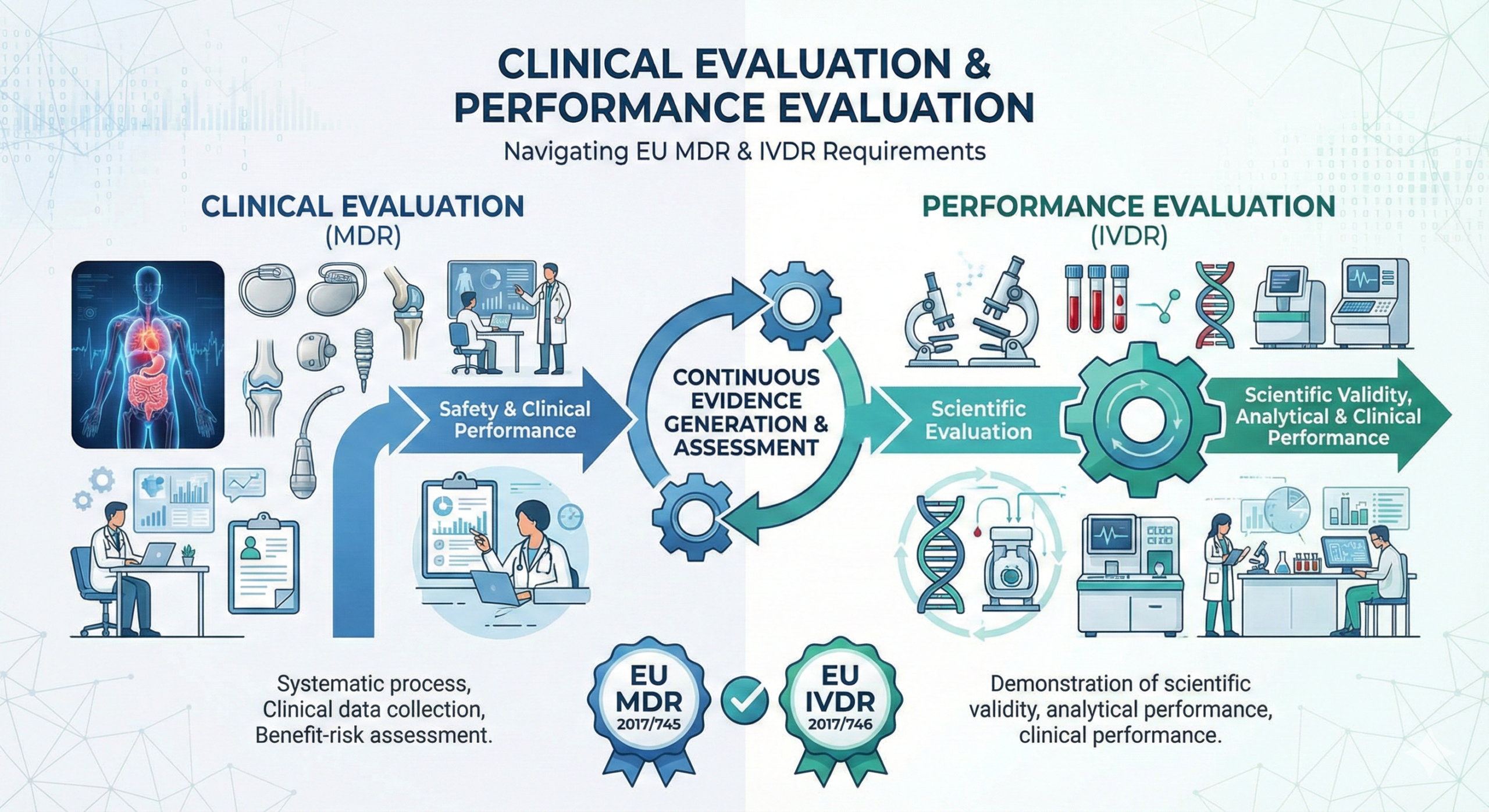
Clinical evaluation is an integral part of the design validation process for medical devices, involving the use of the device on human subjects to confirm its effectiveness and safety. With the exception of IVD products (in vitro diagnostic devices), clinical evaluation is mandatory for virtually all medical devices.
Medical devices must be effective and safe for their intended use, making evaluation with human subjects essential. The approach to clinical evaluation varies depending on device type, associated risks, and the availability of existing clinical data. In some cases, clinical evaluation may necessitate conducting clinical trials, commonly referred to as “clinical investigations.”
Clinical investigations conducted for the purpose of obtaining regulatory approvals or certifications are termed “clinical trials” or “clinical investigations.” These trials constitute a critical process through which medical devices must scientifically demonstrate their safety and effectiveness before being used in general medical practice.
Performance Evaluation
Performance evaluation is required for IVD products in place of clinical evaluation. Rather than conducting clinical trials on human subjects, IVD products must undergo systematic evaluation of their analytical performance—such as sensitivity and specificity—and clinical performance. During the recent COVID-19 pandemic, the accuracy of PCR testing (sensitivity and specificity) became a prominent topic of discussion, underscoring the importance of performance evaluation in regulatory oversight.
Distinguishing Devices Used for Clinical or Performance Evaluation from Customer Distribution
The ISO 13485 requirement that “medical devices used for clinical evaluation or performance evaluation shall not be considered as distributed for customer use” is particularly significant. This stipulation provides regulatory protection for the distribution of unapproved medical devices to healthcare facilities for the purpose of conducting clinical or performance evaluations. The United States refers to this regulatory mechanism as the “IDE (Investigational Device Exemption),” which permits the investigational use of unapproved medical devices.
By establishing this regulatory status, manufacturers can appropriately collect the clinical data necessary for design validation.
Timing of Design Validation
Design validation must be completed before the product is released to customers. It is therefore common for the author to receive inquiries asking whether design validation is mandatory for regulatory approval or certification and whether validation must be completed well before the final release to customers rather than immediately beforehand.
For most medical devices, these assumptions are indeed correct. However, there exist medical devices for which validation—defined as the confirmation of suitability by users under actual use conditions—cannot be completed until the device is installed in the clinical facility. A typical example is the heavy-ion beam therapy system.
Unlike conventional medical devices that are fully assembled in a factory and then distributed, heavy-ion beam therapy systems are constructed on-site at the medical facility. The building housing the system is constructed, and the device is then assembled within that facility. Because each system is custom-designed for its specific installation site, design validation can only be performed once the device is installed in the actual clinical use environment.
It is important to clarify the definition of “release” in this context. Release refers to the transfer of the product to the customer. Device installation at a medical facility and the transfer of ownership or responsibility do not necessarily occur simultaneously. In the case of complex systems, the timing of installation and release may differ, which can significantly affect the scheduling of design validation activities.
Related Articles
- Clinical Evaluation and Performance Evaluation
- Clinical Evaluation and Performance Evaluation in Medical Device Regulation
- Why Is Continuous Clinical Evaluation Necessary?
- The Importance of Clinical Evaluation in Medical Device Development
- Why Objective Evidence Matters: Performance Evaluation and Regulatory Requirements in Medical Devices
- Importance of Clinical Evaluation
